
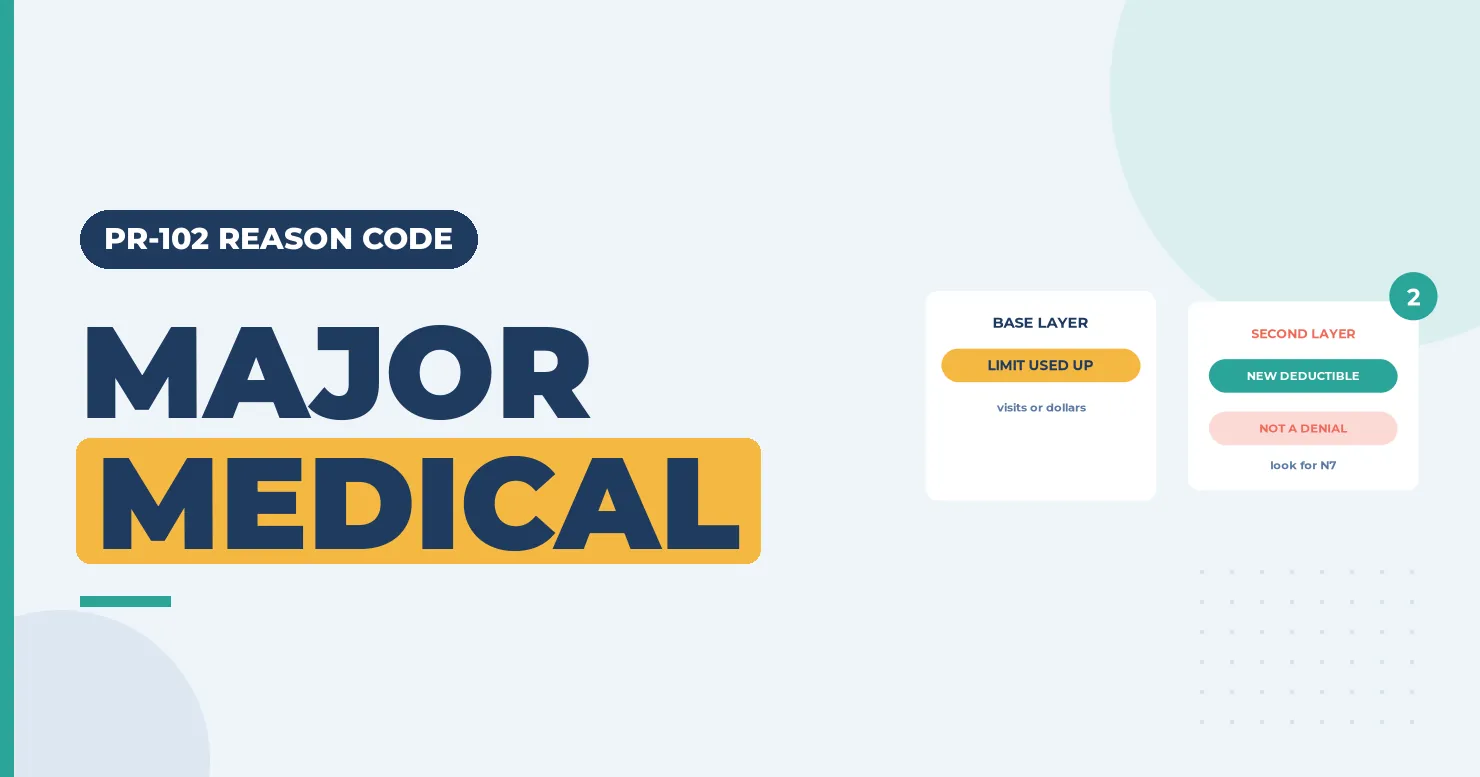
PR-102 means the claim was paid under the plan’s major medical part, and that part has its own cost sharing. The PR group says the patient owes the amount. It’s not a denial. You’ll see it on older-style plans that split benefits into a base layer and a major medical layer. Many self-funded employer plans and some union plans still work this way. If you post PR-102 as a write-off, you lose money the patient owes. If you bill it without explaining, you’ll get an angry phone call. (Primary source: X12 Claim Adjustment Reason Codes)
In brief: CARC 102 reads “Major Medical Adjustment.” The base benefit ran out or didn’t apply, so the major medical layer took over with its own deductible or coinsurance. Post the PR amount to the patient and explain the two layers on the statement.
Part of our denial codes library. Written by Manikandan J, CPC, CRCR, who has posted remits for self-funded and union plans. Published 21 October 2026. Last updated: 21 October 2026. Code wording is quoted word for word from X12.
CARC 102 in the X12 list
| Field | X12 text |
|---|---|
| Code | 102 |
| Description | “Major Medical Adjustment.” |
| Start | 01/01/1995 |
Source: X12 Claim Adjustment Reason Codes, checked 21 October 2026. X12 gives no usage note, so the remark code and plan terms fill in the details.
Example scenario (fictional names), part 1
PR-102 Denial Example: What Happened
Grace Okafor bills for Summit Spine Chiropractic. Dr. Henry Voss treated a patient’s neck pain (M54.2) with segmental dysfunction of the cervical spine (M99.01), billed as 98940. The plan was Ridgeline Benefit Trust, a fictional self-funded employer plan.
The first ten visits paid in full after copays. Visit eleven came back with CAS*PR*102 for most of the allowed amount and remark LQ*HE*N7. Nothing about the visit had changed. Grace’s first thought was a PR-102 denial code she’d never seen.
Why would the same visit suddenly cost the patient more? Keep reading, or jump to how the PR-102 denial was resolved.
Base benefits vs major medical
Base benefits are the first layer of coverage. They often pay set amounts or a set number of visits. Major medical is the second layer. It picks up after the base layer is used up or for care the base layer doesn’t cover. It usually has its own deductible and coinsurance.
| Base layer | Major medical layer | |
|---|---|---|
| When it pays | First, up to its limits | After base limits, or for care base doesn’t cover |
| Cost sharing | Often a copay or set amount | Its own deductible and coinsurance |
| What you see on the remit | Normal PR-1, PR-2 or PR-3 lines | CARC 102, often with N7 |
For plain-language meanings of deductible and coinsurance, see HealthCare.gov’s deductible glossary entry.
The remark code to look for
| RARC | X12 wording |
|---|---|
| N7 | “Alert: Processing of this claim/service has included consideration under Major Medical provisions.” |
N7 confirms the major medical layer handled the line. Check the X12 RARC list for any other remark on the same line.
Which group code comes with 102?
- PR-102: the patient owes the amount, such as a major medical deductible. This is the most useful reading for billers.
- CO-102: the contract says the provider absorbs the change. Write it off and check the contract terms.
- OA-102: an other adjustment, for example a secondary payer showing how the primary handled major medical.
How to work a PR-102 line
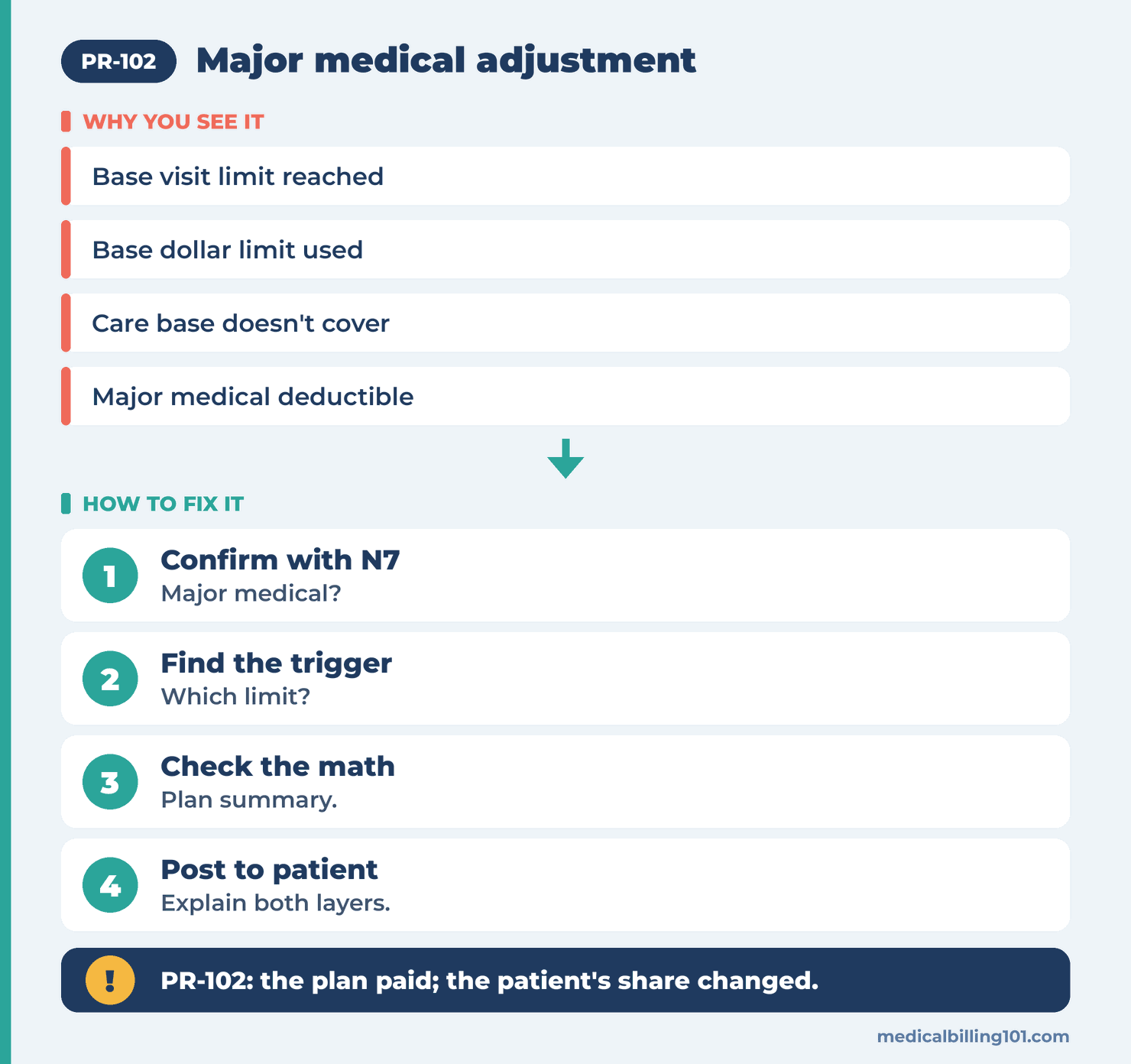
- Confirm it’s major medical. Look for N7 and compare it with past visits.
- Find the trigger. Ask the plan, or check the portal, for base visit limits or dollar limits that ran out.
- Check the math. Match the PR amount to the major medical deductible and coinsurance in the plan summary.
- Post it to the patient. Use the PR amount, not a write-off.
- Explain it. Add a short note to the statement saying the base benefit was used and major medical terms applied.
- Warn future visits. Note the change in the account so the front desk can quote the new cost.
Example scenario (fictional names), part 2
How the PR-102 Denial Was Resolved
Grace called Ridgeline with the claim number. N7 had already told her the major medical layer handled the visit. The agent said the base layer paid ten chiropractic visits a year, and visit eleven moved to major medical. Its separate deductible hadn’t been met yet.
Fix: nothing to correct on the claim. Grace posted the PR amount to the patient and added the plan’s explanation to the statement.
Outcome: the patient paid after reading the note. Grace set up an eligibility alert at visit eight for every Ridgeline member.
Names and details are illustrative; no real patient data.
Worked example (illustrative)
A small hospital bills an outpatient MRI for a union plan member. The remit shows part of the allowed amount as PR-1 under the base layer and the rest as PR-102 with N7. The biller checks the plan summary. The base layer paid a set dollar amount for imaging, and major medical coinsurance applied above it. Both lines go to the patient’s balance, and the statement shows each layer.
Mistakes we see with CARC 102
- Calling it a denial. The plan paid. CARC 102 only explains how.
- Writing off a PR amount. That’s money the patient owes under their plan.
- Appealing without a reason. Appeal only if the base layer still had benefits left.
- Missing the reset date. Base limits often reset at the plan year. Check before you quote costs in January.
Related codes
- PR-1, PR-2 and PR-3: deductible, coinsurance and copay.
- Full CARC and RARC list: look up benefit maximum and other codes.
- CO-45: charge exceeds the fee schedule.
Key takeaways
PR-102 is a payment explained, not a denial. The major medical layer took over, often with a new deductible or coinsurance. Confirm the trigger with the plan, post the amount to the patient and explain the two layers in plain words. Then flag the account so future visits are quoted right.
FAQ
What does reason code 102 mean?
It means “Major Medical Adjustment.” The payer handled the line under the plan’s major medical terms.
Is PR-102 a denial?
No. It’s an adjustment that shows the patient’s share under major medical.
Can I bill the patient for PR-102?
Yes. The PR group means the patient owes it under their plan.
What does N7 mean?
N7 means “Alert: Processing of this claim/service has included consideration under Major Medical provisions.”
Why did the patient’s cost change mid-year?
The base layer often has visit or dollar limits. Once they’re used, major medical cost sharing applies.
Should I appeal a PR-102?
Only if the plan applied major medical too early, such as when base visits were still left.
Sources
How we checked: each code quote on this page was compared word for word with the X12 CARC and RARC lists on 21 October 2026.
- X12, Claim Adjustment Reason Codes (CARC 102, 1, 2, 3, 45). Accessed 21 Oct 2026.
- X12, Remittance Advice Remark Codes (N7). Accessed 21 Oct 2026.
- HealthCare.gov, Deductible (glossary). Accessed 21 Oct 2026.
Last updated: 21 October 2026 · This page is educational and doesn’t replace plan documents or payer contracts.