
The PR-23 denial code means a secondary payer reduced its payment because of what the primary payer already paid or adjusted. It put that amount under patient responsibility, which is usually wrong. The fix is to check the primary EOB, confirm the prior payment on the claim, and bill the patient only the true cost share. (Primary source: X12 Claim Adjustment Reason Codes)
In brief: reason code 23 reads “The impact of prior payer(s) adjudication including payments and/or adjustments. (Use only with Group Code OA)”. X12 allows only OA for this code. So a PR-23 amount is not a patient bill. It is the part the primary payer already handled.
Part of our denial codes library. Written by Manikandan J, CPC, CRCR, who has posted and appealed secondary payer remits for primary care, specialty and hospital outpatient teams. Published 3 November 2026. Last updated: 3 November 2026. Code wording quoted word for word from X12. Read about the author and our editorial policy, or contact us to report an error.
What does denial code PR-23 mean?
Denial code PR-23 means the secondary payer is showing the effect of the primary payer’s decision. That effect includes the primary payment and the primary contractual write-off. The secondary then pays only what is left, such as the primary’s coinsurance. PR is the wrong group here, because X12 limits code 23 to OA.
| Field | Value |
|---|---|
| Code | 23 |
| Description | “The impact of prior payer(s) adjudication including payments and/or adjustments. (Use only with Group Code OA)” |
| Allowed group | OA only |
| Start | 01/01/1995 |
| Last modified | 09/30/2012 |
Source: X12 Claim Adjustment Reason Codes, checked 3 November 2026.
Methodology: the code wording is copied from the X12 lists, and the form fields come from the NUCC and CMS manuals cited below.
Key terms: The primary payer pays first under coordination of benefits (COB). The secondary payer pays after it sees the primary EOB. Prior payer impact is everything the primary paid or wrote off on the same line.
PR-23 vs OA-23 vs CO-23: what is the difference?
PR-23, OA-23 and CO-23 all describe the same thing: the prior payer’s effect on this claim. OA-23 is the only form X12 allows. CO-23 and PR-23 are payer labeling choices. PR-23 is the riskiest one, because a billing system may move the whole amount to the patient statement.
| Version | What the payer is saying | What you do |
|---|---|---|
| OA-23 | Informational: the primary already covered this part | Post as a zero-balance adjustment |
| CO-23 | Same impact, labeled as a provider write-off | Post it, then check the primary contract |
| PR-23 | Same impact, labeled as patient share | Do not bill it; bill only the primary’s real cost share |
In my posting work, PR-23 caused more wrong statements than any other secondary code. The amount looks like a balance, but it is mostly money already paid.
Does the patient owe a PR-23 amount?
No, the patient does not owe the PR-23 amount itself. That amount is the primary payment plus the primary write-off. The patient owes only the deductible, coinsurance or copay that the primary assigned and the secondary did not pay. You find those amounts on the primary EOB, usually as PR-1, PR-2 or PR-3.
For example, if the primary paid $112 and wrote off $35 on a $175 charge, the PR-23 line may show $147. The patient’s real share is only the unpaid part of the primary’s $28 coinsurance.
Why does a secondary payer send PR-23?
A secondary payer sends PR-23 when its system reads the prior payer data and labels the result with the wrong group. It can also happen when the claim reports the primary payment wrong. A primary paid amount that is too high makes the secondary think little or nothing is left to pay.
Common triggers, such as these, show up in secondary claim reviews:
- The paper claim showed the full charge in Box 29 instead of the primary payment.
- The 837 loop 2320 or 2430 carried the wrong paid amount from a stale primary EOB.
- The primary reprocessed the claim after the secondary was billed.
- The secondary does not cover coinsurance assessed by a previous payer, which comes with remark N765.
Example scenario (fictional names), part 1
PR-23 Denial Example: What Happened
Tomasz Novak is the AR specialist at Cedar Hollow Family Medicine, a fictional primary care clinic. A patient with type 2 diabetes had a 99214 visit with a $175 charge. The primary plan allowed $140, paid $112 and assigned $28 coinsurance.
The clinic sent a paper claim to the secondary plan. The secondary paid nothing. The 835 showed CAS*PR*23*175.00 on the line.
The posting system then moved $175 to the patient statement.
Why did the secondary think nothing was left to pay? Keep reading, or jump to how it was resolved. Keep reading, or jump to how the PR-23 denial was resolved.
How do I fix a PR-23 denial on a secondary claim?
To fix a PR-23 denial, compare the primary EOB with the secondary claim and remit line by line. If the claim reported the primary payment wrong, send a corrected claim. If the claim was right, ask the secondary to reprocess with the OA group. Hold the patient statement until the remit is clean.
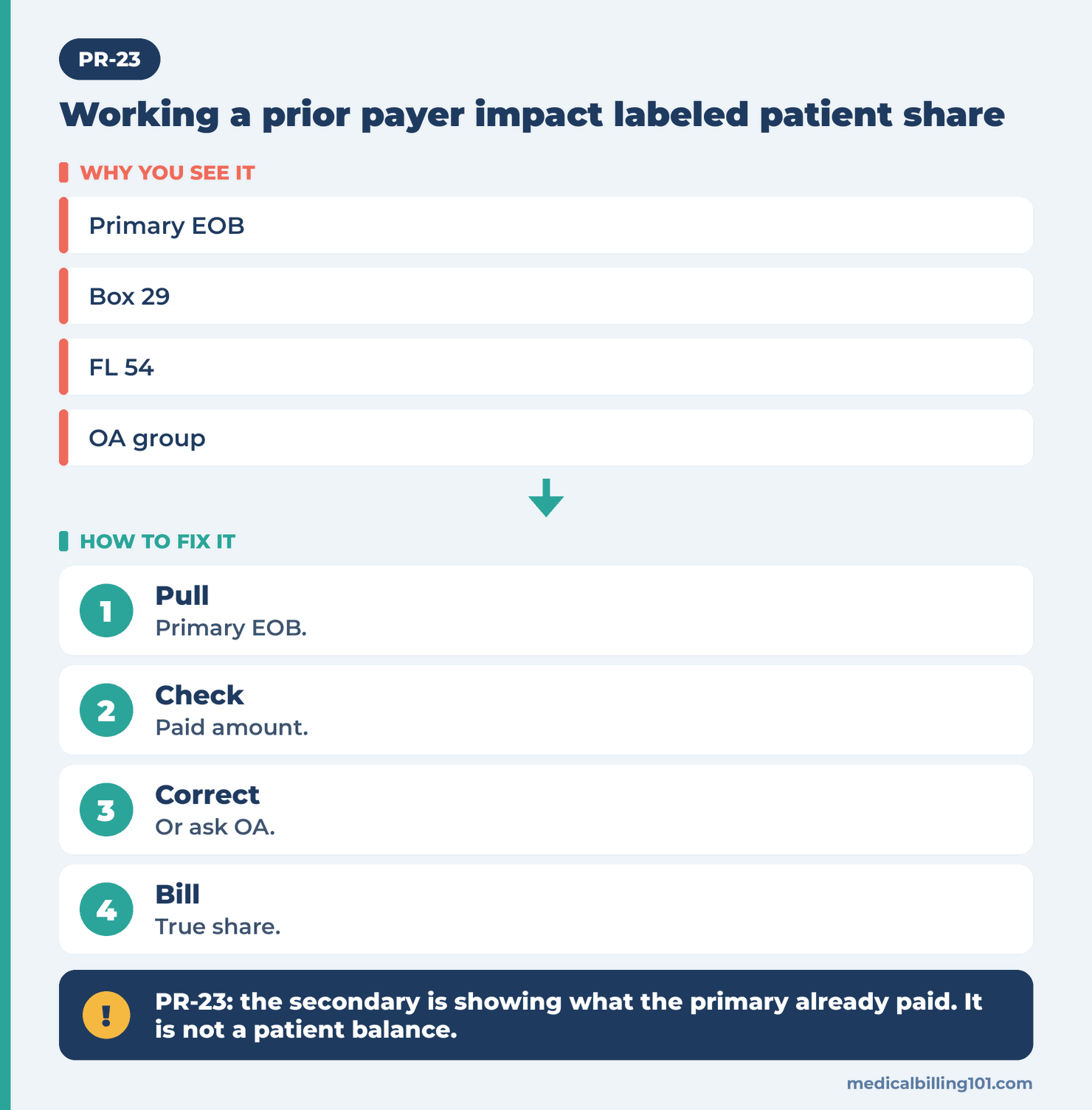
- Pull the primary EOB. Note the allowed amount, payment, write-off and patient share for each line.
- Check the secondary claim. On paper, Box 29 holds the amount paid (NUCC 1500 claim form instructions). On a UB-04, FL 54 holds prior payments per payer.
- Send a corrected claim if a number was wrong. Use frequency code 7, the original claim number and a copy of the primary EOB.
- Ask for the group fix if the claim was right. Tell the secondary that X12 limits code 23 to OA.
- Bill the patient only the true share. Use the primary’s PR amounts minus anything the secondary paid.
How do I post a PR-23 adjustment correctly?
Post a PR-23 amount as a non-billable prior payer adjustment, not as patient responsibility. Most practice systems let you map a CARC and group pair to a posting rule. Map PR-23 and OA-23 to the same rule, so the patient balance only includes the primary’s real cost share.
A good rule has three checks. It ties the PR-23 total to the primary paid and write-off amounts. It flags any gap over a few dollars. It sends the line to a hold queue instead of the statement run.
Example scenario (fictional names), part 2
How the PR-23 Denial Was Resolved
Tomasz pulled the paper claim. The billing system had filled Box 29 with the $175 total charge, not the $112 primary payment. The secondary read that as a primary payment in full.
Fix: he sent a corrected claim with frequency code 7 and the original claim number in Box 22. He changed Box 29 to $112.00 and attached the primary EOB.
Outcome: the secondary paid the $28 coinsurance. The new remit showed $147 as prior payer impact, and the patient owed $0. Tomasz removed the $175 from the statement and fixed the Box 29 default for all secondary claims.
Names and details are illustrative; no real patient data.
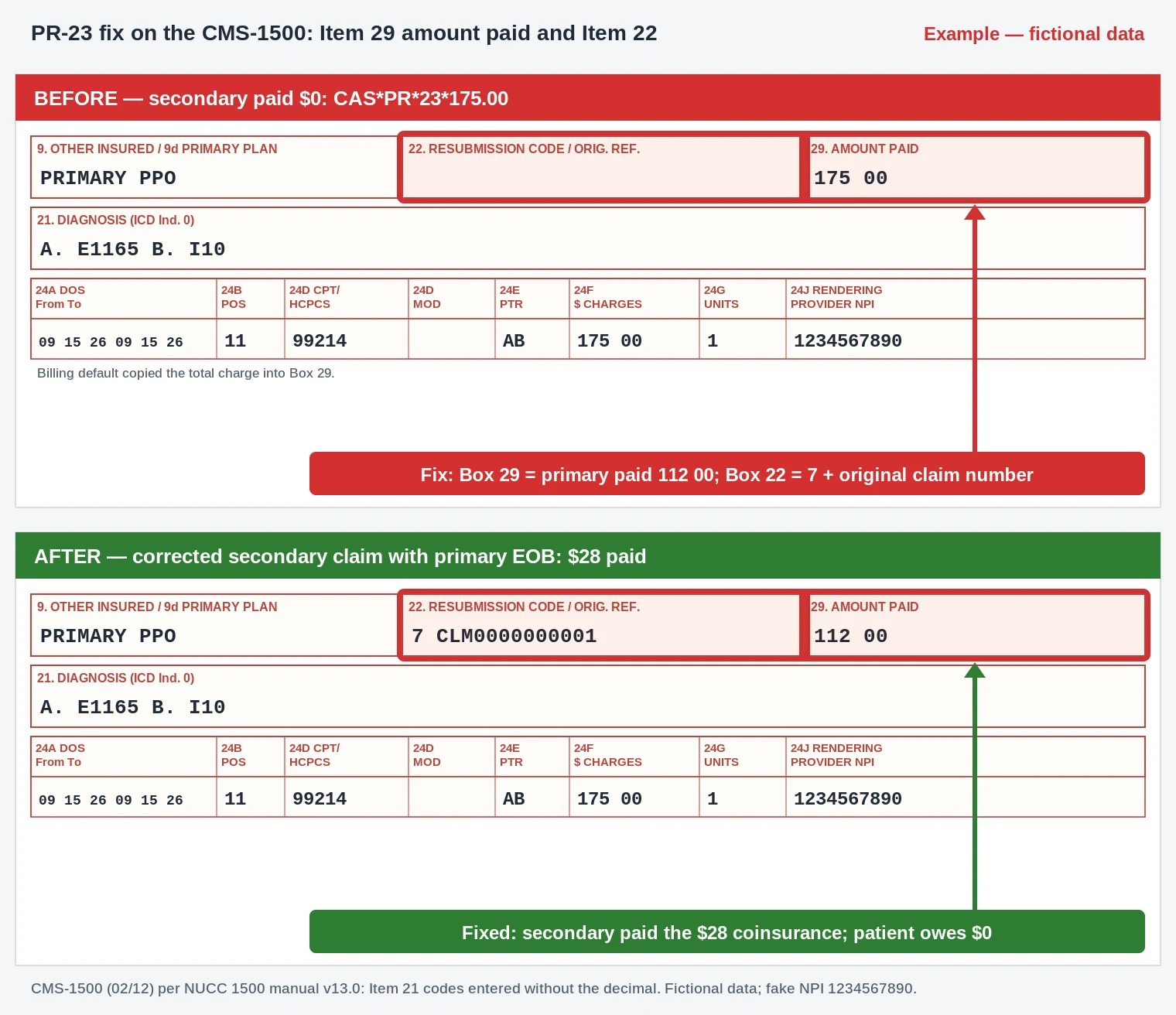
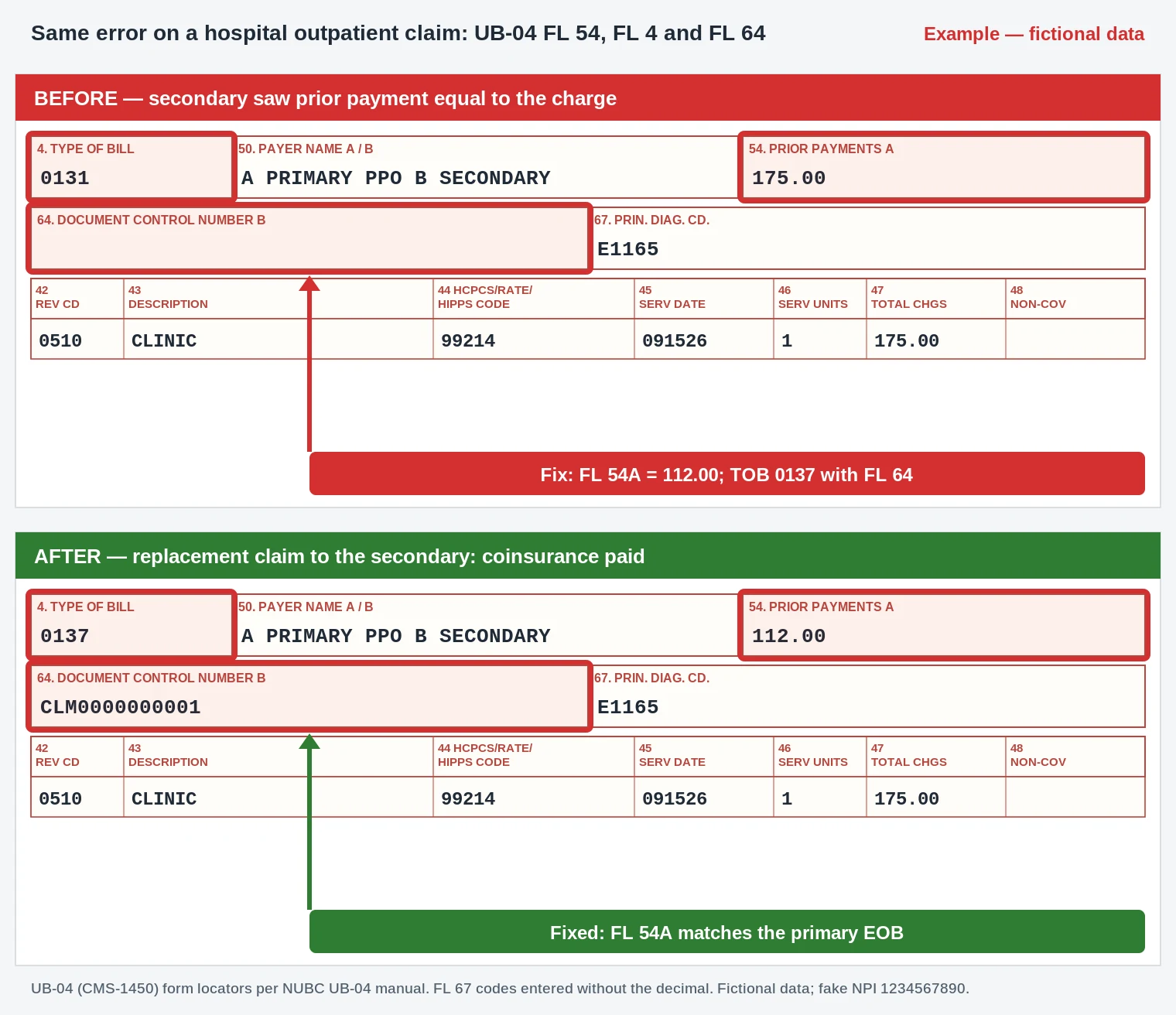
- Box 29 / FL 54A: $175.00 (the full charge) replaced with $112.00, the amount the primary actually paid.
- Box 22 / FL 4 + FL 64: frequency code 7 with the original claim number (bill type 0137 on the UB-04).
- Box 9d / FL 50A: primary plan unchanged; the primary EOB was attached to the corrected claim.
- Box 21 / FL 67: E11.65 (entered as E1165) and I10 are unchanged.
How do I prevent PR-23 billing errors?
You prevent PR-23 billing errors by sending the secondary the exact primary numbers and by posting code 23 as non-billable. Most errors start with a wrong paid amount or a missing primary EOB. Short checks at claim creation and at posting stop most wrong statements before they go out.
- Bill the secondary only after the primary remit posts.
- Send primary payment data electronically in loops 2320 and 2430 when the payer accepts it.
- Turn off any default that copies total charges into Box 29.
- Map PR-23, CO-23 and OA-23 to one non-billable posting rule.
- Review every secondary line where the payer paid $0 but the primary left patient share.
Related codes
| Code | Meaning |
|---|---|
| OA-23 | Same prior payer impact, standard OA group |
| CO-23 | Same impact, labeled as a provider write-off |
| CO-22 | Care may be covered by another payer under COB |
| PR-22 | Other coverage issue assigned to the patient |
| PR-2 | Coinsurance amount the patient may owe |
FAQ
What does PR-23 mean on an EOB?
It means the secondary payer reduced its payment by what the primary paid or adjusted, and labeled it patient share.
Is PR-23 a valid denial code?
Reason code 23 is valid, but X12 allows it only with group OA. PR-23 is a payer labeling issue.
Should I bill the patient for PR-23?
No. Bill only the primary’s real deductible, coinsurance or copay that the secondary did not pay.
Where is the primary payment on a CMS-1500?
Box 29 holds the amount paid on paper claims. Electronic claims report it in loops 2320 and 2430.
What remark codes come with code 23?
N765, “This payer does not cover coinsurance assessed by a previous payer.” and N4 for a missing prior payer EOB are common.
Sources
How we checked: the CARC 23, N765 and N4 text was compared word for word with the X12 lists on 3 November 2026.
- X12, Claim Adjustment Reason Codes (CARC 23). Accessed 3 Nov 2026.
- X12, Remittance Advice Remark Codes (N765, N4). Accessed 3 Nov 2026.
- X12, Claim Adjustment Group Codes. Accessed 3 Nov 2026.
- NUCC, 1500 claim form instructions. Accessed 3 Nov 2026.
- CMS, Medicare Claims Processing Manual, chapter 25. Accessed 3 Nov 2026.
Last updated: 3 November 2026 · Educational content; not legal advice.
Related denial codes
- OA-23: Prior Payer(s) Adjudication Impact (COB)
- CO-23: Prior Payer Impact Filed Under Group Code CO
- PR-24: Charges Covered Under a Capitation Agreement or Managed Care Plan
- PR-22: Another Payer May Be Primary (Coordination of Benefits)
- CO-24: Charges Covered Under a Capitation Agreement or Managed Care Plan
- CO-22: Care May Be Covered by Another Payer (Coordination of Benefits)
- CO-21: Injury Is the No-Fault Carrier’s Liability
- PR-20: Injury or Illness Covered by the Liability Carrier