
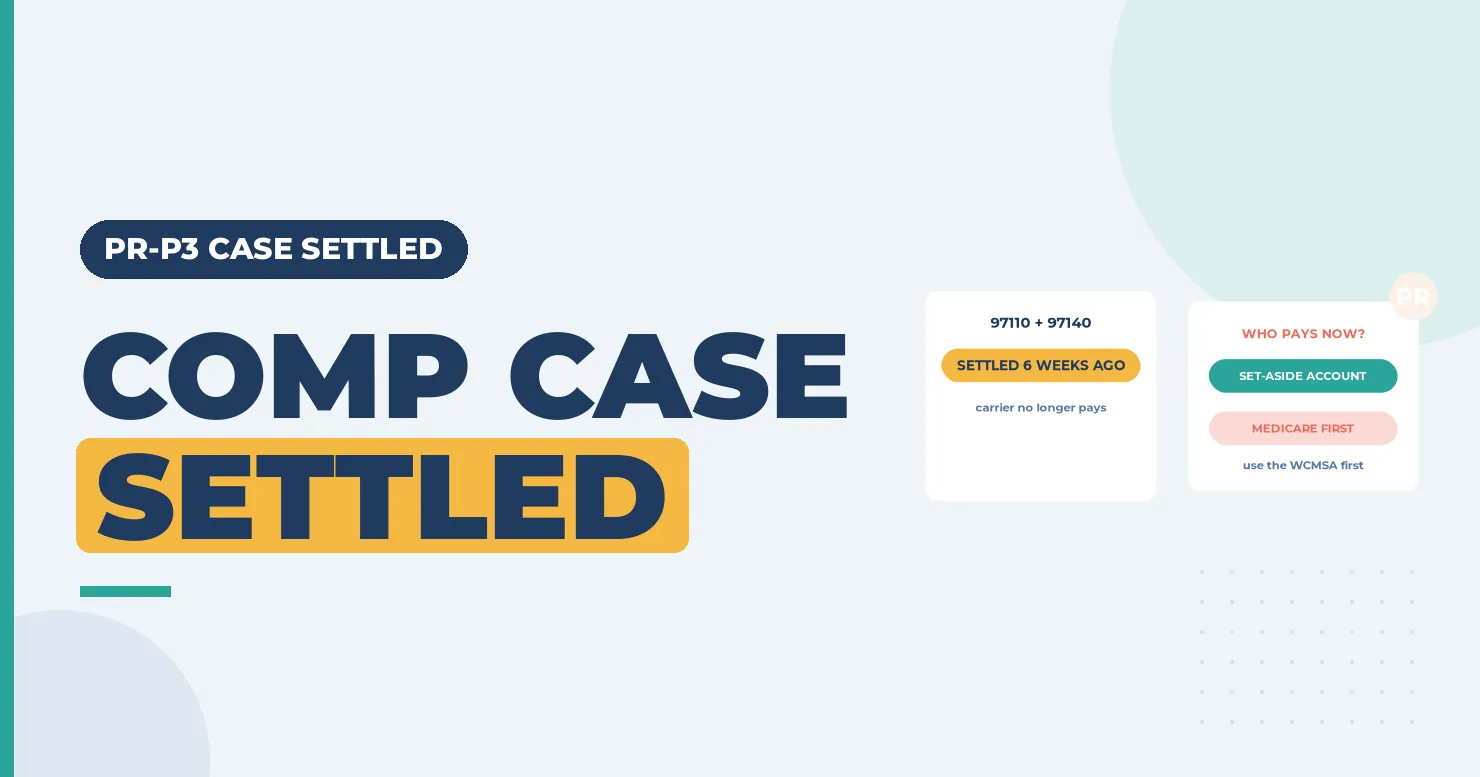
The PR-P3 denial code means the injured worker’s comp case has settled, so the carrier no longer pays for care. The patient now pays for care of that injury, most often from a Medicare set-aside account made in the settlement. Bill the account’s administrator or the patient, not Medicare, until the account is used up. (Primary source: X12 Claim Adjustment Reason Codes)
In brief: reason code P3 moves the balance to the patient. Ask the patient for the settlement details, find out who manages the set-aside funds, and bill that account. Medicare pays for the work injury only after the set-aside is exhausted and accounted for.
Part of our denial codes library. Written by Manikandan J, CPC, CRCR, who has handled settled workers’ comp accounts for physical therapy, pain management and orthopedic practices. Published 21 November 2026. Last updated: 21 November 2026. Code wording quoted word for word from X12. Read about the author and our editorial policy, or contact us to report an error.
What does denial code PR-P3 mean?
Denial code PR-P3 says the comp case closed with a settlement, and the deal makes the patient pay for future care of that injury. The money for that care usually sits in a Workers’ Compensation Medicare Set-Aside Arrangement, often shortened to WCMSA. Only workers’ compensation carriers send this code, and X12 allows only the PR group with it.
| Field | Value |
|---|---|
| Code | P3 |
| Description | “Workers’ Compensation case settled. Patient is responsible for amount of this claim/service through WC ‘Medicare set aside arrangement’ or other agreement. To be used for Workers’ Compensation only. (Use only with Group Code PR)” |
| Group codes | PR only, per X12 |
| Start | 11/01/2013; replaces code 201 for comp use |
| Common remarks | N722, N585 |
Source: X12 Claim Adjustment Reason Codes, checked 21 November 2026.
Methodology: the code wording is copied from the X12 list. The set-aside rules come from the CMS guide cited below.
Key terms: A WCMSA is the part of a comp settlement saved for future care of the injury that Medicare would cover. A professional administrator is a company that holds the money and pays providers. Self-administration is when the patient runs the account and pays bills.
PR-P3 or PR-201: which one did you get?
| Code | Who sends it | What it covers |
|---|---|---|
| PR-P3 | A workers’ comp carrier | The comp case settled; the patient pays through a WC set-aside or other agreement |
| PR-201 | A health plan or other payer | Patient responsibility through a set-aside arrangement outside the comp-only rule |
| CO-P3 or OA-P3 | Should not appear | X12 allows P3 with PR only, so ask the carrier to correct its remittance |
Example scenario (fictional names), part 1
PR-P3 Denial Example: What Happened
- Clinic: Brightwater Physical Therapy, billing lead Maya Kendrick
- Provider: therapist Jordan Ellery, PT
- Patient: a former delivery driver with a right rotator cuff strain from a work fall, S46.011D for follow-up care
- Claim: 97110 and 97140, sent to the fictional comp carrier that had paid every visit for a year
The 835 came back with CAS*PR*P3 and remark code N722, “Patient must use Workers’ Compensation Set-Aside (WCSA) funds to pay for the medical service or item.” Nobody at the front desk knew the case had settled.
So who pays for the next twelve visits? Keep reading, or jump to how the PR-P3 denial was resolved.
Who pays after a PR-P3?
The settlement decides who pays. The CMS WCMSA Reference Guide says an approved set-aside amount must be appropriately exhausted before Medicare will begin to pay for care related to the settlement. The guide also says the account is run by the patient or by a paid administrator.
| Who manages the account | How you get paid |
|---|---|
| Professional administrator | Send the bill to the administrator named in the settlement |
| The patient (self-administered) | Bill the patient, who pays from the set-aside account |
| No set-aside, other agreement | Bill the patient under the settlement terms |
| Set-aside exhausted and reported | Bill Medicare as primary for the injury-related care |
How do I fix a PR-P3 denial?
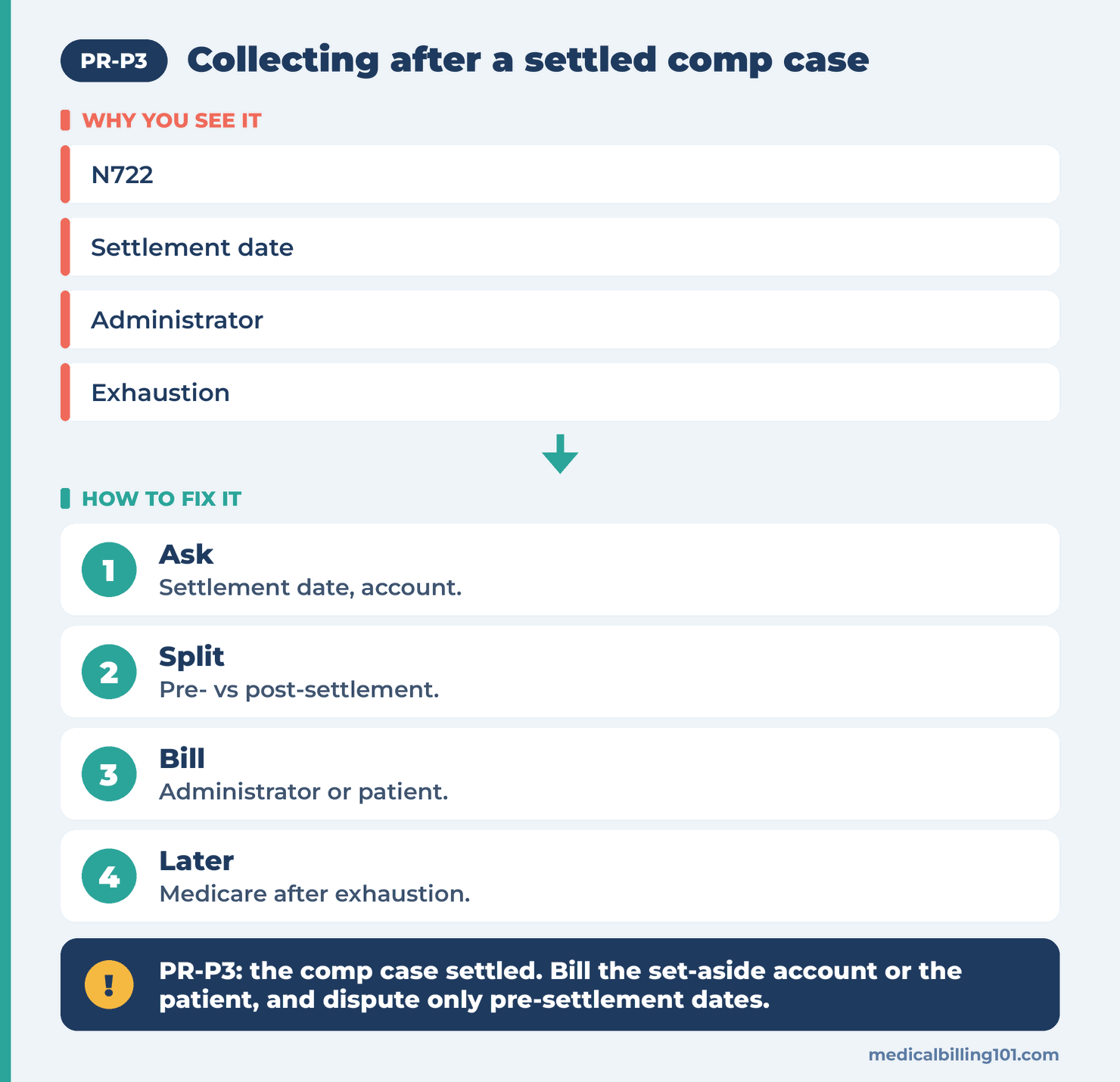
To fix a PR-P3 denial, you usually do not change the claim at all. The carrier’s decision is correct once a settlement exists, so the work is about finding the right account and collecting.
| Step | What to do | Why it matters |
|---|---|---|
| 1 | Ask the patient for the settlement date and the set-aside contact | Services before the settlement date still belong to the carrier |
| 2 | Check the remark: N722 points to set-aside funds, N585 to a final settlement | It tells you which agreement applies |
| 3 | Bill the administrator or the patient at the comp fee level the settlement uses | Set-aside spending is reviewed later |
| 4 | Dispute only dates of service before the settlement | Those lines may still be payable by the carrier |
Example scenario (fictional names), part 2
How the PR-P3 Denial Was Resolved
Maya called the patient and learned the case had settled six weeks earlier.
- The settlement named a professional administrator for the WCMSA.
- Two of the denied visits were dated before the settlement, so Maya asked the carrier to reprocess those two.
- She sent the later visits, 97110 and 97140 with S46.011D, to the administrator with the denial attached.
Fix: no corrected claim was needed. Maya moved the balance to the set-aside account. She disputed only the dates before the settlement.
Outcome: the carrier paid the two early visits, and the administrator paid the rest. Brightwater now asks every comp patient monthly whether the case has settled.
Names and details are illustrative; no real patient data.
Names and details are illustrative; no real patient data.
Can I bill Medicare for a PR-P3 balance?
Not while set-aside money is left. Medicare pays second for work injuries, and the CMS Medicare Secondary Payer Manual, Chapter 1 explains the basic rules. Bill Medicare for care of the injury only after the set-aside is used up and the spending is reported. Care for other health problems can go to Medicare as usual.
How do I prevent surprise PR-P3 denials?
Ask comp patients at every visit whether the case has settled or a hearing is scheduled. For example, a patient in mediation may settle between two therapy visits. Keep the adjuster’s name, the claim number and any set-aside administrator on the account, such as a separate field in your practice system. Then the first P3 remit becomes a quick billing switch instead of a long collection problem.
Related codes
| Code | Meaning |
|---|---|
| PR-201 | Patient responsible through a set-aside arrangement or other agreement |
| CO-P1 | State-mandated requirement for property and casualty |
| CO-19 | Work-related injury; the liability of the workers’ comp carrier |
| CO-22 | Care may be covered by another payer under coordination of benefits |
FAQ
What does PR-P3 mean?
The workers’ comp case settled, and the patient now pays for care of that injury through a set-aside account or other agreement.
Can CARC P3 come with CO or OA?
No. X12 says P3 is used only with group code PR. A CO-P3 or OA-P3 is a payer setup error.
Who do I bill after a PR-P3 denial?
Bill the company named in the settlement to run the account. If the patient runs it, bill the patient.
When will Medicare pay for the injury again?
When the approved set-aside money is used up on the right care and the spending is reported to CMS.
Are visits before the settlement date affected?
Usually not. Send those dates back to the carrier, since the settlement only covers care after it took effect.
Sources
How we checked: the CARC P3 quote was matched word for word with the X12 CARC list on 21 November 2026, and N722 and N585 with the X12 RARC list.
- X12, Claim Adjustment Reason Codes (CARC P3, 201, P1, 19, 22). Accessed 21 Nov 2026.
- X12, Remittance Advice Remark Codes (N722, N585). Accessed 21 Nov 2026.
- CMS, WCMSA Reference Guide (set-aside exhaustion and administration). Accessed 21 Nov 2026.
- CMS, Medicare Secondary Payer Manual, Chapter 1. Accessed 21 Nov 2026.
Last updated: 21 November 2026 · Educational content; not legal advice.