
CO-91 means the payer changed the dispensing fee on a drug claim. The drug itself may be paid in full, but the fee for filling it was cut or taken off. On Medicaid pharmacy claims, the fee is set by the state. On Medicare DME claims for nebulizer drugs, the fee has its own HCPCS codes and strict timing rules. Most CO-91 lines come from billing the wrong fee code, billing a fee too soon, or billing more fees than the period allows. (Primary source: X12 Claim Adjustment Reason Codes).
In brief: CO-91 means “Dispensing fee adjustment.” Check which fee applies (state Medicaid fee, PBM contract fee or a Medicare fee code). Count the fees already paid in the period, and confirm you didn’t bill too early. Rebill with the right code if needed. If the cut matches the contract, write it off.
Part of our denial codes library. Written by Manikandan J, CPC, CRCR, who has worked pharmacy and DME drug claims for payers and billing companies. Published 20 October 2026. Last updated: 20 October 2026. Code wording is quoted word for word from X12.
Official X12 wording for CARC 91
| Field | Official X12 text |
|---|---|
| Description | “Dispensing fee adjustment.” |
| Start | 01/01/1995 |
Source: X12 Claim Adjustment Reason Codes, checked 20 October 2026.
Denial code 91, CARC 91 and reason code 91
You may see denial code 91, CARC 91 or reason code 91. They’re the same. With CO, the cut is a contract adjustment the patient doesn’t owe.
What a dispensing fee pays for
A dispensing fee is the fee a payer pays a pharmacy for filling a prescription, apart from the drug’s own cost. A professional dispensing fee is the Medicaid term for that fee. Under 42 CFR 447.502, it covers pharmacy costs such as the pharmacist’s time, drug review, filling the container, counseling and delivery. A supplying fee is a separate Medicare Part B fee for some oral cancer, anti-nausea and transplant drugs.
Medicare’s inhalation drug fee codes
Medicare pays a pharmacy a dispensing fee for nebulizer drugs supplied through DME. The rules are in 42 CFR Part 414, Subpart L.
| HCPCS | What it’s for | Key rule |
|---|---|---|
| G0333 | Initial 30-day supply as a Medicare beneficiary | Once in a lifetime |
| Q0513 | Each later 30-day supply | One fee per 30 days |
| Q0514 | Each later 90-day supply | One fee per 90 days |
The CGS nebulizer fact sheet adds that the fee must be on the same claim as the drug. It also says Medicare won’t pay a fee for saline or for compounding. Fee amounts are on the Noridian fee page.
Why CO-91 shows up
- Wrong fee code. Billing G0333 when the patient already had an initial fee from any pharmacy.
- Too many fees. A second fee in the same 30-day or 90-day period, even from another pharmacy.
- Billed too soon. A refill fee sent before the payer’s early-refill window opens.
- Fee on its own claim. The fee was sent without the drug.
- Contract rate. A PBM or state pays a lower fee than your charge.
Fixing a CO-91
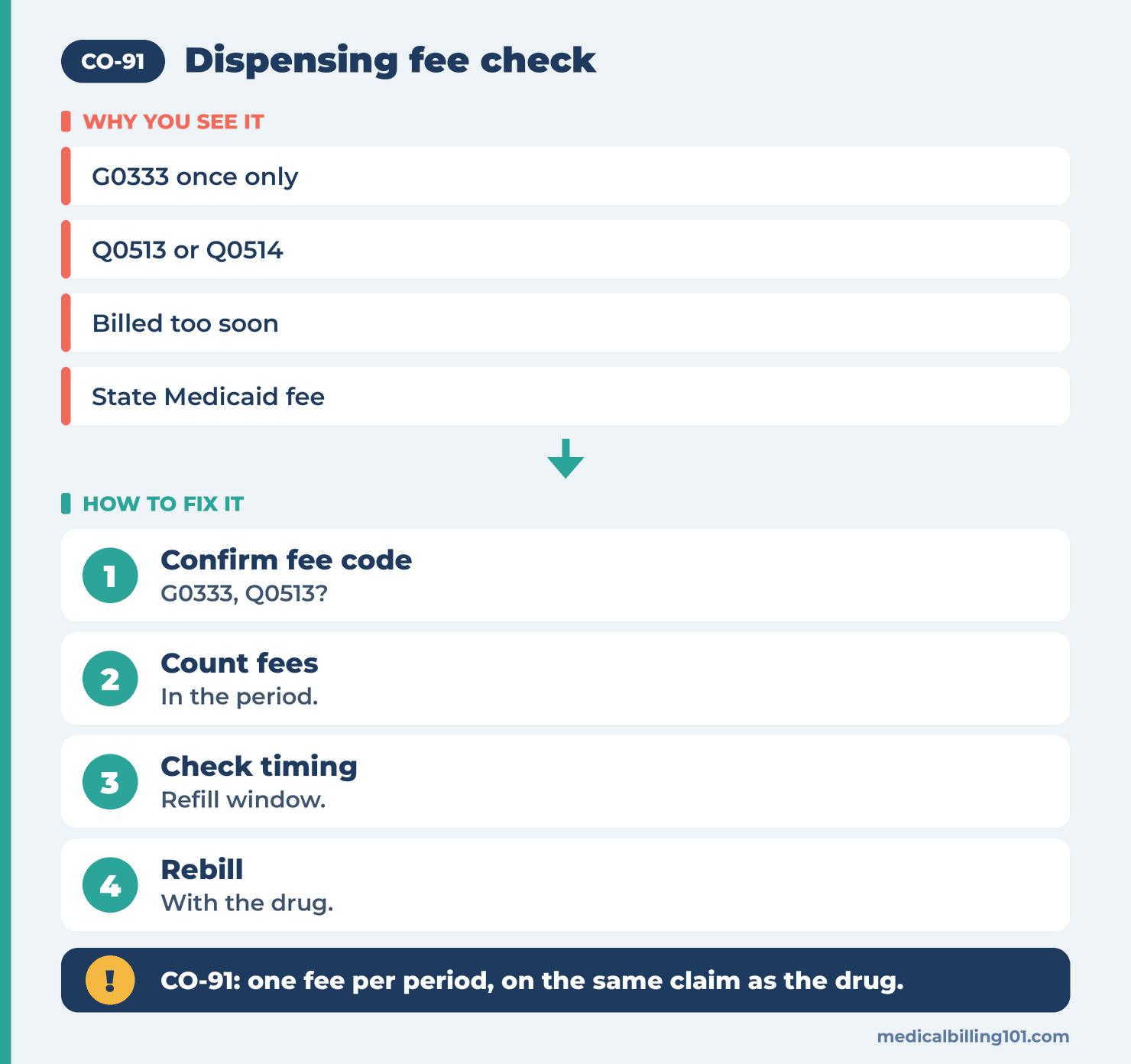
- Confirm which fee code applies for the payer and the patient’s history.
- Count fees already paid in the 30-day or 90-day period.
- Check timing against the refill window.
- Rebill with the right code on the same claim as the drug.
- Write off the contract difference if the fee was paid at the correct rate.
Worked example (illustrative)
A DME pharmacy ships a patient’s first nebulizer drugs and bills G0333 with the drug. The remit shows CAS*CO*91 on the fee line. The billing team checks the patient’s history and finds another pharmacy billed G0333 two years ago. They send a corrected claim with Q0513 for the 30-day fee, and it pays.
Consider a Medicaid case. A pharmacy bills a usual dispensing fee to a state Medicaid plan and gets CO-91 for the difference. The state pays its set professional dispensing fee, which is lower than the pharmacy’s charge. That cut is correct, so the pharmacy writes it off.
Prevention checklist
- [ ] Ask new nebulizer patients if they’ve had inhalation drugs under Medicare before.
- [ ] Track fee dates so you don’t bill a second fee in the same period.
- [ ] Always put the fee on the same claim as the drug.
- [ ] Load each state’s dispensing fee into your pricing table.
- [ ] Review CO-91 lines by payer each month.
Related denial codes
- CO-90: ingredient cost adjustment.
- CO-16: claim lacks information needed for adjudication.
- CO-45: charge exceeds fee schedule or contracted amount.
- CO-18: exact duplicate claim or service.
- Full CARC and RARC list for code lookups.
- Denial codes hub for every code we cover.
Key takeaways
CO-91 changes the fee for filling a drug, not the drug’s price. For Medicare nebulizer drugs, use G0333 once in a lifetime and Q0513 or Q0514 after that, one fee per period, on the same claim as the drug. For Medicaid, the state’s set fee usually explains the cut.
FAQ
What does CO-91 mean?
It means the payer adjusted the dispensing fee for filling a drug.
What is G0333?
It’s Medicare’s once-in-a-lifetime dispensing fee for a patient’s first 30-day supply of inhalation drugs.
Can two pharmacies both get a dispensing fee in the same month?
Not for Medicare inhalation drugs. Only one fee is paid per 30-day or 90-day period.
Who sets the Medicaid dispensing fee?
Each state Medicaid agency sets its own professional dispensing fee.
Can I bill the patient for a CO-91 cut?
No. The CO group means it’s a contract adjustment.
Is CO-91 the same as CO-90?
No. CO-90 adjusts the drug’s ingredient cost, and CO-91 adjusts the fee for dispensing it.
Sources
How we checked: every code quote on this page was compared word for word with the X12 CARC list on 20 October 2026.
- X12, Claim Adjustment Reason Codes (CARC 91). Accessed 20 Oct 2026.
- eCFR, 42 CFR 447.502, Definitions. Accessed 20 Oct 2026.
- eCFR, 42 CFR Part 414 Subpart L, Supplying and Dispensing Fees. Accessed 20 Oct 2026.
- CGS Medicare, Nebulizer Drugs: Dispensing Fees. Accessed 20 Oct 2026.
Last updated: 20 October 2026 · This page is educational and doesn’t replace payer contracts or coding rules.