
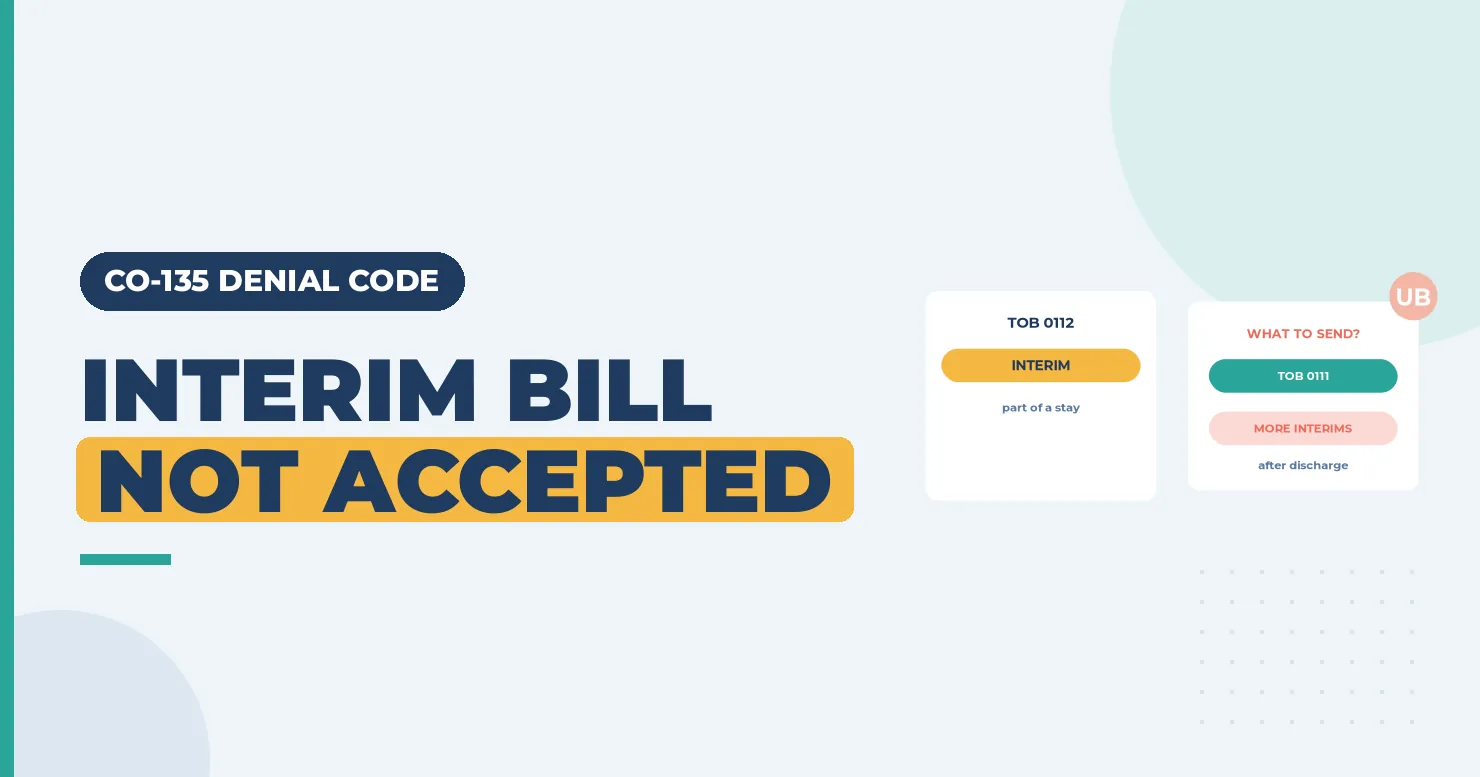
CO-135 is an institutional claim problem. A hospital, skilled nursing facility or other facility sent an interim bill, one that covers only part of a stay, and the payer doesn’t accept interim bills for that patient, plan or setting. The answer is usually to hold the claim until discharge and send one admit-through-discharge bill, or to follow the payer’s exact interim billing rules. The CO group means you can’t bill the patient for it. (Primary source: X12 Claim Adjustment Reason Codes)
In brief: CARC 135 reads “Interim bills cannot be processed.” Look at the third digit of the type of bill. If it’s 2, 3 or 4 and the payer wants one final claim, rebill as a 1 after discharge.
Part of our denial codes library. Written by Manikandan J, CPC, CRCR, who has worked hospital and post-acute claim edits on the UB-04. Published 21 October 2026. Last updated: 21 October 2026. Code wording quoted word for word from X12.
Reason code 135 as X12 lists it
| Field | X12 text |
|---|---|
| Code | 135 |
| Description | “Interim bills cannot be processed.” |
| Start | 10/31/1998 |
| Last modified | 09/30/2007 |
Source: X12 Claim Adjustment Reason Codes, checked 21 October 2026.
Type of bill frequency codes, in plain terms
The type of bill is the four-digit code in UB-04 form locator 4, such as 0111. The last digit is the frequency code, which tells the payer where this claim sits in the stay. An interim bill is a claim for part of a stay while the patient is still there, or for a stretch of a longer stay.
| Last digit | Meaning | Typical use |
|---|---|---|
| 1 | Admit through discharge | One claim for the whole stay |
| 2 | Interim, first claim | First part of a long stay |
| 3 | Interim, continuing claim | Middle parts of a long stay |
| 4 | Interim, last claim | Final part, ending at discharge |
| 7 | Replacement of prior claim | Corrected claim |
| 8 | Void or cancel of prior claim | Cancel a claim sent in error |
Medicare’s rules for when interim bills are allowed sit in Chapter 3 of the Medicare Claims Processing Manual. Commercial and Medicaid plans set their own rules in the contract or provider manual.
Example scenario (fictional names), part 1
CO-135 Denial Example: What Happened
Grace Adeyemi bills for St. Brendan Community Hospital. A patient with a severe hip infection stayed 38 days for IV antibiotics and two surgeries. At day 30, the hospital’s system dropped an interim claim, type of bill 0112, to Harbor Mutual Health, a fictional commercial plan.
The 835 came back with CAS*CO*135 on the whole claim and remark LQ*HE*MA30, “Missing/incomplete/invalid type of bill.” The same setup worked fine for another plan.
Why did it fail here, and what should Grace send instead? Keep reading, or jump to how the CO-135 denial was resolved.
Remark codes you may see with CARC 135
| RARC | X12 wording |
|---|---|
| MA30 | “Missing/incomplete/invalid type of bill.” |
| N379 | “Claim level information does not match line level information.” |
N379 can appear when the statement dates or occurrence codes don’t fit the frequency code. Find more on the X12 RARC page.
How to fix a CO-135 denial

- Read the type of bill. Confirm the frequency digit and the statement-covers dates in form locator 6.
- Check the payer’s interim rule. For example, some plans pay only one admit-through-discharge claim per stay, such as many commercial DRG contracts.
- Hold until discharge if needed. Combine every day and charge into one claim with frequency 1.
- Follow the sequence when interim bills are allowed. Send 2, then 3, then 4 in order, with no gaps or overlaps in dates.
- Void before you replace. If an interim claim already processed, check whether the payer wants a void (8) first.
- Update the billing system. Set interim billing by payer, not one rule for all.
Example scenario (fictional names), part 2
How the CO-135 Denial Was Resolved
Grace checked Harbor Mutual’s provider manual. Inpatient stays under its DRG contract had to be billed as one claim after discharge. The 30-day interim trigger in the system had been built for a different plan’s contract.
Fix: after discharge on day 38, she sent one claim with type of bill 0111, covering admission to discharge. The denied interim claim needed no void because it never processed.
Outcome: the stay paid under the DRG. The IT team split the interim trigger by payer, so only plans that allow it get interim claims.
Names and details are illustrative; no real patient data.

CMS-1500 not shown: type of bill and interim inpatient billing exist only on the UB-04 facility claim.
- FL 4: type of bill 0112 (interim, first claim) replaced with 0111 (admit through discharge).
- FL 6: statement period now runs from admission to the day-38 discharge (placeholder dates).
- FL 17: patient status 30 (still a patient) becomes the discharge status (01 shown as a placeholder).
- No void: the denied interim claim never processed, so no frequency 8 claim was needed.
Worked example (illustrative)
A skilled nursing facility bills a long-term Medicaid resident monthly with frequency codes 2 and 3. A new managed Medicaid plan takes over and wants each month billed as its own admit-through-discharge claim. The first monthly claim denies with CO-135. The facility rebills that month with frequency 1 and changes its setup for that plan.
Common mistakes with interim claims
- Gaps between interim claims. Each claim should start the day after the last one ended.
- Sending a 4 without a 2. Payers expect the full sequence when they allow interim bills.
- Changing the DRG mid-stay. Interim claims may price on partial data, so read the contract.
- Missing the timely filing date. Holding a claim until discharge doesn’t stop the clock.
Related codes
- CO-16: claim lacks information needed for adjudication.
- CO-18: exact duplicate claim or service.
- CO-5: procedure code or bill type inconsistent with the place of service.
- CO-29: time limit for filing has expired.
Recap
CO-135 means the payer won’t take an interim bill. Check the frequency digit of the type of bill and the payer’s rules. If it wants one claim per stay, send frequency 1 after discharge. If it allows interim bills, send them in order with clean dates.
FAQ
What does denial code CO-135 mean?
The payer won’t process an interim bill for this claim. It reads “Interim bills cannot be processed.”
Which type of bill codes are interim?
A last digit of 2, 3 or 4, such as 0112, 0113 or 0114.
How do I fix CARC 135?
Hold the claim until discharge and send one claim with frequency 1, unless the payer’s rules allow interim billing.
Does CO-135 apply to professional claims?
Rarely. It’s mainly a facility code tied to the UB-04 or 837I.
Can I bill the patient for CO-135?
No. It’s a CO adjustment. Fix and rebill the claim to the payer.
Do I need to void the interim claim first?
Only if it processed. A denied interim claim usually needs no void, but check the payer’s rules.
Sources
How we checked: each code quote on this page was matched word for word with the X12 CARC and RARC lists on 21 October 2026.
- X12, Claim Adjustment Reason Codes (CARC 135, 5, 16, 18, 29). Accessed 21 Oct 2026.
- X12, Remittance Advice Remark Codes (MA30, N379). Accessed 21 Oct 2026.
- CMS, Medicare Claims Processing Manual, Chapter 3. Accessed 21 Oct 2026.
- NUBC, Official UB-04 data specifications. Accessed 21 Oct 2026.
Last updated: 21 October 2026 · Educational content; not legal advice.