
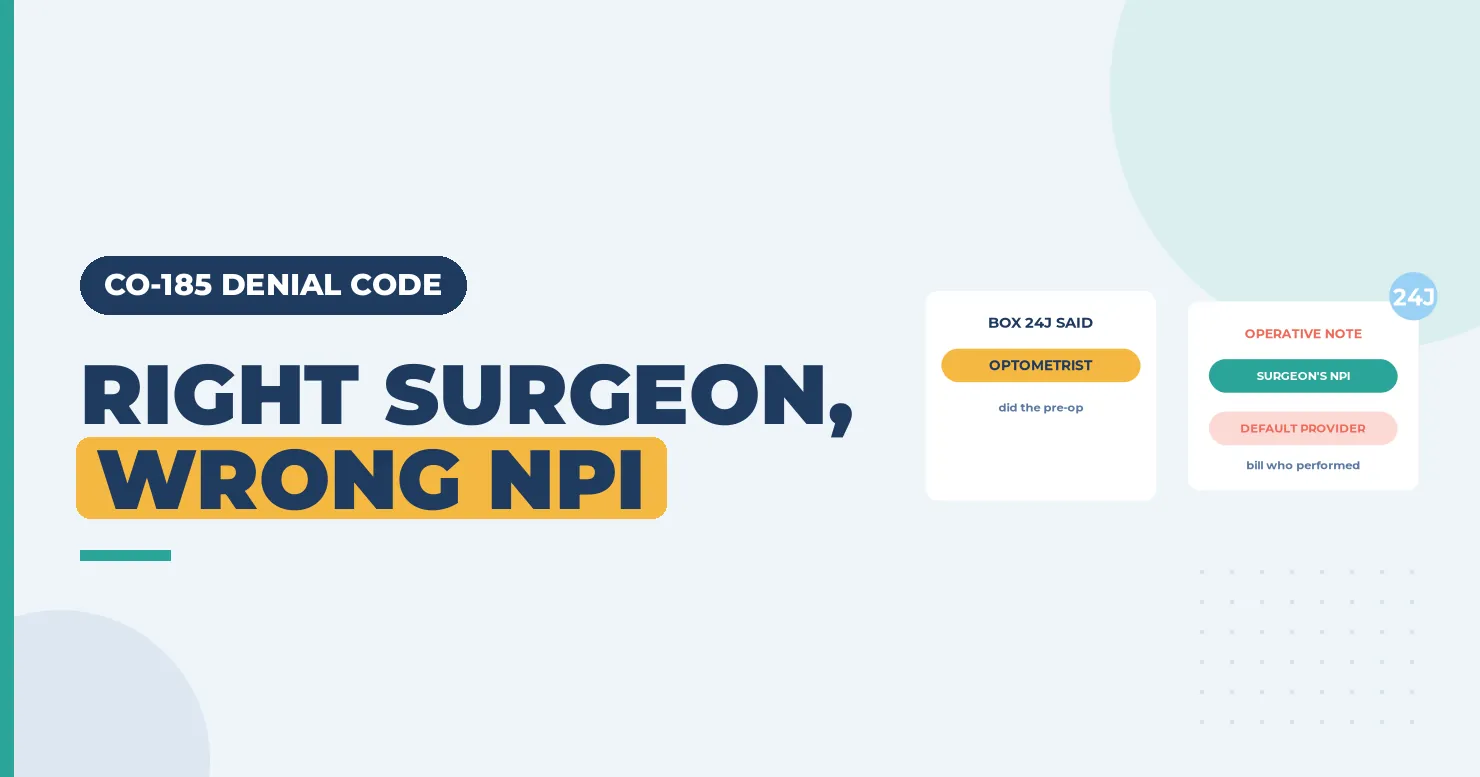
CO-185 means the payer won’t pay because the provider listed as rendering the service isn’t eligible to perform it. The payer checks the rendering NPI against its records: provider type, specialty, credentials and scope. When the claim shows someone the payer doesn’t allow to perform that code, the line is denied. Very often the right person did the work and the claim simply named the wrong one. (Primary source: X12 Claim Adjustment Reason Codes)
In brief: CARC 185 reads “The rendering provider is not eligible to perform the service billed.” Check who actually performed the service in the record. If the claim named the wrong person, correct Box 24J (or UB-04 FL 77 for surgery) and send a corrected claim. If the right person was named, review credentialing and the payer’s scope rules.
Part of our denial codes library. Written by Manikandan J, CPC, CRCR, who has cleaned up rendering-provider setups for surgical and eye care groups. Published 22 October 2026. Last updated: 22 October 2026. Code wording quoted word for word from X12.
Official CARC 185 description
| Field | X12 text |
|---|---|
| Code | 185 |
| Description | “The rendering provider is not eligible to perform the service billed.” |
| X12 usage note | Refer to the 835 Healthcare Policy Identification Segment (loop 2110 Service Payment Information REF), if present. |
| Start | 06/30/2005 |
| Last modified | 07/01/2017 |
Source: X12 Claim Adjustment Reason Codes, checked 22 October 2026.
Key terms
The rendering provider is the person who actually performed the service. The billing provider is the group or facility that gets paid, shown in Box 33. A scope-of-practice rule is a state law or plan policy that limits which provider types may perform a service, such as surgery, anesthesia or certain diagnostic tests.
Example scenario (fictional names), part 1
CO-185 Denial Example: What Happened
Hannah Okafor handles claims for Bayview Eye Associates. The practice’s surgeon, Dr. Victor Lam, removed a cataract from a patient’s right eye with a lens implant (66984-RT) for an age-related nuclear cataract (H25.11). One of the practice’s optometrists had done the pre-op exam, and the scheduling template still had her as the default provider.
The claim to Harborview Health Plan, a fictional commercial plan, went out with the optometrist’s NPI in Box 24J. The 835 showed CAS*CO*185 with remark LQ*HE*N95, “This provider type/provider specialty may not bill this service.”
Did Bayview need a new credential, or just a different NPI? Keep reading, or jump to how the CO-185 denial was resolved.
Common causes of reason code 185
- Default provider in the system. For example, the scheduled provider fills Box 24J even when someone else performs the service.
- Scope of practice. The provider type can’t perform this code under the plan’s rules or state law.
- Credentialing gaps. A new provider is enrolled under a specialty that doesn’t match the services billed.
- Supervision billing errors. A service billed under a mid-level provider’s NPI when the plan requires the supervising physician, or the reverse.
- Group NPI in the rendering field. Some payers reject a type 2 (organization) NPI in Box 24J.
How to fix a CO-185 denial
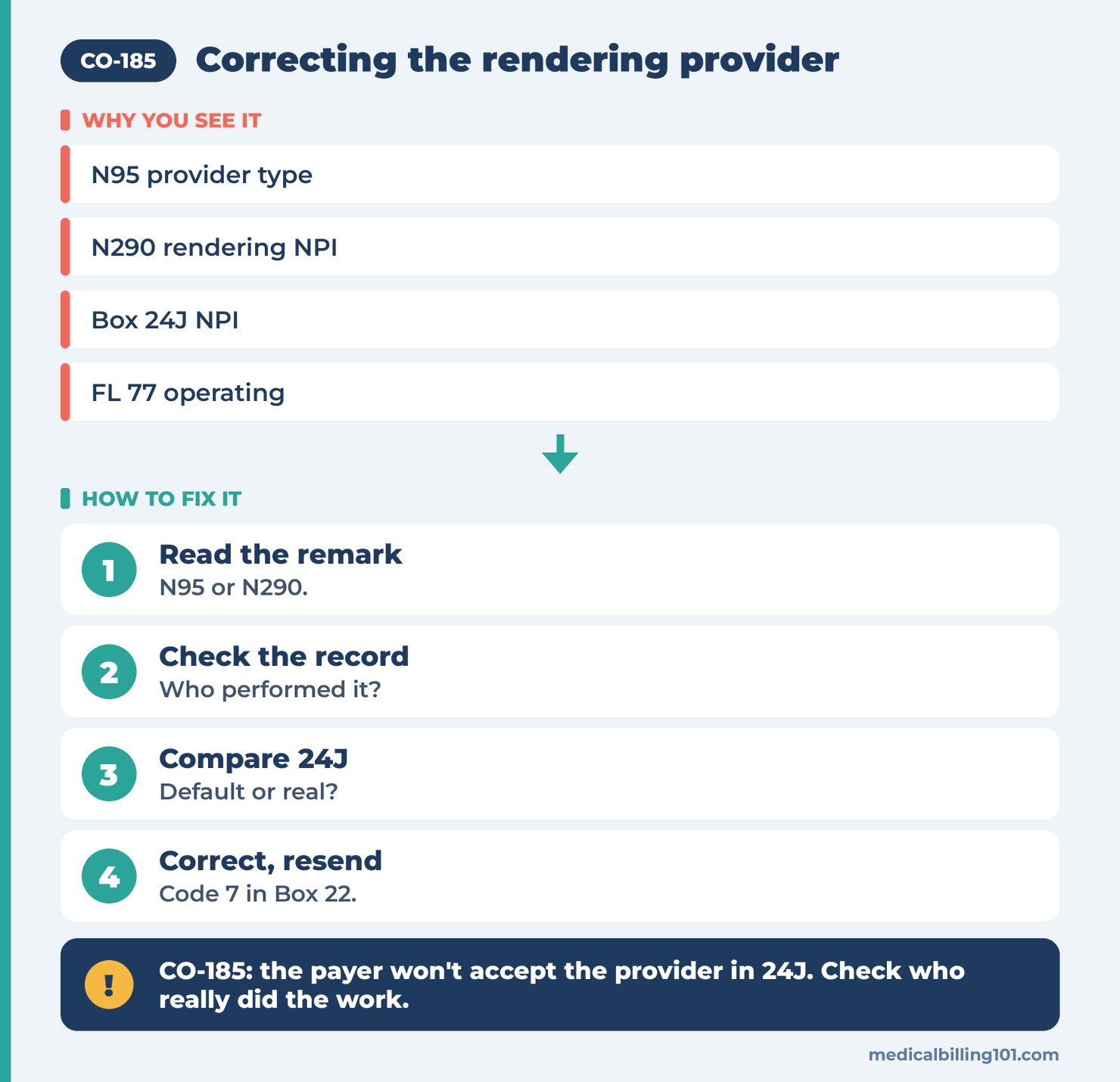
- Read the remark code. N95 points to provider type. N290 points to a missing or invalid rendering NPI, which is closer to a data error.
- Check the record. The operative note, procedure note or signature tells you who performed the service.
- Compare it with Box 24J. If the names differ, the fix is a corrected claim with the right rendering NPI.
- If the right person was named, check the payer’s enrollment record for that provider and the plan’s scope policy. Fix the enrollment or appeal with the policy text.
- Send a corrected claim with frequency code 7 and the original claim number in Box 22.
- Fix the default in the scheduling or charge system so it doesn’t happen again.
Example scenario (fictional names), part 2
How the CO-185 Denial Was Resolved
Hannah pulled the operative note. Dr. Lam had performed the surgery and signed the note. The optometrist had only done the pre-op exam and would see the patient for post-op care later.
Fix: Hannah sent a corrected claim with Box 22 code 7 and the original claim number. Box 24J now showed Dr. Lam’s individual NPI for 66984-RT.
Outcome: Harborview paid the surgery line. Bayview changed its charge entry so surgical codes always take the surgeon from the operative note, and it reviewed its other open surgical claims for the same default.
Names and details are illustrative; no real patient data.
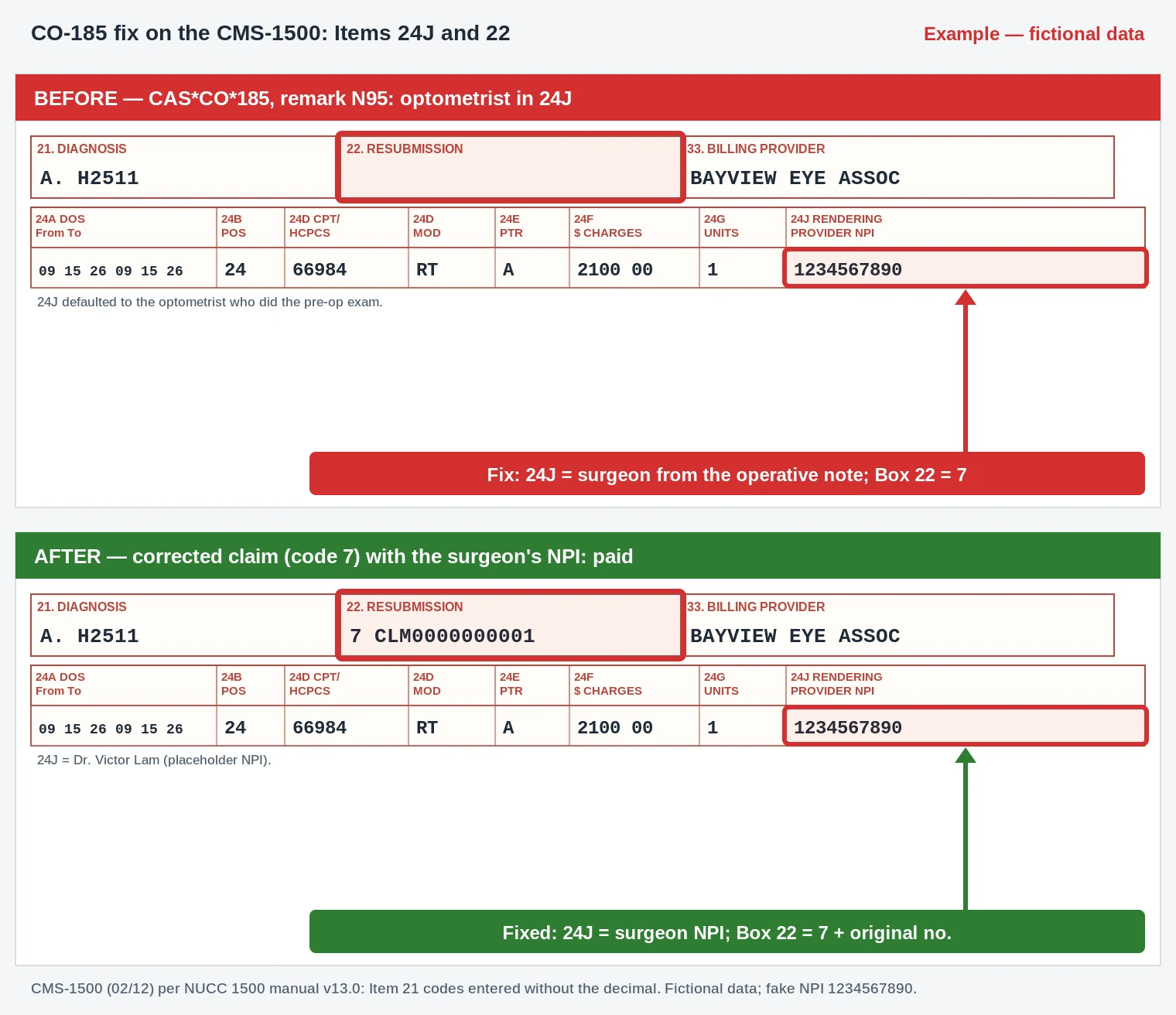
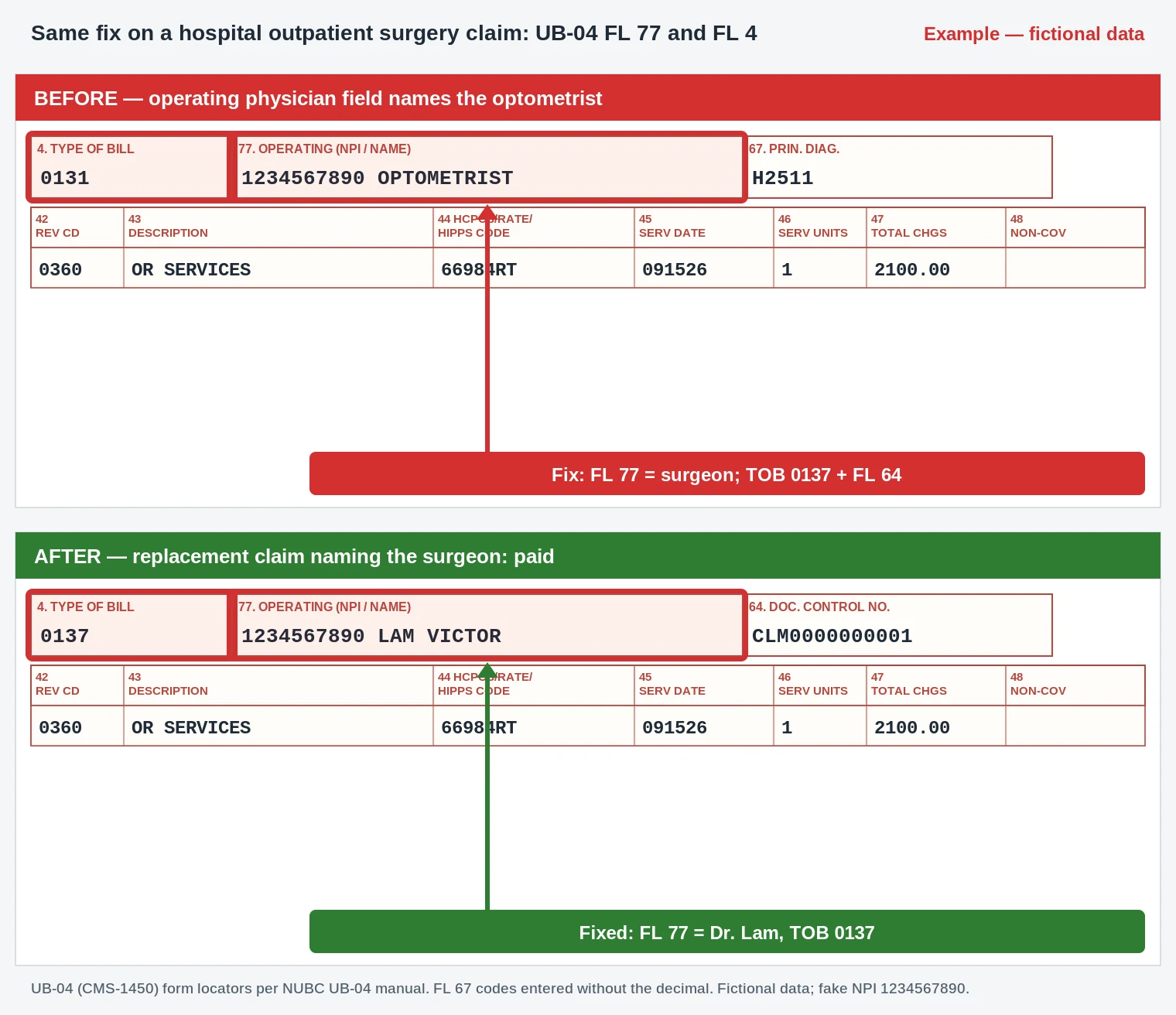
- Box 24J / FL 77: rendering (CMS-1500) and operating physician (UB-04) changed from the optometrist to Dr. Victor Lam, who signed the operative note.
- Box 22 / FL 4 + FL 64: resubmission code 7 with the original claim number (type of bill 0137).
- Box 24D / FL 44: 66984-RT with H25.11 (entered as H2511) is unchanged.
CARC 185 vs similar provider codes
| Code | What it says | When it fits |
|---|---|---|
| CO-185 | Rendering provider not eligible to perform the service | The performer is the problem |
| CO-183 | Referring provider not eligible | The referrer is the problem |
| CO-184 | Ordering provider not eligible | The orderer is the problem |
| CO-170 | Denied when performed by this type of provider | Same idea, older wording |
| N290 | Rendering provider primary identifier invalid | NPI data problem |
Where the rendering provider goes
- CMS-1500: Box 24J holds the rendering provider’s individual NPI on each line. Leave it blank only when the billing provider in Box 33 is the person who did the work.
- UB-04: FL 76 is the attending provider and FL 77 the operating physician. For a surgical procedure on a facility claim, FL 77 should name the surgeon.
- 837P: loop 2310B (claim level) or 2420A (line level).
The NUCC 1500 instructions cover Box 24J in detail.
Recap
CO-185 means the payer won’t accept the rendering provider for the service billed. Check the record to see who really performed it. Correct Box 24J or FL 77 when the claim named the wrong person. When the right person was named, fix the enrollment or appeal under the plan’s scope rules.
FAQ
What does CO-185 mean?
The payer says the rendering provider on the claim isn’t eligible to perform the service that was billed.
Is CO-185 a credentialing problem?
Sometimes. Often it’s a data problem, such as the wrong provider in Box 24J. Check the record before you start credentialing work.
Which box holds the rendering provider?
Box 24J on the CMS-1500. On the UB-04, the surgeon goes in FL 77 and the attending in FL 76.
Can a mid-level provider’s service be billed under the physician?
Only when the payer’s rules allow it, such as incident-to rules for some plans. Check the plan policy first.
Can I bill the patient for a CO-185 line?
No. Group code CO means the amount is the provider’s responsibility.
How is CO-185 different from CO-170?
Both point to provider type. CO-185 names the rendering provider directly, while CO-170 is a broader provider-type denial.
Sources
How we checked: each code quote on this page was matched word for word with the X12 CARC and RARC lists on 22 October 2026.
- X12, Claim Adjustment Reason Codes (CARC 185, 183, 184, 170). Accessed 22 Oct 2026.
- X12, Remittance Advice Remark Codes (N95, N290). Accessed 22 Oct 2026.
- NUCC, 1500 Claim Form instructions. Accessed 22 Oct 2026.
- CMS, NPPES NPI Registry. Accessed 22 Oct 2026.
Last updated: 22 October 2026 · Educational content; not legal advice.
Related denial codes
- CO-184: Prescribing or Ordering Provider Not Eligible
- CO-183: Referring Provider Not Eligible to Refer
- CO-194: Anesthesia Performed by the Operating Physician
- CO-172: Payment Adjusted for a Provider of This Specialty
- CO-171: Denied for This Provider Type in This Type of Facility
- CO-170: Payment Denied When Performed or Billed by This Type of Provider
- CO-206: NPI Missing on the Claim
- CO-207: NPI Invalid Format Fix