
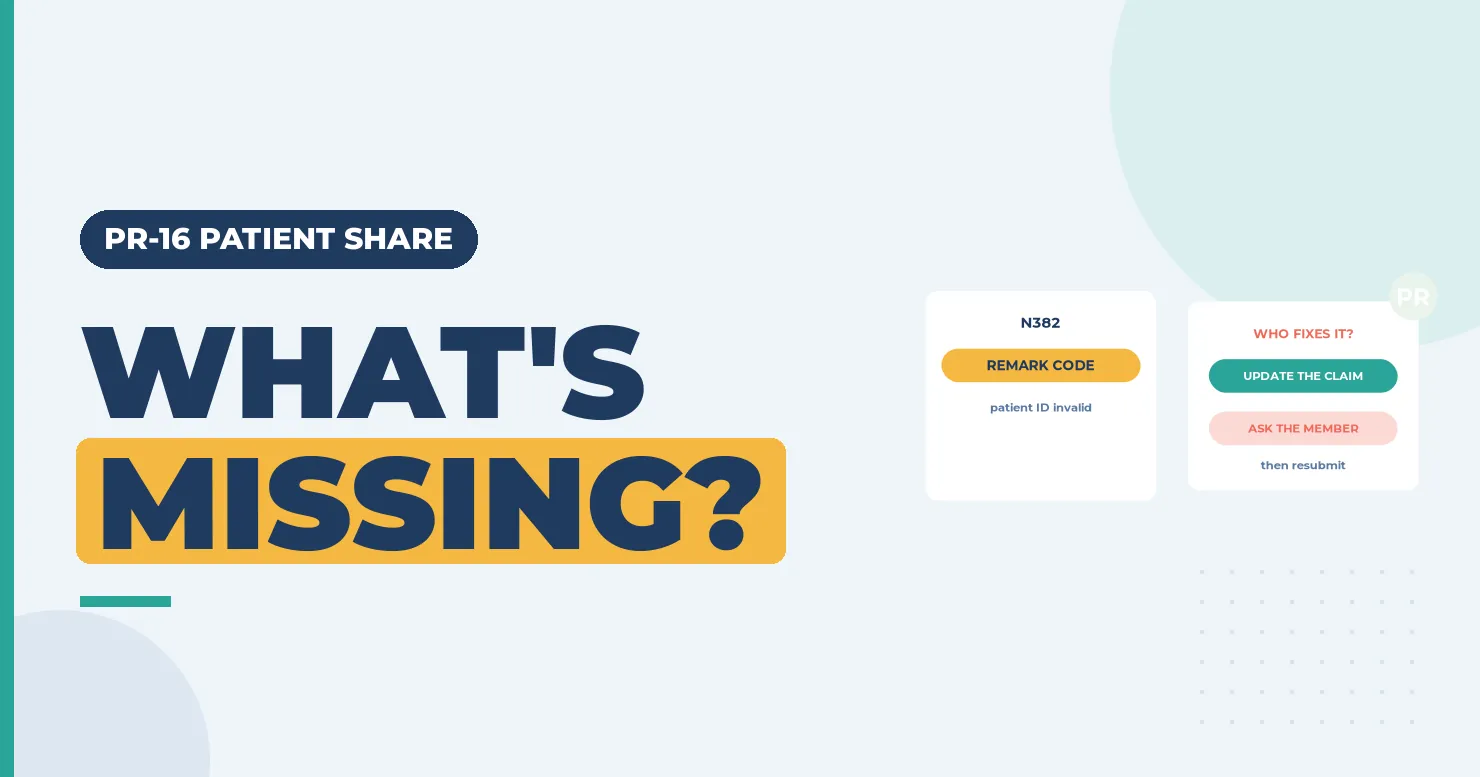
The PR-16 denial code means the plan could not finish processing because something on the claim was missing, invalid, or entered in the wrong place. The PR group assigns the balance to the patient, but that label rarely means the patient truly owes the charge. It usually signals that the missing detail sits with the member, such as a new insurance ID or an unanswered questionnaire. (Primary source: X12 Claim Adjustment Reason Codes)
In brief: reason code 16 reads “Claim/service lacks information or has submission/billing error(s).” It must arrive with at least one remark code, and that remark names the problem. Read it first, correct the field or collect the member’s information, then resubmit before billing anyone.
Part of our denial codes library. Written by Manikandan J, CPC, CRCR, who has worked missing-information denials across physician, urgent care and hospital billing teams. Published 29 October 2026. Last updated: 29 October 2026. Code wording quoted word for word from X12. Read about the author and our editorial policy, or contact us to report an error.
CARC 16 at a glance
| Field | Value |
|---|---|
| Code | 16 |
| Description | “Claim/service lacks information or has submission/billing error(s).” |
| Usage note | At least one remark code must be provided; not for missing attachments |
| Start | 01/01/1995 |
| Group on this page | PR, patient responsibility |
Source: X12 Claim Adjustment Reason Codes, checked 29 October 2026.
Key terms: A remark code is the RARC that explains exactly which detail the payer needed. The insured’s ID number is Box 1a on the CMS-1500 and FL 60 on the UB-04. A PR line is an amount the plan says the member owes, which the office should verify before sending a statement.
Methodology: the CARC and RARC wording is copied from the X12 lists, and the field numbers come from the NUCC and CMS manuals cited below.
Why a plan uses PR instead of CO
Most payers send this reason as CO-16, because the provider controls the claim data. A plan chooses PR when it believes the fix depends on the member. Two remark codes explain most of these cases:
| Remark | Official wording | Who usually fixes it |
|---|---|---|
| N382 | “Missing/incomplete/invalid patient identifier.” | Office, after getting the member’s current card |
| N179 | “Additional information has been requested from the member. The charges will be reconsidered upon receipt of that information.” | Member, by answering the plan’s request |
| MA130 | Medicare’s note that the claim is unprocessable and needs a new submission | Office, with a new claim |
With N179, the plan has typically mailed the member a form, for example an accident or other-insurance questionnaire. The claim stays denied until the member responds, so a quick reminder call often settles it.
Example scenario (fictional names), part 1
PR-16 Denial Example: What Happened
Priya Nair is the billing lead at Riverbend Urgent Care, a fictional walk-in clinic. A fictional employer plan denied a sore throat visit, CPT 99213 with diagnosis J02.9. The 835 showed CAS*PR*16*145.00 and LQ*HE*N382.
The patient had been seen at the clinic many times before, and the eligibility check at check-in had passed. Even so, the $145 had already moved to her statement queue.
What was missing from a claim for a familiar patient? Keep reading, or jump to how it was resolved. Keep reading, or jump to how the PR-16 denial was resolved.
How to fix a PR-16 denial
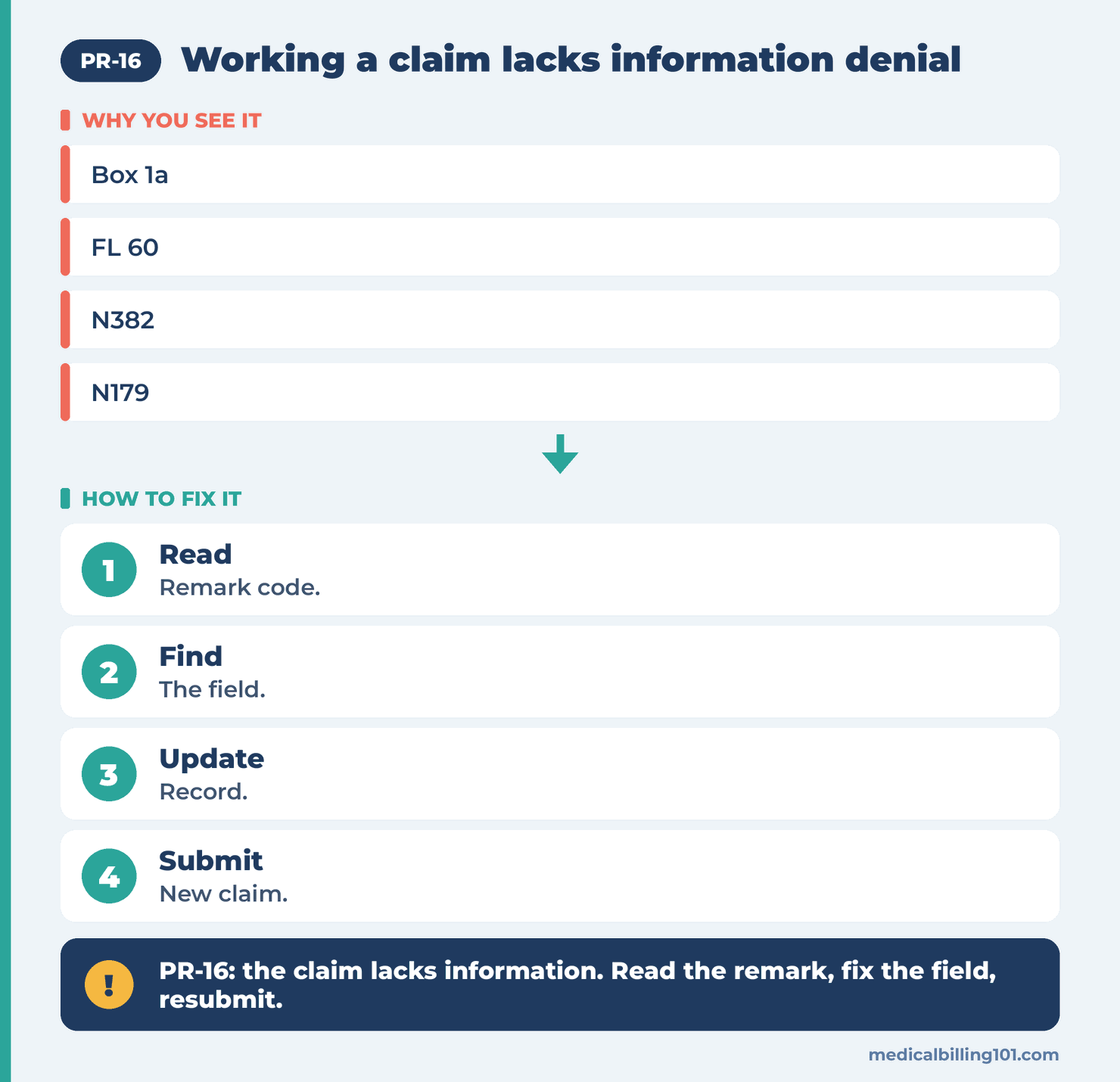
- Read the remark code. CARC 16 never stands alone. The RARC on the same line or claim names the missing or invalid data element.
- Find the field on the claim as sent. Compare the submitted 837 or paper claim with the current registration screen, because someone may have updated the record after billing.
- Update the record or contact the member. For an ID problem, get a copy of the current card. For N179, ask the member to complete the payer’s request.
- Resubmit correctly. Many payers, including Medicare, treat a CARC 16 claim as unprocessable, so send a new claim rather than an appeal. Others accept a corrected claim with frequency code 7 and the original claim number in Box 22 (NUCC 1500 claim form instructions).
- Hold the patient statement. Keep the PR amount off the bill until the plan reprocesses.
Patient identifier errors in detail
Identifier problems usually follow a plan change. Employers often switch carriers or plan years on January 1, and the new card may carry a different member ID, prefix, or group number. The old ID can still pass a quick eligibility check if the carrier keeps the inactive record visible. On the CMS-1500 the ID goes in Box 1a, and in the 837P it is NM109 in loop 2010BA. On a facility claim the ID belongs in FL 60, matched to the payer in FL 50 (Medicare Claims Processing Manual, chapter 25).
Example scenario (fictional names), part 2
How the PR-16 Denial Was Resolved
Priya compared the claim with the eligibility response. The employer had moved to a new plan year on January 1, and the patient’s card now showed a new member ID. Registration had kept the old card on file, so Box 1a carried the retired number.
Fix: she scanned the new card, updated Box 1a, and sent a new claim. The 99213 line, J02.9 and the date of service stayed the same.
Outcome: the plan paid the visit, and Priya removed the $145 from the patient’s statement. She then found six other January claims with retired IDs and corrected them before they denied.
Names and details are illustrative; no real patient data.
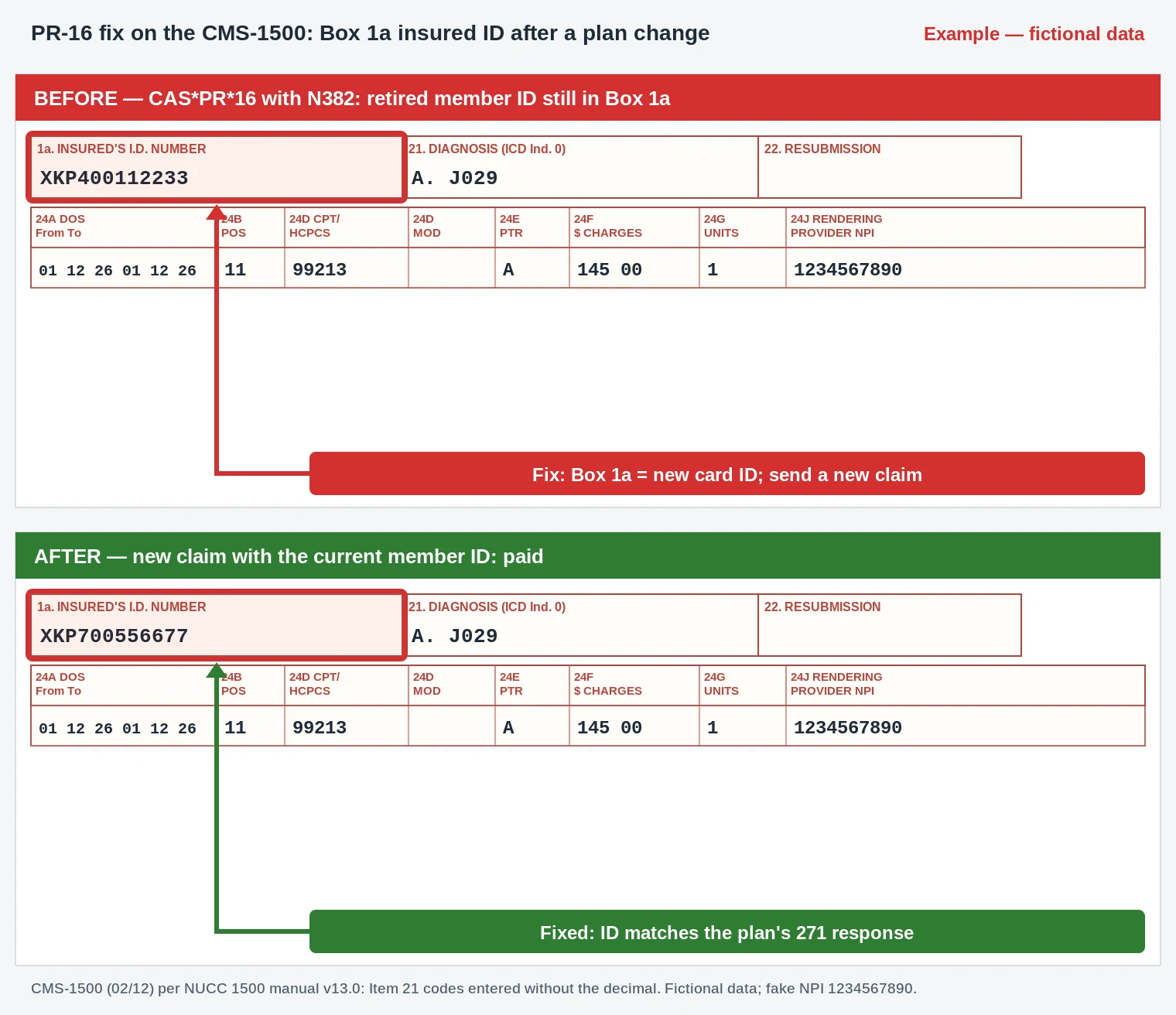
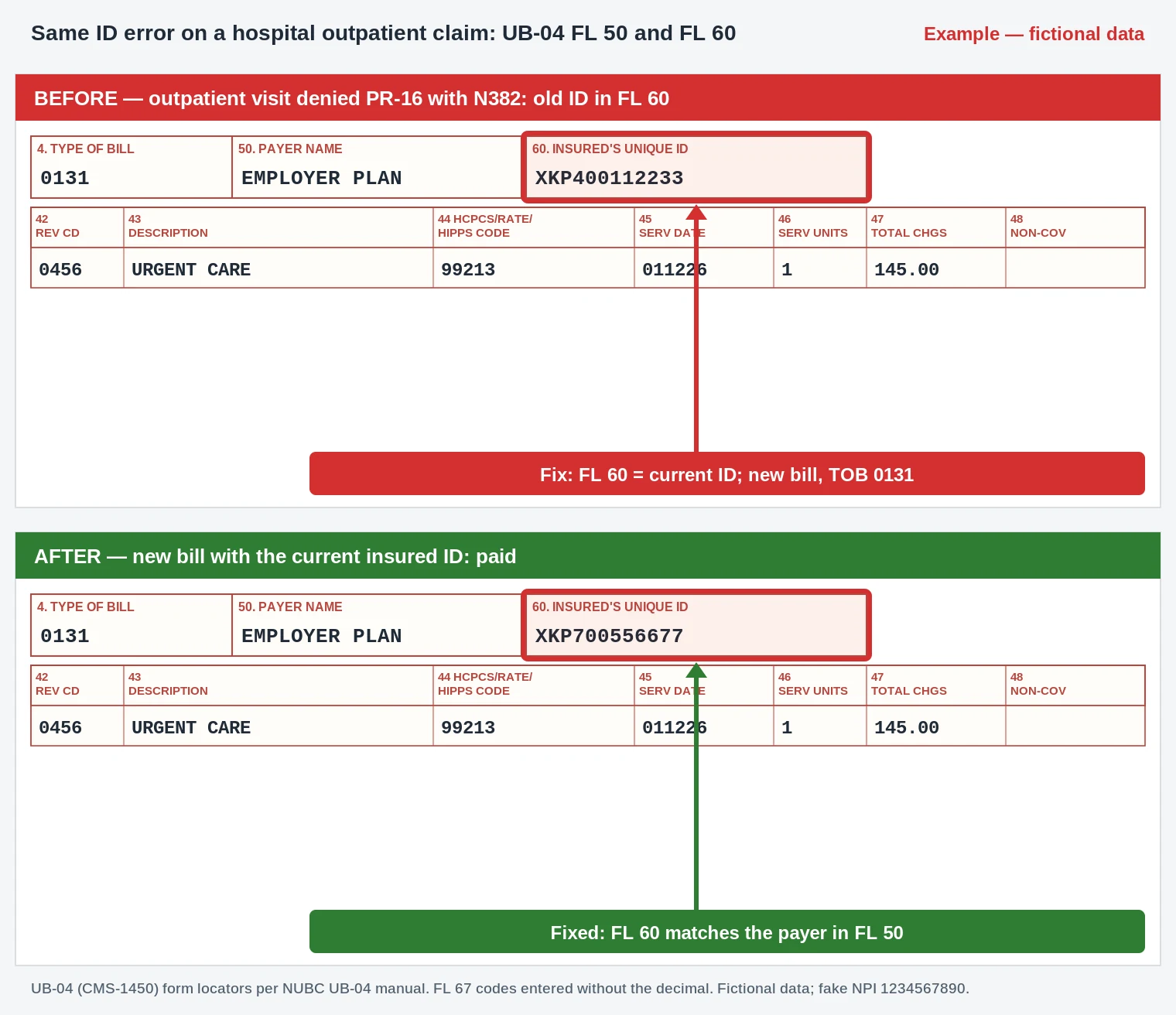
- Box 1a / FL 60: retired ID XKP400112233 replaced with current ID XKP700556677 (fictional).
- Box 11c / FL 50: plan name checked against the new card; unchanged.
- Box 21 / FL 67: J02.9 (entered as J029) and CPT 99213 are unchanged.
- Box 22 / FL 4: left blank and TOB 0131, because the plan wanted a new claim, not a replacement.
- Box 24A / FL 45: date of service unchanged.
Prevention
- Scan the front and back of the insurance card at every visit in January and after any job change.
- Run real-time eligibility with the ID on the new card, not the one saved in the record.
- Add a scrubber edit that flags a member ID that differs from the latest 271 response.
- Track N179 denials and call the member within a week of the remit.
Related codes
| Code | Meaning |
|---|---|
| CO-16 | Same missing information, provider owns it |
| CO-31 | Patient cannot be identified as the plan’s insured |
| PR-22 | Care may be covered by another payer |
| PR-14 | Birth date falls after the service date |
FAQ
What does PR-16 mean?
The claim lacked information or had a billing error, and the plan assigned the line to the patient while it waits for the correction.
Should I bill the patient for denial code 16?
Usually not. Read the remark code first. Bill the patient only if they refuse to supply information the plan requires.
Which remark codes come with CARC 16?
N382, “Missing/incomplete/invalid patient identifier.” and N179 for information requested from the member are common with PR.
Can I appeal a PR-16 denial?
Medicare treats these claims as unprocessable, so you send a new claim instead. Commercial plans vary, so check the payer’s corrected claim policy.
Where is the member ID on a UB-04?
FL 60 holds the insured’s unique ID, on the line that matches the payer in FL 50.
Sources
How we checked: the CARC 16, N382, N179 and MA130 text was compared word for word with the X12 lists on 29 October 2026.
- X12, Claim Adjustment Reason Codes (CARC 16). Accessed 29 Oct 2026.
- X12, Remittance Advice Remark Codes (N382, N179, MA130). Accessed 29 Oct 2026.
- X12, Claim Adjustment Group Codes. Accessed 29 Oct 2026.
- NUCC, 1500 claim form instructions. Accessed 29 Oct 2026.
- CMS, Medicare Claims Processing Manual, chapter 25. Accessed 29 Oct 2026.
- CMS, Medicare Claims Processing Manual, chapter 26. Accessed 29 Oct 2026.
- CMS, Medicare Claims Processing Manual, chapter 1. Accessed 29 Oct 2026.
Last updated: 29 October 2026 · Educational content; not legal advice.
Related denial codes
- CO-16: Claim Lacks Information or Has a Billing Error
- CO-B15: Qualifying Service Not Received or Adjudicated
- PR-14: Birth Date Falls After the Service Date
- CO-14: Date of Birth Follows the Date of Service
- CO-13: Date of Death Precedes Date of Service
- M5: Monthly Rental Payments Explained
- N3: Missing Consent Form Explained
- N29: Missing Documentation, Now Retired