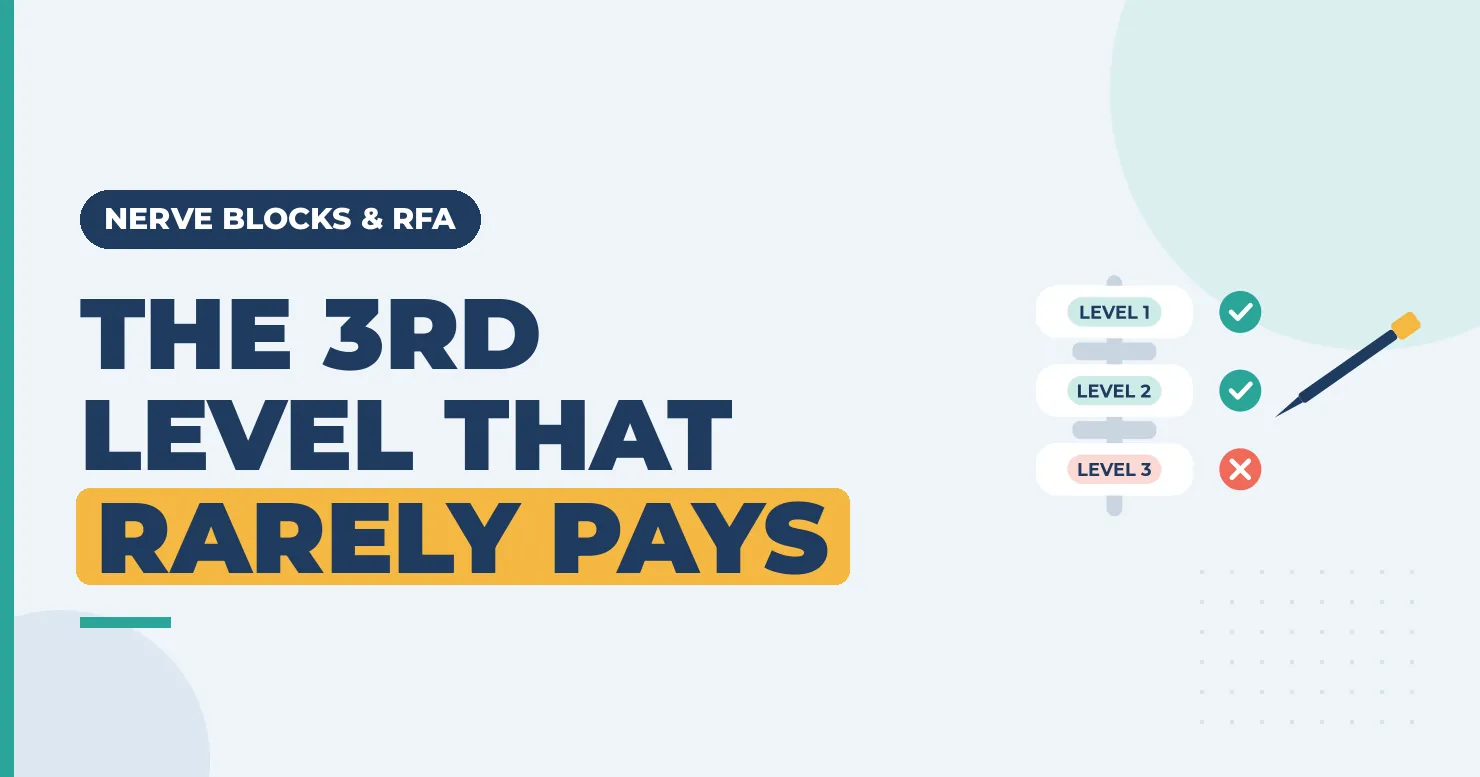
Getting paid for the 3rd level of nerve blocks or RFA is rare under Medicare. Its billing articles treat a third level as not medically necessary. Bill two levels, or get an ABN if the patient wants the third.
Commercial plans vary. This guide covers the codes, the level limits, and what you can do before the procedure.
TL;DR: Medicare pays one or two facet levels per session in a region. Codes 64492 and 64495 (third level) are non-covered. RFA is billed per joint and has the same two-level limit.
Written by Manikandan J, CPC, CRCR, a certified coder and revenue cycle specialist. Published 3 November 2026. Last updated: 3 November 2026.
Table of Contents
Does Medicare pay for the 3rd level of nerve blocks or RFA?
No, Medicare does not pay for the 3rd level of nerve blocks or RFA in one session. The facet joint billing article allows one or two levels per spinal region. Procedures at three or more levels are not medically necessary under the policy.
This rule sits in the Novitas billing and coding article A56670 for facet joint interventions. Other contractors use the same national LCD language. See the First Coast LCD L38773 and its billing article A58364.
A medial branch block (MBB) is a diagnostic injection that numbs the nerves to a facet joint. Radiofrequency ablation (RFA) heats those nerves to give longer relief. Both follow the same level limit.
CMS gave a strong hint in 2024. It took 64492 and 64495 off the OPD prior authorization list. The CMS OPD prior authorization page explains that these codes would always get a non-affirmed decision.
Which codes report the 3rd level?
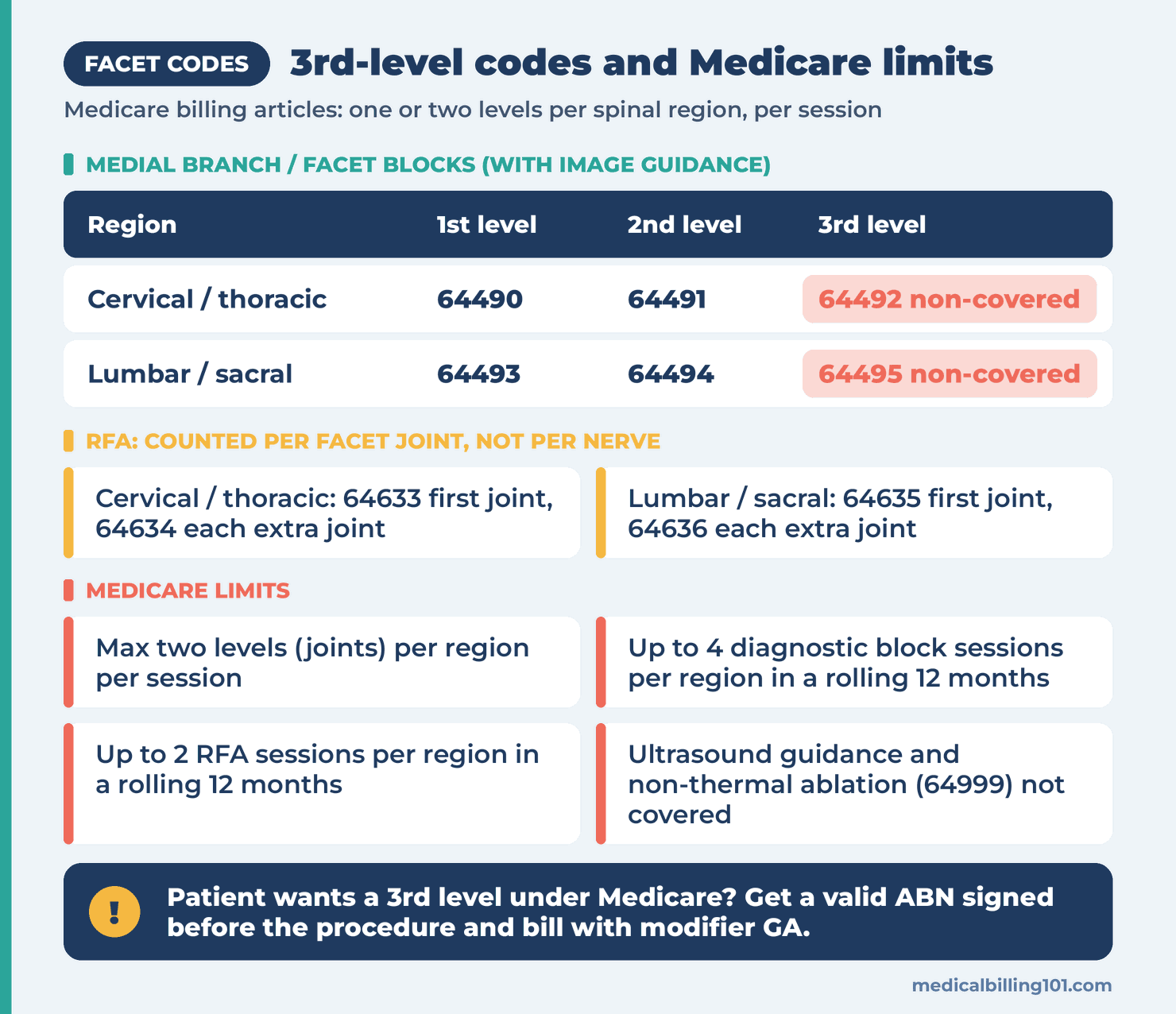
The 3rd level is reported with add-on code 64492 for cervical or thoracic blocks and 64495 for lumbar or sacral blocks. These codes go with a first-level and a second-level code from the same family.
| Region | 1st level | 2nd level | 3rd level |
|---|---|---|---|
| Cervical / thoracic | 64490 | 64491 | 64492 |
| Lumbar / sacral | 64493 | 64494 | 64495 |
For example, a lumbar block at L3-L4, L4-L5, and L5-S1 is 64493, 64494, and 64495. Use modifier 50 for a bilateral block. Use RT or LT for one side. Medicare also asks for modifier KX on diagnostic blocks when the policy rules are met.
A denied third level often comes back as a medical necessity denial. Our CO-50 denial code guide covers that remark. Our CO-151 guide covers frequency limits.
How are RFA levels counted?
RFA levels are counted per facet joint, not per nerve. Code 64633 is the first cervical or thoracic joint and 64634 is each extra joint. Code 64635 is the first lumbar or sacral joint and 64636 is each extra joint.
Medicare limits RFA to two joint levels per session, the same as blocks. It also limits frequency. A patient can have up to four diagnostic block sessions and two RFA sessions per region in a rolling 12 months.
Ultrasound guidance is not covered for these codes. Non-thermal ablation is reported with 64999 and is non-covered.
On pain clinic AR work, I see the same pattern. A third level is rarely a coding error. It is a scheduling decision. Catch it at the order, not after the denial.
Can you bill the patient for the 3rd level?
You can bill a Medicare patient for the 3rd level only with a valid ABN signed before the procedure. The ABN tells the patient Medicare will likely deny the extra level. The patient then chooses to proceed and pay.
Without an ABN, the provider usually takes the loss. Add modifier GA when a valid ABN is on file. Keep the signed form with the record.
Do commercial payers pay for a 3rd level?
Commercial payers sometimes pay for a 3rd level, but many follow the Medicare limit. Read the payer’s facet joint policy before the procedure. Ask for the exact level count in the prior authorization.
For instance, a plan may set its own level limit in its facet policy. If a commercial claim denies, compare the policy to the note. Our medical necessity documentation guide shows what reviewers look for. Our appeal letter generator can help you write the appeal.
This step is simple. Read the policy. Count the levels. Get the approval in writing.
3-step checklist
- Check the payer’s facet policy for the level limit before scheduling.
- For Medicare, plan two levels per region, or get an ABN for a third.
- Bill the right add-on code and modifier, then review any denial against the policy.
FAQ
Does Medicare pay for a 3rd level medial branch block?
No. Medicare LCD billing articles limit facet blocks to one or two levels per session in a spinal region. A third level, billed with 64492 or 64495, is treated as not medically necessary.
Is RFA billed per level or per joint?
RFA codes 64633 to 64636 are billed per facet joint. The add-on code is for each additional joint. Medicare still limits the session to two joint levels.
Can I get the patient to pay for the 3rd level?
For Medicare, give an ABN before the service when the patient wants the extra level. Without a valid ABN, the provider usually cannot bill the patient.
Do commercial payers pay for three levels?
Some do, but many copy the Medicare limit. Check the payer’s facet joint policy before the procedure. Get the level count in the prior authorization.
Is 64492 still on the OPD prior authorization list?
No. CMS removed 64492 and 64495 from OPD prior authorization in 2024. The reason was that a request for them would always be non-affirmed.
Sources
My methodology was simple. I compared each rule with the Medicare LCD, the billing articles, and the CMS prior authorization page. Policies change, so check the current version before you bill.
- Novitas Solutions, Billing and Coding: Facet Joint Interventions for Pain Management (A56670). Accessed 3 Nov 2026.
- First Coast Service Options, LCD L38773 Facet Joint Interventions for Pain Management. Accessed 3 Nov 2026.
- First Coast Service Options, Billing and Coding article A58364. Accessed 3 Nov 2026.
- CMS, Prior Authorization for Certain Hospital Outpatient Department Services. Accessed 3 Nov 2026.
Read about the author, or contact us with a question. See our editorial policy.
Last updated: 3 November 2026 · Educational content for U.S. billers. Payer policies vary by plan, so check the plan’s current policy.