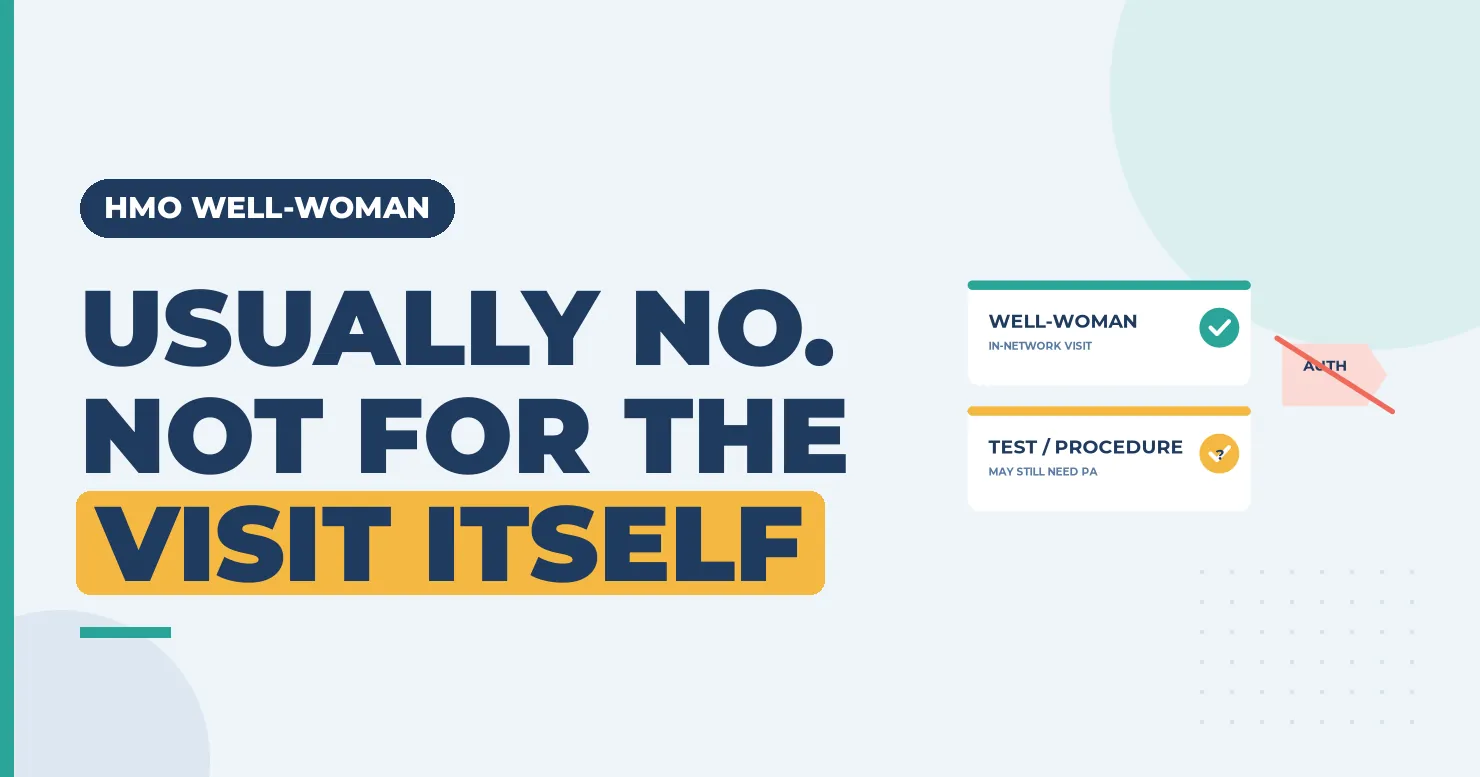
A BCBS HMO well-woman visit usually does not need prior authorization when an in-network OB/GYN does it. Federal rules let a woman see an in-network OB/GYN with no referral or auth. This holds for most HMO plans that make members pick a primary care doctor.
If your Blue plan still asks for an authorization, request only what you plan to do. For a new patient preventive gyn exam, that means the 99384-99387 preventive code with Z01.419, not extra problem visit codes “just in case.”
TL;DR: Check the member’s Blue plan first. Most non-grandfathered HMO plans cannot require a referral or authorization for OB/GYN care from an in-network OB/GYN. Do not add 99202-99215 or 98000-98015 to a preventive-only request. Ask for a problem visit only when one is planned or happens.
Written by Manikandan J, CPC, CRCR, a certified coder and revenue cycle specialist. Published 13 November 2026. Last updated: 13 November 2026.
Table of Contents
Does a BCBS HMO need a referral or prior auth for a well-woman exam?
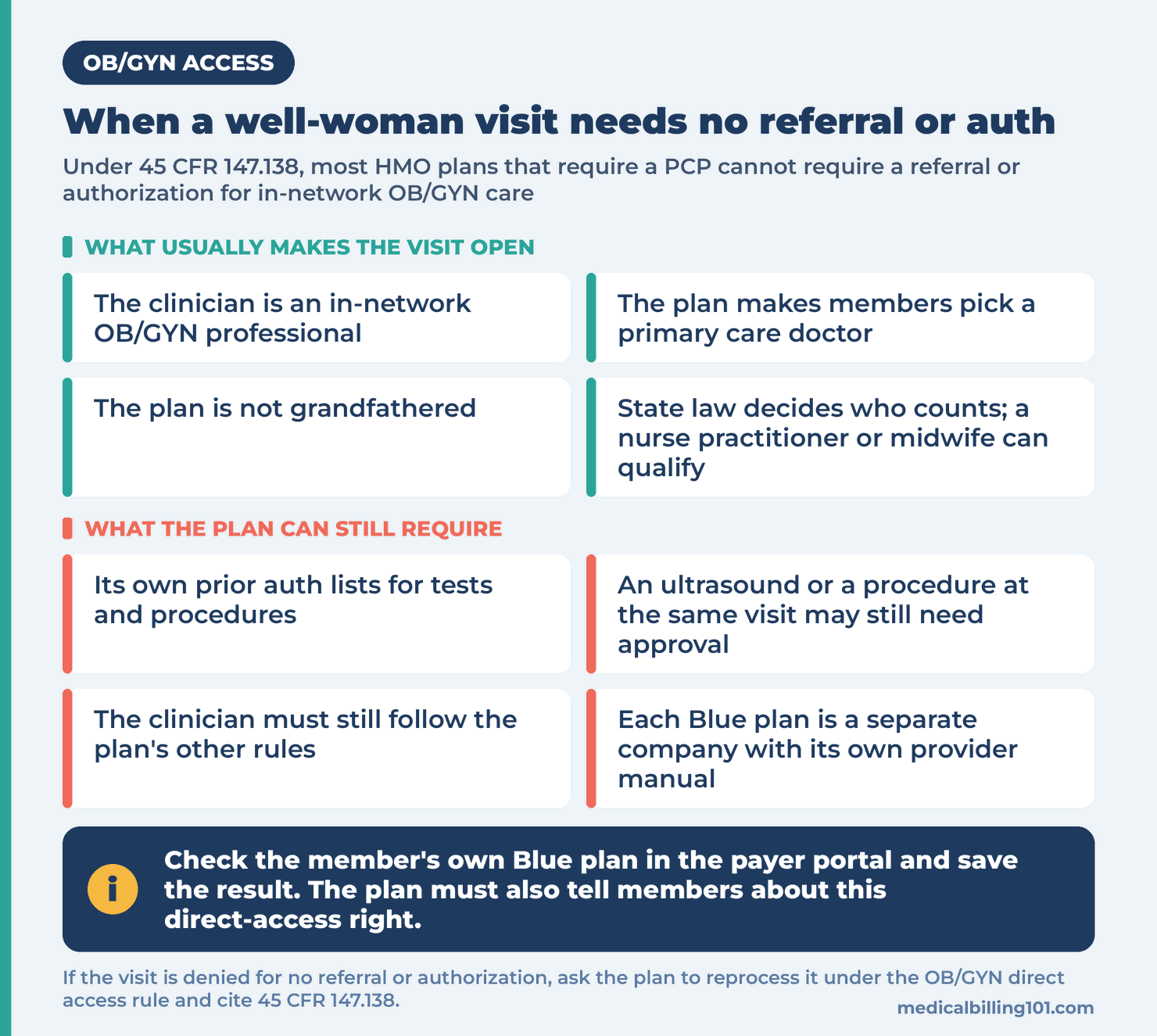
Usually no, if the visit is with an in-network OB/GYN and the plan is not grandfathered. Under 45 CFR 147.138, a plan that makes members pick a primary care doctor cannot ask for a referral or auth for OB/GYN care. The care must come from an in-network OB/GYN. The plan must also tell members about this right.
The rule has limits. It covers plans that make members pick a primary care doctor. It applies to an in-network clinician who works in OB/GYN care. State law decides who counts, so a nurse practitioner or midwife can qualify.
The plan can still make that clinician follow its other rules. That includes its own prior auth lists for tests and procedures. So the visit itself is usually open. But an ultrasound or a procedure at the same visit may still need approval.
Each Blue plan is a separate company with its own provider manual. Check the member’s plan in your payer portal, such as Availity for many Blue plans, and save the result. Our prior authorization checklist shows how to log that check.
Which codes go on a prior authorization request for a preventive gyn exam?
Only the codes for the service you plan to provide go on the request. For a new patient annual preventive gyn exam with no complaint, that is the age-based preventive code from 99384-99387 with Z01.419. Problem-oriented visit codes do not belong on a preventive-only request.
The preventive codes run by age and patient status. Pick the one row that fits the patient.
| Patient age | New patient | Established patient |
|---|---|---|
| 12-17 years | 99384 | 99394 |
| 18-39 years | 99385 | 99395 |
| 40-64 years | 99386 | 99396 |
| 65 years and older | 99387 | 99397 |
Z01.419 means a gynecological exam without abnormal findings. If the provider finds something abnormal during the exam, Z01.411 is the matching code. That choice is made after the visit, not on the request.
An auth is the plan saying yes to a planned service it finds needed. Asking for 9920X or 9921X with only a preventive code gives the plan nothing to say yes to. It can also flag the account for review.
Should you add 99202-99215 or 98000-98015 to a well-woman authorization?
No, you should not add 99202-99215 or 98000-98015 to a preventive-only auth request. Those codes are for problem visits. With no complaint and no problem to check, there is nothing for the plan to approve. The preventive code alone does not support them.
99202-99215 are office or outpatient problem visits. 98000-98015 are telemedicine E/M codes, added to CPT for 2025. 98000-98007 are audio-video visits, and 98008-98015 are audio-only visits. An in-person annual exam fits neither group.
A cleaner fix is at scheduling. Tell the patient the visit is preventive. If she wants a new problem checked, ask her to say so in advance. Then you can request a problem visit, or book it as a separate visit.
In my audits, padded auth requests did not stop denials. The denials came from problem visits that no one had planned or written up as separate work.
Can you bill a problem visit with modifier 25 on the same day as a preventive exam?
Yes, you can bill a problem visit with modifier 25 on the same day. The provider must work up a real, separate problem. That work must go beyond the preventive exam. Add modifier 25 to the 99202-99215 code, and link it to the problem code.
The record should show the extra work clearly. A short separate note section for the problem helps. Use our modifier 25 and 59 helper to check the pairing before you submit.
Medicare treats this differently. CMS calls 99381-99397 noncovered for Medicare patients. The covered problem visit is paid, and the practice may charge the patient the difference, per the Medicare Claims Processing Manual, Chapter 12, section 30.6.2. An HMO commercial plan follows its own contract.
If the problem visit was not on the auth and the plan denies it, read the remit first. Our prior authorization denial guide covers your options. Our appeal letter generator drafts the letter.
Is a well-woman visit covered at no cost under a BCBS HMO?
Usually yes, when the visit is in-network and the plan is not grandfathered. The ACA says plans must cover the women’s preventive care in the HRSA guidelines with no cost to the patient. Those guidelines include a yearly well-woman visit. See 45 CFR 147.130.
Cost sharing can apply to the problem visit. If the provider also bills 99213-25, the patient may owe a copay for that part. Explain this before the visit. Our patient cost estimator helps you show the split.
Grandfathered plans are an exception. A plan that has kept grandfathered status may not follow these rules. Check the plan documents or ask the plan directly.
What if a BCBS HMO denies a well-woman visit for no referral or authorization?
Ask the plan to reprocess it under the OB/GYN direct access rule. This works when the provider is an in-network OB/GYN and the plan makes members pick a primary care doctor. Cite 45 CFR 147.138. Attach the plan check that shows the plan type and network status.
- Confirm the plan type, network status, and whether the plan is grandfathered.
- Check the rendering provider’s specialty on the claim. An OB/GYN billed under a different specialty can trip the referral edit.
- Call the plan and ask for a reprocess. Write down the call reference number.
- If they refuse, file a written appeal within the plan’s deadline. Check the date in our timely filing calculator.
For a similar case, see our Aetna 99213 with X-ray denial post. It uses the same “separate service” logic.
3-step checklist
- Check the member’s Blue plan for OB/GYN direct access and any auth list, then save the result.
- Request only the planned preventive code, such as 99385 with Z01.419, never padded problem visit codes.
- Bill 99202-99215 with modifier 25 only when the provider works up and writes up a separate problem.
FAQ
Does a BCBS HMO require a referral for an OB/GYN visit?
Usually not. Under 45 CFR 147.138, a non-grandfathered plan that requires a primary care provider cannot require a referral or authorization for OB/GYN care from an in-network OB/GYN professional. Check the member’s own Blue plan to confirm.
What diagnosis code is used for a well-woman exam?
Z01.419 is used for a gynecological exam without abnormal findings. If the provider finds something abnormal during the exam, Z01.411 is used instead. The preventive visit code depends on age and new or established status.
Can 99385 and 99213 be billed together?
Yes, when the provider evaluates a significant, separately identifiable problem at the same visit. Add modifier 25 to 99213 and link it to the problem diagnosis. The record must show the extra work beyond the preventive exam.
What are CPT codes 98000-98015?
98000-98015 are telemedicine evaluation and management codes added to CPT for 2025. 98000-98007 cover audio-video visits and 98008-98015 cover audio-only visits. They do not describe an in-person preventive exam.
Does the patient pay for a well-woman visit?
For an in-network visit under a non-grandfathered plan, the preventive well-woman visit is usually covered without cost sharing under the ACA. A separately billed problem visit can still carry a copay or deductible.
Sources
My methodology was simple. I read the federal patient-protection and preventive-services rules in the eCFR, the HRSA women’s preventive guidelines, and the Medicare manual section on preventive and problem visits on the same day. Blue plans differ, so confirm the member’s own plan documents.
- eCFR, 45 CFR 147.138: Patient protections (OB/GYN direct access). Accessed 13 Nov 2026.
- eCFR, 45 CFR 147.130: Coverage of preventive health services. Accessed 13 Nov 2026.
- HRSA, Women’s Preventive Services Guidelines. Accessed 13 Nov 2026.
- CMS, Medicare Claims Processing Manual, Chapter 12, sections 30.6.2 and 30.6.6. Accessed 13 Nov 2026.
- eCFR, 45 CFR 147.140: Preservation of right to maintain existing coverage (grandfathered plans). Accessed 13 Nov 2026.
Read about the author, or contact us with a question. See our editorial policy.
Last updated: 13 November 2026 · Educational content for U.S. billers. Payer policies vary by plan, so check the plan’s current policy.