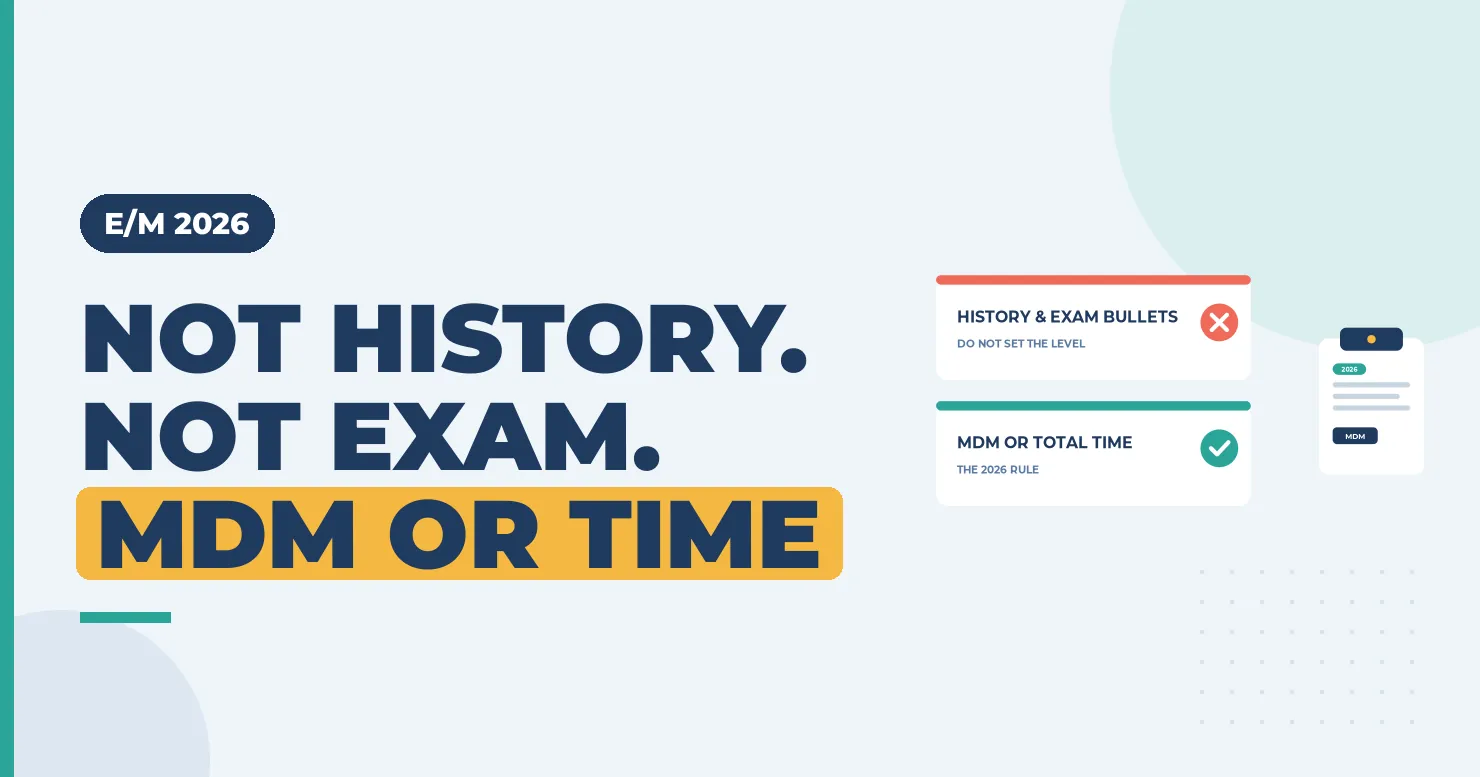
Yes. This E/M cheat sheet 2026 page puts the AMA MDM table and office visit times on one screen. Pick the level by MDM or by total time, never by history and exam.
Most downcodes come from old sheets that still count history bullets. Use the two-of-three MDM rule below, or the 2026 time minimums, and the level will hold up in review.
TL;DR: Office visit codes 99202-99205 and 99212-99215 are chosen by medical decision making (MDM) or total time on the date of service. MDM has three elements: problems, data and risk. Two of the three must meet or exceed a level. History and exam must be medically appropriate, but they do not set the level.
Written by Manikandan J, CPC, CRCR, a certified coder and revenue cycle specialist. Published 18 November 2026. Last updated: 18 November 2026.
Table of Contents
Is there a reliable E/M coding cheat sheet for 2026?
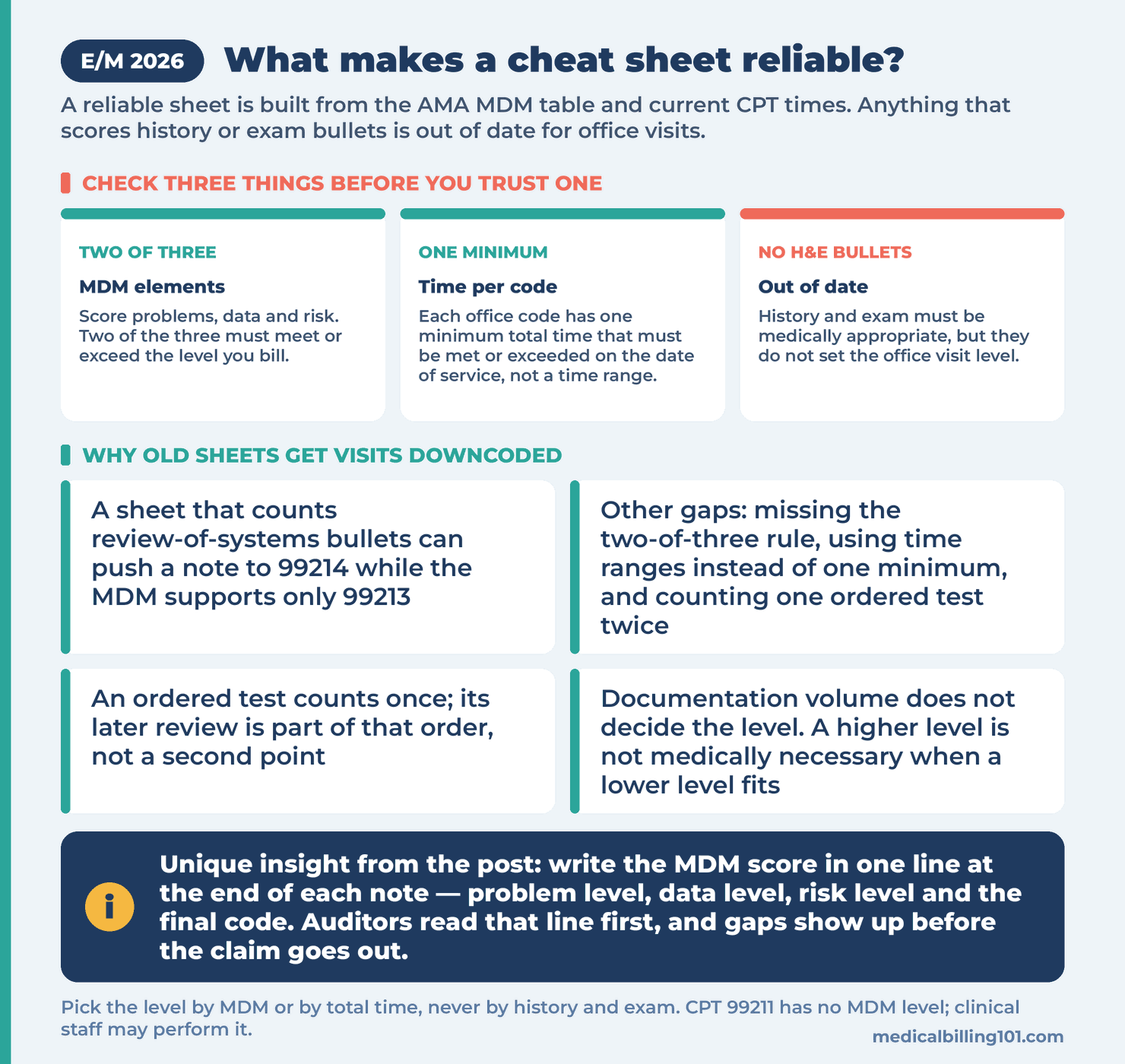
Yes, if it is built from the AMA MDM table and current CPT times. The most reliable E/M cheat sheet copies Table 1 of the AMA E/M guidelines and the minimum time for each code. Anything that scores history or exam bullets is out of date for office visits.
Many sheets passed around online are audit tools from 2021 or earlier. Some still work. Check three things before you trust one. It must use two of three MDM elements. It must list one minimum time per code. It must not count history or exam elements.
The rest of this page is that one-screen sheet. You can also run a note through our free E/M level calculator, which uses the same MDM table.
How do you pick an office visit level by MDM?
Medical decision making (MDM) is the level of thinking behind a visit, scored on problems, data and risk. Score each of the three MDM elements, then take the level that two of them meet or exceed. The AMA says two of three elements must be met or exceeded. The table below is a short version of the AMA table for office visits.
| MDM level | New / established | Problems addressed | Data reviewed and analyzed | Risk of patient management |
|---|---|---|---|---|
| Straightforward | 99202 / 99212 | 1 self-limited or minor problem | Minimal or none | Minimal risk |
| Low | 99203 / 99213 | 2+ self-limited or minor; 1 stable chronic illness; 1 acute uncomplicated illness or injury; 1 stable acute illness | Limited: 2 items from Category 1, or an independent historian | Low risk |
| Moderate | 99204 / 99214 | 1+ chronic illness with exacerbation, progression or side effects; 2+ stable chronic illnesses; 1 undiagnosed new problem with uncertain prognosis; 1 acute illness with systemic symptoms; 1 acute complicated injury | Moderate: 1 of 3 categories | Moderate risk, such as prescription drug management |
| High | 99205 / 99215 | 1+ chronic illness with severe exacerbation, progression or side effects; 1 acute or chronic illness or injury that poses a threat to life or bodily function | Extensive: 2 of 3 categories | High risk, such as a decision about hospitalization |
CPT 99211 has no MDM level. The AMA says the MDM concept does not apply to 99211, and clinical staff may perform it.
What counts as data and risk in E/M MDM?
Data has three categories. Category 1 counts unique tests and documents. Category 2 is your independent read of another clinician’s test. Category 3 is a discussion of management with an outside clinician. Risk is the danger of the management chosen, not the disease itself.
- Category 1 items. Review of prior external notes from each unique source, review of each unique test result, ordering each unique test, and an independent historian. Low needs 2 items. Moderate and high need 3.
- Category 2. Independent interpretation of a test performed by another physician or qualified professional, not separately reported.
- Category 3. Discussion of management or test interpretation with an external physician, qualified professional or appropriate source, not separately reported.
- Moderate risk examples. Prescription drug management, minor surgery with identified risk factors, elective major surgery without identified risk factors, and care limited by social determinants of health.
- High risk examples. Drug therapy requiring intensive monitoring for toxicity, elective major surgery with identified risk factors, emergency major surgery, a decision about hospitalization, a decision not to resuscitate or to de-escalate care, and parenteral controlled substances.
An ordered test counts once. Its later review is part of that order, not a second point. The final diagnosis alone also does not set complexity. Our answer on E/M level for a cancer patient shows how that rule plays out in a real audit dispute.
What are the 2026 office visit time thresholds?
Each office code has one minimum total time that must be met or exceeded on the date of service, per the AMA CPT Assistant office visit table. For 2026, 99213 needs 20 minutes, 99214 needs 30 and 99215 needs 40. New patient codes need 15, 30, 45 and 60 minutes. Total time includes work before and after the visit that day.
| Code | MDM level | Minimum total time | 2026 Medicare national amount (office) |
|---|---|---|---|
| 99202 | Straightforward | 15 minutes | About $75.15 (2.25 RVUs) |
| 99203 | Low | 30 minutes | About $117.57 (3.52 RVUs) |
| 99204 | Moderate | 45 minutes | About $177.36 (5.31 RVUs) |
| 99205 | High | 60 minutes | About $236.81 (7.09 RVUs) |
| 99211 | Not applicable | No time threshold | About $24.38 (0.73 RVUs) |
| 99212 | Straightforward | 10 minutes | About $59.45 (1.78 RVUs) |
| 99213 | Low | 20 minutes | About $95.19 (2.85 RVUs) |
| 99214 | Moderate | 30 minutes | About $135.61 (4.06 RVUs) |
| 99215 | High | 40 minutes | About $192.39 (5.76 RVUs) |
Countable time includes preparing to see the patient, the exam, counseling, ordering, documenting and care coordination. Do not count travel, separately reported services or general teaching. For split visits, count only distinct time once. Our RVU calculator converts these RVUs for your own locality.
When do you add G2212 or G2211 to a Medicare office visit?
G2212 is the Medicare add-on code for prolonged office visit time. Add it only when you pick the level by time and pass the CMS prolonged threshold. For Medicare, one unit of G2212 starts at 69 minutes with 99215 and 89 minutes with 99205. G2211 is the visit complexity add-on for ongoing longitudinal care.
- G2212 units. Per the CMS Evaluation and Management Services booklet, 99215 alone covers 40-54 minutes. Add one unit at 69-83 minutes, two at 84-98, and three or more at 99 minutes or more. 99205 alone covers 60-74 minutes; one unit starts at 89 minutes.
- G2211 rule. It is reported with 99202-99205 or 99211-99215. Medicare does not pay it when the base visit carries modifier 25, except with the AWV, vaccine administration or a Part B preventive service.
- 2026 value. G2211 is 0.52 RVUs, about $17.37. G2212 is 1.02 RVUs, about $34.07 per unit.
Payers that follow CPT may want 99417 instead. CPT starts 99417 at 75 minutes with 99205 and 55 minutes with 99215. Check each payer’s policy before you bill either code.
Why do old E/M cheat sheets get visits downcoded?
They score the wrong things. CMS says the extent of history and exam is not an element in selecting the office visit level. A sheet that counts review-of-systems bullets can push a note to 99214 while the MDM supports only 99213.
Other common gaps are missing the two-of-three rule, using time ranges instead of one minimum, and counting one ordered test twice. CMS also says documentation volume does not decide the level. A higher level is not medically necessary when a lower level fits.
In my AR work, most E/M downcode appeals I saw were lost because the note listed many exam bullets but no clear management decision.
Payer data checks also flag high 99214 and 99215 rates. Our guide to OIG audit triggers explains why. If a Medicare contractor starts pulling records, read how to handle a MAC prepayment review.
How does the cheat sheet work with modifier 25 and same-day procedures?
Score only the separate, significant E/M work. When a procedure is done the same day, the E/M needs modifier 25 and must stand on its own MDM. For minor procedures, CMS includes the usual pre-procedure evaluation in the procedure payment, so that work does not count.
Write the MDM score in one line at the end of each note: problem level, data level, risk level and the final code. Auditors read that line first, and gaps show up before the claim goes out. Our modifier 25 and 59 helper walks through the same-day test. Our answer on Aetna denying 99213 billed with an x-ray shows a real fix. For follow-up calls, see whether a telehealth phone follow-up is billable.
3-step checklist
- Score problems, data and risk; take the level two of three meet or exceed.
- If time is higher, check the minimum minutes and document total time that day.
- For Medicare, add G2212 or G2211 only when the CMS rules above are met.
FAQ
What is the best E/M cheat sheet for 2026?
The best one is built from AMA Table 1 for MDM and the current CPT minimum times. It uses two of three MDM elements and does not count history or exam bullets.
How many MDM elements are needed for an E/M level?
Two of three. Problems, data and risk are scored separately, and two must meet or exceed the level you bill.
How many minutes is 99214 in 2026?
CPT 99214 needs at least 30 minutes of total time on the date of service. 99215 needs at least 40 minutes.
Do history and exam still count for office E/M levels?
No. They must be medically appropriate, but CMS says their extent is not an element in selecting the office visit level.
When can G2212 be billed with 99215 for Medicare?
Only when the level is chosen by time and total time reaches 69 minutes. Each further 15 minutes adds another unit.
Sources
My methodology was simple. I checked the AMA E/M guideline table and time rules, the current CMS E/M services booklet and the 2026 Medicare fee schedule file. Commercial payers may apply their own rules, so check each payer’s policy.
- AMA, CPT Evaluation and Management (E/M) Code and Guideline Changes: Table 1 Levels of MDM, time activities, 99211 note (linked above). Accessed 18 Nov 2026.
- AMA, CPT Assistant October 2024 special edition: office E/M descriptors, minimum times and 99417 notes (linked above). Accessed 18 Nov 2026.
- CMS, MLN006764 Evaluation and Management Services, May 2026: history and exam, G2211, G2212 time table (linked above). Accessed 18 Nov 2026.
- CMS, PFS Relative Value Files, CY 2026 October release, RVUs (CMS page). Accessed 18 Nov 2026.
- CMS, Medicare Claims Processing Manual, Chapter 12, section 40: minor surgery and same-day visits (CMS manual). Accessed 18 Nov 2026.
Read about the author, or contact us with a question. See our editorial policy.
Last updated: 18 November 2026 · Educational content for U.S. billers. Check each payer’s current rules.