

The CO-P13 denial code means a workers’ comp carrier reduced or denied your bill because of a state comp regulation or payment policy. It is a catch-all code, so the real reason sits in the remark code and the carrier’s explanation of review. Find the exact rule first, then decide whether to correct, appeal or write off. (Primary source: X12 Claim Adjustment Reason Codes)
In brief: reason code P13 says a state rule cut your payment, but not which rule. Ask the carrier for the citation. Billing deadlines, missing required reports and rules about who may treat are the usual causes. Many can be overturned with proof.
Part of our denial codes library. Written by Manikandan J, CPC, CRCR, who has worked comp denials for clinics in several states and learned that each one runs its own rulebook. Published 23 November 2026. Last updated: 23 November 2026. Code wording quoted word for word from X12. Read about the author and our editorial policy, or contact us to report an error.
What does denial code CO-P13 mean?
Denial code CO-P13 means the carrier applied a workers’ comp regulation or payment policy of the state that governs the claim. X12 tells payers to use it only if no other code is applicable, so P13 often hides a rule that has no code of its own.
| Field | Value |
|---|---|
| Code | P13 |
| Description | “Payment reduced or denied based on workers’ compensation jurisdictional regulations or payment policies, use only if no other code is applicable.” |
| Use | Workers’ compensation only |
| Group codes | No X12 group restriction; CO is the usual pairing |
| Start | 11/01/2013; replaces code W2 |
| Where the rule appears | Remark code, the EOR, or a policy reference on the 835 |
Source: X12 Claim Adjustment Reason Codes, checked 23 November 2026.
Methodology: the code wording is copied from the X12 list. The deadline example uses the Texas Labor Code, quoted from the state’s statute site, because P13 is always tied to one state’s rules.
Key terms: A jurisdiction is the state whose comp law covers the injury. A payment policy is a state rule about how or when a bill is paid. Reconsideration is the formal request asking the carrier to review its own decision.
CO-P13 vs OA-P13: same rule, different owner
CO-P13 makes the cut your practice’s loss unless you overturn it. Comp rules in most states keep the injured worker out of the bill either way. OA-P13 shows up less often, for example when a carrier reports a rule-based cut that no contract assigns to you. With either group, the rule decides the outcome, not the group code.
| Group | Who holds the amount | What decides the fix |
|---|---|---|
| CO-P13 | Your practice | Whether you can show the rule was met |
| OA-P13 | Not assigned | The same rule, read from the EOR |
Example scenario (fictional names), part 1
CO-P13 Denial Example: What Happened
Tomás Reyes handles accounts at Brazos Valley Hand Therapy in Texas. A machine operator cut two fingers at work, S61.212A, and had six therapy visits in March. The front desk did not know it was a work injury and billed the patient’s group health plan.
In June the health plan denied the visits as work-related. Tomás sent the bills to the comp carrier on day 128 after the first visit. The remittance came back with CAS*CO*P13 and remark N1, “Alert: You may appeal this decision in writing within the required time limits following receipt of this notice by following the instructions included in your contract, plan benefit documents or jurisdiction statutes.” The EOR cited the Texas 95-day billing rule.
Was the money lost, or does the wrong-payer filing count? Keep reading, or jump to how the CO-P13 denial was resolved.
Which state rules lead to CARC P13?
Most P13 cuts fall into a few groups, though each state words them differently. Read the EOR text before you call; it usually names the rule.
| Rule type | Example of what the carrier says | Can you overturn it? |
|---|---|---|
| Billing deadline | Bill received after the state limit | Yes, with proof of an allowed exception |
| Required report missing | No initial or progress report on file | Often, by sending the report |
| Treating provider rules | Provider not chosen or approved under state rules | Sometimes, with the approval record |
| Dispensing or supply limits | Office-dispensed drug or item limited by rule | Rarely; check the rule text |
| Network rules | Out-of-network care in a comp network | Only with referral or emergency proof |
How do I fix a CO-P13 denial?
To fix a CO-P13 denial, prove the rule was met or that an exception applies. In Texas, Labor Code section 408.027 sets a 95-day limit to bill the carrier. Section 408.0272 keeps your right to payment if you filed with the worker’s health plan inside that window and then billed the carrier within 95 days of learning of the mistake.
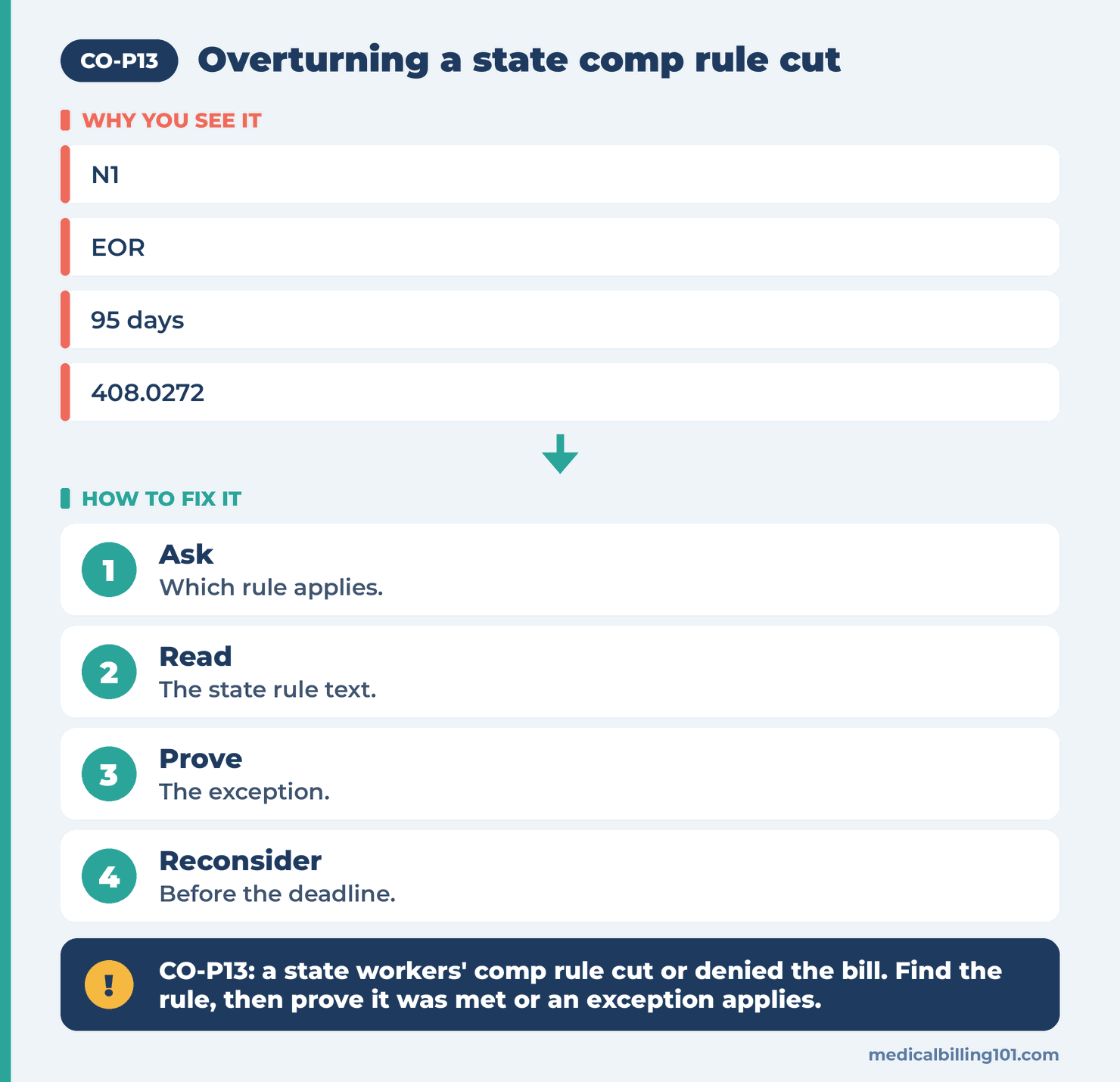
| Step | Action | Proof to gather |
|---|---|---|
| 1 | Read the EOR and remark; ask which rule applies | Rule citation from the carrier |
| 2 | Pull the state rule text | State statute or comp agency site |
| 3 | Check for an exception | Wrong-payer filing, written extension, missing report now done |
| 4 | Request reconsideration on time | Texas: TDI health care provider resources list the steps |
| 5 | Go to state dispute resolution if denied | Keep the carrier’s final answer |
Example scenario (fictional names), part 2
How the CO-P13 Denial Was Resolved
Tomás printed the health plan’s claim history showing the March visits billed in April, inside 95 days. He added the June denial letter, dated 34 days before he billed the carrier.
Fix: he sent a reconsideration request with both documents and a short cover letter citing Labor Code section 408.0272. The bills and codes stayed the same, because nothing on them was wrong.
Outcome: the carrier reversed the P13 and paid all six visits at the Texas fee guideline rates. The front desk now asks every new patient whether the injury happened at work.
Names and details are illustrative; no real patient data.
Names and details are illustrative; no real patient data.
Why are there no claim form changes for a P13 fix?
A P13 denial rarely means a field was wrong. In cases such as the one above, the bill was correct and the dispute is about timing or a rule. Send proof with the reconsideration instead of editing codes. Texas rules give a separate deadline for reconsideration, currently 10 months from the date of service, so do not wait for a second remittance.
Can I bill the patient for a CO-P13 amount?
No. The CO group assigns it to your practice, and comp statutes restrict billing the injured worker for covered care. If the rule truly applies and no exception fits, write the amount off and fix the process that caused it.
Related codes
| Code | Meaning |
|---|---|
| CO-29 | Time limit for filing has expired |
| CO-P2 | Injury is not work related, so the comp carrier is not liable |
| CO-19 | Work-related injury that is the liability of the comp carrier |
| CO-P4 | Workers’ comp claim found non-compensable |
| CO-P8 | Claim is under investigation |
FAQ
What does CO-P13 mean?
A workers’ comp carrier cut or denied the bill under a state comp regulation or payment policy that has no more specific code.
Why do carriers use P13 instead of a specific code?
X12 tells them to use P13 only if no other code fits. State rules vary so much that many have no code of their own.
Is P13 the same as a timely filing denial?
Not always. CARC 29 is the general timely filing code, but some comp carriers send P13 when a state billing deadline is the reason.
Do I send a corrected claim for P13?
Only if a field was actually wrong. Most P13 fixes are a reconsideration with proof that the state rule was met.
What code did CARC P13 replace?
X12 lists P13 as the replacement for deactivated code W2 from 11/01/2013.
Sources
How we checked: the CARC P13 quote was matched word for word with the X12 CARC list on 23 November 2026. N1 was checked on the X12 RARC list.
- X12, Claim Adjustment Reason Codes (CARC P13, P2, P4, P8, 19, 29). Accessed 23 Nov 2026.
- X12, Remittance Advice Remark Codes (N1). Accessed 23 Nov 2026.
- Texas Labor Code chapter 408, sections 408.027 and 408.0272. Accessed 23 Nov 2026.
- Texas Department of Insurance, Division of Workers’ Compensation, health care provider resources. Accessed 23 Nov 2026.
Last updated: 23 November 2026 · Educational content; not legal advice.