

A Medicare Part A or Part B claim appeal is the formal process a provider, supplier or beneficiary uses to challenge an Original Medicare payment decision, from a MAC redetermination through federal district court.
This guide is for billing and revenue-cycle staff working Original Medicare (fee-for-service) denials. It covers the five appeal levels in 42 CFR part 405, subpart I, the filing deadlines, the current forms, the 2026 amount-in-controversy thresholds, and when not to appeal (unprocessable claims and reopenings).
Key Takeaways – Original Medicare has five appeal levels: MAC redetermination, QIC reconsideration, OMHA ALJ hearing, Medicare Appeals Council, and federal district court. – Level 1 uses form CMS-20027 (120 days). Level 2 uses CMS-20033 (180 days). Level 3 uses OMHA-100 (60 days). Level 4 uses DAB-101 (60 days). – For requests filed on or after 1 January 2026, the amount in controversy must be at least $200 for an ALJ hearing and $1,960 for judicial review. – A claim returned as unprocessable (often with MA130) has no appeal rights. Fix it and send a new claim. – Clerical errors usually go through a reopening, not an appeal.
How this guide was checked: deadlines, forms and AIC figures are taken from CMS appeal pages, the MLN006562 booklet (September 2025) and the Federal Register notice for calendar year 2026. Last reviewed: 5 October 2026.
Table of Contents
Before you appeal: is it a denial, an unprocessable claim, or a clerical error?
Not every unpaid remittance line is an appeal. CMS and Medicare contractors treat three cases differently.
Returned as unprocessable (no appeal rights)
CMS says a claim returned as unprocessable for incomplete or invalid information “is not denied, and, as such, is not afforded appeal rights” (Medicare Claims Processing Manual, Ch. 1, §80.3.1). The remittance often carries remark code MA130 or a related message such as N704, and the reason is frequently a CO-16 (claim lacks information or has a billing error). Noridian’s reopening page is explicit: claims with MA130 or N704 “must be resubmitted as a new claim.” Correct the missing data and file again inside the timely filing limit. Do not file a redetermination.
Clerical error → reopening
A reopening lets the MAC correct a clerical error or omission without a formal appeal. Noridian describes it as a process “to correct clerical errors or omissions without having to request a formal appeal,” with a filing window of one year from the initial determination date for most cases. Typical items include a wrong billed amount, a wrong diagnosis code, a wrong modifier (with exceptions), or a wrong place of service. Items that are too complex for a reopening, including medical necessity disputes and many modifier scenarios, go to a redetermination instead. CMS also notes that MACs “do not process claim corrections involving minor errors and omissions through the appeals process.”
Payment denial → appeal
Only an actual payment determination (a denial or underpayment on an adjudicated claim) has appeal rights. Examples include CO-50 (not medically necessary), CO-29 (timely filing), and coverage denials with an LCD or NCD remark. Those go through the five-level path below.
The five levels at a glance
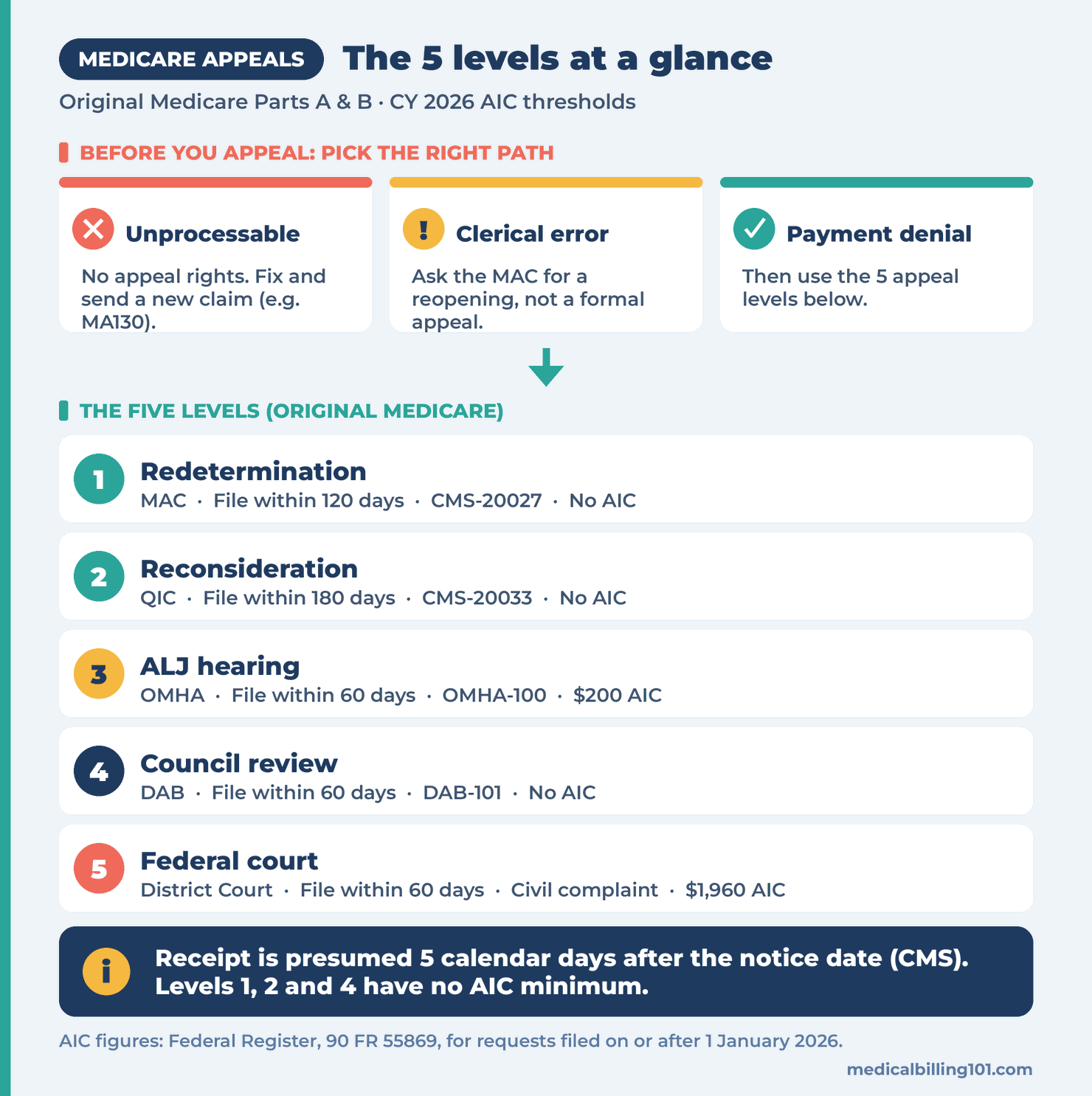
| Level | Who decides | File within | Typical decision time | AIC required? | Form |
|---|---|---|---|---|---|
| 1. Redetermination | Medicare Administrative Contractor (MAC) | 120 days of receipt of the initial determination | About 60 days | No | CMS-20027 (or written request) |
| 2. Reconsideration | Qualified Independent Contractor (QIC) | 180 days of receipt of the redetermination | About 60 days | No | CMS-20033 (or written request) |
| 3. ALJ hearing | Office of Medicare Hearings and Appeals (OMHA) | 60 days of receipt of the reconsideration | About 90 days | Yes ($200 in CY 2026) | OMHA-100 (OMHA-100A if multiple beneficiaries) |
| 4. Council review | Medicare Appeals Council (DAB) | 60 days of receipt of the OMHA decision | About 90 days (180 if escalated) | No | DAB-101 (or written request) |
| 5. Judicial review | U.S. District Court | 60 days of receipt of the Council decision | No statutory CMS deadline | Yes ($1,960 in CY 2026) | Civil complaint (no HHS form) |
CMS states that receipt of each notice is presumed 5 calendar days after the date on the notice, unless there is evidence to the contrary. The table’s filing windows and forms follow CMS’s Original Medicare appeals pages and MLN006562, Medicare Parts A & B Appeals Process (September 2025).
Level 1: Redetermination by the MAC
A redetermination is a fresh look at the claim by MAC staff who were not involved in the initial determination (CMS: First Level of Appeal).
Deadline. File within 120 days of receipt of the initial claim determination (the remittance advice / ERA or the beneficiary’s MSN). Receipt is presumed 5 days after the notice date.
How to file. Use form CMS-20027 (Medicare Redetermination Request Form), or a written request that includes:
- beneficiary name and Medicare number;
- the specific service(s) and date(s) of service;
- the name of the party or representative;
- an explanation of why you disagree.
Send it to the MAC that made the initial determination. Most MACs accept electronic appeals through their portals. Attach supporting records. There is no minimum amount in controversy at this level.
Decision. The MAC generally decides within 60 days. If the MAC dismisses the request, you can ask the QIC to review the dismissal (within 60 days of receipt). Or you can ask the MAC to vacate it (within 6 months / 180 days of the dismissal notice, per CMS).
Level 2: Reconsideration by a QIC
A reconsideration is an independent review of the record by a Qualified Independent Contractor (CMS: Second Level of Appeal).
Deadline. File within 180 days of receipt of the redetermination decision (MRN, MSN or RA). If you are appealing a MAC dismissal of your redetermination request, file within 60 days of receipt of the dismissal.
How to file. Use form CMS-20033 (Medicare Reconsideration Request Form), or a written request with the elements listed on the MRN. Include a copy of the MRN or RA, the MAC’s name, and any evidence the redetermination said was missing. Submitting evidence after you file can extend the QIC’s decision clock. There is still no AIC minimum.
Decision. The QIC generally decides within 60 days. If it cannot, it must notify you of the right to escalate the case to OMHA.
Level 3: Decision by OMHA (ALJ hearing)
Level 3 is heard by an Administrative Law Judge, or an OMHA attorney adjudicator for on-the-record reviews, at the Office of Medicare Hearings and Appeals (CMS: Third Level of Appeal).
Deadline. File within 60 days of receipt of the QIC reconsideration (or dismissal).
Amount in controversy (CY 2026). CMS’s third-level page and the Federal Register notice both set the ALJ threshold at $200 for requests filed on or after 1 January 2026 (90 FR 55869, 4 December 2025). You may aggregate claims that meet the regulatory rules in 42 CFR 405.1006.
How to file. Use form OMHA-100 (Request for ALJ Hearing or Review of Dismissal). Use OMHA-100A when the request covers multiple beneficiaries. You may also file through the OMHA e-Appeal Portal. Send a copy of the request to the other parties who received the QIC decision. To ask for an on-the-record decision instead of a hearing, also file OMHA-104 (Waiver of Right to an ALJ Hearing).
Decision. For Parts A and B, OMHA generally has 90 days to decide. If that clock runs out, you may ask OMHA to escalate the case to the Council.
Level 4: Review by the Medicare Appeals Council
The Council is part of the HHS Departmental Appeals Board (CMS fourth-level appeal page).
Deadline. File within 60 days of receipt of the OMHA decision or dismissal. There is no AIC requirement at this level.
How to file. Use form DAB-101, or a written request that follows the instructions on the OMHA notice. You can also file electronically at the Council’s e-file site. Send a copy to the other parties. Escalation from OMHA (when OMHA misses its deadline) starts a 180-day Council clock.
Decision. About 90 days for a standard review from an OMHA decision; 180 days when the case was escalated. If the Council cannot finish in time, you may ask to escalate to federal district court.
Level 5: Judicial review in federal district court
Deadline. File a civil action within 60 days of receipt of the Council’s decision (or of the Council’s notice that it cannot issue a timely decision) (CMS fifth-level appeal page).
Amount in controversy (CY 2026). The judicial-review threshold is $1,960 for requests filed on or after 1 January 2026 (90 FR 55869; confirmed on CMS’s fifth-level page). There is no HHS appeal form; this is a federal court filing. Procedures are in 42 CFR 405.1136.
Practical tips for provider appeals
- Read the remittance first. Confirm it is a denial, not an unprocessable return. Check every CARC and RARC. Our denial codes hub maps the common pairings.
- Stay inside the clock. Count from the presumed receipt date (notice date + 5 days) unless you can prove later receipt.
- Use the named form when you can. CMS accepts any written request that has the required elements, but CMS-20027, CMS-20033, OMHA-100 and DAB-101 reduce missing-field dismissals.
- Attach the evidence that matches the denial reason. For a medical necessity denial, that usually means the clinical records and the LCD or NCD criteria (see medical necessity documentation).
- Track MAC-specific filing. Noridian and other MACs publish portal, fax and mail instructions and timeliness calculators. Follow the contractor that processed the claim.
- Don’t appeal what you should reopen or resubmit. Clerical fixes go to reopening. Unprocessable claims go to a new claim.
Frequently asked questions
How long do I have to appeal a Medicare denial? For a redetermination (level 1), 120 days from receipt of the initial determination. Each later level has its own window: 180 days for a QIC reconsideration, then 60 days for OMHA, the Council and federal court. Receipt is presumed 5 days after the notice date.
What is the Medicare amount in controversy for 2026? For requests filed on or after 1 January 2026, CMS set the thresholds at $200 for an ALJ hearing and $1,960 for judicial review (Federal Register, 90 FR 55869, 4 December 2025). Levels 1, 2 and 4 have no AIC minimum.
What forms do I need to appeal a Medicare claim? CMS-20027 for a redetermination, CMS-20033 for a QIC reconsideration, OMHA-100 (and OMHA-100A if needed) for an ALJ hearing, and DAB-101 for Council review. A written request that includes the required elements is also accepted at each of those levels. Level 5 is a federal court complaint.
Can I appeal a claim returned as unprocessable? No. CMS says unprocessable claims are not denials and have no appeal rights. Correct the information and submit a new claim. Correct the information and submit a new claim instead.
What is the difference between a reopening and an appeal? A reopening corrects a clerical error or omission at the MAC, usually within one year of the initial determination. An appeal challenges the payment decision itself through the five levels above. Noridian and CMS both direct minor errors to reopening, not redetermination.
Does this guide cover Medicare Advantage appeals? No. This page covers Original Medicare (Parts A and B) under 42 CFR 405 subpart I. Medicare Advantage (Part C) and Part D use different regulations (42 CFR parts 422 and 423), even though they share the same annual AIC thresholds.
Sources
- CMS, Original Medicare (Fee-for-service) Appeals
- CMS, First Level of Appeal: Redetermination by a Medicare Contractor
- CMS, Second Level of Appeal: Reconsideration by a QIC
- CMS, Third Level of Appeal: Decision by OMHA
- CMS, Fourth Level of Appeal: Review by the Medicare Appeals Council
- CMS, Fifth Level of Appeal: Judicial Review in Federal District Court
- CMS MLN006562, Medicare Parts A & B Appeals Process (September 2025)
- Federal Register, 90 FR 55869 (4 December 2025): CY 2026 AIC thresholds
- 42 CFR part 405, subpart I (eCFR)
- CMS form CMS-20027 (Medicare Redetermination Request)
- CMS form CMS-20033 (Medicare Reconsideration Request)
- HHS OMHA, Forms for Level 3 (OMHA-100, OMHA-100A, OMHA-104)
- HHS DAB, Council forms (DAB-101)
- CMS Medicare Claims Processing Manual, Ch. 1, §80.3.1 (unprocessable claims)
- Noridian JE Part B, Reopening
Last reviewed: 5 October 2026 · Educational only; confirm current deadlines and forms with CMS and your MAC before you file.

Manikandan is a Revenue Cycle Management (RCM) specialist with over 10 years of hands-on experience in US healthcare billing. He has worked extensively with commercial payers, Medicare, and Medicaid across multiple specialties including surgery, orthopedics, and radiology. Manikandan founded Medical Billing 101 to provide free, accurate denial code guides, CPT coding references, and Medicare billing resources for US medical billing professionals.

1 thought on “How to Appeal a Denied Medicare Claim: The 5 Levels Explained”
Comments are closed.