
CO-109 is a Claim Adjustment Reason Code that means you sent the claim to a payer or Medicare contractor that isn’t responsible for it, and the CO group code means the patient can’t be billed for that reason. (Primary sources: X12 Claim Adjustment Reason Codes · CMS Medicare Claims Processing Manual, Ch. 1, §10.1.9 · First Coast, Tips to prevent RUC CO 109)
Quick answer: CO-109 means the payer that received the claim says another payer or contractor should process it. Common causes are a Medicare Advantage plan, a Railroad Retirement beneficiary, a DME item sent to the A/B MAC, or a service the SNF must pay for. The remark code points to the right payer. Send the claim there.
Part of our denial codes library. Written by Manikandan, a revenue cycle management specialist with more than 10 years of US medical billing experience. Last reviewed: 6 October 2026. Official code wording is quoted word for word from X12; Medicare rules link to their CMS or Medicare contractor source.
CO-109 denial code description (official X12 wording)
X12 Claim Adjustment Reason Code 109, verbatim:
“Claim/service not covered by this payer/contractor. You must send the claim/service to the correct payer/contractor.”
Source: X12 Claim Adjustment Reason Codes, checked 6 October 2026. Start: 01/01/1995 | Last Modified: 01/29/2012.
The key words are “this payer/contractor.” CO-109 doesn’t say the service isn’t covered. It says this payer isn’t the one that pays for it.
What CO-109 means in plain English
- CO (Contractual Obligation) means the amount is the provider’s responsibility on this remit. You can’t move it to the patient.
- CARC 109 means the claim reached the wrong place. The right payer may cover it in full.
- A Medicare CO-109 is usually a return, not a payment decision. CMS tells contractors that misdirected claims “shall be returned as unprocessable” (Ch. 1, §10.1.9.1), and First Coast says “claims that are returned as unprocessable cannot be appealed.”
CO-109 is different from CARC B11, “The claim/service has been transferred to the proper payer/processor for processing.” With B11 the payer forwarded the claim for you. With 109, you have to send it yourself.
CO-109 vs PR-109 vs OA-109 vs PI-109
| Group + 109 | Who carries the amount | Can you bill the patient? | Notes |
|---|---|---|---|
| CO-109 | Provider, for now | No | The usual form. Rebill the correct payer |
| PR-109 | Patient, per this payer | Check first | Some payers use PR when the member’s coverage sits elsewhere. Look for the correct payer before billing the patient |
| OA-109 | Neither group fits | No, until the right payer decides | Used “when no other group code applies” (CMS Ch. 22, §60.1) |
| PI-109 | Payer-initiated | No | Non-Medicare remits only. Medicare remittances use CO, OA and PR |
Remark codes that come with CO-109
The remark code is the most useful part of a CO-109 because it tells you where the claim belongs.
| RARC | Official X12 text (shortened where marked) | Where to send the claim | Published by |
|---|---|---|---|
| N104 | “This claim/service is not payable under our claims jurisdiction area. You can identify the correct Medicare contractor to process this claim/service through the CMS website at www.cms.gov.” | The A/B MAC for the right jurisdiction, or the DME MAC (or the reverse) | CMS Ch. 1, §10.1.9.1 to 10.1.9.3 and 10.1.9.9 |
| N105 | “This is a misdirected claim/service for an RRB beneficiary. Submit paper claims to the RRB carrier: Palmetto GBA…” | Palmetto GBA, the Railroad Retirement Board’s Medicare contractor | CMS Ch. 1, §10.1.9.4 |
| N127 | “This is a misdirected claim/service for a United Mine Workers of America (UMWA) beneficiary. Please submit claims to them.” | The UMWA health plan | CMS Ch. 1, §10.1.9.5 |
| N418 | “Misrouted claim. See the payer’s claim submission instructions.” | The wrong contractor, or the patient’s Medicare Advantage (HMO) plan | Noridian JD DME |
| N538 + N193 | “A facility is responsible for payment to outside providers who furnish these services/supplies/drugs to its patients/residents.” | The skilled nursing facility, under consolidated billing | Noridian JE Part B, SNF |
RARC wording is from the X12 RARC list, checked 6 October 2026. Each CMS section above lists “Group Code: CO, CARC: 109” with the RARC shown. A Medicare Advantage CO-109 often comes with no remark code at all, so check eligibility even when the RARC line is empty.
Where CO-109 shows up in the 835
A trimmed, illustrative 835 line for a Railroad Retirement beneficiary billed to a local Part B MAC:
CLP*PCN12345*4*210.00*0.00**MB*ICN123456789~
SVC*HC:99214*210.00*0.00**1~
DTM*472*20260915~
CAS*CO*109*210.00~
LQ*HE*N105~
CLP02 = 4means the claim was denied. Medicare doesn’t adjudicate a misdirected claim, so expect $0.00.CAS*CO*109carries the adjustment.LQ*HE*N105names the RRB contractor as the right destination.
How to fix CO-109: decision path
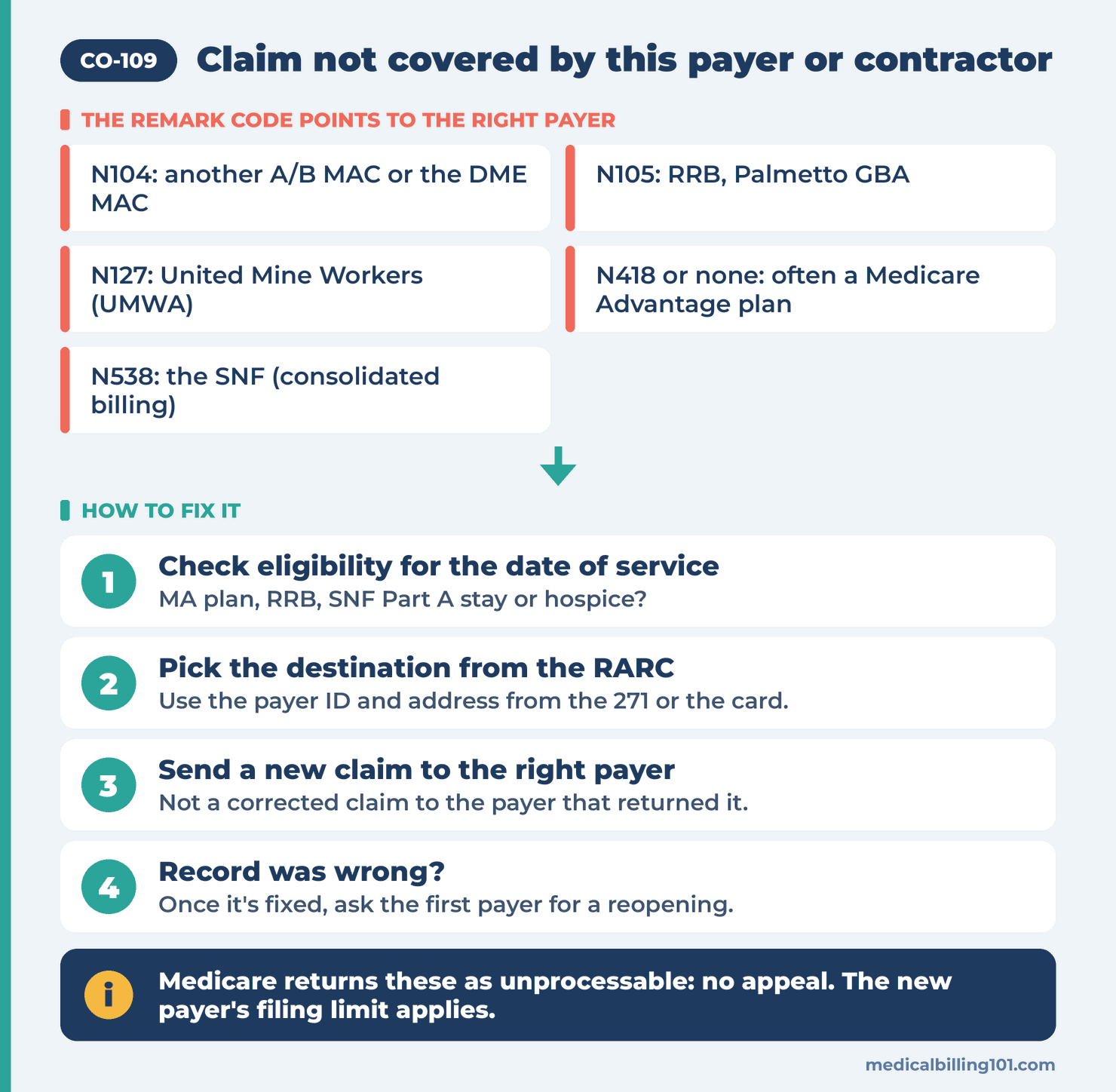
- Read the remark code and the patient’s eligibility for the date of service. Use the MAC portal or a 270/271 inquiry. Look for a Medicare Advantage plan, RRB entitlement, an inpatient or SNF Part A stay, and hospice.
- Pick the destination from the RARC.
- N104: the right A/B MAC jurisdiction or the DME MAC.
- N105: Palmetto GBA for RRB.
- N127: UMWA.
- N418 or no RARC: often a Medicare Advantage plan.
- N538: the SNF.
- Send a new claim to the correct payer. Don’t send a corrected or replacement claim (frequency 7) to the payer that denied it. That payer has no claim to correct.
- Watch the clock. The new payer’s filing limit applies, and the time spent at the wrong payer doesn’t usually stop it. Medicare’s limit is 12 months from the date of service (42 CFR 424.44). Keep the CO-109 remit as proof of timely filing in case the new payer allows an exception.
- Reopen only when the record was wrong. If the payer’s eligibility file was out of date, such as a Medicare Advantage enrollment that ended, ask the patient to have the plan fix it. Then use a reopening. Noridian JD DME says that if the HMO record “has been updated for date of service submitted, a self service reopening in the Noridian Medicare Portal may be conducted.”
- Write off only after the right payer decides. CO-109 alone is never a reason to write off a claim. It’s a routing problem.
Medicare and major payer notes
Medicare Advantage. National Government Services says this denial “is received when your Medicare patient is enrolled in an MA plan, instead of ‘traditional fee-for-service’ Medicare,” and tells providers to “submit the patient’s Medicare claims to that MA Plan” (NGS top claim errors). Other MACs use CO-24 for Medicare Advantage patients, so the same situation can show up as either code depending on the contractor. Noridian’s portal shows the MA plan’s name, address and ID in Expanded Denial Details. The CMS MA Plan Directory lists contracts and contacts.
Railroad Retirement (N105). RRB Part B claims go to Palmetto GBA, not your local MAC. First Coast notes that its SPOT eligibility screen shows “an alert… notifying the beneficiary is a railroad retiree.”
DME vs A/B MAC (N104). Under CMS §10.1.9.2 and 10.1.9.3, a claim sent to the A/B MAC that belongs to the DME MAC, or the reverse, is returned with CO-109 and N104. One exception: electronic DMEPOS claims sent to the wrong DME MAC are “automatically routed to the appropriate DME MAC jurisdiction for processing” (§10.1.9).
SNF consolidated billing (N538). When a patient is in a covered Part A SNF stay, many services are the SNF’s responsibility. Noridian tells providers to check whether the service is on File 1 (physician services) or File 2 (professional components billed with modifier 26) on the CMS SNF Consolidated Billing page. If the service isn’t on either list, bill the SNF. If it is on File 2, “a reopening can be performed to update appropriate procedure code or modifier(s).”
Blue Cross Blue Shield out-of-area patients. Under the BlueCard Program, you normally send claims for patients from other BCBS plans to your local BCBS plan. The BCBSNM manual says the program “lets you submit claims for patients from other BCBS Plans… to your local BCBS Plan” (BCBSNM BlueCard Program Provider Manual). Sending them straight to the home plan is a common cause of a wrong-payer denial.
Commercial and Medicaid. Wrong-payer denials often follow a plan change, a carve-out (such as behavioral health or pharmacy managed by another company), or a Medicaid managed care plan that replaced fee-for-service. Check the back of the current card and the 271 response for the claims address and payer ID.
Worked example (illustrative)
A primary care practice bills a $210.00 office visit to its local Medicare Part B MAC. The patient’s card says “Railroad Retirement Board.” The remit shows:
CAS*CO*109*210.00withLQ*HE*N105
Reading it: the MAC didn’t process the claim. N105 names Palmetto GBA as the RRB contractor.
Fix: submit a new claim to Palmetto GBA (RRB) using the instructions and EDI enrollment details in the N105 text. Don’t appeal to the local MAC, because the return is unprocessable.
Prevention: flag RRB patients in the PM system at registration so their claims route to the RRB payer ID automatically.
CO-109 resubmission cover note template
Most CO-109s need only a clean new claim. Use this note when you send a paper claim or need to show timely filing to the new payer. Replace the bracketed text.
[Date]
To: [Correct payer name], [Claims department / address]

Re: New claim for [patient name], Member ID [ID], DOB [MM/DD/YYYY]
Date(s) of service: [MM/DD/YYYY]   Billed: $[amount]

This claim was first filed on [date] with [first payer], which
returned it on [remit date] with CARC 109 ("Claim/service not covered
by this payer/contractor") and remark code [RARC]. Eligibility checked
on [date] shows [your plan] as the responsible payer for this date of
service.

Enclosed: the claim, a copy of the [first payer] remittance showing
CO-109, and the eligibility response.

[If outside your filing limit:] We ask that you accept the original
filing date of [date] as proof of timely filing.

[Name, title]  [Practice, NPI, Tax ID]  [Phone / email]
CO-109 prevention checklist
- Check eligibility at every visit, not just the first. Medicare Advantage elections and plan changes often take effect on the 1st of the month.
- Scan both sides of every card and ask, “Do you have a Medicare Advantage, Railroad or union health plan?”
- Route RRB patients to the RRB payer ID in your PM system.
- Map DME HCPCS codes to the DME MAC so they never go to the A/B MAC.
- Before billing a SNF resident, confirm whether they’re in a Part A stay and check the CMS consolidated billing files.
- Send out-of-area BCBS claims to your local Blue plan.
- Keep the CO-109 remit with the claim history as proof of timely filing.
Related denial codes
- CO-24: charges covered under a capitation or managed care plan. Some MACs use it for Medicare Advantage patients.
- CO-22: another payer may be primary under coordination of benefits. See also claims denied for coordination of benefits.
- CO-B9: patient enrolled in hospice.
- MA130: unprocessable claim, no appeal rights. Submit a new claim.
- CO-B11: the payer transferred the claim to the right payer for you.
- CO-16: missing or invalid claim information.
FAQ
What is the CO 109 denial code description?
X12 describes CARC 109 as “Claim/service not covered by this payer/contractor. You must send the claim/service to the correct payer/contractor.” It means the payer that received the claim isn’t responsible for it.
What does denial code 109 mean in Medicare?
Medicare uses CO-109 when a claim belongs to someone else, such as a Medicare Advantage plan, the RRB contractor, UMWA, another MAC, the DME MAC or a SNF. CMS has MACs return these claims as unprocessable, so there’s nothing to appeal. You send a new claim to the right place.
How do I fix a CO-109 denial?
Check the remark code and the patient’s eligibility for the date of service, find the correct payer, and submit a new claim there. If the patient’s Medicare Advantage or other record was wrong and has since been fixed, request a reopening with the original payer.
Can I appeal a CO-109 denial?
Usually not for Medicare. First Coast says claims returned as unprocessable “cannot be appealed.” For commercial plans, appeal only if you can show the plan was the responsible payer on the date of service, for example with a 271 response.
Is CO-109 the same as CO-22?
No. CO-22 says another payer may be primary under coordination of benefits, so the claim may come back for secondary processing. CO-109 says the payer isn’t responsible at all, so the claim should go elsewhere.
Can I bill the patient for a CO-109?
Not under the CO group code. Find and bill the correct payer first. Only the patient responsibility that payer assigns can go to the patient.
Sources
- X12, Claim Adjustment Reason Codes (CARC 109, B11). CARC 109 Last Modified 01/29/2012. Accessed 6 Oct 2026.
- X12, Remittance Advice Remark Codes (N104, N105, N127, N418, N538, N193). Accessed 6 Oct 2026.
- CMS, Medicare Claims Processing Manual (IOM 100-04), Ch. 1, §10.1.9 to 10.1.9.9, Disposition of Misdirected Claims (Rev. 3510)
- CMS, Medicare Claims Processing Manual (IOM 100-04), Ch. 22, §60.1 Group Codes
- 42 CFR 424.44, Time limits for filing claims
- First Coast Service Options, Tips to prevent RUC CO 109 (March 12, 2025)
- Noridian JD DME, Reason Code 109 / Remark Code N418 (last updated Jun 06, 2025)
- Noridian JE Part B, Skilled Nursing Facility (CO-109/N538/N193), last updated Dec 12, 2024
- National Government Services, Top Claim Errors (CO-109 entry reviewed Jul 1, 2026)
- CMS, SNF Consolidated Billing
- CMS, MA Plan Directory
- BCBSNM, BlueCard Program Provider Manual (June 2026)
Last reviewed: 6 October 2026 · This page is educational and doesn’t replace payer-specific instructions.