
CO-39 is a Claim Adjustment Reason Code that means the payer already denied the services when authorization or pre-certification was requested. The service was reviewed up front and not approved — this is not the same as forgetting to request auth. (Primary sources: X12 Claim Adjustment Reason Codes · X12 Remittance Advice Remark Codes · Noridian JE Part A, Prior Authorization)
Quick answer: CO-39 means the payer denied the service at the prior-authorization or pre-certification request, before or instead of paying the claim. Read the auth determination, don’t confuse it with CO-197 (auth absent). Appeal the authorization decision with stronger clinicals, request a peer-to-peer when offered, or bill only if a later approval or different covered service applies.
Part of our denial codes library. Written by Manikandan, a revenue cycle management specialist with more than 10 years of US medical billing experience. Last reviewed: 9 October 2026. Official code wording is quoted word for word from X12; Medicare rules link to their CMS or Medicare contractor source.
CO-39 denial code description (official X12 wording)
X12 Claim Adjustment Reason Code 39, verbatim:
“Services denied at the time authorization/pre-certification was requested.”
Source: X12 Claim Adjustment Reason Codes, checked 9 October 2026. Start: 01/01/1995.
The key words are denied at the time … was requested. The payer is telling you the authorization decision itself was a denial, not that the auth number was missing from the claim.
What CO-39 means in plain English
Each part of the code answers a different question:
- CO (Contractual Obligation) is the payer’s classification of who carries the amount. CMS says these adjustments are “Generally… considered a write off for the provider and are not billed to the patient” (Medicare Claims Processing Manual, Ch. 22, §60.1).
- CARC 39 tells you why: when auth/pre-cert was requested, the payer denied the services.
Typical triggers include, for example, a non-affirmed Medicare outpatient department (OPD) prior auth, a commercial medical-necessity denial on a pre-cert, an experimental/investigational determination at pre-service review, or an out-of-network auth denial.
In plain terms: the payer already said no at prior auth. Fix the auth decision before you bill again.
CO-39 vs CO-197, CO-15 (historical), CO-50 and N54
| Code | Official X12 text | What it tells you |
|---|---|---|
| 39 | “Services denied at the time authorization/pre-certification was requested.” | Auth was requested and denied |
| 197 | “Precertification/authorization/notification/pre-treatment absent.” | Auth/notification was missing. See CO-197 |
| 50 | “These are non-covered services because this is not deemed a ‘medical necessity’ by the payer. …” | Medical necessity denial (may also appear after service). See CO-50 |
| N54 (RARC) | “Claim information is inconsistent with pre-certified/authorized services.” | Claim doesn’t match what was authorized |
CO-39 ≠ CO-197. Mixing them up wastes appeal time. Missing auth (197) is often fixed by obtaining auth or proving an exemption. Denied auth (39) requires overturning the determination or changing the plan of care.
Note: our site previously had a WordPress redirect from /denial-codes/co-19/ to /denial-codes/co-197/. CARC 19 is workers’ compensation liability, not prior auth — that redirect is wrong and should be fixed separately. This page covers CARC 39.
CO-39 vs PR-39 vs OA-39 vs PI-39
| Group + 39 | Who carries the amount | Can you bill the patient? | When you’ll typically see it |
|---|---|---|---|
| CO-39 | Provider | Usually no under contract; check waiver / notice rules | Common commercial and some Medicare remits |
| PR-39 | Patient | Only with a valid patient notice / plan rules | When the remit assigns patient liability |
| OA-39 | Neither group fits | Check remark codes | When no other group code applies |
| PI-39 | Payer-initiated reduction | No | Non-Medicare remits only |
Remark codes that help with CARC 39
| RARC | Official X12 text | What it adds |
|---|---|---|
| N54 | “Claim information is inconsistent with pre-certified/authorized services.” | Claim doesn’t match an approved auth (different problem) |
| N130 | “Consult plan benefit documents/guidelines for information about restrictions for this service.” | Plan restriction details |
| N115 | “This decision was based on a Local Coverage Determination (LCD). …” | LCD-based decision (Medicare) |
RARC wording is quoted from the X12 RARC list, checked 9 October 2026. Always pull the original authorization determination letter or portal decision — the remit alone rarely has the clinical rationale.
Where CO-39 shows up in the 835
Here’s a trimmed, illustrative example:
CLP*PT20261005A*4*4200.00*0.00**MB*2626000333444~
SVC*HC:27447*4200.00*0.00~
CAS*CO*39*4200.00~
LQ*HE*N130~
CLPstatus4= denied.CAS*CO*39*4200.00shows the auth-request denial carried onto the claim.
This 835 snippet is illustrative only.
How to fix CO-39: decision path
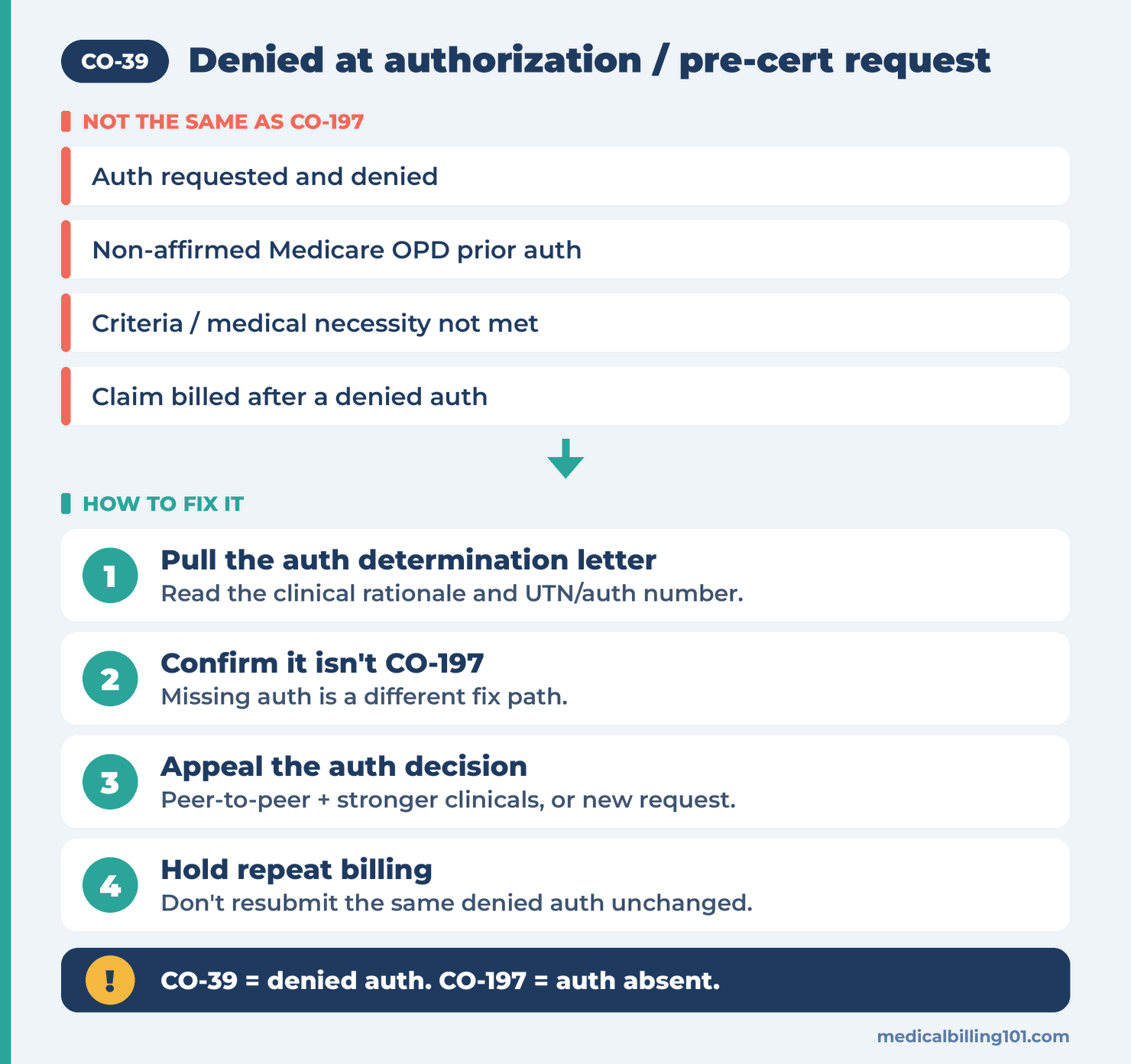
- Pull the authorization determination. Get the denial letter. Note the auth number or UTN. Note the exact reason, such as medical need, criteria, experimental status or network rules.
- Confirm you didn’t actually have a CO-197 problem. If no auth was on file, work CO-197 instead.
- Decide: appeal auth vs change care vs patient liability.
- Appeal / resubmit auth with additional clinical documentation, peer-to-peer, or a new request when the payer allows unlimited resubmissions (Noridian JE Part A notes unlimited resubmissions for non-affirmed OPD prior auth with the original UTN in some workflows — confirm current JE instructions).
- Alternative covered service if criteria support a different CPT/HCPCS.
- Patient financial responsibility only with a valid waiver/notice under payer and state rules.
- Do not keep billing the same denied auth. If you send the claim again with no new approval, you will likely see CO-39 again.
- If the service already occurred under a verbal/partial approval, gather that evidence for a claim-level appeal.
- Track deadlines. Auth appeals and claim appeals often have different clocks.
Medicare and major payer notes
Medicare outpatient prior auth. Some hospital outpatient services need prior auth first. If the request is not approved, do not treat that like a missing-auth case. Appeal or send a new request with more notes. Noridian JE Part A posts the steps for its prior-auth list (Noridian JE Part A Prior Authorization).
Commercial plans. Plans such as UHC, Cigna, Aetna and the Blues often deny at pre-cert in the portal first. CO-39 on the remit means the claim followed that denial. Start with the plan’s prior-auth appeal, not only a corrected claim.
Link to CO-197. Use CO-197 when auth was never on file. Use this page when auth was filed and denied.
Worked example (illustrative)
Ortho requests pre-cert for CPT 27447. The plan denies for criteria not met. Surgery proceeds after a scheduling error; the claim returns CAS*CO*39.
Reading it: the auth was denied; this is not a missing-auth (197) problem.
Fix: file the plan’s UM appeal with updated clinical notes, imaging and failed-conservative-treatment documentation, and request peer-to-peer. Hold secondary billing until the auth appeal resolves. If overturned, ask for claim reprocessing with the new auth number.
Prevention: hard-stop scheduling when auth status is “denied” or “pending,” and require financial counseling before elective surgery without affirmation.
CO-39 authorization appeal template
[Date]
[Payer] Utilization Management Appeals
[Address, fax or portal reference]

Re: Appeal of authorization denial (CARC 39 on claim)
Member: [Name]   ID: [ID]   DOB: [MM/DD/YYYY]
Auth request #: [Number / UTN]   Denied date: [MM/DD/YYYY]
Service: [CPT/HCPCS, diagnosis]   Provider: [Name, NPI]
Claim # (if already billed): [Claim #]

The authorization was denied and the claim adjudicated as CO-39
("Services denied at the time authorization/pre-certification was
requested"). Please overturn the determination because:
[ ] Criteria in [policy # / LCD] are met as shown in the enclosed
    records (see tabbed notes dated …).
[ ] Additional clinical information not previously reviewed: [list].
[ ] Peer-to-peer requested with [physician name, phone, times].

If overturned, please update the auth to approved and reprocess
claim [number] (or confirm we may submit a new claim with the
approval).

Enclosed: denial letter, clinical records, imaging, prior treatments,
claim remittance.

[Name, credentials]  [Practice, NPI]  [Phone / email]
CO-39 prevention checklist
- Distinguish “denied auth” (39) from “missing auth” (197) in work queues.
- Hard-stop scheduling/elective procedures on denied or pending auth.
- Save the determination letter and UTN/auth number in the account.
- Use payer criteria checklists before the initial auth submission.
- Offer peer-to-peer quickly when medical necessity is the issue.
- Train financial counselors on patient notices when auth is denied.
- Track CO-39 by procedure and payer for criteria training.
- Link staff to the CO-197 page for absent-auth cases.
Related denial codes
- CO-197: precertification/authorization/notification absent.
- CO-50: medical necessity denial.
- CO-252: attachment/documentation required.
- PR-204: not covered under the current benefit plan.
- CO-45: charge exceeds allowable.
- CO-16: claim lacks information.
Quick tip from denial queues
For example, many teams dump every auth problem into one worklist. Split denied auth (CO-39) from missing auth (CO-197) on day one. That single sort step cuts repeat claims and shortens appeal time.
In short
CO-39 means the payer said no at prior auth. This is not the same as missing auth. Appeal the auth decision. Add better notes. Do not bill the same denied auth again.
FAQ
What is the CO-39 denial code description?
X12 describes CARC 39 as “Services denied at the time authorization/pre-certification was requested.” The payer denied the service when auth/pre-cert was requested.
How is CO-39 different from CO-197?
CO-39 = auth was requested and denied. CO-197 = precert/authorization/notification was absent. Fix 197 by obtaining auth or proving an exception; fix 39 by overturning the determination or changing the plan of care.
How do I fix a CO-39 denial?
Retrieve the auth denial rationale, submit a UM/auth appeal with stronger clinicals (and peer-to-peer if available), or choose a covered alternative. Rebilling the same denied auth without a new approval usually fails.
Does Medicare use prior auth the same way?
Medicare Fee-for-Service uses prior authorization for certain OPD and other selected services. A non-affirmation is a pre-claim denial of the request; claim appeal rights depend on whether a claim was later submitted and finalized. Follow your MAC’s prior-auth pages (for example Noridian JE Part A).
Can I bill the patient after CO-39?
Only when the group code and your notices/waiver rules allow patient liability. A CO adjustment is generally a provider write-off. Get written guidance from the contract and any signed patient agreement before billing.
Should I appeal the claim or the authorization?
Start with the authorization/UM appeal that created the denial. Once auth is overturned, ask the payer to reprocess the claim (or submit a new claim with the approval number). Key named sources on this page include Claim Adjustment Reason Codes, Remittance Advice Remark Codes, Prior Authorization pages from Noridian Part A and Medicare Claims Processing Manual group-code rules.
Quick facts
| Item | Value |
|---|---|
| X12 code | 39 |
| X12 start | 01/01/1995 |
| Last reviewed | 9 October 2026 |
Named contractor sources include First Coast Service Options materials where linked, plus Novitas Solutions and Noridian Healthcare Solutions pages cited above.
Sources
- X12, Claim Adjustment Reason Codes (CARC 39, 197, 50). CARC 39 Start 01/01/1995. Accessed 9 Oct 2026.
- X12, Remittance Advice Remark Codes (N54, N130, N115). Accessed 9 Oct 2026.
- Noridian JE Part A, Prior Authorization
- Noridian JE Part A, Common Part A OPD Prior Authorization Q&A
- CMS, Medicare Claims Processing Manual (IOM 100-04), Ch. 22, §60.1 Group Codes
- Related on this site: CO-197 prior authorization guide
Access dates and figures on this page were checked on 9 October 2026 against X12 and CMS sources.
Last reviewed: 9 October 2026 · This page is educational and doesn’t replace payer-specific instructions.