
OA-23 is Claim Adjustment Reason Code 23 reported only with group code OA. It means the remittance is showing the impact of a prior payer’s adjudication — payments and/or contractual adjustments already posted — so your secondary (or tertiary) payment does not double-post those dollars to accounts receivable. It is a coordination-of-benefits (COB) reporting code, not a coverage denial. (Primary sources: X12 Claim Adjustment Reason Codes · X12 Example 07: Coordination of Benefits · CMS Medicare Claims Processing Manual, Ch. 22, §60.1)
Quick answer: OA-23 is informational COB math. Confirm the group code is OA, match the amount to prior payments plus prior contractual write-offs already on the AR, leave prior patient-responsibility out of OA-23, then post only the new secondary payment and any new adjustments.
Part of our denial codes library. Written by Manikandan, a revenue cycle management specialist with more than 10 years of US medical billing experience. Last reviewed: 10 October 2026. Official code wording is quoted word for word from X12; Medicare rules link to their CMS or Medicare contractor source.
OA-23 denial code description (official X12 wording)
X12 Claim Adjustment Reason Code 23, verbatim:
“The impact of prior payer(s) adjudication including payments and/or adjustments. (Use only with Group Code OA)”
Source: X12 Claim Adjustment Reason Codes, checked 10 October 2026. Start: 01/01/1995 | Last Modified: 09/30/2012.
Older code 71 (“Primary Payer amount”) was stopped 06/30/2000 with the note “Use code 23.” If you still see “primary payer amount” language in training materials, map it to CARC 23 with group OA.
What OA-23 means in plain English
Break the label apart:
- OA means Other Adjustment and is required with CARC 23. X12’s own usage note says use CARC 23 only with Group Code OA. CMS Ch. 22 §60.1 describes OA as the group used “when no other group code applies.”
- CARC 23 tells the poster: these dollars already hit the AR from a prior payer’s payment and/or contractual adjustments. Do not post them again as a new write-off or new payment.
- “Impact” in the X12 835 TR3 / COB examples is the sum of prior payments plus prior contractual reductions that the provider already posted — even when the secondary payer’s own benefit calculation differs.
In plain terms: the secondary remit is reminding your system what the primary already did, so automatic posting does not create a negative balance. For example, if primary paid $400 and wrote off $200, OA-23 is often $600.
OA-23 vs CO-22, CO-23, CO-45 and MA04
| Code | Official X12 text (short) | What it tells you |
|---|---|---|
| OA-23 | Impact of prior payer(s) adjudication including payments and/or adjustments (OA only) | COB posting of prior payment + prior contractual amounts |
| CO-22 | This care may be covered by another payer per coordination of benefits. | Another payer may be primary — often a denial/hold until COB is resolved. See CO-22 |
| CO-23 | (same CARC 23, wrong group) | Should not appear; X12 requires OA with 23 |
| CO-45 | Charge exceeds fee schedule/maximum allowable… must not duplicate provider adjustment amounts from prior payer(s) | Current payer’s own contractual reduction — must not duplicate OA-23 dollars |
| MA04 (RARC) | Secondary payment cannot be considered without the identity of or payment information from the primary payer… | Missing/illegible primary info — fix and resubmit secondary |
If the remit says the claim should have gone to another payer first, look for CO-22 or CO-109, not OA-23. OA-23 appears after a prior payer has already adjudicated.
Why group code must be OA (not CO or PR)
X12’s usage note is mandatory: Use only with Group Code OA. Reasons:
- Prior payments and prior contractual write-offs are not a new contractual obligation of the secondary payer (so not CO-23).
- They are not newly assigned patient responsibility (so not PR-23).
- OA keeps automated posters from treating the amount as a fresh write-off or a patient balance.
X12 RFI guidance and Example 07 stress that OA-23 should include prior payments and contractual adjustments other than patient responsibility. Remaining patient responsibility after COB is reported with group PR and the appropriate CARC (1, 2, 3, 275, etc.).
Where OA-23 shows up in the 835
Illustrative secondary line after a primary paid $400 and took a $200 contractual reduction on a $700 charge:
CLP*PT20261010B*2*700.00*50.00*50.00*MB*2626000987611~
SVC*HC:27447*700.00*50.00~
CAS*OA*23*600.00~
CAS*PR*2*50.00~
CAS*OA*23*600.00= prior payment ($400) + prior contractual ($200) already on AR.CAS*PR*2*50.00= remaining coinsurance the patient still owes after COB.- Secondary paid $50.
This 835 snippet is illustrative only. Some payers report OA-23 at claim level, some at service level; X12 expects the same dollars not to be repeated at both levels.
How to fix / post OA-23: decision path
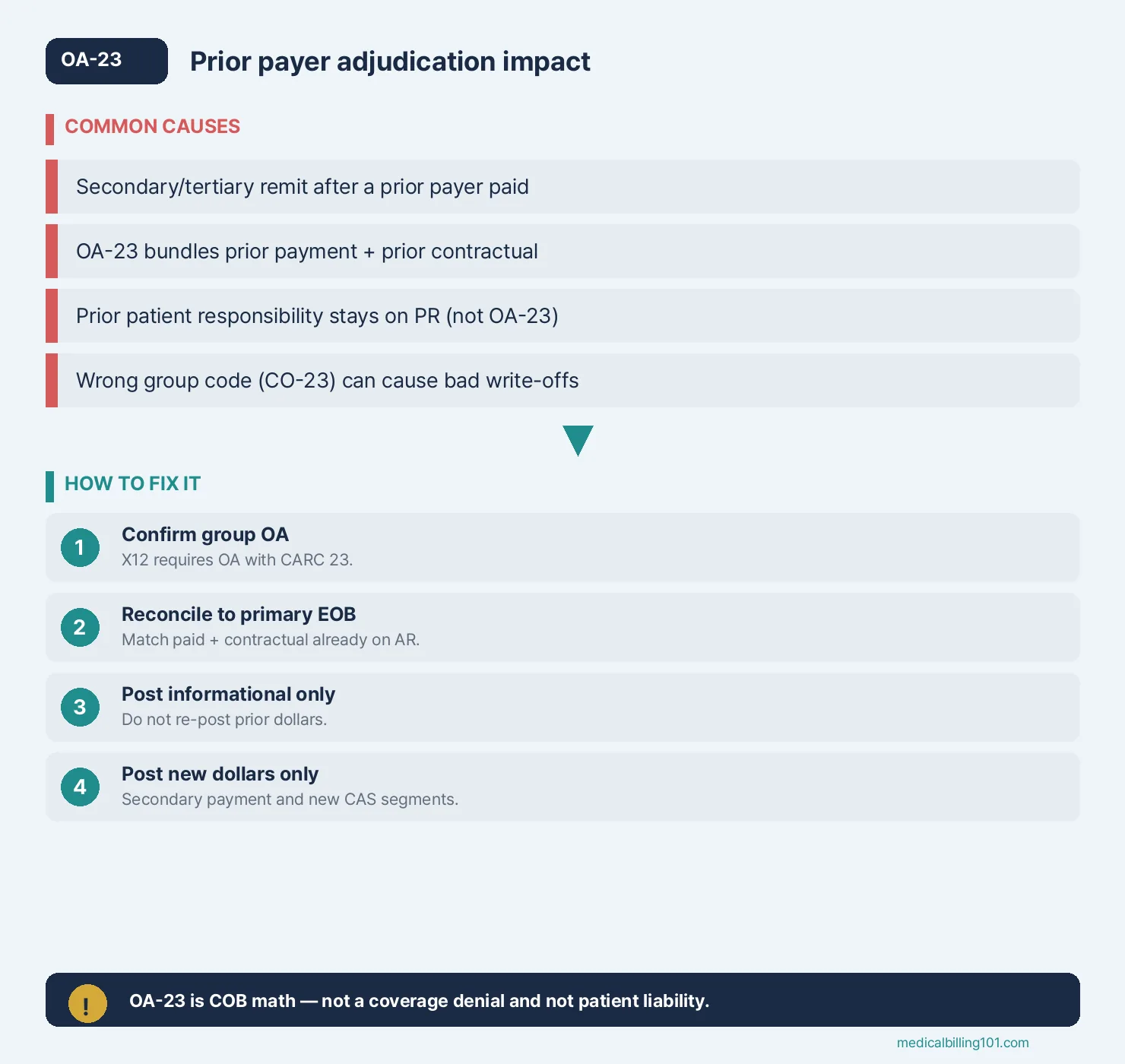
- Confirm the group code is OA. If you see CO-23 or PR-23, treat it as a payer reporting issue — do not auto-write-off or auto-bill the patient for that CAS alone.
- Reconcile to the primary EOB/835. OA-23 should approximate prior paid + prior contractual. If it does not, hold the secondary remit and compare both remits line by line.
- Do not re-post prior payment or prior CO write-off. Mark OA-23 informational in your PM so AR stays balanced.
- Post new secondary payment and new adjustments only. New CO-45 (or similar) from the secondary is a current contractual amount; new PR is patient liability after COB.
- Watch for missing primary data. If the secondary denied instead of paying, look for CO-16 with MA04 / N4, or CO-22.
- Tertiary claims. The same OA-23 idea applies for any subsequent payer: report cumulative prior impact so each poster only books new dollars.
Medicare and major payer notes
Medicare as secondary. Medicare secondary remits commonly use OA-23 to show the impact of the primary payer so MSP payment calculation does not look like a denial of the primary’s work. Still verify MSP questionnaire / other-insurance data when secondary payment is zero.
Commercial secondary / tertiary. Many plans follow the X12 COB examples: OA*23 for prior payment + contractual; PR for leftover patient responsibility; separate CAS for the secondary’s own contractual reduction.
Duplicate risk. Do not confuse OA-23 with OA-18 (exact duplicate). OA-18 means this claim/service is a duplicate of one already received; OA-23 means prior-payer dollars are being acknowledged on a secondary remit.
Worked example (illustrative)
Primary commercial paid $320 and adjusted $180 CO-45 on a $500 office-surgery line. Secondary Medicare remit shows OA-23 $500 and pays $0 with PR-2 $0 remaining.
Reading it: OA-23 absorbed the full billed amount as prior impact; secondary found nothing left to pay. That can be correct MSP math or a mapping error if primary actually left patient responsibility.
Fix: Compare primary PR totals to the secondary remit. If primary left deductible/coinsurance and Medicare should have considered it, escalate with both remits. If primary truly paid/adjusted the full charge, post OA-23 informational and close the balance.
Prevention: Send complete primary payment information on the secondary claim (837 COB loops / paper EOB) so the secondary can calculate correctly the first time.
OA-23 posting / dispute template
[Date]
[Secondary payer] Provider Relations / COB
[Address, fax or portal reference]

Re: OA-23 (prior payer adjudication impact) — posting / review request
Patient: [Name]   Member ID: [ID]   DOB: [MM/DD/YYYY]
Claim number: [Claim #]   Date(s) of service: [MM/DD/YYYY]
CPT/HCPCS: [Code]   NPI: [NPI]

The remittance shows CAS*OA*23*[amount]. Primary payer [Name] paid $[paid]
and adjusted $[contractual] (group/CARC [e.g. CO-45]). Please confirm:
[ ] OA-23 correctly equals prior payment + prior contractual (excluding PR).
[ ] Remaining patient responsibility should be reported as PR-[code] $[amt].
[ ] Secondary allowed/paid amount of $[amt] is final for this line.

Enclosed: primary 835/EOB, secondary 835/EOB, claim copy, COB worksheet.

[Name, credentials]  [Practice, NPI]  [Phone / email]
OA-23 prevention checklist
- Train posters: OA-23 is COB impact, not a coverage denial.
- Never map OA-23 to patient statements.
- Reconcile OA-23 to primary paid + primary contractual before closing AR.
- Keep prior PR out of the OA-23 bucket; expect separate PR CAS segments.
- Audit payers that send CO-23 or duplicate OA-23 at claim and line for the same dollars.
- Attach complete primary remits on secondary submissions to reduce MA04 / N4 loops.
- Link related COB denials: CO-22, CO-109.
- Track OA-23 volume by secondary payer for posting automation QA.
Related denial codes
- CO-22: another payer may be primary (COB).
- OA-18: exact duplicate claim/service.
- CO-45: current payer contractual reduction (must not duplicate prior adjustments).
- CO-16 / MA04: secondary lacks primary payment information.
- CO-109: wrong payer/contractor.
- CARC & RARC guide: how group + CARC + RARC fit together.
In short
OA-23 means “prior payer already moved these dollars.” Keep it on OA, match it to the primary remit, post only what is new, and leave patient responsibility on PR.
FAQ
What is the OA-23 denial code description?
X12 describes CARC 23 as “The impact of prior payer(s) adjudication including payments and/or adjustments. (Use only with Group Code OA)”. It reports prior payments and/or adjustments so secondary posting does not duplicate them.
Is OA-23 a denial?
Usually no. It is a COB reporting adjustment on a secondary or later remittance. The claim may still pay; OA-23 explains prior-payer impact already on the AR.
Can I bill the patient for OA-23?
No. OA-23 is not patient responsibility. Amounts the patient still owes after COB appear under group PR with a different CARC (for example PR-1, PR-2 or PR-3).
Why must OA-23 use group code OA?
X12’s usage note requires Group Code OA. Using CO or PR would mis-assign responsibility and can cause wrong write-offs or wrong patient bills.
What is the difference between OA-23 and CO-22?
CO-22 means care may be covered by another payer (COB not yet resolved as primary). OA-23 appears when a prior payer has already adjudicated and the current remit is accounting for that impact.
How do I post OA-23 in my practice management system?
Treat it as informational: reconcile to the primary payment and contractual amounts already posted, then post only the secondary payment and any new CAS segments. Do not re-post the prior dollars. Key named sources on this page include Claim Adjustment Reason Codes, Claim Adjustment Group Codes, X12 Coordination of Benefits examples and the Medicare Claims Processing Manual from Centers For Medicare guidance.
Quick facts
| Item | Value |
|---|---|
| X12 code | 23 |
| X12 start | 01/01/1995 |
| Last modified | 09/30/2012 |
| Required group | OA only |
| Last reviewed | 10 October 2026 |
| Page type | WordPress Page under Denial Codes hub 183 |
| Primary keyword | denial code oa 23 |
Sources
- X12, Claim Adjustment Reason Codes (CARC 23). Start 01/01/1995, Last Modified 09/30/2012. Accessed 10 Oct 2026.
- X12, Example 07: Coordination of Benefits. Accessed 10 Oct 2026.
- X12, RFI #2143: Secondary Claim Reporting – COB. Accessed 10 Oct 2026.
- X12, RFI #2535: 835 Secondary Payment (OA23) Clarifications. Accessed 10 Oct 2026.
- CMS, Medicare Claims Processing Manual (IOM 100-04), Ch. 22, §60.1 Group Codes
Access dates and figures on this page were checked on 10 October 2026 against X12 and CMS sources.
Last reviewed: 10 October 2026 · This page is educational and doesn’t replace payer-specific instructions.