
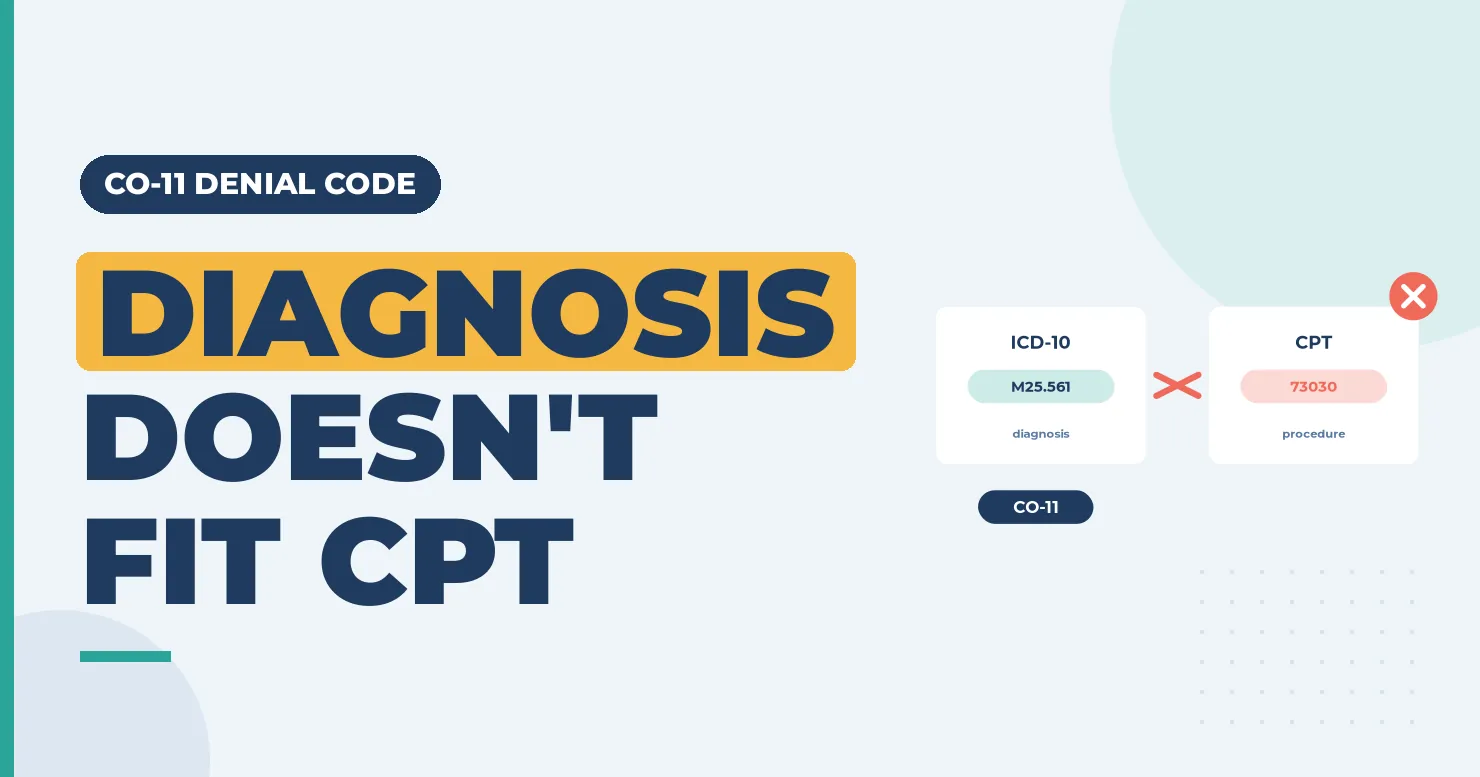
CO-11 is Claim Adjustment Reason Code 11 with group code CO. CARC 11 means the payer’s edit found that the diagnosis code on the line does not fit the procedure code billed. People search for it as “co 11 denial code”, and this page covers that search: the X12 words, the usual causes and the fastest fixes. (Primary sources: X12 Claim Adjustment Reason Codes · CMS ICD-10-CM Official Guidelines FY 2027 · CMS Medicare Coverage Database)
Quick answer: Open the claim line and check which diagnosis the line points to. Most CO-11 denials come from a wrong diagnosis pointer, a diagnosis that is too vague, or a code that the payer’s policy does not list for that procedure. If the record supports a better code, send a corrected claim. If the code was right, appeal with the notes and the payer policy.
Part of our denial codes library. Written by Manikandan, a revenue cycle management specialist with more than 10 years of US medical billing experience. Last reviewed: 12 October 2026. Official code wording is quoted word for word from X12; coding rules link to CMS.
CO-11 denial code description (official X12 wording)
X12 Claim Adjustment Reason Code 11, verbatim:
“The diagnosis is inconsistent with the procedure. Usage: Refer to the 835 Healthcare Policy Identification Segment (loop 2110 Service Payment Information REF), if present.”
Source: X12 Claim Adjustment Reason Codes, checked 12 October 2026. Start: 01/01/1995 | Last Modified: 07/01/2017.
The CARC is 11. Payers usually send it with group code CO, so the amount is a provider issue to fix, not a patient bill. The usage note matters: when the 835 has a policy REF, it names the policy that drove the edit.
What CO-11 means in plain English
- The payer compared the ICD-10-CM code on the line with the CPT or HCPCS code and decided they do not belong together.
- Often the edit is simple. For example, a knee X-ray is billed with a shoulder diagnosis, or the line points to the wrong diagnosis.
- Sometimes it is policy-based: the payer’s coverage policy lists the diagnoses that support that procedure, and yours is not on the list.
- CO-11 is a coding match problem. It is fixed with a correct code or a better pointer, backed by the record.
- An LCD is a Local Coverage Determination: a MAC’s rule on when a service is reasonable and necessary in its region.
- A diagnosis pointer is the letter on each service line (A to L on the CMS-1500) that links the line to one of the claim’s diagnosis codes.
CO-11 vs CO-9, CO-10, CO-12, CO-50, CO-167 and CO-4
| Code | Official X12 idea | Difference |
|---|---|---|
| 11 | Diagnosis is inconsistent with the procedure | Diagnosis and procedure do not match |
| 9 | Diagnosis is inconsistent with the patient’s age | Age edit |
| 10 | Diagnosis is inconsistent with the patient’s gender | Sex edit |
| 12 | Diagnosis is inconsistent with the provider type | Specialty edit |
| 50 | Non-covered; not deemed a medical necessity by the payer | Necessity review — CO-50 |
| 167 | This (these) diagnosis(es) is (are) not covered | Diagnosis excluded from coverage |
| 4 | Procedure code is inconsistent with the modifier used | Modifier mismatch — CO-4 |
CARC 11 and CARC 50 are often confused. 11 is a match edit between two codes. 50 is a necessity decision about the service. Read which one is on the remit before you choose the fix.
Group code matrix for CARC 11
| Group + 11 | Who carries the amount | Typical next step |
|---|---|---|
| CO-11 | Provider | Fix the code or pointer; corrected claim or appeal |
| PR-11 | Patient (rare) | Confirm a valid notice made the patient liable |
| OA-11 | Other adjustment | Read remarks and the policy REF |
| PI-11 | Payer-initiated (non-Medicare) | Treat like CO |
CMS Ch. 22 §60.1 says CO amounts are generally “a write off for the provider and are not billed to the patient.” With CO-11, the better path is usually a fix, not a write-off.
Remark codes and pointers seen with CARC 11
| Pointer | Role |
|---|---|
| 835 REF (Healthcare Policy Identification) | Names the payer policy behind the edit when present |
| M76 | “Missing/incomplete/invalid diagnosis or condition.” |
| M64 | “Missing/incomplete/invalid other diagnosis.” |
| N381 | Alert to check the contract — N381 |
If no remark appears, compare the line’s diagnosis pointer and codes with the payer’s policy for that CPT code.
Where CO-11 shows up in the 835
SVC*HC:73560*95.00*0.00**1~
CAS*CO*11*95.00~
REF*0K*KNEE-IMAGING-POLICY~
- The knee X-ray line (CPT 73560) was denied in full with CASCO11.
- The REF line points to the payer’s imaging policy. Open it before you rework the claim.
Illustrative only. The policy ID and amounts are examples.
How to fix CO-11: decision path
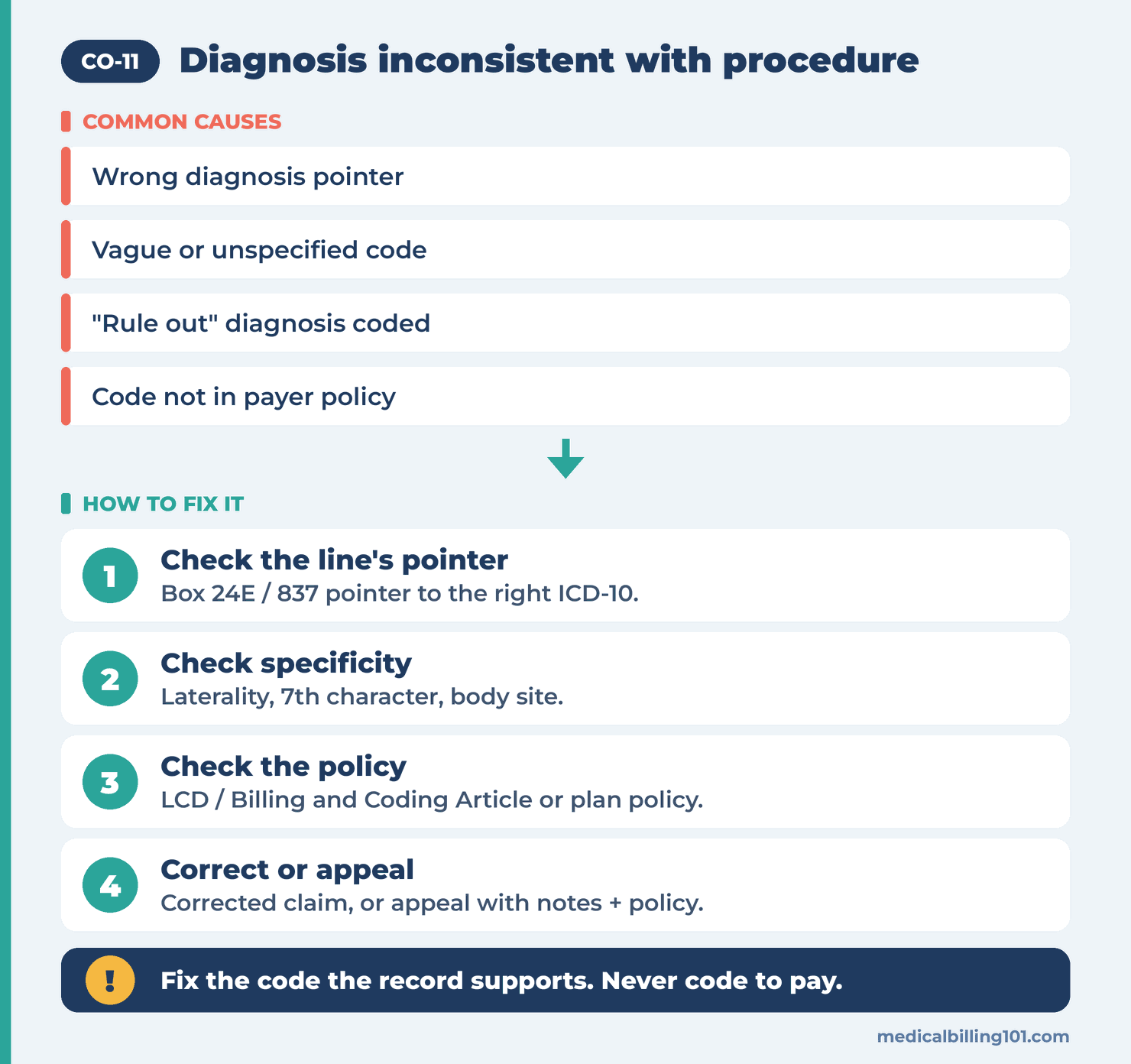
- Check the diagnosis pointer. On the CMS-1500 (box 24E) or 837 line, which diagnosis does the denied line point to? A wrong pointer is the most common and easiest fix.
- Check specificity. The ICD-10-CM guidelines require the full number of characters and the highest level of specificity documented. Details such as laterality, encounter type (seventh character) and body site matter.
- Check the payer policy. For Medicare, search the Medicare Coverage Database for the LCD or Billing and Coding Article that lists the ICD-10 codes that support the CPT code. Commercial plans publish their own policies.
- Check the record. Does the provider’s note support a diagnosis that matches the procedure? Do not change a code the record does not support.
- If the pointer or code was wrong, send a corrected claim (frequency code 7 on an 837) with the right diagnosis.
- If the code was right, appeal with the note, the order, and the policy section that lists or allows the diagnosis.
- If the diagnosis truly does not support the service, stop billing it as covered. For Medicare, an ABN must be given before the service to shift liability to the patient.
- Track the pattern by provider, CPT code and payer, and fix the charge capture or template behind it.
ICD-10-CM rules that prevent CO-11
The ICD-10-CM Official Guidelines for Coding and Reporting (FY 2027, Section IV, outpatient services) are the coding rules most CO-11 fixes depend on:
- List the main reason first. Section IV.G: “List first the ICD-10-CM code for the diagnosis, condition, problem, or other reason for encounter/visit shown in the medical record to be chiefly responsible for the services provided.”
- Do not code uncertain diagnoses in outpatient care. Section IV.H says not to code “probable,” “suspected,” “rule out” and similar terms. Code the symptoms, signs or abnormal results instead. A “rule out” code is a common reason a test looks unsupported.
- Diagnostic tests. Section IV.K: for diagnostic services, sequence first the reason “chiefly responsible” for the service. When the final report is available at coding, code the confirmed diagnosis.
- Specificity. Section IV.F: use the full number of characters required, to the highest level of specificity documented.
Medicare and commercial notes
Medicare. Many CO-11 and CO-50 denials on Medicare claims come from LCD and Billing and Coding Article edits. The article lists the ICD-10-CM codes that support medical necessity for the CPT codes it covers. Find the article for your MAC in the Medicare Coverage Database and compare your diagnosis to it.
A Billing and Coding Article is the MAC document that turns an LCD into coding instructions, such as covered ICD-10-CM codes and required modifiers.
Commercial. Commercial plans run their own diagnosis-to-procedure edits and publish medical or payment policies. When the 835 includes a policy REF, use it. If not, search the plan’s policy library for the CPT code.
Do not “code to pay.” Choosing a diagnosis only because it passes the edit, when the record does not support it, creates compliance risk. Fix the documentation or the code, not the rule.
Worked example (illustrative)
A patient comes in with right knee pain after a fall. The provider orders a knee X-ray (CPT 73560). The claim has two diagnoses: hypertension (pointer A) and right knee pain (pointer B). The X-ray line points to A only. The remit shows CASCO11.
CO-11 appeal letter template
[Date]
[Payer] Appeals / Provider Services
[Address, fax or portal]

Re: CARC 11 (diagnosis inconsistent with procedure) — [appeal / reconsideration]
Patient: [Name]   Member ID: [ID]   DOB: [MM/DD/YYYY]
Claim number: [Claim #]   Date(s) of service: [MM/DD/YYYY]
CPT/HCPCS: [Code]   ICD-10-CM: [Code(s)]

The remittance shows CAS*CO*11. Please reprocess because:
[ ] The diagnosis [code] is documented in the enclosed note and is
    listed as supporting [CPT] in [policy / LCD / article ID, section].
[ ] The line pointer was corrected; a corrected claim is attached.
[ ] The procedure was performed for [reason] as documented in the order.

Enclosed: remit, claim, provider note, order, policy excerpt.

[Name, credentials]  [Practice, NPI]  [Phone / email]
Prevention checklist
- [ ] Require a diagnosis pointer for every procedure line.
- [ ] Code to the highest level of specificity, with laterality and seventh characters.
- [ ] Never code “rule out” or “probable” diagnoses on outpatient claims.
- [ ] Keep LCD and Billing and Coding Article links for your high-volume tests.
- [ ] Run a diagnosis-to-procedure scrubber edit before claims go out.
- [ ] Separate CO-11 (match) from CO-50 (necessity) in your denial log.
- [ ] Train staff with the CARC and RARC guide.
Related denial codes
- CO-50: not deemed a medical necessity.
- CO-4: procedure code inconsistent with the modifier.
- CO-16: claim lacks information or has a billing error.
- CO-96: non-covered charges.
- CO-236: NCCI procedure-to-procedure edit.
- CARC and RARC guide.
Key takeaways
CARC 11 means the diagnosis on the line does not fit the procedure. Check the pointer, the specificity and the payer policy. Correct the claim when the record supports a better code; appeal with the record when your code was right.
FAQ
What is the CO-11 denial code description?
X12 describes CARC 11 as “The diagnosis is inconsistent with the procedure,” with a usage note to refer to the 835 Healthcare Policy Identification Segment when present. CO-11 is that reason code with group code CO.
What is the most common cause of a CO-11 denial?
A wrong diagnosis pointer on the claim line is the most common cause. Vague or uncertain diagnosis codes and codes missing from the payer’s policy for that procedure are the next most common.
How do I fix a CO-11 denial?
Check the line’s diagnosis pointer, the code’s specificity and the payer’s policy. Send a corrected claim if the record supports a better code, or appeal with the note and policy if the code was right.
What is the difference between CO-11 and CO-50?
CO-11 means the diagnosis and procedure codes do not match. CO-50 means the payer decided the service was not medically necessary. They need different fixes.
Can I bill the patient for a CO-11 denial?
Not when the group code is CO. CO amounts are generally not billed to the patient. For Medicare, a valid ABN given before the service is needed to shift liability.
Where do I find which diagnoses a Medicare payer accepts?
Search the CMS Medicare Coverage Database for the LCD and its Billing and Coding Article. The article lists ICD-10-CM codes that support medical necessity for the CPT codes it covers.
Quick facts
| Item | Value |
|---|---|
| X12 code | 11 |
| X12 start | 01/01/1995 |
| Last modified | 07/01/2017 |
| Usual group code | CO |
| Fix type | Corrected claim or appeal |
| Last reviewed | 12 October 2026 |
Sources
- X12, Claim Adjustment Reason Codes (CARC 11, 9, 10, 12, 50, 167, 4). CARC 11 Start 01/01/1995, Last Modified 07/01/2017. Accessed 12 Oct 2026.
- X12, Remittance Advice Remark Codes (M76, M64, N381). Accessed 12 Oct 2026.
- CMS, ICD-10-CM Official Guidelines for Coding and Reporting FY 2027 (Section IV). Accessed 12 Oct 2026.
- CMS, Medicare Coverage Database (LCDs and Billing and Coding Articles). Accessed 12 Oct 2026.
- CMS, Medicare Claims Processing Manual (IOM 100-04), Ch. 22, §60.1 Group Codes. Accessed 12 Oct 2026.
Code wording and coding rules on this page were checked on 12 October 2026 against X12 and CMS sources.
Last reviewed: 12 October 2026 · This page is educational and doesn’t replace payer-specific instructions.