
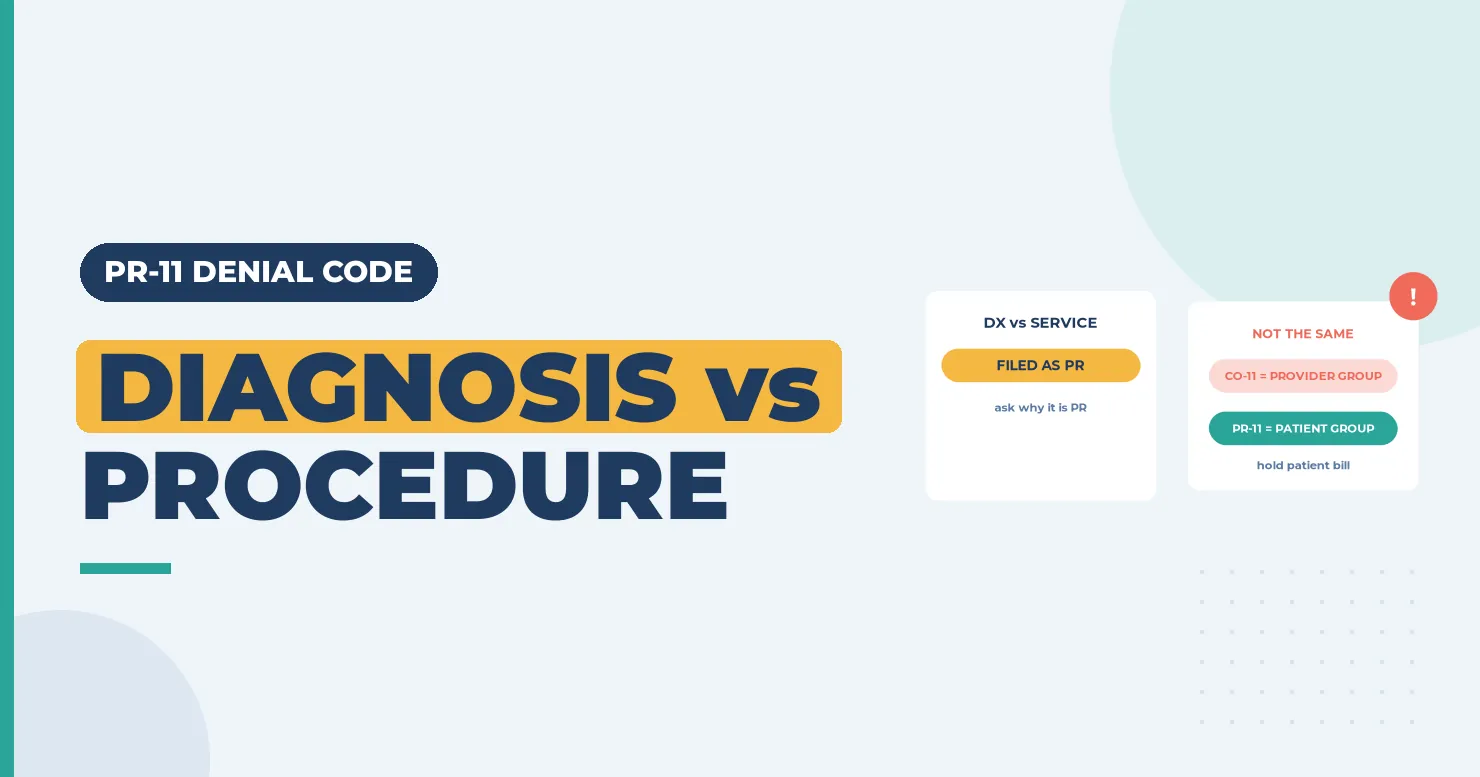
PR-11 is Claim Adjustment Reason Code 11 with group code PR. CARC 11 means the diagnosis is inconsistent with the procedure. A diagnosis pointer is the reference on a service line that links the procedure to a diagnosis code on the claim. The payer found that the diagnosis on the line does not fit the procedure, and it placed the amount under patient responsibility. That pairing is unusual, so read it with care before you bill anyone. Many people search for “pr 11 denial code”, and that is the phrase this page answers. (Primary sources: X12 Claim Adjustment Reason Codes · CMS Claims Processing Manual, Ch. 22, §60.1 · CMS Claims Processing Manual, Ch. 26)
Quick answer: The reason in PR-11 is a coding match problem, but the group says the patient may owe the amount. Check the diagnosis code and the diagnosis pointer on the line, fix them if the record supports a change, and resubmit. Then ask the payer why a diagnosis edit was placed in the PR group. Do not send a patient statement until the payer confirms the amount is a real patient share.
Part of our denial codes library. Written by Manikandan, a revenue cycle management specialist with more than 10 years of US medical billing experience. Last reviewed: 16 October 2026. Official code wording is quoted word for word from X12; Medicare rules link to their CMS source.
PR-11 denial code description (official X12 wording)
X12 Claim Adjustment Reason Code 11, verbatim:
“The diagnosis is inconsistent with the procedure. Usage: Refer to the 835 Healthcare Policy Identification Segment (loop 2110 Service Payment Information REF), if present.”
Source: X12 Claim Adjustment Reason Codes, checked 16 October 2026. Start: 01/01/1995. Last Modified: 07/01/2017.
The CARC is 11. Here the group code is PR. CMS describes PR as the group code used “when the adjustment represent an amount that may be billed to the patient or insured. This group would typically be used for deductible and copay adjustments.” CMS Transmittal 470 (2005) lists CARC 11 with group code CO, not PR, for Medicare fiscal intermediaries.
What PR-11 means in plain English
- The diagnosis and the procedure did not fit. The payer’s edit compared the ICD-10-CM code with the CPT or HCPCS code.
- The group is PR. The remit says the patient may be responsible for the amount.
- That is not the usual group for this reason. A match edit is a billing and coding issue, and CMS describes PR as typically used for deductible and copay adjustments.
- Do not assume the patient owes it. Ask the payer to confirm what the PR amount is.
- Fix the line first. A corrected claim may remove the adjustment.
PR-11 vs CO-11, CO-50 and lookalikes
| Code | Official X12 idea | What it tells you |
|---|---|---|
| PR-11 | Diagnosis inconsistent with the procedure | Match edit filed to the patient group. This page |
| CO-11 | Same reason, group CO | Provider write-off path. See CO-11 |
| 50 | Non-covered services because this is not deemed a medical necessity by the payer | Necessity decision. See CO-50 |
| PR-4 | Procedure code inconsistent with the modifier used | Modifier edit in the PR group. See PR-4 |
| 9 | Diagnosis inconsistent with the patient’s age | Age edit. See CO-9 |
| 10 | Diagnosis inconsistent with the patient’s gender | Sex edit. See CO-10 |
How the payer reaches PR-11
CMS Claims Processing Manual Ch. 26, Item 21 tells physicians and nonphysician practitioners to use diagnosis codes “to the highest level of specificity for the date of service” and to enter the diagnoses “in priority order.” Item 24E says to enter the diagnosis reference “to relate the date of service and the procedures performed to the primary diagnosis.”
So each line carries a pointer, and the payer reads the diagnosis the pointer picks. If that diagnosis is not on the payer’s list for the procedure, the line can come back with CARC 11. Remark codes can name the rule. X12 wording for three of them is below.
| RARC | Official X12 wording (shortened) |
|---|---|
| M76 | Missing/incomplete/invalid diagnosis or condition. |
| N115 | This decision was based on a Local Coverage Determination (LCD). |
| N386 | This decision was based on a National Coverage Determination (NCD). |
Common triggers for PR-11
- Wrong pointer. The line points to a diagnosis that belongs to a different service.
- A diagnosis that is too vague. For example, an unspecified code where the record supports a more specific one.
- A diagnosis not on the payer’s list. The policy lists the diagnoses that support the procedure, and yours is not one of them.
- Wrong procedure code. The diagnosis is right and the code is not.
- A diagnosis keyed for another visit. Consider a problem list that auto-filled the claim.
- The group was set by the payer. The edit fired correctly, but the payer put the amount in PR.
Where PR-11 shows up in the 835
CLP*PCN61774*4*140.00*0.00*140.00*12*CLAIM330917~
SVC*HC:73562*140.00*0.00**1~
CAS*PR*11*140.00~
REF*0K*DX-EDIT-73562~
- Status code 4 means the claim was denied.
- The line paid $0.
- CAS*PR*11*140.00 put the full charge under patient responsibility.
- The optional REF line may name the payer policy behind the edit.
- This sample is illustrative only. Real remits vary.
How to fix PR-11: decision path
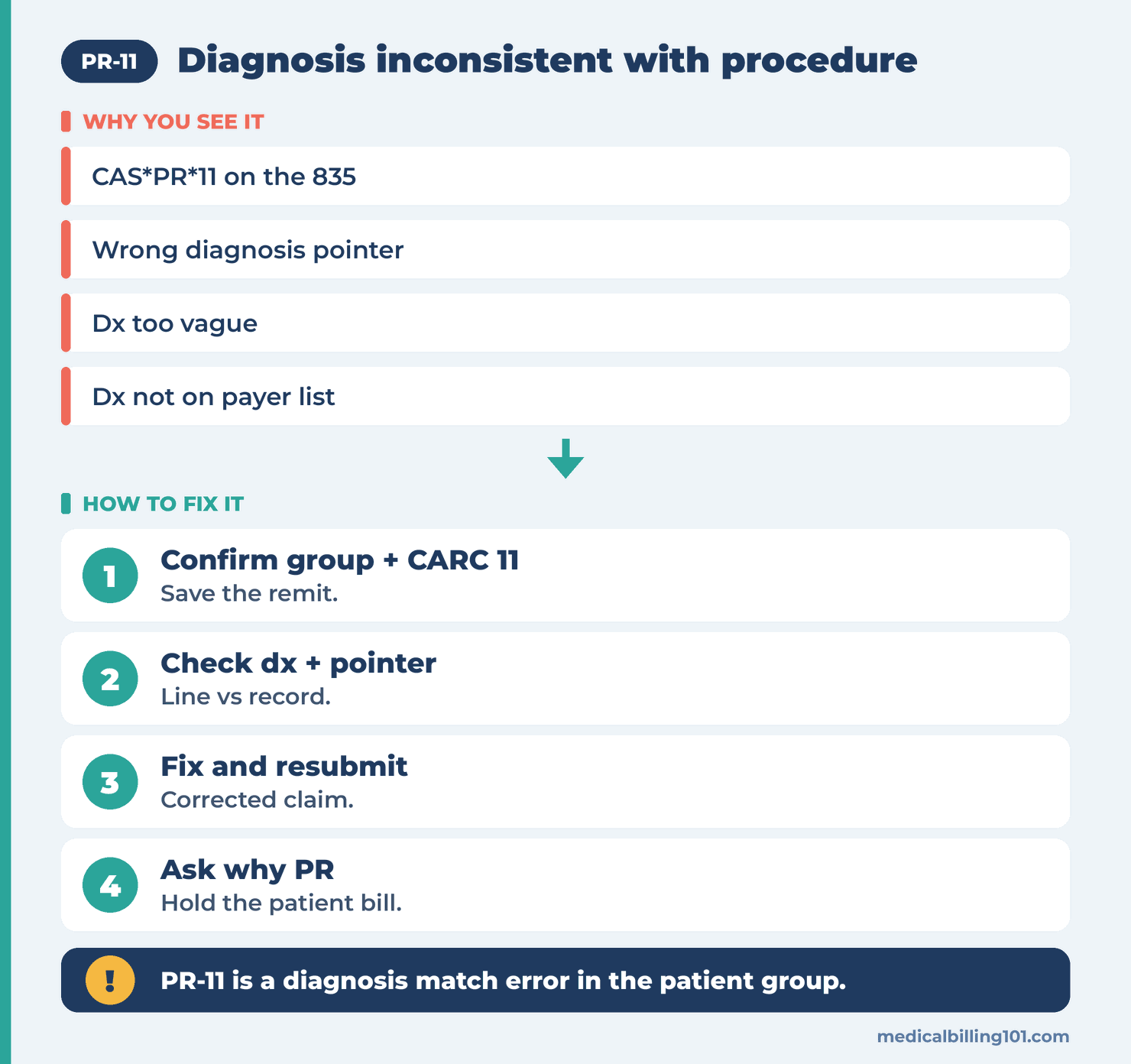
- Confirm the CAS segment. Check the group (PR), the reason (11), and the amount. Save the remit and any policy REF.
- Open the claim line. Note the procedure code, the diagnosis pointer, and the diagnosis it picks.
- Compare with the record. Does the note support that diagnosis for that service?
- Look up the payer policy for the procedure and its listed diagnoses.
- Correct the pointer or the code if the record supports a change, and resubmit as a corrected claim.
- If the claim was right, appeal with the note and the policy language.
- Ask the payer why the amount is in PR. A diagnosis edit is not a deductible or a copay.
- Hold the patient bill until the payer confirms the patient share.
Medicare, commercial and Medicaid notes
Medicare. CMS Transmittal 470 says that when a service is denied as “not reasonable and necessary” and no notice was delivered, “the beneficiary could not be held liable, and group code PR must not be used.” That passage is about necessity denials, not diagnosis edits, but it shows how CMS treats PR. Ask your contractor why PR was used here. Check the LCD or NCD named in the remark.
Commercial. Group code use varies by payer. Ask which rule put the amount in PR and whether your contract lets you bill it to the patient.
Medicaid. State programs publish their own diagnosis and procedure lists. Check the state provider manual before you bill the patient.
Worked example (illustrative)
A practice bills an X-ray, CPT 73562, for a knee. The line points to diagnosis B, and diagnosis B is a shoulder complaint. The remit shows CAS*PR*11*140.00.
Reading it: The diagnosis the pointer picked does not fit a knee X-ray, so the match edit fired.
Check: The note and the order both describe knee pain. The knee diagnosis is on the claim as diagnosis A, and the pointer was set to the wrong letter.
Fix: The biller changes the pointer to diagnosis A and sends a corrected claim. The biller also calls the payer to ask why the original amount was placed under patient responsibility, and holds the patient statement until the payer answers.
Second scenario: The pointer was right and the knee diagnosis is not on the payer’s list for this X-ray. The biller appeals with the note and the payer’s policy language.
Prevention checklist
- [ ] Review diagnosis pointers at charge entry, line by line.
- [ ] Code to the highest level of specificity the record supports.
- [ ] Keep payer diagnosis lists for your top procedures.
- [ ] Hold patient statements on any PR line with reason 11.
- [ ] Track PR-11 by payer to spot wrong group code use.
- [ ] Keep the CARC and RARC guide handy for staff training.
Related denial codes
- CO-11: the same reason under the contractual group.
- PR-4: procedure inconsistent with the modifier, filed under PR.
- CO-50: not deemed a medical necessity by the payer.
- CO-16: claim lacks information or has a billing error.
- CARC and RARC guide.
Key takeaways
PR-11 is a diagnosis match problem that the payer filed under patient responsibility. Fix the code or the pointer, and resubmit. Ask the payer why the group is PR, and hold the patient bill until it confirms the amount.
FAQ
What is the PR-11 denial code description?
X12 describes CARC 11 as “The diagnosis is inconsistent with the procedure.” PR-11 is that reason with group code PR.
Can I bill the patient for PR-11?
Not yet. The PR group says the patient may owe the amount, but the reason is a coding match edit. Ask the payer to confirm what the patient share is first.
What is the difference between PR-11 and CO-11?
The reason is the same. The group is not. CO means a provider write-off, and PR means the patient may owe the amount.
Is PR-11 a medical necessity denial?
No. CARC 11 is a match edit between a diagnosis and a procedure. A necessity decision uses CARC 50.
How do I fix PR-11?
Check the diagnosis and the diagnosis pointer on the line, correct them if the record supports it, and resubmit. Then ask the payer why the amount was in the PR group.
Is PR-11 appealable?
If the claim was right and the note supports it, appeal with the record and the payer’s policy. If the pointer or code was wrong, send a corrected claim.
Quick facts
| Item | Value |
|---|---|
| X12 code | 11 |
| X12 start | 01/01/1995 |
| Last modified | 07/01/2017 |
| Official wording | The diagnosis is inconsistent with the procedure |
| Group on this page | PR |
| CMS 2005 group for CARC 11 | CO |
| Common confusions | CO-11 (same reason, CO group), CO-50 (necessity) |
| Last reviewed | 16 October 2026 |
Sources
- X12, Claim Adjustment Reason Codes (CARC 9, 10, 11, 16, 50). CARC 11 Start 01/01/1995; Last Modified 07/01/2017. Accessed 16 Oct 2026.
- X12, Remittance Advice Remark Codes (M76, N115, N386). Accessed 16 Oct 2026.
- CMS, Medicare Claims Processing Manual (IOM 100-04), Ch. 22, §60.1 Group Codes. Accessed 16 Oct 2026.
- CMS, Medicare Claims Processing Manual (IOM 100-04), Ch. 26, Items 21 and 24E. Accessed 16 Oct 2026.
- CMS, Transmittal 470 (4 Feb 2005). Accessed 16 Oct 2026.
- Medical Billing 101, CO-11 guide.
Code wording and Medicare rules on this page were checked on 16 October 2026 against X12 and CMS sources.
Last reviewed: 16 October 2026 · This page is educational and doesn’t replace payer-specific contracts or coding rules.