
CO-129 is Claim Adjustment Reason Code 129 with group code CO. CARC 129 says “Prior processing information appears incorrect.” Prior processing information is what the payer, or another payer, recorded the first time this claim or a related claim was handled. Here the payer says that record does not look right, so it will not pay as it stands. X12 requires a remark code with this CARC, and that remark is where the real reason sits. Many people search for “co 129 denial code”, and that is the phrase this page answers. (Primary sources: X12 Claim Adjustment Reason Codes · X12 Remittance Advice Remark Codes · X12 RFI 2186)
Quick answer: CO-129 means the payer thinks earlier processing information for this claim is wrong. It is a pointer, not a diagnosis. Read the remark code on the same line, then compare the claim with the payer’s claim history and with any other payer’s remit. If your data was wrong, send a corrected claim. If the payer’s record was wrong, dispute it with proof. If the line is a recoupment, answer the overpayment notice by its deadline. A CO group means the patient is not billed.
Part of our denial codes library. Written by Manikandan, a revenue cycle management specialist with more than 10 years of US medical billing experience. Last reviewed: 18 October 2026. Official code wording is quoted word for word from X12; other sources link to their origin.
CO-129 denial code description (official X12 wording)
X12 Claim Adjustment Reason Code 129, verbatim:
“Prior processing information appears incorrect. At least one Remark Code must be provided (may be comprised of either the NCPDP Reject Reason Code, or Remittance Advice Remark Code that is not an ALERT.)”
Source: X12 Claim Adjustment Reason Codes, checked 18 October 2026. Start: 02/28/1997. Last Modified: 01/30/2011.
The CARC is 129. X12 does not tie it to one group code, so read the group on your remit. This page covers the CO pairing, where CO means Contractual Obligation in the X12 group code list. CMS Ch. 22, §60.1 says CO adjustments are generally a write-off for the provider and are not billed to the patient.
A remark code is a second code on the remittance that adds detail. An ALERT remark is informational only. X12 says 129 needs at least one remark that is not an ALERT. An NCPDP reject reason code, used on pharmacy claims, can serve instead.
What CO-129 means in plain English
- The payer says earlier processing data looks wrong. It could be its own record, a prior claim, or what another payer reported.
- The remark code carries the reason. X12 will not let 129 stand alone. Start there.
- It is not a coverage decision. The service may be fully covered once the data is fixed.
- It can deny, reverse or recoup. X12 RFI 2186 uses 129 with N199 to report an overpayment found on payer review.
- A CO group means contract liability. The patient is not billed for it.
When payers use CARC 129
- Another payer’s data disagrees with yours. A secondary payer finds the primary payer’s amounts differ from what the claim shows.
- A prior claim was processed with wrong data. The payer’s history carries a wrong date, code or patient detail, and this claim collides with it.
- A payer-initiated review changed an earlier payment. The payer reports an overpayment or a recoupment and cites 129.
- Patient or subscriber data does not match. The remark may point to a name or identifier problem.
- A pharmacy claim failed on a prior fill. The NCPDP reject reason code gives the detail.
CO-129 vs CO-B13, OA-18, CO-22 and lookalikes
| Code | Official idea | Difference |
|---|---|---|
| CO-129 | Prior processing information appears incorrect | The payer’s record or the claim data is in doubt. This page |
| CO-B13 | Previously paid | Payer says money already went out. See CO-B13 |
| OA-18 | Exact duplicate claim/service | Same claim sent twice. See OA-18 |
| CO-22 | This care may be covered by another payer per coordination of benefits | A different payer may owe. See CO-22 |
| CO-16 | Claim/service lacks information or has submission/billing error(s) | Your claim is incomplete. See CO-16 |
| CARC 23 | The impact of prior payer(s) adjudication including payments and/or adjustments | Informational. X12 limits it to group code OA |
Remark codes that can come with CO-129
X12 requires a remark with 129, so the remark is your fix list. These are wordings from X12:
- N199: “Additional payment/recoupment approved based on payer-initiated review/audit.” X12 RFI 2186 pairs it with 129 for an overpayment.
- N48: “Claim information does not agree with information received from other insurance carrier.”
- MA36: “Missing/incomplete/invalid patient name.”
- MA130: “Your claim contains incomplete and/or invalid information, and no appeal rights are afforded because the claim is unprocessable. Please submit a new claim with the complete/correct information.” See MA130.
Billing references such as ROI’s CARC 129 page list MA36, MA130 and N48 among the common pairings. Your payer may use others, so trust the remit in front of you.
Where CO-129 shows up in the 835
CLP*PCN40718*4*325.00*0.00*0.00*12*CLAIM662931~
SVC*HC:99213*325.00*0.00**1~
CAS*CO*129*325.00~
LQ*HE*N48~
- Status code 4 means the claim was denied.
- The line paid $0.
- CAS*CO*129*325.00 moves the full charge to a contractual adjustment with reason 129.
- LQ*HE*N48 carries the remark that explains it. In some remits the remark sits in an RMK segment.
- This sample is illustrative only. Real remits vary.
How to fix CO-129: decision path
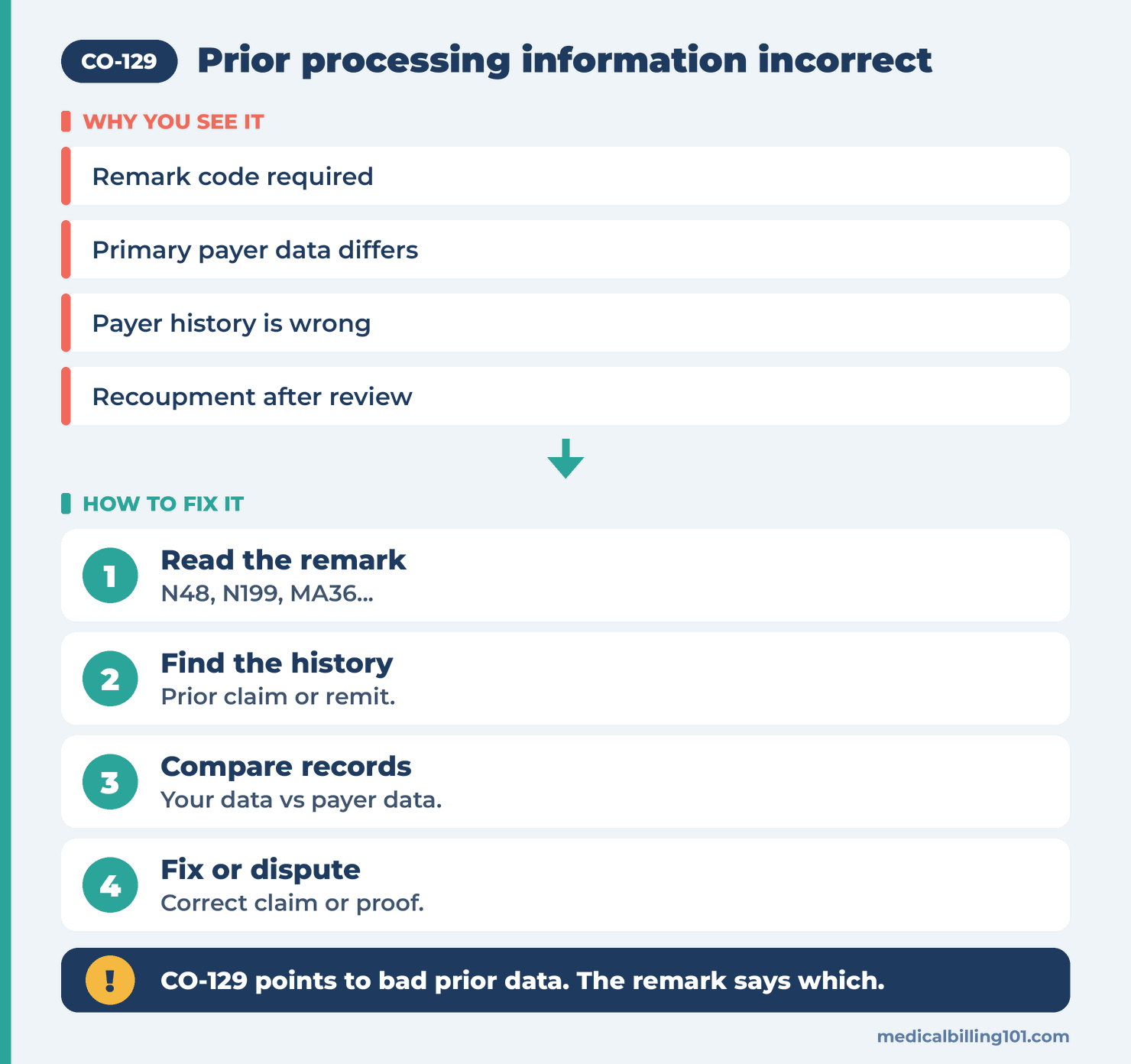
- Read the remark code first. It tells you whether the problem is your data, another payer’s data or the payer’s own record.
- Check the claim status. Is it a denial, a reversal or a recoupment? The next steps differ.
- Pull the payer’s claim history. Find the earlier processing the payer means. Look at dates, codes, amounts and patient details.
- Compare it with your records. Include the primary payer’s remit if this is a secondary claim.
- If your claim data was wrong, send a corrected claim in the way the payer’s manual describes, such as frequency code 7 for a replacement claim.
- If the payer’s record was wrong, ask for a reconsideration and attach the proof, such as the primary payer’s remit or the original claim.
- If the line is a recoupment, read the overpayment notice, note its deadline and answer through the dispute route it names.
- Do not bill the patient under a CO group. Check your contract if you are unsure.
Medicare, commercial and Medicaid notes
Medicare. Medicare Secondary Payer claims depend on the primary payer’s remit being accurate. If a remark such as N48 appears, compare your claim with the primary payer’s adjustment detail line by line.
Commercial. Plans differ on corrected claims and on how they reverse earlier payments. Check the provider manual for the correction route and the time limits for corrections and disputes.
Medicaid. Medicaid is often the payer of last resort, so a mismatch with a primary plan is a common cause. Check your state’s manual for how it wants primary payer data reported.
Worked example (illustrative)
A clinic bills a secondary payer after the primary payer paid. The remit shows CAS*CO*129*325.00 with remark N48.
Reading it: The payer says the claim information does not agree with what the other carrier reported. The CARC says the prior processing information appears incorrect.
Check: The primary payer’s remit shows an allowed amount of $210.00 and a $40.00 copay. The claim sent to the secondary payer listed a $60.00 copay, because the front desk had keyed the wrong figure.
Fix: The billing team corrects the copay and the primary payment on the claim and sends a replacement claim with the primary remit attached. It does not bill the patient for the $325.00 adjustment.
Second scenario: A remit shows 129 with N199 as a recoupment after a payer audit. The team reads the notice, finds the deadline and sends its response and records through the dispute route the notice names. If the payer’s finding is correct, it posts the refund and notes the cause.
Prevention checklist
- [ ] Key primary payer amounts straight from the primary remit, not from memory.
- [ ] Check patient name, date of birth and member ID against the card at each visit.
- [ ] Attach the primary remit to secondary claims when the payer allows it.
- [ ] Work remark codes the day a remit posts, not only the CARC.
- [ ] Log the deadline on every recoupment or overpayment notice.
- [ ] Track 129 by remark code to see which fix repeats.
- [ ] Keep the CARC and RARC guide handy for staff training.
Related denial codes
- CO-B13: previously paid.
- OA-18: exact duplicate claim or service.
- CO-22: care may be covered by another payer.
- CO-16: claim lacks information or has a billing error.
- MA130: unprocessable claim with no appeal rights.
- CARC and RARC guide.
Key takeaways
CO-129 says the payer thinks earlier processing information is wrong, and X12 requires a remark code to say why. Read the remark, compare your claim with the payer’s history and any other payer’s remit, and fix whichever record is wrong. A CO group means the patient is not billed.
FAQ
What is the CO-129 denial code description?
X12 words it as “Prior processing information appears incorrect,” followed by a rule that at least one remark code that is not an ALERT must be provided.
Why does CO-129 always come with a remark code?
X12 requires it. The remark, or an NCPDP reject reason code on pharmacy claims, tells you which piece of prior processing information is in doubt.
Is CO-129 the same as a duplicate claim denial?
No. A duplicate uses OA-18 and means the same claim or service was already processed. CO-129 means the payer’s earlier processing data, or the data it was given, looks wrong.
Can I bill the patient for CO-129?
Not under a CO group. CMS says CO adjustments are generally a write-off for the provider. Check your contract for exceptions.
What does CO-129 with N199 mean?
X12 RFI 2186 says an overpayment found by the payer is reported with CARC 129 and RARC N199, “Additional payment/recoupment approved based on payer-initiated review/audit.” Read the notice and respond by its deadline.
Can I appeal a CO-129 denial?
Yes, when the payer’s record is wrong. Send the proof, such as the primary payer’s remit. If the remark says the claim is unprocessable, as MA130 does, send a new claim instead.
Quick facts
| Item | Value |
|---|---|
| X12 code | 129 |
| X12 start | 02/28/1997 |
| X12 last modified | 01/30/2011 |
| Official wording | Prior processing information appears incorrect |
| Remark code | Required, not an ALERT |
| Group on this page | CO |
| Common confusions | CO-B13 (previously paid), OA-18 (duplicate), CO-22 (other payer) |
| Last reviewed | 18 October 2026 |
Sources
- X12, Claim Adjustment Reason Codes (129, 16, 18, 22, 23). CARC 129 Start 02/28/1997. Accessed 18 Oct 2026.
- X12, Remittance Advice Remark Codes (N199, N48, MA36, MA130). Accessed 18 Oct 2026.
- X12, RFI 2186: payment prior claim submission. Accessed 18 Oct 2026.
- CMS, Medicare Claims Processing Manual (IOM 100-04), Ch. 22, §60.1 Group Codes. Accessed 18 Oct 2026.
- ROI, CARC 129 reference (common RARC pairings). Accessed 18 Oct 2026.
Code wording on this page was checked on 18 October 2026 against X12 sources.
Last reviewed: 18 October 2026 · This page is educational and doesn’t replace payer-specific contracts or coding rules.