
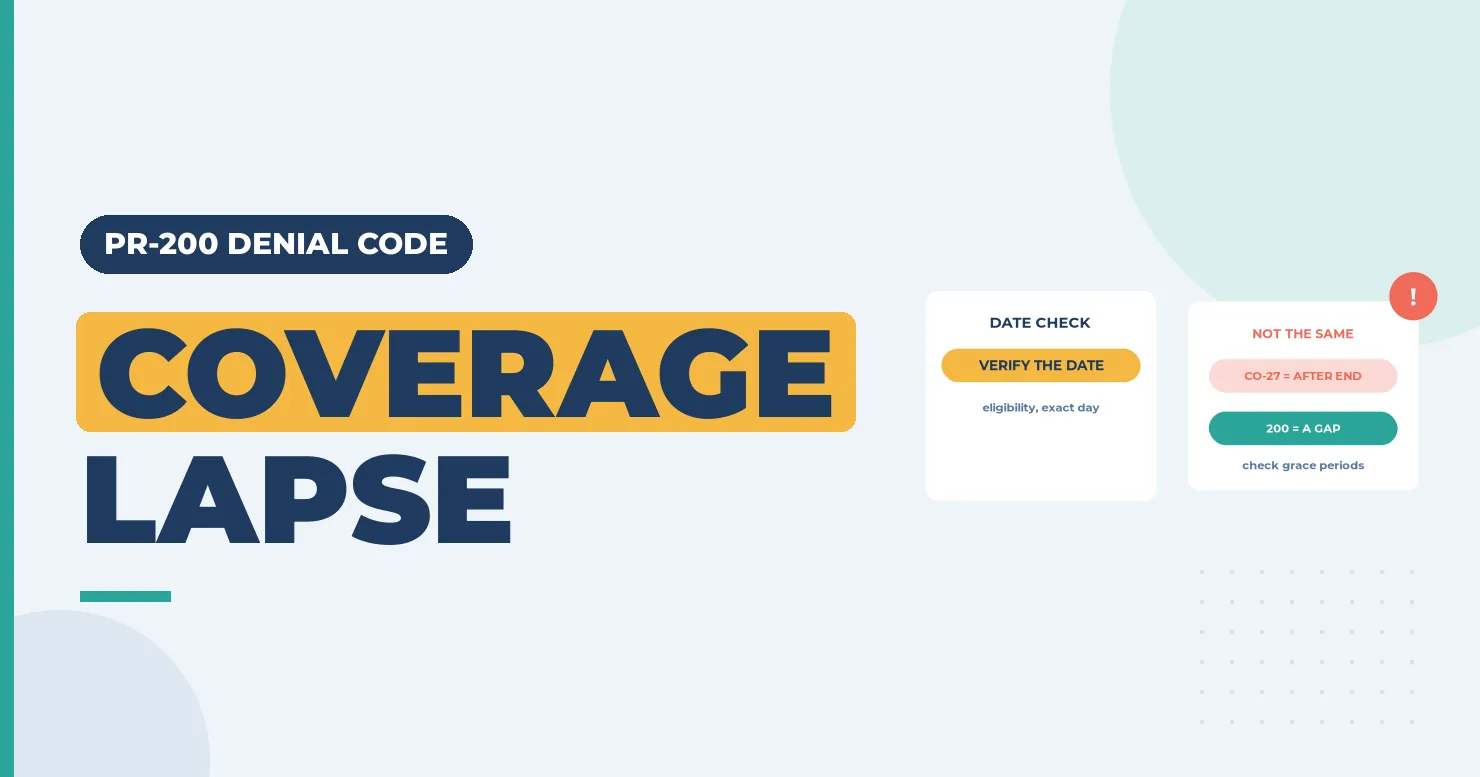
PR-200 is Claim Adjustment Reason Code 200 with group code PR. CARC 200 says “Expenses incurred during lapse in coverage.” A lapse in coverage is a gap when the patient’s plan was not active, for example after a missed premium or an eligibility break. The payer says the date of service fell inside that gap. Group PR means Patient Responsibility, so the remit assigns the amount to the patient. Many people search for “pr 200 denial code”, and that is the phrase this page answers. (Primary sources: X12 Claim Adjustment Reason Codes · X12 Remittance Advice Remark Codes · 45 CFR 156.270)
Quick answer: PR-200 means the payer says the patient had no active coverage on the date of service. Before you bill the patient, verify eligibility for that exact date. Grace periods, retroactive reinstatement and a second plan can all change the answer. If coverage was active, appeal with proof. If another plan covered the date, rebill it. If the lapse is real, the PR group lets you bill the patient, subject to your contract and state law.
Part of our denial codes library. Written by Manikandan, a revenue cycle management specialist with more than 10 years of US medical billing experience. Last reviewed: 18 October 2026. Official code wording is quoted word for word from X12; federal rules link to their source.
PR-200 denial code description (official X12 wording)
X12 Claim Adjustment Reason Code 200, verbatim:
“Expenses incurred during lapse in coverage”
Source: X12 Claim Adjustment Reason Codes, checked 18 October 2026. Start: 10/31/2006. X12 lists no usage note and no later modification.
The CARC is 200. Here the group code is PR. CMS describes PR as the group code used “when the adjustment represent an amount that may be billed to the patient or insured. This group would typically be used for deductible and copay adjustments.” The word “may” matters. It does not say the patient must pay.
What PR-200 means in plain English
- The payer says coverage had a gap. The date of service falls in a period when the plan was not active.
- The group is PR. The remit assigns the amount to the patient.
- It is a date check. The question is whether coverage was active on that one date.
- Lapses are sometimes reversed. A paid premium, a grace period or a retroactive approval can close the gap.
- Do not bill first. Verify eligibility for the exact date before you send a statement. A wrong bill to a patient who was covered is hard to take back.
PR-200 vs CO-26, CO-27, CARC 238 and lookalikes
| Code | Official idea | Difference |
|---|---|---|
| PR-200 | Expenses incurred during lapse in coverage | A gap in the middle of coverage. This page |
| CO-26 | Expenses incurred prior to coverage | Before the start date. See CO-26 |
| CO-27 | Expenses incurred after coverage terminated | After the end date. See CO-27 |
| CARC 238 | Claim spans eligible and ineligible periods of coverage, this is the reduction for the ineligible period | X12 limits it to group code PR |
| CARC 239 | Claim spans eligible and ineligible periods of coverage. Rebill separate claims | Split the claim by period |
| CARC 257 | The disposition of the claim/service is undetermined during the premium payment grace period | Pending, not final. X12 limits it to group code OA |
| PR-204 | This service/equipment/drug is not covered under the patient’s current benefit plan | Plan benefit issue. See PR-204 |
Why coverage lapses
You will see six causes in practice. Knowing which one applies tells you what to do next.
- Unpaid premium. The plan ended or paused coverage after a missed payment.
- Marketplace grace period. A person receiving advance payments of the premium tax credit gets 3 consecutive months to catch up. The plan must pay claims in month one and may pend claims in months two and three, under 45 CFR 156.270(d).
- Grace period runs out. The plan terminates enrollment on the date set under the Exchange rules in 45 CFR 155.430(d)(4), as 156.270(g) requires. Claims for the months it pended can then be denied.
- Eligibility break. A Medicaid redetermination or an employer plan change leaves a gap of days or weeks.
- Late reinstatement. The patient pays or re-enrolls later, and the plan restores coverage back to the gap.
- Payer data error. The plan’s file shows a gap that did not happen.
Remark codes that can come with PR-200
X12 does not fix one remark for 200. These X12 wordings fit lapse situations:
- N30: “Patient ineligible for this service.”
- N619: “Coverage terminated for non-payment of premium.”
- N617: “This enrollee is in the second or third month of the advance premium tax credit grace period.”
- N618: “Alert: This claim will automatically be reprocessed if the enrollee pays their premiums.”
- N581: “Investigation of coverage eligibility is pending.”
If you see N618, do not resubmit. The payer says it will reprocess the claim if the patient catches up on premiums. Track it and recheck eligibility before you bill the patient.
Where PR-200 shows up in the 835
CLP*PCN61207*4*540.00*0.00*540.00*HM*CLAIM300418~
SVC*HC:99204*540.00*0.00**1~
CAS*PR*200*540.00~
LQ*HE*N619~
- Status code 4 means the claim was denied.
- The line paid $0, and CAS*PR*200*540.00 puts the full charge in patient responsibility.
- LQ*HE*N619 says coverage ended for non-payment of premium.
- This sample is illustrative only. Real remits vary.
How to fix PR-200: decision path
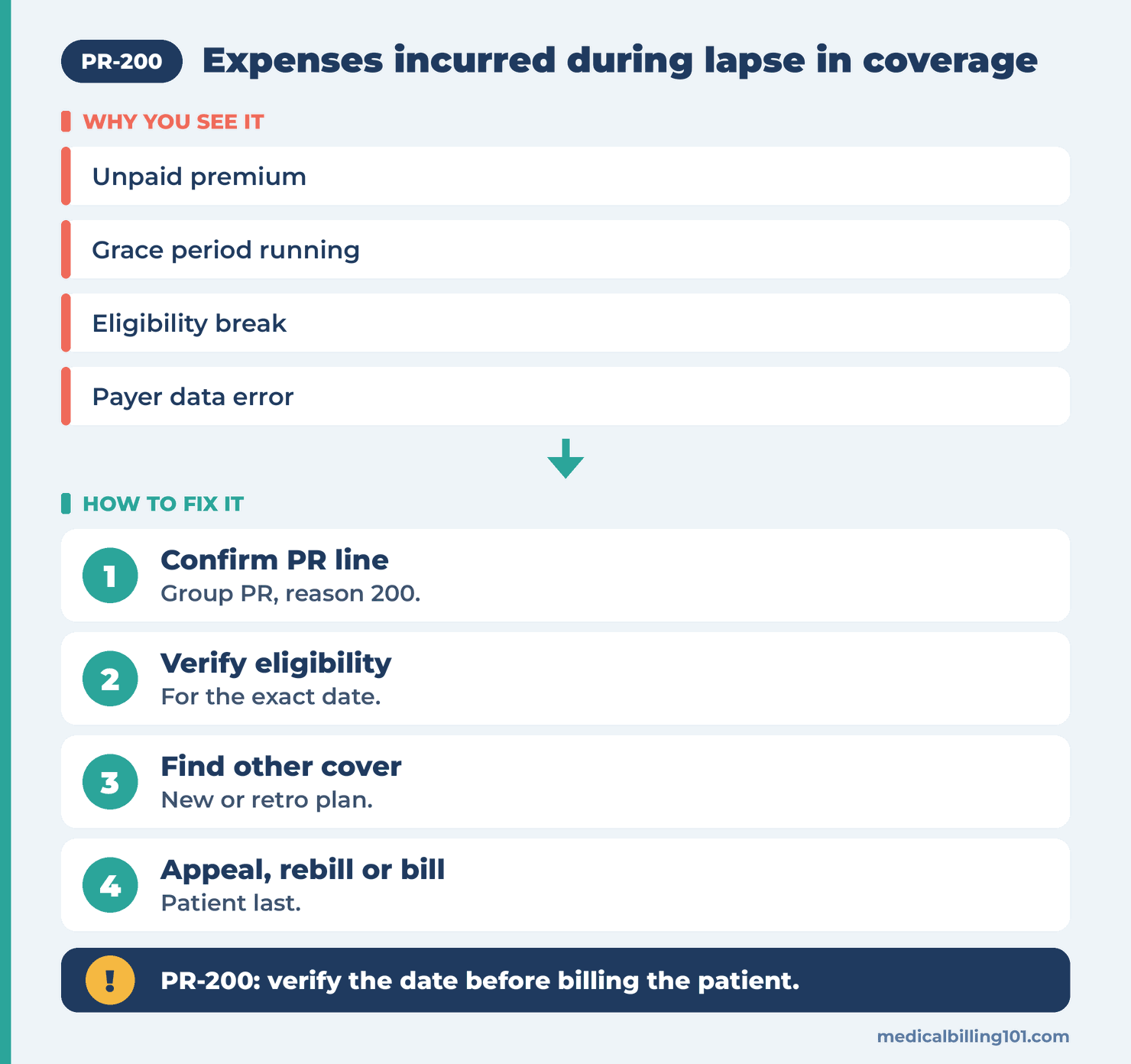
- Confirm the CAS line. Check the group (PR), the reason (200), the amount and the date of service.
- Run eligibility for that exact date. Use the payer portal or a 270/271 check. Save the response.
- Check for a grace period. For marketplace plans, ask the payer whether the date falls in month one, two or three.
- Look for other coverage. Ask the patient for a new card, a spouse’s plan, Medicaid or any retroactive plan.
- If coverage was active, send an appeal or reconsideration with the eligibility proof.
- If another payer covers the date, rebill it within its filing limit.
- If coverage is later reinstated, ask the payer to reprocess, or follow its resubmission steps.
- If the lapse is real, bill the patient as your contract and state law allow, and offer a payment plan.
Medicare, commercial and Medicaid notes
Medicare. Medicare coverage dates come from entitlement records. If you see a lapse on a Medicare claim, check the beneficiary’s eligibility record and enrollment dates before you bill anyone.
Commercial. Plans set their own grace periods and reinstatement rules. For marketplace plans, 45 CFR 156.270 sets the 3-month grace period for people receiving advance premium tax credits.
Medicaid. Federal rules at 42 CFR 435.915 say a state must make eligibility effective as early as the third month before the month of application, when the person received covered services and would have been eligible. A Medicaid approval after the visit can close a gap. State details vary, so check yours.
Worked example (illustrative)
A clinic sees a marketplace patient on 12 September for a new patient visit. The remit shows CAS*PR*200*540.00 with remark N619.
Reading it: The payer says the visit fell in a lapse in coverage. The remark says coverage was terminated for non-payment of premium.
Check: The eligibility check shows no active coverage from 1 August to 30 September, because premiums went unpaid. The 12 September visit sits inside that gap. The patient has no other plan on file.
Fix: The billing team tells the patient what happened, explains the balance and offers a payment plan, as its policy and state law allow. It does not appeal, because the coverage proof does not support one.
Second scenario: The same remit shows N617 and the patient says premiums were paid on 20 September. The team asks the payer if the date was inside the grace period, and requests reprocessing if the premium was received in time. It holds the patient bill until the payer answers.
Prevention checklist
- [ ] Verify eligibility for the date of service on the day of the visit.
- [ ] Re-verify for marketplace patients who said they were behind on premiums.
- [ ] Ask every patient about other coverage at check-in.
- [ ] Save the eligibility response with the claim.
- [ ] Hold claims that show N617 or N618 until the payer decides.
- [ ] Discuss financial responsibility with patients who are in a grace period.
- [ ] Keep the CARC and RARC guide handy for staff training.
Related denial codes
- CO-26: expenses incurred prior to coverage.
- CO-27: expenses incurred after coverage terminated.
- PR-204: service not covered under the current benefit plan.
- CO-31: patient cannot be identified as our insured.
- PR-1, PR-2 and PR-3: deductible, coinsurance and copay.
- CARC and RARC guide.
Key takeaways
PR-200 says the date of service fell in a gap in coverage and assigns the amount to the patient. Verify eligibility for that exact date, check for a grace period or other coverage, and appeal or rebill if the gap is wrong. Bill the patient only when the lapse is real.
FAQ
What is the PR-200 denial code description?
X12 words it as “Expenses incurred during lapse in coverage.”
What does PR mean in PR-200?
PR is the group code for Patient Responsibility. CMS says it is used when the amount may be billed to the patient or insured.
Can I bill the patient for PR-200?
Often yes, but verify eligibility for the exact date first. Check your contract and state law, and wait if the payer says it will reprocess the claim.
What is the difference between PR-200 and CO-27?
CO-27 means the service came after coverage ended. PR-200 means the service fell in a gap while the person still had a plan that was not active.
What is the marketplace grace period?
Under 45 CFR 156.270(d), a person receiving advance payments of the premium tax credit gets 3 consecutive months. The issuer must pay claims in month one and may pend claims in months two and three.
Can I appeal a PR-200 denial?
Yes, when coverage was active, or was reinstated, for the date of service. Send the eligibility proof with your appeal.
Quick facts
| Item | Value |
|---|---|
| X12 code | 200 |
| X12 start | 10/31/2006 |
| Official wording | Expenses incurred during lapse in coverage |
| Group on this page | PR (Patient Responsibility) |
| Common remarks | N30, N619, N617, N618, N581 |
| Common confusions | CO-26 (before coverage), CO-27 (after coverage), CARC 238 (split claim) |
| Last reviewed | 18 October 2026 |
Sources
- X12, Claim Adjustment Reason Codes (200, 26, 27, 238, 239, 257). CARC 200 Start 10/31/2006. Accessed 18 Oct 2026.
- X12, Remittance Advice Remark Codes (N30, N619, N617, N618, N581). Accessed 18 Oct 2026.
- eCFR, 45 CFR 156.270, Termination of coverage or enrollment for qualified individuals. Accessed 18 Oct 2026.
- eCFR, 42 CFR 435.915, Effective date (Medicaid). Accessed 18 Oct 2026.
- CMS, Medicare Claims Processing Manual (IOM 100-04), Ch. 22, §60.1 Group Codes. Accessed 18 Oct 2026.
Code wording and federal rules on this page were checked on 18 October 2026 against X12 and eCFR sources.
Last reviewed: 18 October 2026 · This page is educational and doesn’t replace payer-specific contracts or coding rules.