
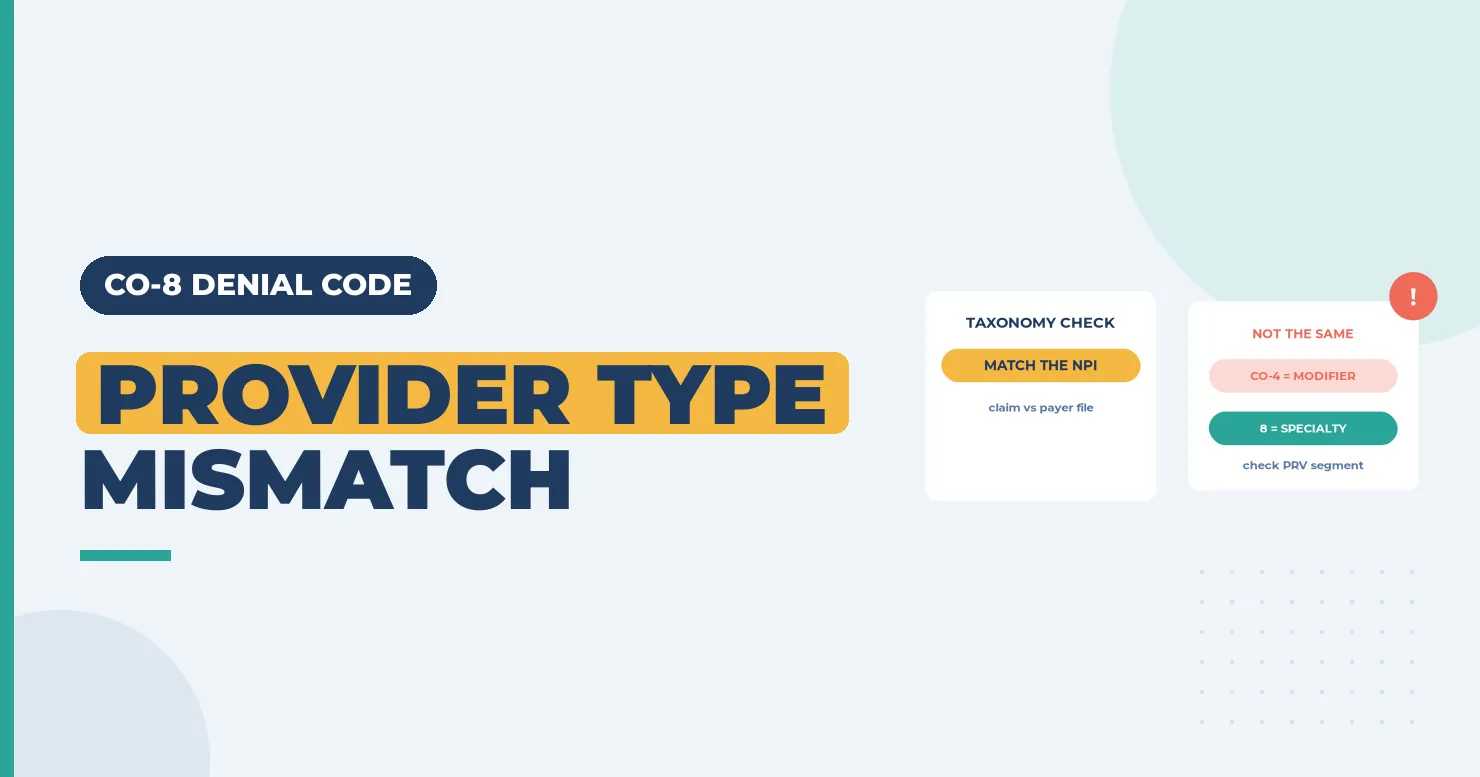
CO-8 is a remittance adjustment. It tells you the payer looked at who performed the service and decided that kind of provider shouldn’t be billing that procedure code. The reason code is about the provider, not the patient, the diagnosis or the coverage. Most of the time the root cause is a taxonomy code on the claim that doesn’t match what the payer has on file. (Primary sources: X12 Claim Adjustment Reason Codes · X12 Remittance Advice Remark Codes · NUCC Health Care Provider Taxonomy)
In brief: CO-8 means “the procedure code is inconsistent with the provider type/specialty (taxonomy).” Compare the taxonomy on the claim with the one the payer has enrolled for the rendering and billing NPI. If the claim was wrong, send a corrected claim. If the payer’s file is wrong, fix the enrollment and ask for reprocessing. If the provider really can’t bill that code, the line is a write-off. Under CO, the patient isn’t billed.
Part of our denial codes library. Written by Manikandan J, CPC, CRCR, who has more than 10 years of US medical billing and revenue cycle experience. Published 20 October 2026. Last updated: 20 October 2026. Code wording is quoted word for word from X12.
CO-8 denial code description (official X12 wording)
| Field | Official X12 text |
|---|---|
| Description | “The procedure code is inconsistent with the provider type/specialty (taxonomy).” |
| Usage | “Refer to the 835 Healthcare Policy Identification Segment (loop 2110 Service Payment Information REF), if present.” |
Source: X12 Claim Adjustment Reason Codes, checked 20 October 2026. Start: 01/01/1995. Last Modified: 07/01/2017.
The word in brackets matters. A taxonomy code is the ten-character code from the NUCC list that describes a provider’s type and specialty, such as 207RC0000X for cardiovascular disease. Payers compare it with the procedure code. When the pair doesn’t make sense to their edit, the line drops with CARC 8. The usage note tells you to look for a policy reference in the 835 REF segment. When it’s there, it names the rule that fired.
Denial code 8, CARC 8 and reason code 8: one code
Denial code 8, CARC 8 and reason code 8 are three names for the same X12 Claim Adjustment Reason Code. Billers add the group code when they talk about a specific remit, which is how you get “CO-8” or “CO 8.” The reason stays the same. The group code changes who carries the balance.
What CO-8 means in plain English
Provider scope means the set of services a provider type may bill under a plan. Think of CO-8 as a scope check that failed. The payer keeps a list of which provider types may bill which codes. For example, a physical therapist billing an evaluation and management visit, a lab billing a surgical code, or a nurse practitioner billing under a specialty the plan doesn’t credential for that service can all trip it. So can a perfectly legitimate service when the claim carries the wrong taxonomy.
That last case is more common than people expect. A group with several specialties often sends one default taxonomy for every claim. When a cardiologist’s echo goes out with the group’s internal medicine taxonomy, the code and the specialty no longer line up.
Group code table: CO-8, PR-8, OA-8 and PI-8
| Group + CARC | Who carries the amount | What to do |
|---|---|---|
| CO-8 | The provider (Contractual Obligation) | Correct or appeal. Don’t bill the patient. |
| PR-8 | The patient (Patient Responsibility) | Rare for this reason. Check that the payer meant PR before you send a statement. |
| OA-8 | Neither side assigned (Other Adjustment) | Read the remark and the REF policy. Call the payer if it’s unclear. |
| PI-8 | The provider, by payer reduction (non-Medicare) | Treat like CO. Check your contract terms. |
CMS describes CO adjustments as amounts that are “generally… considered a write off for the provider and are not billed to the patient” (Medicare Claims Processing Manual, Ch. 22, §60.1). Medicare remits use CO, OA and PR only.
Common causes of CO-8 (with the remark code each tends to bring)
Payers choose their own remark pairings, so read the RARC column as a frequent match, not a rule. RARC wording is from the X12 RARC list.
| Cause | Typical RARC | Fix |
|---|---|---|
| The service is outside what this provider type may bill | N95 | Confirm the plan’s scope rules. If correct, write off. If another provider type did the work, bill under that provider. |
| The payer doesn’t cover the code for this specialty | N808 | Read the plan policy in the REF segment. Appeal if the policy allows the specialty. |
| The claim’s taxonomy is too general for the edit | N94 | Send the specific taxonomy for the rendering provider on a corrected claim. |
| Rendering provider taxonomy missing or invalid | N288 | Add the rendering taxonomy in the PRV segment of loop 2310B and resubmit. |
| Billing provider taxonomy missing or invalid | N255 | Fix the billing provider PRV segment in loop 2000A. |
| Payer’s enrollment file lists a different specialty | N95 or N808 | Update the enrollment or credentialing record, then ask for reprocessing. |
| Group billed a specialist’s service under the group’s default taxonomy | N94 or N95 | Map taxonomy to the rendering provider in your PM system. |
How to fix CO-8: step by step
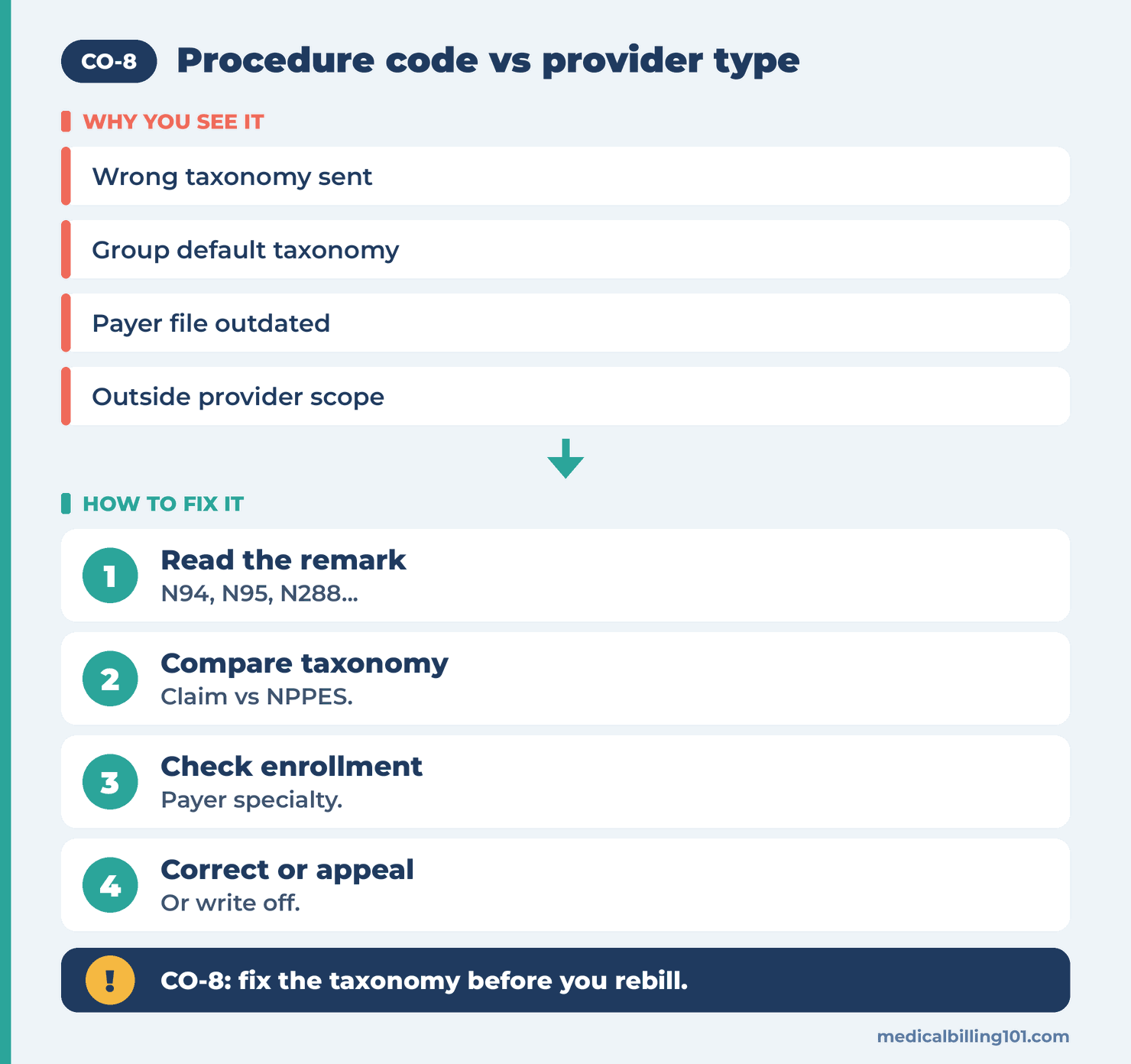
- Read the remark code and any REF policy. N288 or N255 is a data problem you can correct. N95 or N808 is a scope or coverage rule.
- Pull the taxonomy from the claim. Check both the billing provider and rendering provider PRV segments.
- Compare it with NPPES and the payer’s file. Look up the NPI in the NPPES NPI Registry. Then check the payer portal or your credentialing record for the specialty the payer has on file.
- Ask who really did the service. If a provider with a different license did it, the claim may need a different rendering provider, not a different code.
- If the claim was wrong, send a corrected claim. Use frequency code 7 if the payer wants a replacement claim. Don’t send a fresh duplicate.
- If the payer’s file was wrong, fix enrollment first. Then ask the payer to reprocess, citing the corrected record and its effective date.
- If the provider type truly can’t bill the code, stop. Under CO the balance is a write-off. Fix the scheduling or referral path so it doesn’t repeat.
Appeal approach
Appeal CO-8 when the provider is licensed and credentialed to perform the service and the plan’s own policy allows it. A good appeal packet has four parts:
- The remit line and remark code.
- Proof of the provider’s specialty: the NPPES record, the payer’s enrollment confirmation, board certification if relevant.
- The plan policy or fee schedule that lists the code as payable for that specialty.
- The record of the service, signed by the rendering provider.
If the denial came from your own taxonomy error, a corrected claim is faster than an appeal. Keep the appeal route for cases where the payer’s rule or file is wrong.
Questions to ask the payer about a CO-8
- Which taxonomy or specialty do you have on file for this NPI, and since what date?
- Which provider types may bill this code under the member’s plan?
- Is the edit based on the billing provider, the rendering provider, or both?
- Do you want a corrected claim or a reconsideration for this fix?
- What is the deadline for each route?
- Can you give me the policy number behind the edit?
Write down the rep’s name, the call reference number and the date. Put them in the claim notes.
Worked example (illustrative)
A multispecialty group bills a transthoracic echo for a cardiology patient. The remit shows CAS*CO*8*410.00 with remark N94. The billing team pulls the claim and finds the group’s default internal medicine taxonomy in the rendering provider PRV segment. The cardiologist’s NPPES record lists a cardiovascular disease taxonomy.
The team sends a corrected claim with the cardiologist’s taxonomy. The line pays on reprocessing. The PM system is then set to pull the taxonomy from each rendering provider’s profile, not from the group default.
Medicare, Medicaid and commercial notes
Medicare. Medicare checks the provider’s enrollment in PECOS. If the specialty there is wrong, update PECOS. Rebilling alone won’t help.
Medicaid. State Medicaid programs often enroll each provider type separately and publish which types may bill which codes. Check the state’s provider manual and fee schedule.
Commercial plans. Credentialing files can lag behind a new hire or a specialty change. Ask the plan to confirm the specialty it loaded and its effective date.
Prevention checklist
- [ ] Store a taxonomy code on every rendering provider profile, not just the group.
- [ ] Match each taxonomy with NPPES when a provider joins or changes specialty.
- [ ] Check that each payer has loaded the same specialty after credentialing.
- [ ] Add a claim scrubber edit that flags taxonomy and procedure pairs your payers have denied before.
- [ ] Track CO-8 by payer and by remark code each month.
Related denial codes
- CO-4: the procedure code is inconsistent with the modifier used.
- CO-5: the procedure code or bill type is inconsistent with the place of service.
- CO-11: the diagnosis is inconsistent with the procedure.
- CO-B7: the provider wasn’t certified or eligible to be paid for this service on this date.
- CO-16: the claim lacks information or has billing errors.
- CARC and RARC guide for how the codes fit together.
Key takeaways
CO-8 is a provider-type check. Start with the taxonomy on the claim, then the payer’s enrollment file, then the plan’s scope rules. Data errors get a corrected claim. File errors get an enrollment fix and reprocessing. Real scope limits get a write-off and a workflow change.
FAQ
What is the CO-8 denial code description?
X12 words CARC 8 as “The procedure code is inconsistent with the provider type/specialty (taxonomy).” The CO group means the provider carries the amount.
Is denial code 8 the same as CO-8?
Yes. Denial code 8, CARC 8 and reason code 8 are the same X12 code. CO is the group code that says the provider owes the adjustment.
What usually causes a CO-8 denial?
A taxonomy on the claim that doesn’t match the payer’s file, a too-general group taxonomy, or a provider type the plan doesn’t allow to bill that code.
Can I bill the patient for CO-8?
Not under CO. CMS describes CO amounts as a provider write-off that isn’t billed to the patient.
Should I appeal or send a corrected claim?
Send a corrected claim when your taxonomy or rendering provider was wrong. Appeal when the provider is credentialed for the service and the payer’s rule or file is wrong.
Where does the taxonomy go on an electronic claim?
In the PRV segment. The billing provider’s is in loop 2000A and the rendering provider’s is in loop 2310B of the 837P.
Sources
How we checked: every code quote on this page was compared word for word with the X12 CARC and RARC lists on 20 October 2026.
- X12, Claim Adjustment Reason Codes (CARC 8). Accessed 20 Oct 2026.
- X12, Remittance Advice Remark Codes (N94, N95, N255, N288, N808). Accessed 20 Oct 2026.
- NUCC, Health Care Provider Taxonomy code set. Accessed 20 Oct 2026.
- CMS, NPPES NPI Registry. Accessed 20 Oct 2026.
- CMS, Medicare Claims Processing Manual, Ch. 22, §60.1 Group Codes. Accessed 20 Oct 2026.
Last updated: 20 October 2026 · This page is educational and doesn’t replace payer contracts or coding rules.