
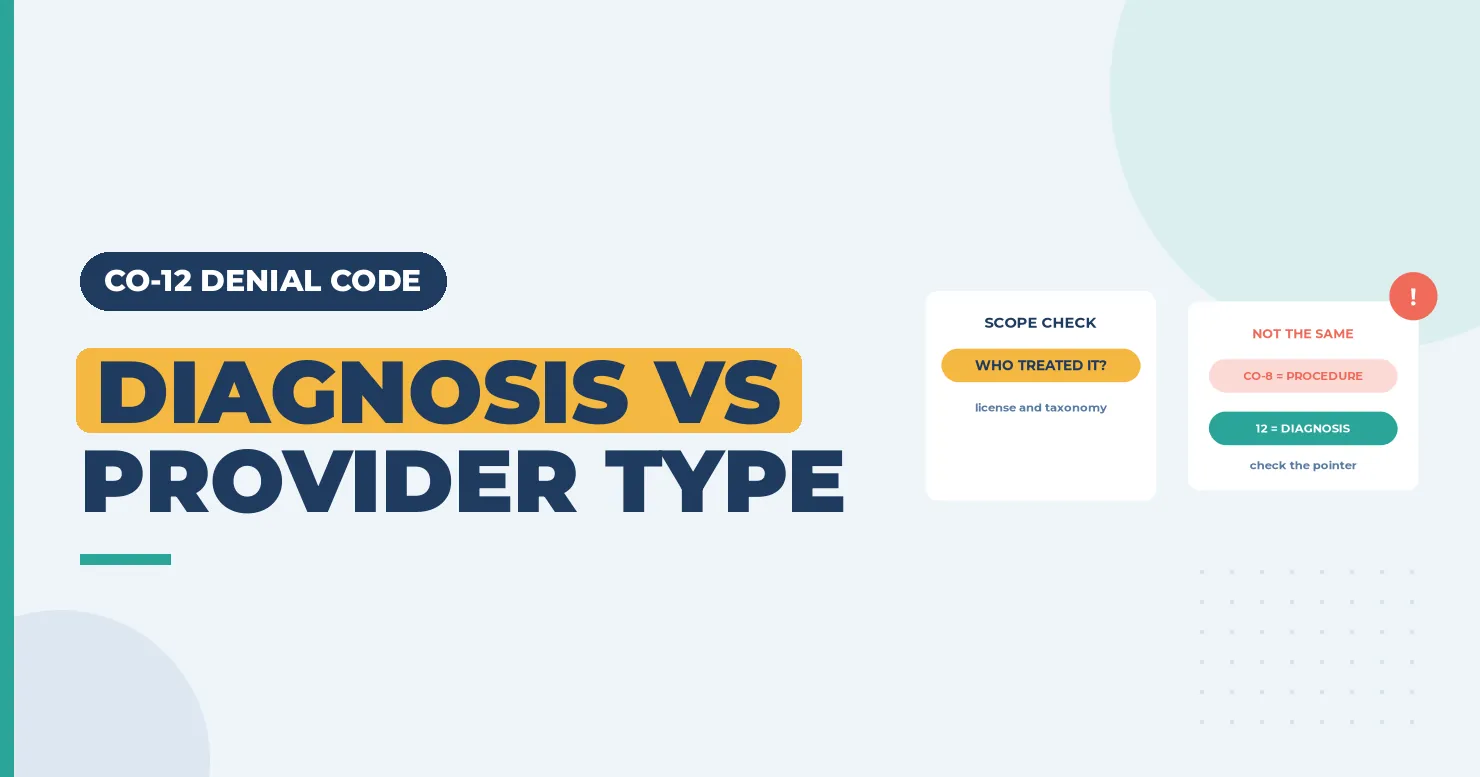
CO-12 is a scope-of-practice denial. When a remit shows it, the payer is questioning who treated the condition, not the condition itself. Its edit compared the diagnosis on the claim with the provider’s type or specialty and decided the pair doesn’t belong together. A podiatrist billing a diagnosis outside the foot and ankle, or a dentist billing a medical condition to a medical plan, are classic triggers. A wrong taxonomy on an otherwise sound claim can trigger it too. (Primary sources: X12 Claim Adjustment Reason Codes · X12 Remittance Advice Remark Codes · NUCC Provider Taxonomy).
In brief: CO-12 means “the diagnosis is inconsistent with the provider type.” Check three things in order: the diagnosis code chosen, the taxonomy on the claim, and the specialty the payer has on file. Fix whichever is wrong with a corrected claim. If all three are right and the condition is within the provider’s licensed scope, appeal with the policy and license details. Don’t bill the patient under CO.
Part of our denial codes library. Written by Manikandan J, CPC, CRCR, who has more than 10 years of US medical billing and revenue cycle experience. Published 20 October 2026. Last updated: 20 October 2026. Code wording is quoted word for word from X12.
The official CARC 12 definition
| Field | Official X12 text |
|---|---|
| Description | “The diagnosis is inconsistent with the provider type.” |
| Usage | “Refer to the 835 Healthcare Policy Identification Segment (loop 2110 Service Payment Information REF), if present.” |
Source: X12 Claim Adjustment Reason Codes, checked 20 October 2026. Start: 01/01/1995. Last Modified: 07/01/2017.
A provider type is the license and specialty category the payer assigns, usually built from the NUCC taxonomy code. CARC 12 doesn’t say the diagnosis is invalid. It says the payer doesn’t expect this kind of provider to be treating this condition. The usage note points to the 835 REF segment, where the payer may name the policy behind the edit.
Denial code 12, CARC 12, reason code 12
All three mean the same X12 code. “CO-12” is simply denial code 12 with the group code CO in front, telling you the provider carries the balance. Some payers also report it as PR-12 or OA-12, and the group changes who pays, not the reason.
CO-12 vs CO-8: a quick way to tell them apart
| CO-12 | CO-8 | |
|---|---|---|
| What clashes with the provider type | The diagnosis | The procedure code |
| Typical example | Podiatrist billing a knee diagnosis | Physical therapist billing an E/M visit |
| First thing to check | The ICD-10-CM code and its pointer | The CPT or HCPCS code |
| Shared fix | Correct taxonomy and enrollment data | Correct taxonomy and enrollment data |
A diagnosis pointer is the letter on each claim line that links it to a diagnosis. Both codes often come from the same root cause: a taxonomy on the claim that doesn’t describe the provider who did the work.
Who pays: group code table
| Group + CARC | Who carries it | What to do |
|---|---|---|
| CO-12 | Provider | Correct or appeal. Don’t send a patient statement. |
| PR-12 | Patient | Rare. Confirm with the payer first. |
| OA-12 | Not assigned | Read the remark and the REF policy. |
| PI-12 | Provider (non-Medicare) | Treat like CO. |
CMS describes CO adjustments as “generally… considered a write off for the provider and are not billed to the patient” (Medicare Claims Processing Manual, Ch. 22, §60.1).
Common causes of CO-12 and how to fix each
Remark codes vary by payer. These are common matches, quoted from the X12 RARC list.
| Cause | Typical RARC | Fix |
|---|---|---|
| Condition is outside the provider’s licensed scope | N95 | Confirm scope under state law and plan policy. If outside it, write off and refer correctly next time. |
| Plan doesn’t cover this condition for this specialty | N808 | Read the REF policy. Appeal if the plan’s own rules allow it. |
| Group’s default taxonomy sent instead of the specialist’s | N94 | Send the rendering provider’s specific taxonomy on a corrected claim. |
| Rendering provider taxonomy missing or wrong | N288 | Fix the PRV segment in loop 2310B. |
| Wrong diagnosis picked or pointed to the line | M76 | Recode from the record and fix the diagnosis pointer. |
| Payer’s file lists an old or wrong specialty | N95 | Update enrollment, then ask for reprocessing. |
How to fix CO-12
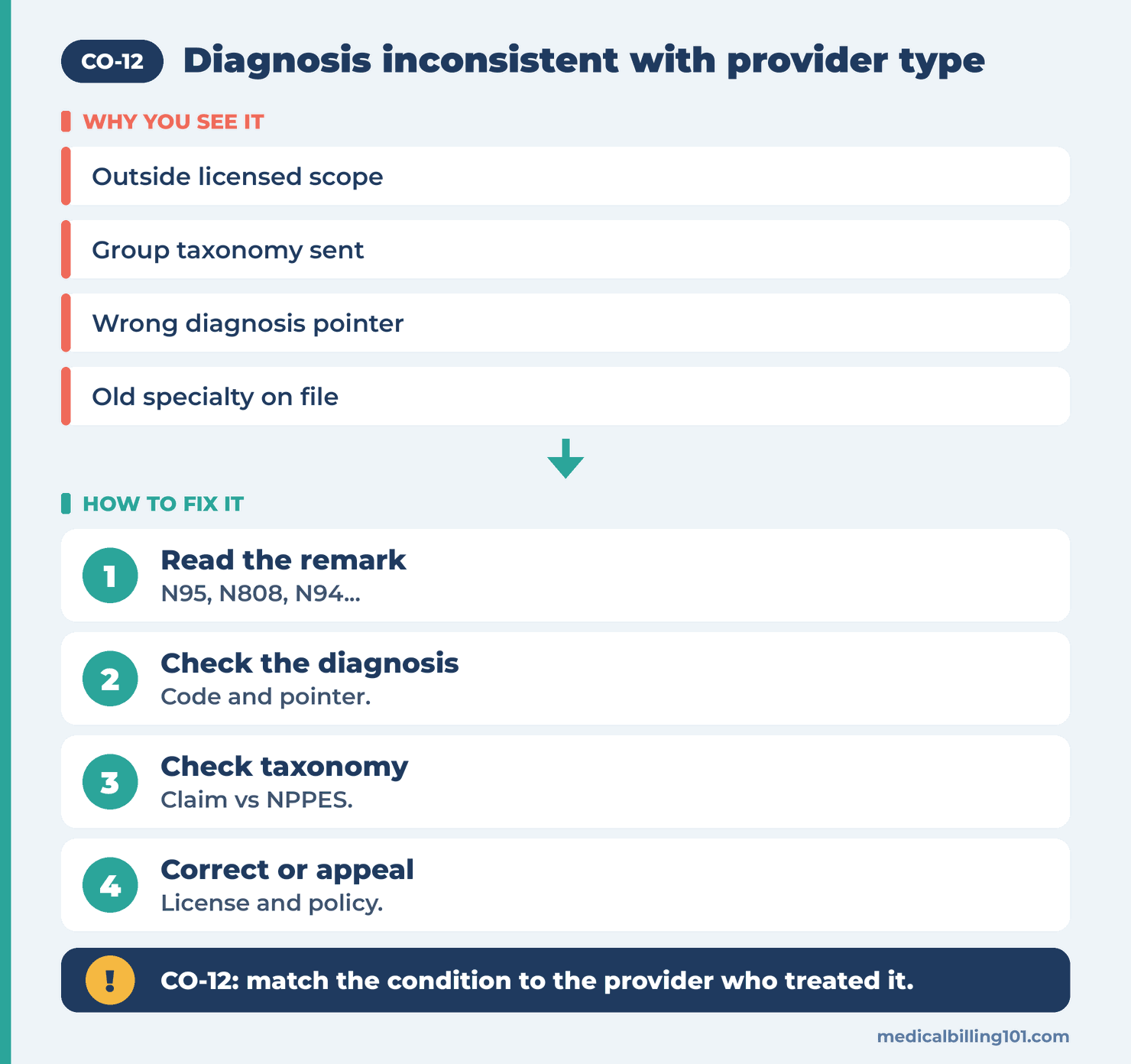
- Read the remark and REF policy. They tell you whether the payer objects to the code, the taxonomy or the scope.
- Check the diagnosis. Is it the right code, and is the pointer on the line aimed at the right diagnosis? A secondary diagnosis pointed as primary can trip the edit.
- Check the taxonomy. Compare the PRV segment with the provider’s NPPES record.
- Check the payer’s file. Confirm the specialty and its effective date in the payer portal or credentialing record.
- Correct what’s wrong and send a corrected claim, using frequency code 7 if the payer wants a replacement.
- Appeal if everything is right. Include the provider’s license scope, specialty certification and the plan policy.
Building an appeal
An appeal works when the provider is licensed to treat the condition and the payer’s edit is too broad. For example, many state laws let nurse practitioners treat a wide range of conditions, while a payer edit may still expect a physician specialty. Send:
- the remit line and remark code;
- the provider’s license and the state scope-of-practice rule that covers the condition, such as a board of nursing or podiatry statute;
- the payer’s credentialing confirmation for the specialty;
- the visit note showing the condition was treated, not just noted.
Questions to ask the payer about a CO-12
- Which specialty do you have on file for this NPI?
- Which diagnosis on the claim triggered the edit?
- Is the edit based on the billing or the rendering provider?
- Is there a written policy listing allowed diagnoses for this specialty?
- Do you want a corrected claim or a reconsideration?
Worked example (illustrative)
A podiatry practice bills a visit for an ankle sprain plus a knee pain diagnosis, with the knee pointed to the E/M line. The remit returns CAS*CO*12*145.00 with remark N95. The record shows the knee was only mentioned in passing, while the ankle was examined and treated. The coder moves the pointer to the ankle diagnosis and keeps the knee as a secondary code. The corrected claim pays.
Prevention checklist
- [ ] Point each line to the diagnosis that was actually treated.
- [ ] Store a specific taxonomy on every rendering provider profile.
- [ ] Check that payers load the right specialty after credentialing.
- [ ] Build scrubber edits for diagnoses your payers reject for each specialty.
- [ ] Review CO-12 trends by provider each month.
Related denial codes
- CO-8: the procedure code is inconsistent with the provider type.
- CO-11: the diagnosis is inconsistent with the procedure.
- CO-146: the diagnosis wasn’t valid for the date of service.
- CO-B7: the provider wasn’t certified for this service on this date.
- CO-16: the claim lacks information.
- Denial codes hub for the full list.
Key takeaways
CO-12 flags a diagnosis that doesn’t fit the provider’s type or specialty. Check the diagnosis pointer, the taxonomy and the payer’s file, and correct what’s wrong. Appeal only when the provider is licensed and credentialed for the condition. The patient isn’t billed under CO.
FAQ
What does denial code CO-12 mean?
It means the diagnosis on the claim is inconsistent with the provider type, so the payer won’t pay the line. CO puts the amount on the provider.
How is CO-12 different from CO-8?
CO-12 is about the diagnosis not fitting the provider type. CO-8 is about the procedure code not fitting the provider type.
Can a wrong taxonomy cause CO-12?
Yes. If the claim shows a taxonomy that doesn’t match the provider who treated the patient, the payer’s edit can deny a perfectly valid diagnosis.
Can I bill the patient for CO-12?
Not under the CO group. Correct the claim or appeal.
Should I appeal CO-12 or correct the claim?
Correct the claim if the code, pointer or taxonomy was wrong. Appeal if all three were right and the provider is licensed to treat the condition.
Where is the provider taxonomy on the claim?
In the PRV segment: loop 2000A for the billing provider and loop 2310B for the rendering provider on the 837P.
Sources
How we checked: every code quote on this page was compared word for word with the X12 CARC and RARC lists on 20 October 2026.
- X12, Claim Adjustment Reason Codes (CARC 12, 8). Accessed 20 Oct 2026.
- X12, Remittance Advice Remark Codes (N94, N95, N288, N808, M76). Accessed 20 Oct 2026.
- NUCC, Health Care Provider Taxonomy. Accessed 20 Oct 2026.
- CMS, Medicare Claims Processing Manual, Ch. 22, §60.1 Group Codes. Accessed 20 Oct 2026.
Last updated: 20 October 2026 · This page is educational and doesn’t replace payer contracts or coding rules.
Related denial codes
- CO-8: Procedure Code vs Provider Type
- PR-11: Diagnosis Inconsistent With the Procedure
- CO-11: The Diagnosis Is Inconsistent With the Procedure
- CO-10: Diagnosis Inconsistent With the Patient's Gender
- CO-9: Diagnosis Inconsistent With the Patient's Age
- CO-B7: Provider Not Certified or Eligible on the Date of Service
- CO-7: Procedure or Revenue Code Inconsistent With the Patient's Gender
- CO-6: Procedure or Revenue Code Inconsistent With the Patient's Age