
CO-14 is one of the simplest denials to understand and one of the easiest to fix. The payer’s system found a patient date of birth that falls after the date of service, which is impossible. So one of the two dates is wrong. The most common story is a newborn claim carrying the mother’s information, or a keying error in the birth year. (Primary sources: X12 Claim Adjustment Reason Codes · X12 Remittance Advice Remark Codes · CMS Medicare Claims Processing Manual, Ch. 22).
In brief: CO-14 means “the date of birth follows the date of service.” Compare the birth date and the service date on the claim with the patient’s insurance card and your medical record. Fix whichever is wrong, update the registration so it doesn’t repeat, and send a corrected claim. There is nothing to appeal, and nothing to bill the patient.
Part of our denial codes library. Written by Manikandan J, CPC, CRCR, who has more than 10 years of US medical billing and revenue cycle experience. Published 20 October 2026. Last updated: 20 October 2026. Code wording is quoted word for word from X12.
CARC 14 official description
| Field | Official X12 text |
|---|---|
| Description | “The date of birth follows the date of service.” |
| Start | 01/01/1995 |
Source: X12 Claim Adjustment Reason Codes, checked 20 October 2026. CARC 14 has never been modified since it was created, and it carries no usage note or remark code rule.
Is denial code 14 the same as CO-14?
Yes. Denial code 14, CARC 14 and reason code 14 identify the same X12 adjustment reason, and CO-14 simply adds the group code. Because a date discrepancy is the billing provider’s responsibility to correct, you’ll almost always see it paired with CO.
What CO-14 means for your team
A date of service is the day the care was given. A date of birth is, of course, the day the patient was born. The payer checks that the second comes before the first. When that sequence fails, the payer’s adjudication system cannot reliably price the claim, apply its age-based edits or match the member record, so processing stops.
Unlike a coverage denial, nothing here is genuinely in dispute, and you don’t need medical records, physician letters or policy citations. You simply need the correct two dates.
Group code table
| Group + CARC | Who carries it | What to do |
|---|---|---|
| CO-14 | Provider | Correct the date and resubmit. |
| PR-14 | Patient | Shouldn’t happen for a data error. Call the payer before billing anyone. |
| OA-14 | Not assigned | Often a crossover line. Fix the primary claim. |
Where the bad date usually comes from
| Cause | Typical RARC | Fix |
|---|---|---|
| Newborn billed under the mother’s ID but with the baby’s DOB, or the reverse | N329 | Match the DOB to the person in the patient loop. Bill the baby under the baby’s own ID once issued. |
| Birth year keyed wrong at registration (such as 2026 for 1962) | N329 | Correct the registration and the claim. |
| Service date keyed wrong, often a year too early | M52 | Correct the date of service from the record. |
| Subscriber DOB entered in the patient field | N340 | Put each DOB in its own loop and check the relationship code. |
| Payer’s member file has the wrong DOB | N329 | Ask the patient or employer to update the plan’s file, then resubmit. |
Remark wording is quoted from the X12 RARC list. Pairings vary by payer.
Fixing CO-14 in four steps
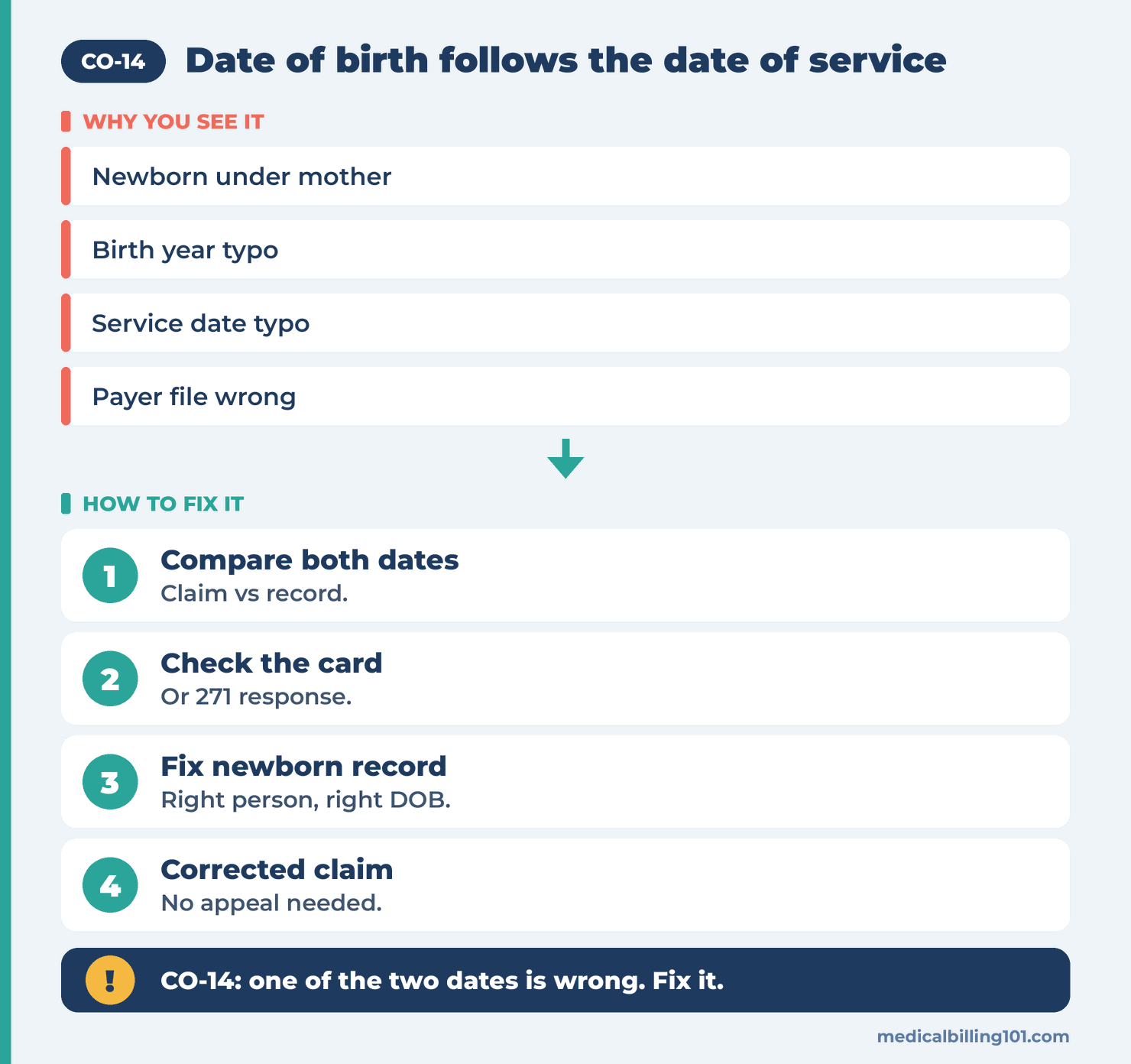
- Put the two dates side by side. Use the claim, the remit and the medical record.
- Check the insurance card or eligibility response. The payer’s DOB is the one its system expects. A 270/271 eligibility check shows it.
- Fix the newborn record if there is one. Newborns are the top source of CO-14. Make sure the baby’s claim carries the baby’s name, DOB and, once issued, the baby’s own member ID.
- Send a corrected claim with frequency code 7 if the payer wants a replacement, or a new claim if it rejected the first one at the front end.
Newborn claims: getting them right
Most CO-14 denials trace back to registration activity during the first weeks of a newborn’s life. Some plans let a newborn be billed under the mother’s ID for a short time after birth. Others want the baby enrolled first. Either way, the birth date on the claim must belong to the person in the patient loop.
For example, if the claim lists the mother as the patient, it should carry her DOB, not the baby’s. If it lists the baby, it should carry the baby’s DOB, and the service date can’t be earlier than the birth. Check your payer’s newborn billing rule, and watch for the plan’s deadline to add the baby to the policy. Missing that deadline leads to a different denial, CARC 34, for no newborn coverage.
Should you appeal CO-14?
No. An appeal argues that the payer made an incorrect decision, whereas here the dates submitted on the claim are logically impossible, so the appropriate remedy is a corrected claim. The only exception is when your claim was right and the payer’s member file is wrong. Then ask the payer, or the patient, to fix the file, and resubmit.
Questions to ask the payer about a CO-14
- What date of birth do you have on file for this member?
- Can a newborn be billed under the mother’s ID, and for how long?
- Should I send a corrected claim or a new claim?
- Did the claim reject at the front end or deny in processing?
Worked example (illustrative)
A pediatric practice sees a newborn on day three, October 4. At registration, the front desk keys the birth date as October 14 instead of October 1. The claim goes out with a birth date ten days after the visit. The remit shows CAS*CO*14*120.00 with remark N329. The biller checks the hospital birth record, fixes the registration and sends a corrected claim, which pays.
Prevention checklist
- [ ] Read the DOB back to the patient or parent at every registration.
- [ ] Run a real-time eligibility check and compare the payer’s DOB.
- [ ] Add a scrubber edit that blocks any claim where the DOB is after the date of service.
- [ ] Build a newborn registration workflow with a clear step to update the ID.
- [ ] Track CO-14 occurrences by registration staff member to target additional training.
Related denial codes
- CO-6: the procedure is inconsistent with the patient’s age.
- CO-9: the diagnosis is inconsistent with the patient’s age.
- CO-31: the patient can’t be identified as the payer’s insured.
- CO-16: the claim lacks information or has billing errors.
- CO-146: the diagnosis wasn’t valid on the date of service.
- Denial codes hub for every code we cover.
Key takeaways
CO-14 means the birth date on the claim is later than the service date. One of them is wrong. Check both against the card and the record, fix the registration, and send a corrected claim. Newborn claims are the usual cause. There’s nothing to appeal and nothing to bill the patient.
FAQ
What does denial code CO-14 mean?
It means the patient’s date of birth on the claim falls after the date of service, which can’t be right, so the payer denied the line.
What is the most common cause of CO-14?
Newborn claims with the wrong person’s birth date, and simple keying errors in the birth year or the service date.
Can I appeal a CO-14 denial?
There’s nothing to appeal. Correct the dates and resubmit. If the payer’s member file is wrong, have it corrected first.
Can I bill the patient for CO-14?
No. It’s a data error under the CO group. Fix and rebill.
Which remark code comes with CO-14?
It varies. N329, “Missing/incomplete/invalid patient birth date,” is a common match.
How do I stop CO-14 from repeating?
Add a claim scrubber edit that stops any claim where the birth date is later than the service date, and tighten newborn registration.
Sources
How we checked: every code quote on this page was compared word for word with the X12 CARC and RARC lists on 20 October 2026.
- X12, Claim Adjustment Reason Codes (CARC 14). Accessed 20 Oct 2026.
- X12, Remittance Advice Remark Codes (N329, N340, M52). Accessed 20 Oct 2026.
- CMS, Medicare Claims Processing Manual, Ch. 22, §60.1 Group Codes. Accessed 20 Oct 2026.
Last updated: 20 October 2026 · This page is educational and doesn’t replace payer contracts or coding rules.