
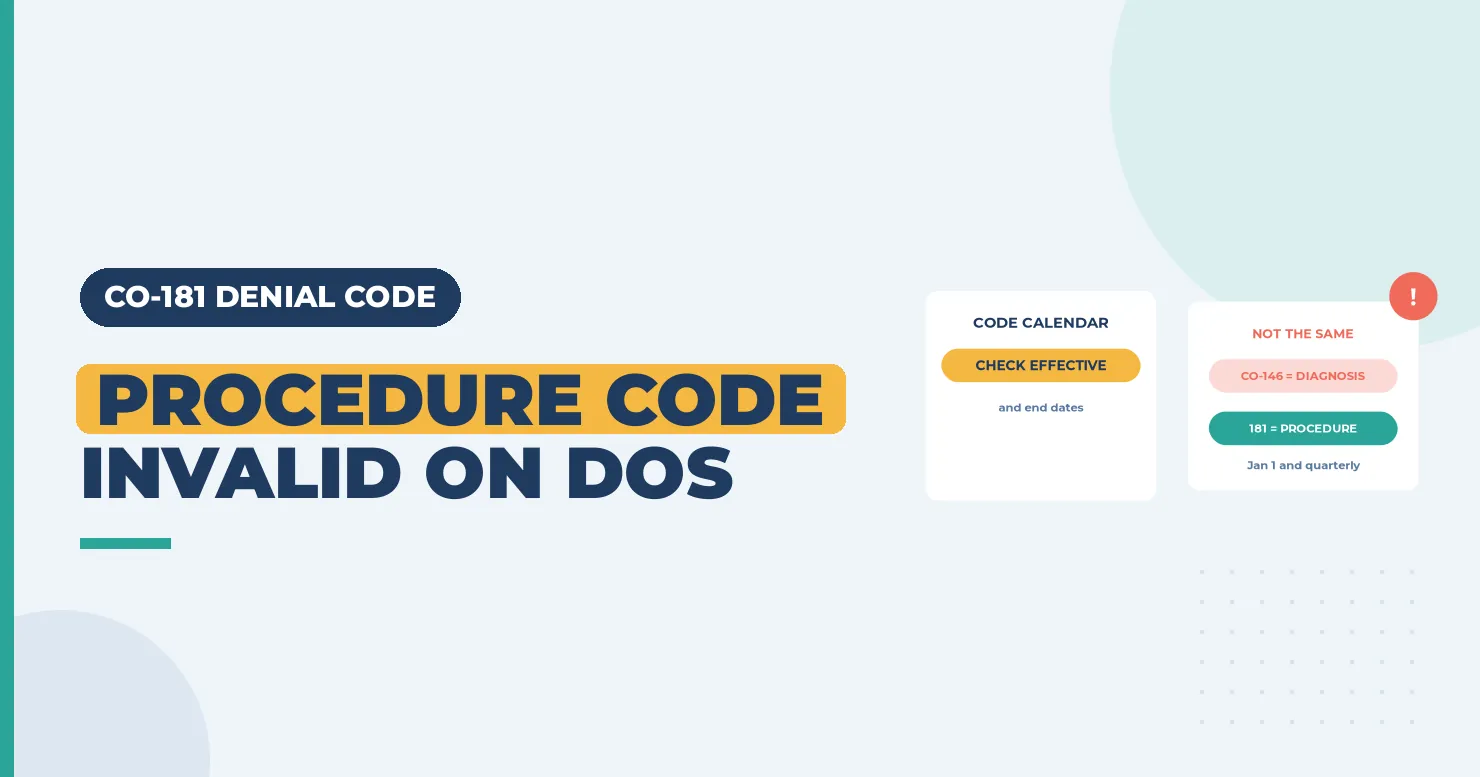
CO-181 means the CPT or HCPCS code on the line wasn’t a valid code on the day the service was performed. The code may have been deleted, replaced, not yet effective, or never valid for that payer. It isn’t a judgment about whether the service was medically necessary or covered under the patient’s benefits. It’s an automated code-set validation that failed, and in almost every case a corrected claim with the appropriate code resolves it. (Primary sources: X12 Claim Adjustment Reason Codes · CMS HCPCS Quarterly Update · X12 Remittance Advice Remark Codes).
In brief: CO-181 means “procedure code was invalid on the date of service.” Look up the code’s effective and termination dates for the date of service. Replace it with the code that was valid that day and matches the documentation, then send a corrected claim. Update your charge master so the old code stops going out. The patient isn’t billed.
Part of our denial codes library. Written by Manikandan J, CPC, CRCR, who has more than 10 years of US medical billing and revenue cycle experience. Published 20 October 2026. Last updated: 20 October 2026. Code wording is quoted word for word from X12.
X12 description of CARC 181
| Field | Official X12 text |
|---|---|
| Description | “Procedure code was invalid on the date of service.” |
| Start | 06/30/2005 |
| Last modified | 09/30/2007 |
Source: X12 Claim Adjustment Reason Codes, checked 20 October 2026. CARC 181 has no usage note, and X12 doesn’t require a remark code with it.
Denial code 181 vs CARC 181 vs reason code 181
These terms all describe the same X12 adjustment reason, just in different settings. Denial code 181 is how most billers say it, CARC 181 is the X12 term, and reason code 181 is what many portals print. Put a group code in front and you get CO-181, the version you’ll see on nearly every remit, because a code-set error is the provider’s to fix.
Why procedure codes expire
Procedure codes change on a fixed calendar:
| Code set | Who maintains it | When changes take effect |
|---|---|---|
| CPT Category I | AMA | January 1 each year |
| CPT Category III | AMA | Released twice a year, effective about six months later. Many sunset after five years. |
| HCPCS Level II | CMS | Quarterly: January, April, July and October |
| Payer-specific codes | Each payer | Per payer notice |
A termination date is the last day a code may be reported. A claim for a later service with that code draws CO-181. An effective date is the first day a new code may be used. Using it earlier fails the same edit.
Group code table
| Group + CARC | Who carries it | What to do |
|---|---|---|
| CO-181 | Provider | Recode and resubmit. |
| PR-181 | Patient | Not expected for a code-set error. Ask the payer before billing anyone. |
| OA-181 | Not assigned | Often a secondary line. Fix the primary claim first. |
| PI-181 | Provider (non-Medicare) | Treat like CO. |
Causes, remark codes and fixes
Remark wording is from the X12 RARC list. Payers choose their own pairings.
| Cause | Typical RARC | Fix |
|---|---|---|
| Code deleted on January 1 still in the charge master | N56 | Find the replacement in the new CPT book or the deleted-code crosswalk. |
| HCPCS code ended in a quarterly update | N56 | Check the CMS quarterly update file for the replacement code. |
| New code used before its effective date | N56 | Use the code valid on the date of service. |
| Code exists but not in the payer’s file for that date or provider | N65 | Ask the payer which code it accepts. |
| Code keyed with a typo, so it isn’t a real code | M51 | Correct the code from the charge ticket. |
| HCPCS code missing or invalid on a drug or supply line | M20 | Add the valid HCPCS code for that date. |
Steps to fix CO-181
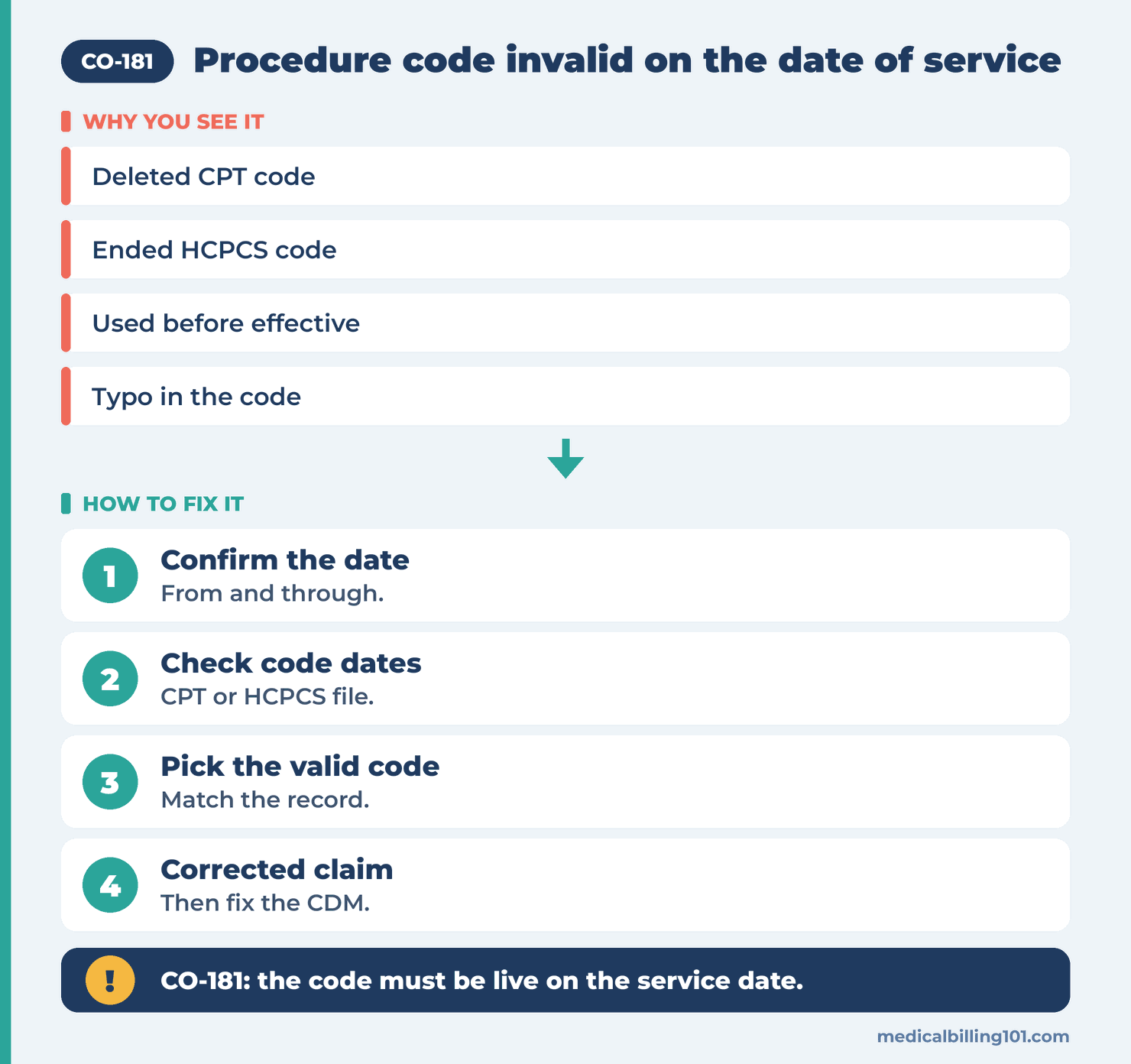
- Confirm the date of service on the line, and for spans, the from and through dates.
- Check the code’s dates. Look it up in the CPT book or the CMS HCPCS file for that period.
- Find the valid code that matches the documentation. For example, a deleted code may split into several new codes, each with different time or work requirements, so don’t just pick the nearest number.
- Check related lines. A replaced code can change bundling, units or modifiers on the same claim, such as an add-on that now pairs with a different base code.
- Send a corrected claim using frequency code 7 if the payer asks for one.
- Fix the charge master and any order sets, templates or favorites lists that still hold the old code.
When an appeal makes sense
Only when the code was valid on the date of service and the payer’s file was out of date. Attach the code listing showing the effective date and ask for reprocessing. This happens most often in the first weeks after a quarterly HCPCS update, before every payer has loaded the new file.
Questions to ask the payer about a CO-181
- Which code set version did you apply for this date?
- Have you loaded the latest HCPCS quarterly update?
- Which code do you accept for this service on this date?
- Is a corrected claim or a new claim the right route?
Worked example (illustrative)
A clinic bills a remote monitoring service on January 9 using a code that was replaced in that year’s CPT update. Its charge master wasn’t refreshed over the holidays. The remit shows CAS*CO*181*92.00 with remark N56. The coder checks the new CPT book, finds the replacement code and its revised unit rules, and sends a corrected claim. The practice then runs a report of every claim since January 1 with a deleted code and corrects them in one batch.
Prevention checklist
- [ ] Load the new CPT file before January 1 and the HCPCS file before each quarter.
- [ ] Run a deleted-code report against your charge master after every update.
- [ ] Update EHR templates, order sets and favorites the same week.
- [ ] Add a scrubber edit that checks each code against the date of service.
- [ ] Watch CO-181 counts in the first month of each quarter.
Related denial codes
- CO-146: the diagnosis was invalid for the date of service.
- CO-4: the procedure code is inconsistent with the modifier.
- CO-5: the procedure code is inconsistent with the place of service.
- CO-11: the diagnosis is inconsistent with the procedure.
- CO-16: the claim lacks information or has billing errors.
- Denial codes hub for the full list.
Key takeaways
CO-181 means the procedure code wasn’t valid on the date of service. Check the code’s effective and end dates, choose the valid code the record supports, and send a corrected claim. Then fix the charge master so it doesn’t happen again. The patient isn’t billed.
FAQ
What does denial code CO-181 mean?
It means the CPT or HCPCS code on the line wasn’t valid on the date of service, so the payer denied it. The provider carries the amount under CO.
Why do CO-181 denials rise in January?
CPT changes take effect on January 1. Codes deleted that day stop being valid for services from then on.
How often do HCPCS codes change?
CMS updates HCPCS Level II codes quarterly, with changes in January, April, July and October.
Is CO-181 the same as CO-146?
No. CO-181 is about the procedure code. CO-146 is about the diagnosis code. Both mean the code wasn’t valid on the date of service.
Can I appeal CO-181?
Only if the code was valid on that date and the payer’s file was outdated. Otherwise, send a corrected claim.
Can I bill the patient for CO-181?
No. It’s a provider coding issue under the CO group.
Sources
How we checked: every code quote on this page was compared word for word with the X12 CARC and RARC lists on 20 October 2026.
- X12, Claim Adjustment Reason Codes (CARC 181). Accessed 20 Oct 2026.
- X12, Remittance Advice Remark Codes (N56, N65, M51, M20). Accessed 20 Oct 2026.
- CMS, HCPCS Quarterly Update. Accessed 20 Oct 2026.
- AMA, CPT code set. Accessed 20 Oct 2026.
- CMS, Medicare Claims Processing Manual, Ch. 22, §60.1 Group Codes. Accessed 20 Oct 2026.
Last updated: 20 October 2026 · This page is educational and doesn’t replace payer contracts or coding rules.