
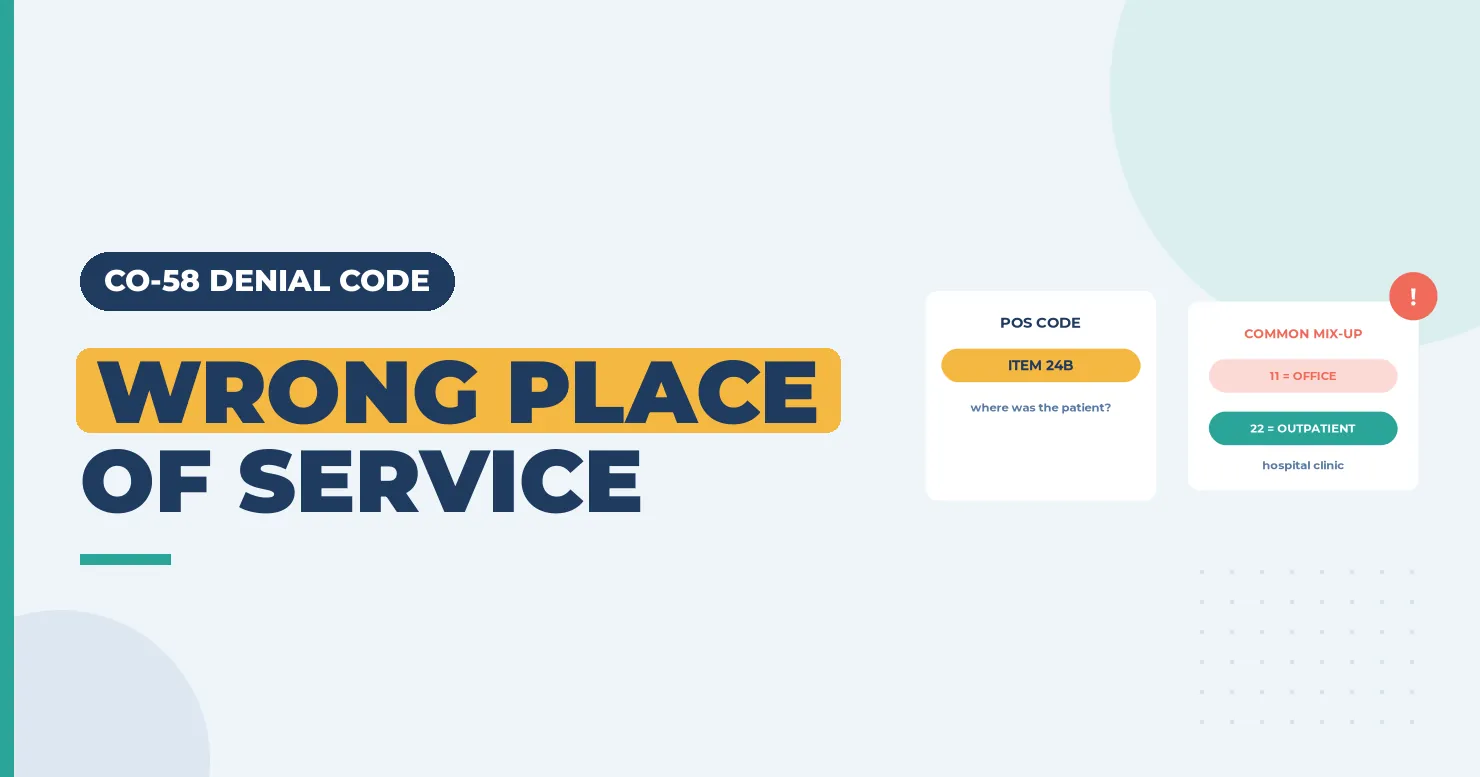
CO-58 means the payer says the service was given in a place where it isn’t covered, or the place of service on the claim doesn’t fit the code. Often nothing was wrong with the care. The claim just used the wrong two-digit place of service (POS) code, or the payer’s policy only pays for that code in certain settings. Fixing CO-58 starts with one question: where was the patient when the service happened? (Primary sources: X12 Claim Adjustment Reason Codes · CMS Place of Service Code Set).
In brief: CO-58 means “Treatment was deemed by the payer to have been rendered in an inappropriate or invalid place of service.” Check where the service really took place and match it to the right POS code. Then check whether the payer covers the code in that setting. If the POS was wrong, send a corrected claim. If the setting was right but the payer limits it, appeal with records or write off under your contract.
Part of our denial codes library. Written by Manikandan J, CPC, CRCR, who has coded and billed professional claims for payers and billing companies. Published 20 October 2026. Last updated: 20 October 2026. Code wording is quoted word for word from X12.
CARC 58 wording from X12
| Field | Official X12 text |
|---|---|
| Description | “Treatment was deemed by the payer to have been rendered in an inappropriate or invalid place of service.” |
| Usage | “Refer to the 835 Healthcare Policy Identification Segment (loop 2110 Service Payment Information REF), if present.” |
| Start | 01/01/1995 |
| Last modified | 07/01/2017 |
Source: X12 Claim Adjustment Reason Codes, checked 20 October 2026.
Denial code 58, CARC 58 and reason code 58
Denial code 58, CARC 58 and reason code 58 are one code. The CO group means the contract keeps the denied amount with the provider. You can’t move it to the patient just because the setting was wrong.
What a place of service code is
A place of service code is a two-digit code on a professional claim that tells the payer where the patient got the service. It goes in item 24B on the CMS-1500 or the 837P claim and line records. A facility rate is the lower physician payment used when the service happens in a hospital or other facility that bills its own costs. Payers use the POS to pick the right rate and to check coverage rules.
| POS | Setting | Common mix-up |
|---|---|---|
| 11 | Office | Used for a visit in a hospital outpatient clinic |
| 19 / 22 | Off-campus / on-campus outpatient hospital | Used for a clinic that bills as an office |
| 21 | Inpatient hospital | Used for an observation stay |
| 23 | Emergency room, hospital | Used for an urgent care visit |
| 24 | Ambulatory surgical center | Procedure not on the ASC list |
| 02 / 10 | Telehealth, other than home / in the patient’s home | Wrong one picked, or POS 11 used without the payer’s rules |
| 31 / 32 | Skilled nursing / nursing facility | Swapped, which changes the rate |
Common causes of CO-58
- Office vs hospital clinic. A clinic owned by a hospital bills POS 11 instead of 19 or 22.
- Observation coded as inpatient. The doctor’s claim shows POS 21 while the patient was in observation, which is POS 22.
- ASC limits. The procedure isn’t on the payer’s covered list for a surgery center.
- Telehealth rules. For example, the payer wants POS 10 for a patient at home, or POS 11 with modifier 95.
- Home services. Some codes are only covered in the home or only in a facility.
- Bad defaults. The billing system fills in the provider’s main location for every claim.
Remarks that often explain the issue come from the X12 RARC list. M77 is “Missing/incomplete/invalid/inappropriate place of service.” N428 is “Not covered when performed in this place of service.”
How to fix a CO-58
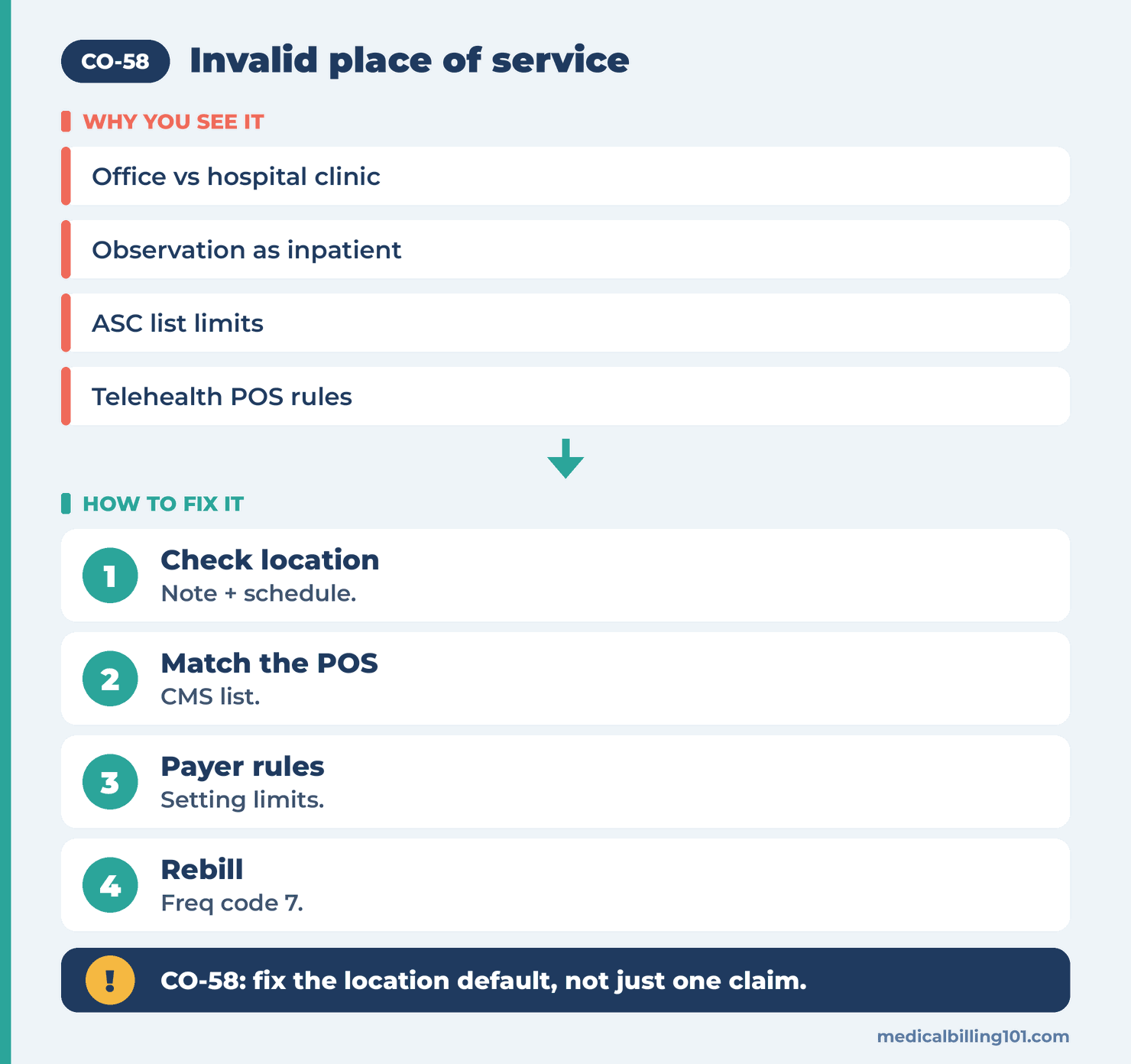
- Check where care happened. Use the note, the schedule and the facility records.
- Match the POS code to the setting using the CMS list.
- Check the payer’s policy for that code. Some codes are office-only or facility-only.
- Check telehealth rules for the date of service, since payers change them often.
- Send a corrected claim (frequency code 7) if the POS was wrong.
- Appeal or write off if the POS was right but the payer doesn’t cover the code there.
The money side of the POS
POS changes the rate even when the claim pays. For example, under the Medicare fee schedule many services have a higher non-facility rate, used for POS 11, and a lower facility rate, used for POS 22. A wrong POS that pays at the higher rate can lead to an overpayment demand later. So treat CO-58 as a chance to fix your POS logic, not just one claim.
Worked example (illustrative)
A cardiology group sees patients in a suite on a hospital campus. The suite is part of the hospital’s outpatient department, but the group’s system defaults to POS 11. A payer denies a 99214 with CAS*CO*58*165.00 and M77. The biller checks the lease and the hospital’s enrollment. The suite is on-campus outpatient, so the right code is POS 22. She sends a corrected claim, which pays at the facility rate. She also fixes the location setting so future claims carry POS 22.
Prevention checklist
- [ ] Map each practice location to its correct POS in the billing system.
- [ ] Ask hospital-based clinics whether they are on-campus or off-campus.
- [ ] Check the payer’s ASC covered list before booking a surgery center case.
- [ ] Review telehealth POS and modifier rules for each payer every quarter.
- [ ] Check observation status before coding hospital visits.
- [ ] Track CO-58 by location to find default errors.
Related denial codes
- CO-5: procedure code or bill type inconsistent with place of service.
- CO-50: not deemed a medical necessity.
- CO-4: procedure code inconsistent with the modifier.
- CO-96: non-covered charges.
- CO-16: claim lacks information needed for adjudication.
- Denial codes hub for every code we cover.
Key takeaways
CO-58 means the payer doesn’t accept the place of service for this code. Find out where the care happened, match the POS from the CMS list, and check the payer’s setting rules. Fix wrong POS codes with a corrected claim, and fix system defaults so the error doesn’t repeat.
FAQ
What does CO-58 mean?
It means the payer decided the service was given in an inappropriate or invalid place of service.
What is the difference between CO-5 and CO-58?
CO-5 says the code or bill type doesn’t match the place of service. CO-58 says the setting itself isn’t covered or valid for the treatment.
Which POS code is used for telehealth?
POS 02 is telehealth outside the patient’s home, and POS 10 is telehealth in the patient’s home. Some payers want POS 11 with modifier 95 instead.
Can I bill the patient for CO-58?
No. Under the CO group, the contract keeps the amount with the provider.
How do I fix a wrong POS?
Send a corrected claim with frequency code 7 and the right POS code.
Which remark codes come with CO-58?
M77 and N428 are common. M77 points to an invalid POS, and N428 says the service isn’t covered in that setting.
Sources
How we checked: every code quote on this page was compared word for word with the X12 CARC and RARC lists on 20 October 2026.
- X12, Claim Adjustment Reason Codes (CARC 58, 5). Accessed 20 Oct 2026.
- X12, Remittance Advice Remark Codes (M77, N428). Accessed 20 Oct 2026.
- CMS, Place of Service Code Set. Accessed 20 Oct 2026.
- CMS, Medicare Claims Processing Manual, Ch. 26, Completing the CMS-1500. Accessed 20 Oct 2026.
Last updated: 20 October 2026 · This page is educational and doesn’t replace payer contracts or coding rules.