

CO-130 means the payer took a fee out of your payment for submitting the claim. It’s not a denial of the service. It’s a deduction. These fees usually come from a contract or provider manual term, often tied to paper claims or a particular submission channel. The CO group means you can’t pass the fee to the patient. (Primary source: X12 Claim Adjustment Reason Codes)
What to know first: CARC 130 reads “Claim submission fee.” Find the contract or manual term behind the fee. If your claim was sent the way the plan requires, or no term supports the fee, ask for it back.
Part of the denial codes library. By Manikandan J, CPC, CRCR, who has set up clearinghouse enrollment for small practices. Published 21 October 2026. Last updated: 21 October 2026. Code wording comes word for word from X12.
CARC 130 in the X12 list
| Field | X12 text |
|---|---|
| Code | 130 |
| Description | “Claim submission fee.” |
| Start | 02/28/1997 |
| Last modified | 06/30/2001 |
Source: X12 Claim Adjustment Reason Codes, checked 21 October 2026.
Where claim submission fees come from
- Paper claim fees in a plan’s provider manual.
- Channel fees for a portal or vendor the plan uses.
- Network or rental agreements that pass a processing fee to the provider.
A claim submission fee is a charge a payer deducts from a payment for handling the claim. It should trace back to a term you agreed to. If you can’t find one, that’s your first point in a dispute.
Example scenario (fictional names), part 1
CO-130 Denial Example: What Happened
Priya Raman runs billing for Northgate Physical Therapy, a three-therapist clinic. Every claim to Lakeshore Health Plan, a fictional commercial plan, went out electronically through the clinic’s clearinghouse.
In March, each Lakeshore payment came in a few dollars short. The 835 showed CAS*CO*130 on every claim. The plan’s provider manual listed a fee for paper claims only.
Why was the plan charging a paper fee on electronic claims? Keep reading, or jump to how the CO-130 denial was resolved.
How Medicare handles paper claims instead
Medicare doesn’t charge a submission fee. Under the Administrative Simplification Compliance Act, Medicare generally won’t pay initial claims sent on paper unless an exception applies. Small providers and a few other situations qualify. CMS lists them on its ASCA self-assessment page.
| Payer type | Paper claim result |
|---|---|
| Medicare, no exception | Not paid |
| Medicare, with exception | Processed normally |
| Commercial plan with a fee term | Paid minus a fee (CARC 130) |
| Commercial plan without a fee term | Processed normally |
Remark codes to know
| RARC | X12 wording |
|---|---|
| M117 | “Not covered unless submitted via electronic claim.” |
| N381 | “Alert: Consult our contractual agreement for restrictions/billing/payment information related to these charges.” |
M117 goes with Medicare’s electronic rule. N381 points to your contract. See the X12 RARC list for more.
Working a CO-130 deduction
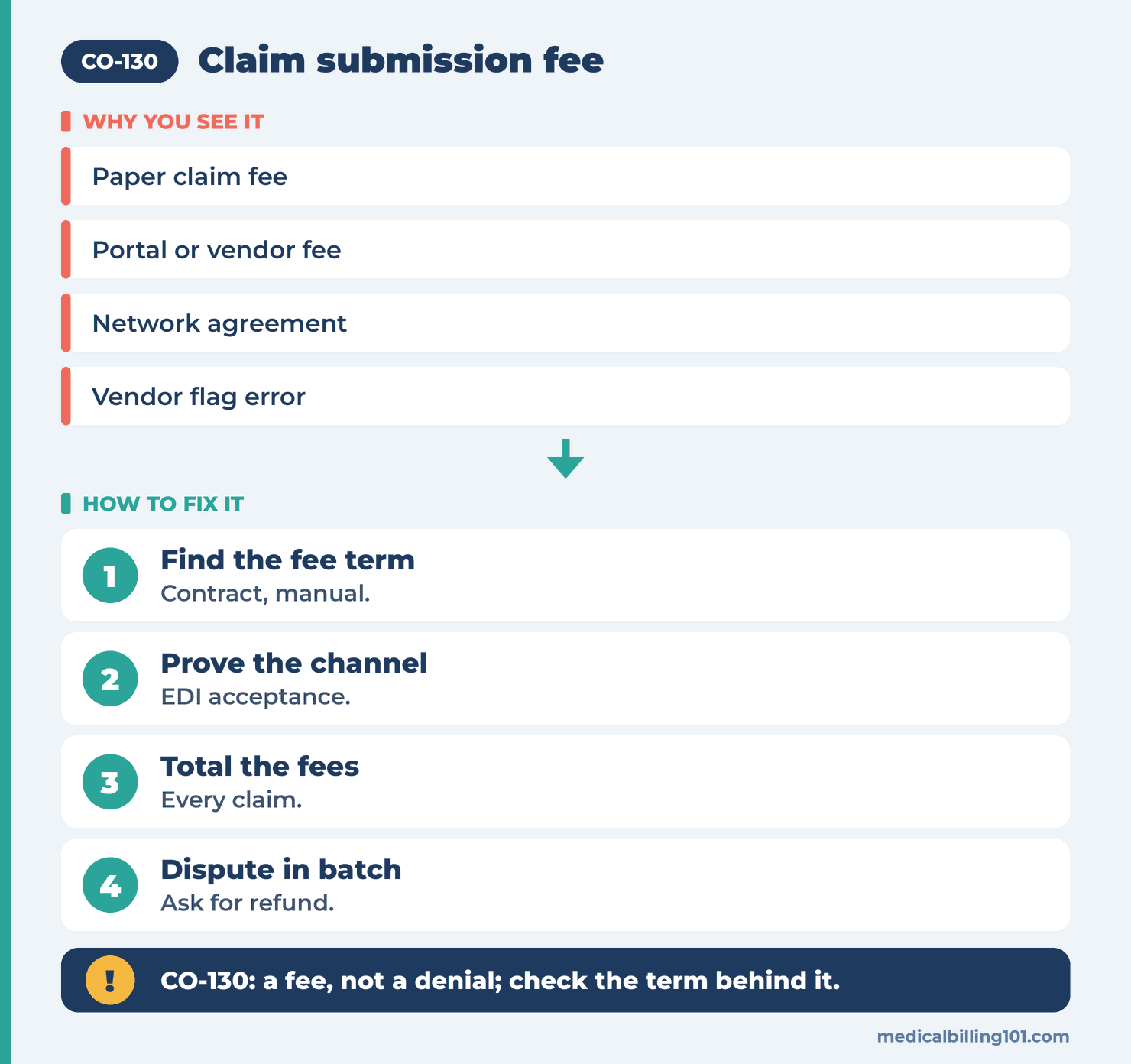
- Find the fee term. Check the contract and the provider manual it references.
- Confirm how the claim went in. Pull the clearinghouse acceptance report for proof.
- Match fee to term. For example, a paper-only fee shouldn’t hit an electronic claim.
- Total the fees. List every affected claim and amount.
- Dispute in one batch. Send the term, the proof and the list.
- Go electronic where you can. It avoids most fees and speeds payment.
Example scenario (fictional names), part 2
How the CO-130 Denial Was Resolved
Priya pulled the clearinghouse reports. Every March claim had been accepted electronically by Lakeshore. She called the plan’s provider line and learned a new intake vendor had flagged claims as paper by mistake.
Fix: Priya sent a batch payment dispute with the acceptance reports and a list of 62 claims with fee amounts.
Outcome: Lakeshore refunded the fees in one adjustment and corrected the vendor setting. Priya now checks one Lakeshore remit each week for CARC 130.
Names and details are illustrative; no real patient data.
Worked example (illustrative)
A solo counselor sends a few paper claims a month to a commercial plan. The plan deducts a small fee on each, coded CARC 130. Her contract does include a paper claim fee. She enrolls with a free clearinghouse option the plan offers, and the fees stop on the next cycle.
Pitfalls
- Billing the patient for the fee. CO means no.
- Ignoring small amounts. Small fees on many claims add up.
- Assuming the fee is right. Vendor and system errors happen.
- Mixing it up with denials. CO-130 is a deduction, not a coverage decision like CO-50.
Related codes
- CO-45: charge exceeds the fee schedule.
- CO-16: claim lacks information or has billing errors.
- CO-253: sequestration reduction.
Bottom line
CO-130 is a claim submission fee taken from your payment. Find the term behind it, prove how you sent the claim and dispute fees that don’t fit. Sending claims electronically avoids most of these fees.
FAQ
What does CO-130 mean?
It means “Claim submission fee.” The payer took a fee from your payment for handling the claim.
Can I bill the patient for a CO-130 fee?
No. The CO group makes it a provider adjustment.
Does Medicare charge claim submission fees?
No. Medicare generally doesn’t pay paper claims at all unless an ASCA exception applies.
How do I stop CO-130 fees?
Send claims the way your contract requires, usually electronically. Then check that the fees stop.
Is CO-130 a denial?
No. The service was paid; the fee was deducted.
What if my contract has no fee term?
Dispute the fee and ask the plan to show the term that allows it.
Sources
How this page was checked: each code quote matches the X12 CARC and RARC lists as read on 21 October 2026.
- X12, Claim Adjustment Reason Codes (CARC 130, 45, 16, 50, 253). Accessed 21 Oct 2026.
- X12, Remittance Advice Remark Codes (M117, N381). Accessed 21 Oct 2026.
- CMS, ASCA Self Assessment. Accessed 21 Oct 2026.
Last updated: 21 October 2026 · For education only; not legal advice.