
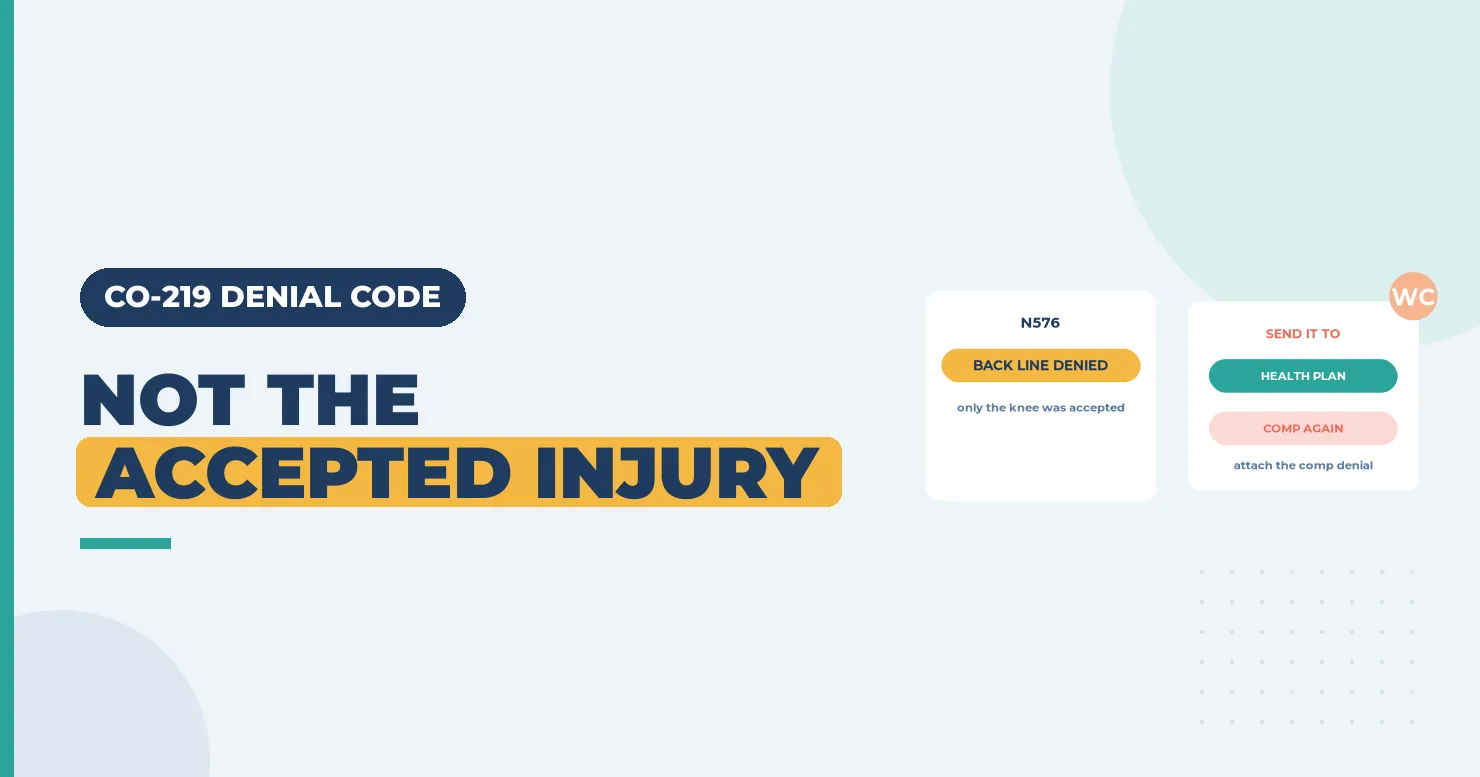
A workers’ compensation claim covers the injury the carrier accepted, and nothing more. When a visit treats the accepted knee and also a back problem the carrier never accepted, the back line can come back as CO-219. The fix is usually to split the care: the accepted injury stays with workers’ comp, and the rest goes to the patient’s health plan or to a dispute. (Primary source: X12 Claim Adjustment Reason Codes)
In brief: CARC 219 starts “Based on extent of injury.” Read the REF segment on the 835 for the jurisdiction rule, compare the denied lines with the accepted body parts, remove unaccepted services from the comp claim, and bill them to the right payer or ask the employer’s carrier to expand the claim.
Part of our denial codes library. Written by Manikandan J, CPC, CRCR, who has billed workers’ compensation and auto claims for therapy and orthopedic clinics. Published 23 October 2026. Last updated: 23 October 2026. Code wording quoted word for word from X12.
Official wording and the REF segment
| Field | Value |
|---|---|
| Code | 219 |
| Description | “Based on extent of injury.” |
| Usage | Payer must send the jurisdiction rule in the 835 REF segment (claim level: Loop 2100 REF qualifier IG; line level: Loop 2110 REF) |
| Start | 01/27/2008 |
| Last modified | 07/01/2017 |
Source: X12 Claim Adjustment Reason Codes, checked 23 October 2026.
Extent of injury is the list of body parts and conditions a workers’ comp carrier has accepted as caused by the work accident. A compensable injury is one the carrier has agreed to pay for. The REF segment is the 835 line that names the state rule or policy behind the denial, so it is the first thing to read.
The usual remark is N576: “Services not related to the specific incident/claim/accident/loss being reported.”
Example scenario (fictional names), part 1
CO-219 Denial Example: What Happened
Jamal Ortiz bills for Riverbend Physical Therapy. A warehouse worker, injured lifting a pallet, had an accepted workers’ comp claim for a right knee sprain (S83.511D, entered as S83511D). At the fourth visit the therapist also treated new low back pain.
The claim carried two lines: 97110 for the knee and 97140 pointed to a lumbar strain (S39.012D, entered as S39012D). The carrier paid the knee line. The 97140 line came back CAS*CO*219 with remark N576, and the REF segment named the state’s accepted-body-part rule.
Who should pay for the back treatment? Keep reading, or jump to how the CO-219 denial was resolved.
Why extent-of-injury denials happen
- A new body part shows up. For example, a back or shoulder complaint that was not in the first report of injury.
- Diagnosis drift. Such as a sprain code changing to a degenerative code, which carriers often see as not work related.
- Unrelated care on the same visit. For instance, a blood pressure check during a comp visit.
- Liability and auto cases. The same code is used when a liability or auto payer limits payment to the injuries in the claim.
Fixing a CO-219 claim
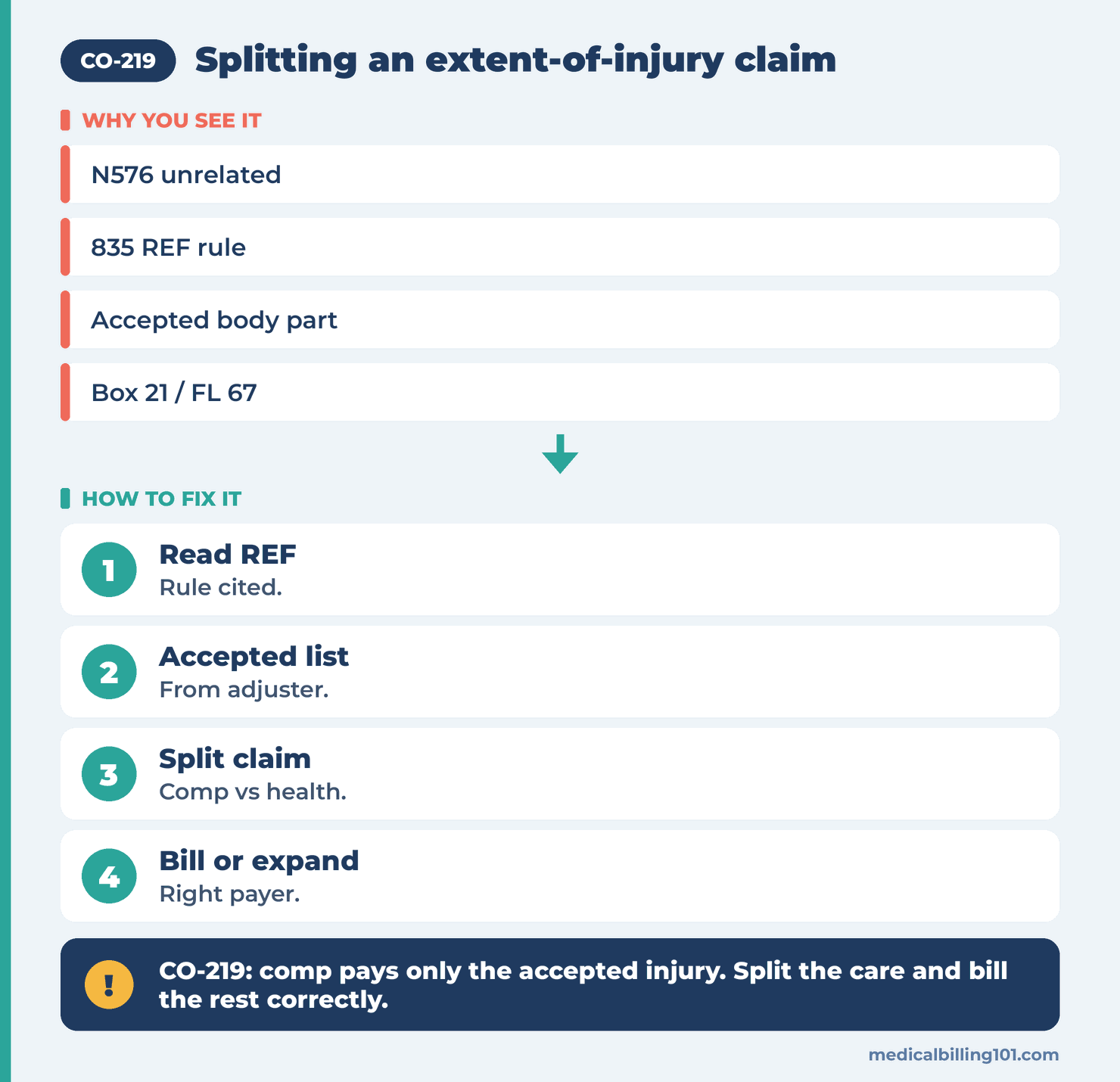
- Read the 835 REF. Note the rule cited and which lines were denied.
- Get the accepted list. Ask the adjuster which body parts and diagnoses are accepted, in writing.
- Split the care. Send a corrected comp claim with only the accepted services and diagnoses.
- Bill the rest correctly. Send the unaccepted service to the health plan with the comp denial attached, or hold it if the patient’s attorney or the doctor is asking the carrier to add the body part.
- Ask for an expansion if the doctor believes the new problem came from the work injury. Each state has its own process. For Medicare patients, CMS explains how comp and liability claims come first on its coordination of benefits and recovery overview.
The claim form section below shows the field changes.
Example scenario (fictional names), part 2
How the CO-219 Denial Was Resolved
Jamal called the adjuster, who confirmed only the right knee was accepted. The therapist agreed the back pain started at home over a weekend.
Fix: Jamal sent a corrected comp claim with only the 97110 knee line and S83511D, then billed the 97140 back line to the patient’s group health plan with the comp denial and remark N576 attached.
Outcome: The health plan paid the back line after the patient’s copay. Riverbend now checks the accepted body part before every comp visit.
Names and details are illustrative; no real patient data.
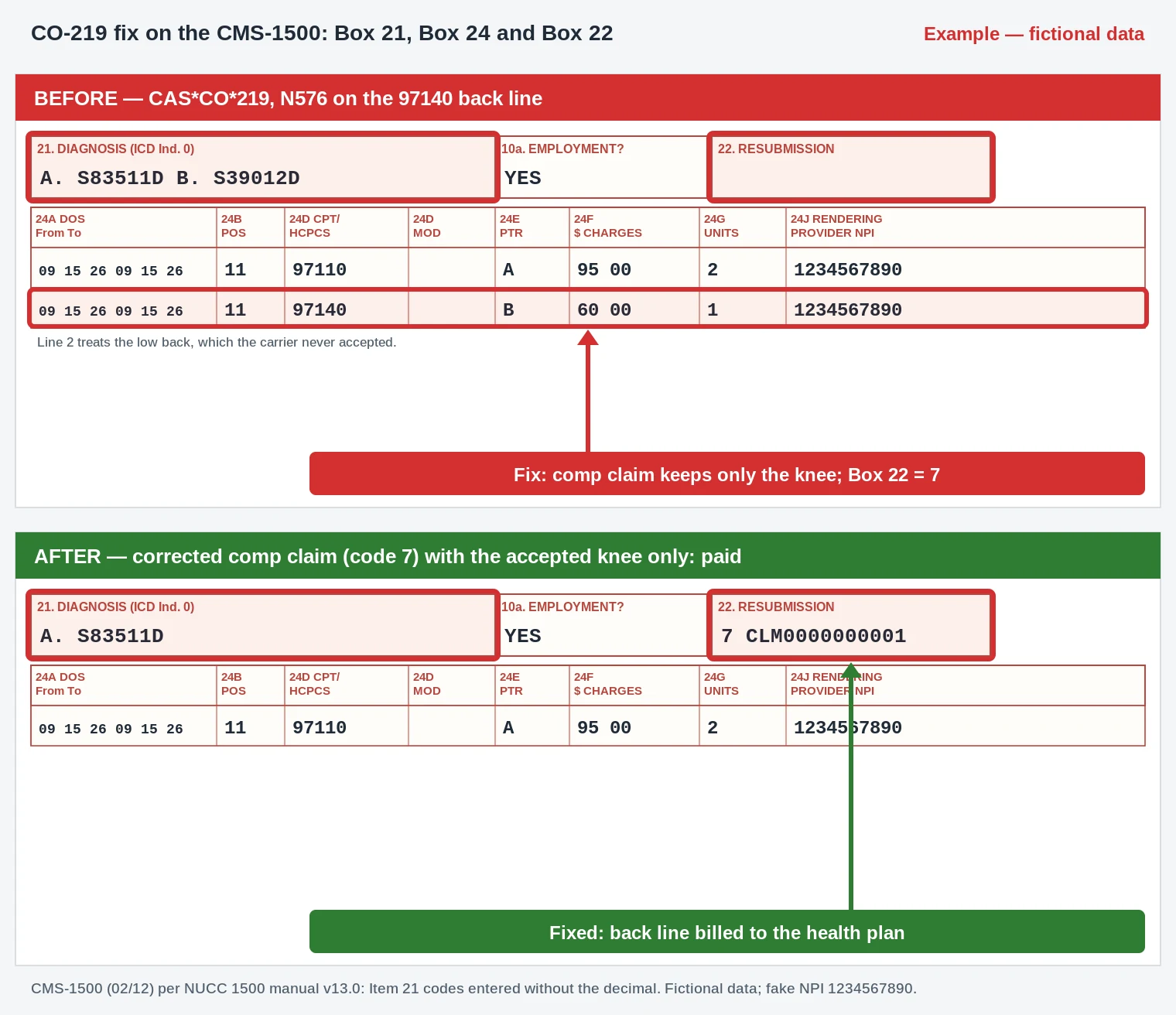
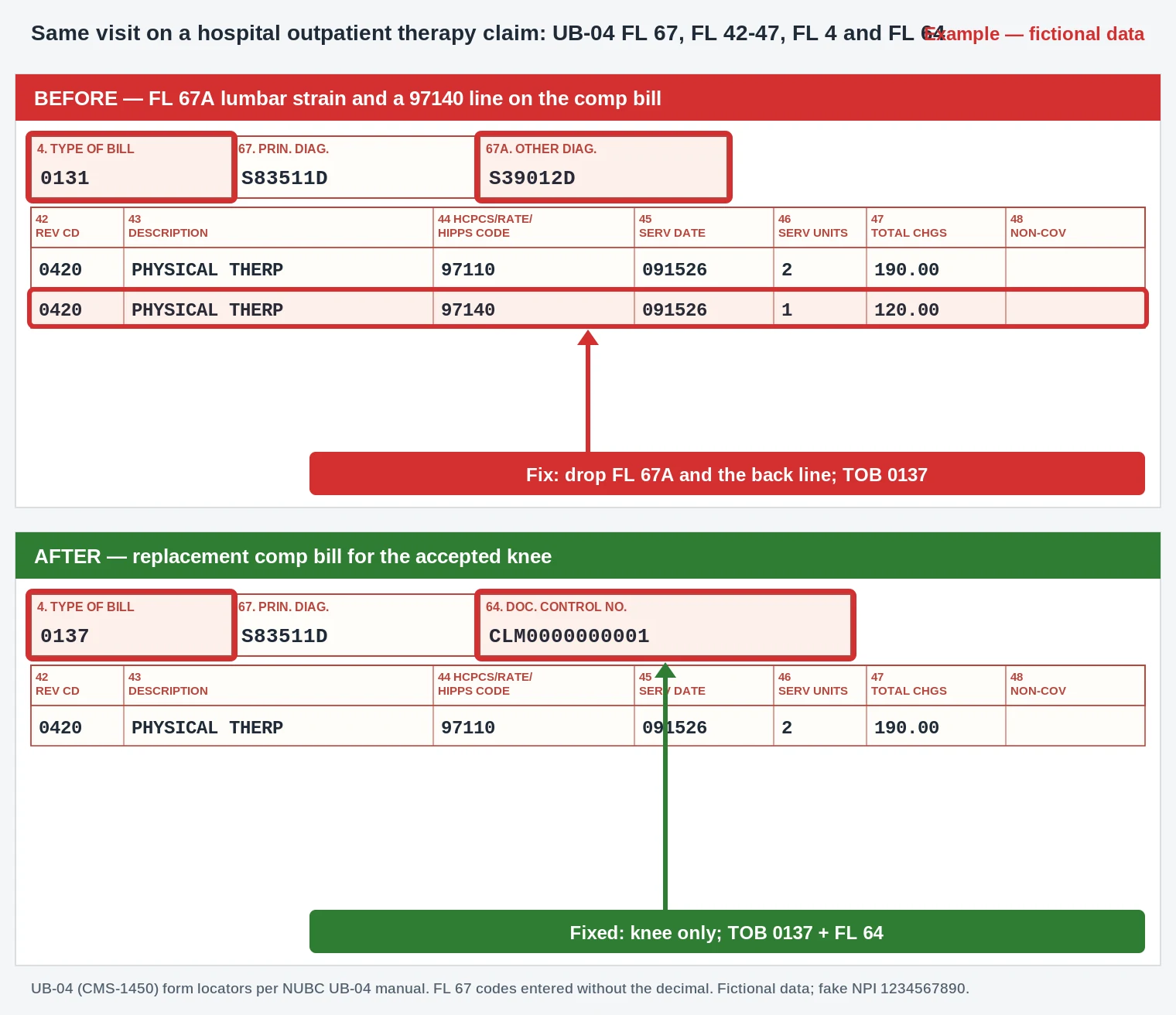
- Box 21 / FL 67A: unaccepted lumbar strain S39.012D (entered as S39012D) removed from the comp claim.
- Box 24 / FL 42-47: the 97140 back line removed and billed to the group health plan with the comp denial.
- Box 22 / FL 4 + FL 64: frequency code 7 with the original claim number (type of bill 0137).
- Box 21 / FL 67: accepted knee sprain S83.511D (entered as S83511D) and 97110 are unchanged.
CO-219 compared with nearby codes
| Code | Plain meaning | Next step |
|---|---|---|
| CO-219 | Outside the accepted injury | Split the care, bill the right plan |
| CO-19 | Work injury, bill comp | Bill the comp carrier |
| CO-21 | No-fault carrier liable | Bill auto or no-fault |
| CO-11 | Diagnosis does not fit procedure | Fix the pointer or code |
| CO-50 | Not medically necessary | Necessity appeal |
Need a refresher on remits? See how to read an explanation of benefits and our corrected claim guide.
FAQ
What does CO-219 mean?
The payer reduced or denied the service based on extent of injury, meaning it falls outside the accepted injury.
Which remark code comes with CO-219?
N576 is common. It says the services are not related to the incident or accident being reported.
Can I bill the health plan instead?
Often yes, for care the comp carrier did not accept. Attach the comp denial so the health plan sees why it is primary.
Do I need a corrected claim?
Yes, if the comp claim carried unaccepted services. Remove them and resubmit with frequency code 7.
Can the patient be billed?
Under group code CO, not by the comp carrier’s terms. State comp rules also limit patient billing, so check them first.
Sources
How we checked: each code quote on this page was matched word for word with the X12 CARC and RARC lists on 23 October 2026.
- X12, Claim Adjustment Reason Codes (CARC 219). Accessed 23 Oct 2026.
- X12, Remittance Advice Remark Codes (N576). Accessed 23 Oct 2026.
- CMS, Coordination of Benefits and Recovery Overview. Accessed 23 Oct 2026.
- NUCC, 1500 Claim Form Instructions. Accessed 23 Oct 2026.
Last updated: 23 October 2026 · Educational content; not legal advice.