
CO-256 is Claim Adjustment Reason Code 256 with group code CO. CARC 256 says “Service not payable per managed care contract.” A managed care contract is the agreement between a provider and a health plan that sets which services are paid, at what rates, and under which rules. Here the payer says this service, as billed, is not payable under yours. That is a contract decision, not a medical-necessity decision. Many people search for “co 256 denial code”, and that is the phrase this page answers. (Primary sources: X12 Claim Adjustment Reason Codes · Anthem Indiana Medicaid bulletin on G18 and 256 · X12 Remittance Advice Remark Codes)
Quick answer: CO-256 means the payer found no payable line for this service in your managed care contract. The usual causes are a code that is not on the contract fee schedule, a missing pricing modifier, a service outside the scope your contract covers, or a claim that paid under the wrong provider record. Check the contract and fee schedule first. If you billed it wrong, send a corrected claim. If the payer processed it wrong, dispute it. A CO group means the patient is not billed.
Part of our denial codes library. Written by Manikandan, a revenue cycle management specialist with more than 10 years of US medical billing experience. Last reviewed: 18 October 2026. Official code wording is quoted word for word from X12; payer examples link to their source.
CO-256 denial code description (official X12 wording)
X12 Claim Adjustment Reason Code 256, verbatim:
“Service not payable per managed care contract.”
Source: X12 Claim Adjustment Reason Codes, checked 18 October 2026. Start: 06/02/2013. X12 lists no usage note and no later modification.
The CARC is 256. The group code is usually CO. In X12’s group code list, CO means Contractual Obligation. CMS Ch. 22, §60.1 says CO adjustments are generally a write-off for the provider and are not billed to the patient. Your own contract may add terms, so read it.
What CO-256 means in plain English
- The contract does not make this service payable. The payer looked for a payable line and did not find one.
- It is about the contract, not the care. The service may be medically necessary and fully covered by the plan.
- The cause is often a data match. A missing modifier or the wrong provider record can make a covered service look uncovered.
- The remark code narrows it down. Read it before you act.
- A CO group means the provider absorbs it. Do not bill the patient unless your contract says so.
Common causes of CO-256
Anthem’s Indiana Medicaid provider bulletins describe the edit behind this CARC. Its denial G18, “disallow not allowed under contract,” maps to CO-256. Anthem lists these reasons, and other plans use similar logic:
- The code is not on the fee schedule. The procedure code is not listed on the state fee schedule tied to your agreement, so the claim cannot be priced.
- A pricing modifier is missing. Some codes pay only with a specific modifier, such as NU, RR, TC or 26. Without it there is no matching fee schedule row.
- The contract covers only certain services. For example, a hospital contracted only as a facility bills professional services on a CMS-1500.
- The claim paid under the wrong provider record. A facility claim can process under a group record, or the reverse, when both share one NPI and tax ID.
- A revenue code and procedure code do not fit. On facility claims, the revenue code may need a procedure code with pricing, or may not be allowed in that setting.
- The provider type or scope does not fit. A transportation provider bills a medical service, for example.
CO-256 vs CO-24, CO-45, CO-109 and lookalikes
| Code | Official idea | Difference |
|---|---|---|
| CO-256 | Service not payable per managed care contract | Your contract has no payable line for it. This page |
| CO-24 | Charges are covered under a capitation agreement/managed care plan | Paid through capitation. See CO-24 |
| CO-45 | Charge exceeds fee schedule/maximum allowable or contracted/legislated fee arrangement | Priced, and the charge is reduced. See CO-45 |
| CO-109 | Claim/service not covered by this payer/contractor | Wrong payer. See CO-109 |
| CO-242 | Services not provided by network/primary care providers | Network rule. See PR-242, which also covers CO-242 |
| CO-4 | The procedure code is inconsistent with the modifier used or a required modifier is missing | Coding edit. See CO-4 |
Remark codes that can come with CO-256
X12 does not fix one remark for 256. These X12 wordings appear in payer guidance with it:
- N130: “Consult plan benefit documents/guidelines for information about restrictions for this service.”
- N448: “This drug/service/supply is not included in the fee schedule or contracted/legislated fee arrangement.”
- N52: “Patient not enrolled in the billing provider’s managed care plan on the date of service.”
- N381: “Consult our contractual agreement for restrictions/billing/payment information related to these charges.” See N381.
Billing references such as QuickIntell list N130, N52 and N448 as examples. Your payer may use others, so trust the remit in front of you.
Where CO-256 shows up in the 835
CLP*PCN30918*4*185.00*0.00*0.00*MC*CLAIM550142~
SVC*HC:E0601*185.00*0.00**1~
CAS*CO*256*185.00~
LQ*HE*N448~
- Status code 4 means the claim was denied.
- The line paid $0.
- CAS*CO*256*185.00 moved the full charge to a contractual adjustment with reason 256.
- LQ*HE*N448 says the item is not in the fee schedule or contracted fee arrangement.
- This sample is illustrative only. Real remits vary.
How to fix CO-256: decision path
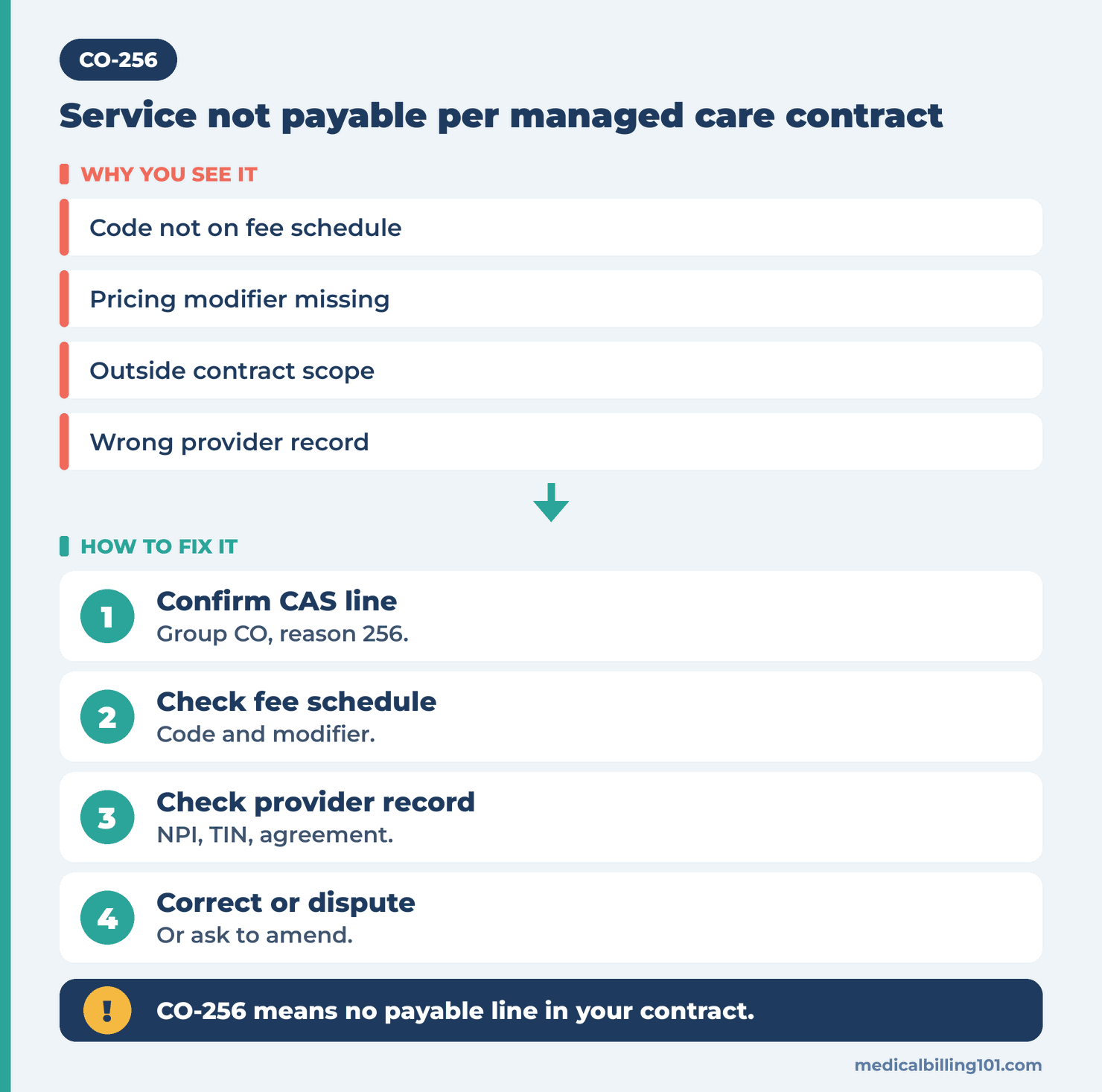
- Confirm the CAS line. Check the group (CO), the reason (256) and the amount. Note the remark code.
- Find your contract fee schedule. Look up the code. Is it listed? Is it priced with a modifier?
- Compare the claim with the schedule. Check the procedure code, modifier, revenue code, units and place of service.
- Check the provider record. Confirm which NPI, tax ID and agreement the payer used to process the claim.
- If you billed it wrong, send a corrected claim in the way the payer’s manual describes.
- If the payer processed it under the wrong record, ask for reprocessing or file a dispute, and attach the contract page.
- If the service is outside your contract, ask your contracting representative about an amendment, or check whether another payer or vendor covers it.
- Do not bill the patient under a CO group unless your contract allows it.
Medicare, commercial and Medicaid notes
Medicare. Traditional Medicare does not use managed care contracts, so 256 mostly shows on Medicare Advantage and other plan remits. Use the plan’s provider manual and its dispute process.
Commercial. Contracts differ on carve-outs, modifiers and provider records. Ask the plan for the fee schedule tied to your agreement ID, and check the dispute time limit.
Medicaid. State managed care plans often price from the state fee schedule. In Anthem’s Indiana Medicaid example, a code missing from the fee schedule is treated as not covered and is not reimbursed.
Worked example (illustrative)
A durable medical equipment supplier bills a rental item to a Medicaid managed care plan. The remit shows CAS*CO*256*185.00 with remark N448.
Reading it: The payer says the item is not payable under the contract fee schedule. The remark says it is not in the fee schedule or contracted fee arrangement.
Check: The state fee schedule lists the code only with the RR modifier for rentals. The claim went out with no modifier, so no schedule row matched.
Fix: The billing team adds the rental modifier and sends a corrected claim with the rental order on file. It does not bill the patient for the $185.00 adjustment.
Second scenario: The code is not on the fee schedule at all, with any modifier. The team asks its contracting representative whether the service can be added to the contract, and writes the line off under its contract if not.
Prevention checklist
- [ ] Load each payer’s contract fee schedule into your billing system.
- [ ] Add a claim scrubber rule for codes that need a pricing modifier.
- [ ] Check that the billing NPI and tax ID match the agreement for the service type.
- [ ] Keep a list of services each contract carves out.
- [ ] Review 256 denials by payer and code each month.
- [ ] Raise repeat gaps with your contracting representative.
- [ ] Keep the CARC and RARC guide handy for staff training.
Related denial codes
- CO-24: charges covered under a capitation agreement or managed care plan.
- CO-45: charge exceeds the fee schedule or contracted fee.
- CO-109: claim not covered by this payer.
- PR-242: services not provided by network providers.
- N381: consult the contractual agreement.
- CARC and RARC guide.
Key takeaways
CO-256 means your managed care contract has no payable line for the service as billed. Check the fee schedule, modifier and provider record first, because many 256 denials are data matches rather than true exclusions. A CO group means the patient is not billed.
FAQ
What is the CO-256 denial code description?
X12 words it as “Service not payable per managed care contract.”
Is CO-256 a medical necessity denial?
No. It is a contract decision. The service may be medically necessary and covered by the plan but not payable under your agreement as billed.
Can I bill the patient for CO-256?
Not under a CO group. CMS says CO adjustments are generally a write-off for the provider. Check your contract for exceptions.
Can a missing modifier cause CO-256?
Yes. Anthem’s Indiana Medicaid bulletin says a code that needs a pricing modifier, billed without it, has no matching fee schedule row and is treated as not allowed under contract.
How is CO-256 different from CO-45?
CO-45 means the service was priced and the charge is reduced to the fee schedule. CO-256 means there was no payable line to price against.
Can I appeal a CO-256 denial?
Yes, when the payer processed it wrongly, for example under the wrong provider record. Send a dispute with the contract page. If the service is outside the contract, ask about an amendment.
Quick facts
| Item | Value |
|---|---|
| X12 code | 256 |
| X12 start | 06/02/2013 |
| Official wording | Service not payable per managed care contract |
| Usual group | CO |
| Common remarks | N130, N448, N52, N381 |
| Common confusions | CO-24 (capitation), CO-45 (fee schedule), CO-109 (wrong payer) |
| Last reviewed | 18 October 2026 |
Sources
- X12, Claim Adjustment Reason Codes (256, 24, 45, 109, 242, 4). CARC 256 Start 06/02/2013. Accessed 18 Oct 2026.
- X12, Remittance Advice Remark Codes (N130, N448, N52, N381). Accessed 18 Oct 2026.
- Anthem Blue Cross and Blue Shield (Indiana Medicaid), G18 denial code update. Accessed 18 Oct 2026.
- Anthem Blue Cross and Blue Shield (Indiana Medicaid), Claim denials for codes G18 and 256. Accessed 18 Oct 2026.
- CMS, Medicare Claims Processing Manual (IOM 100-04), Ch. 22, §60.1 Group Codes. Accessed 18 Oct 2026.
- QuickIntell, CARC 256 reference (common remark pairings). Accessed 18 Oct 2026.
Code wording on this page was checked on 18 October 2026 against X12 sources.
Last reviewed: 18 October 2026 · This page is educational and doesn’t replace payer-specific contracts or coding rules.