
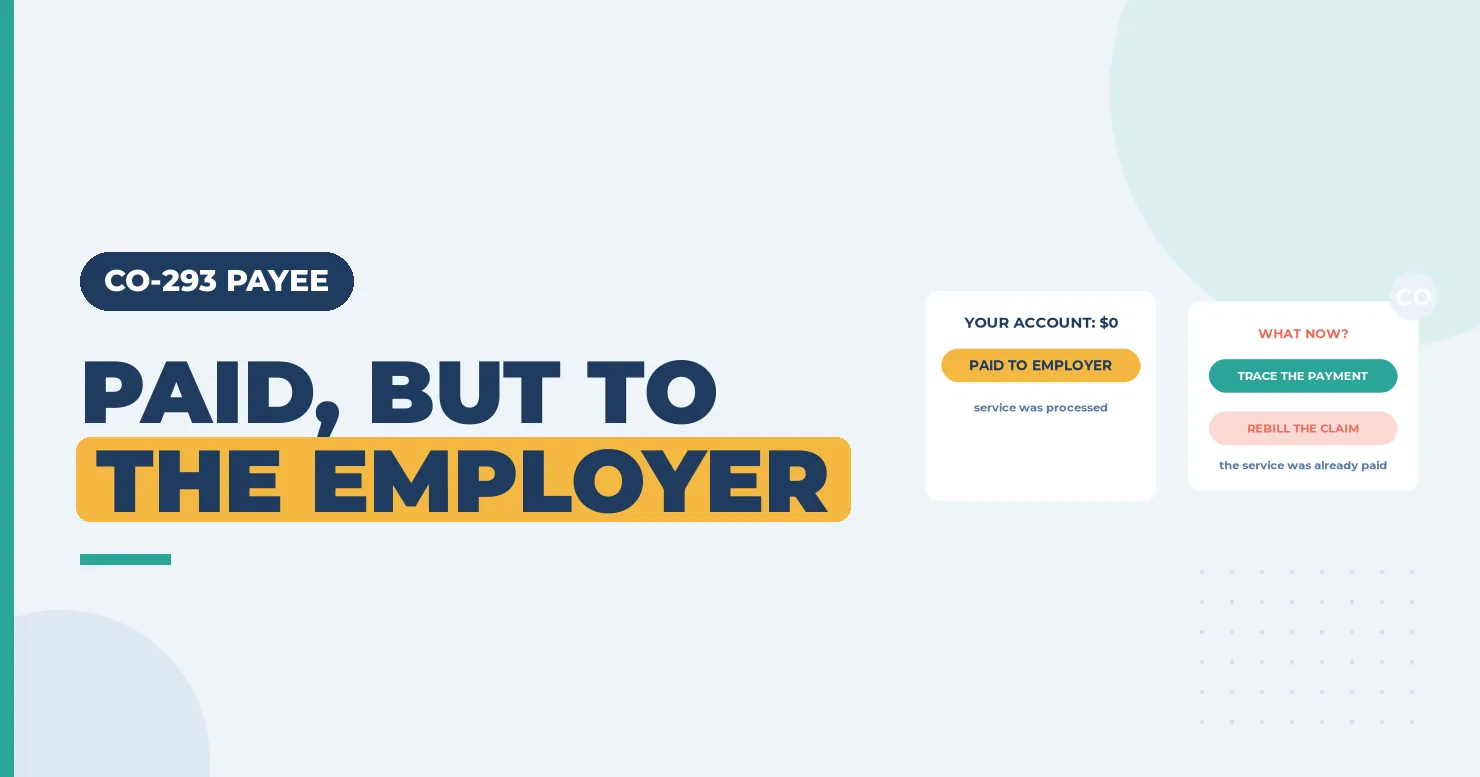
The CO-293 denial code means the payer sent the payment to the employer instead of to you. Your line shows no payment, although the claim was fully processed. The fix is to identify who received the funds, then correct the payee record with the payer or with the employing organization. (Primary source: X12 Claim Adjustment Reason Codes)
In brief: CARC 293 is a payee notice, not a medical necessity denial. The service was reimbursed, but the money reached a different organization. With CO-293, do not rebill and do not charge the patient; trace the payment first.
Part of our denial codes library. Written by Manikandan J, CPC, CRCR, who has traced misdirected payments for physician groups and hospital-employed practices. Published 14 November 2026. Last updated: 14 November 2026. Code wording quoted word for word from X12. Read about the author and our editorial policy, or contact us to report an error.
What does denial code CO-293 mean?
Denial code CO-293 means the payer paid an employer for the service you billed. Reason code 293 usually appears when a physician is employed by a hospital system or a large medical group. The payer reimburses the employer under that enrollment arrangement, so your own account receives nothing.
| Field | Value |
|---|---|
| Code | 293 |
| Description | “Payment made to employer.” |
| Group codes | No X12 group restriction; CO is the most common |
| Start | 05/01/2018 |
Source: X12 Claim Adjustment Reason Codes, checked 14 November 2026.
Methodology: the code wording is copied from the X12 list, and the payee steps follow the NUCC claim form instructions cited below.
Key terms: The payee is the party that receives the payment. The billing provider is the entity named in the claim’s billing section. CO is the contractual obligation group code.
CO-293 vs OA-293: what is the difference?
CO-293 means the payer posted the zero payment as a contract matter, because the money went to a party it has an agreement with. OA-293 says the same without assigning any liability. In both versions, the key question is who got the check or deposit.
| Version | What it tells you | First step |
|---|---|---|
| CO-293 | Payment went to the employer under a contract | Find the payee and the remittance date |
| OA-293 | Same payment, no liability stated | Find the payee and the remittance date |
Neither version means the patient owes the amount.
Why did the payer pay the employer?
The payer pays the employer when the payer’s file shows the employer as the payee for that provider. A physician employed by a hospital, such as a hospitalist or an employed specialist, is a typical case. The hospital bills and collects, and the physician is paid through payroll.
Problems usually begin when the payer’s provider file becomes outdated. A physician who left a group, or a practice that changed its tax identification number, can keep a payee link to the former employer. Then the payer continues sending reimbursement to the wrong organization while your billing office sees nothing.
Example scenario (fictional names), part 1
CO-293 Denial Example: What Happened
Marisol Quinn is the biller for Ridgeview Internal Medicine. Dr. Anil Prasad saw a patient for high blood pressure and Marisol billed 99213 with I10.
The fictional plan returned an 835 with CAS*CO*293 on the 99213 line and zero paid to Ridgeview. The claim status said processed and paid.
Dr. Prasad had left a hospital group six months earlier. Where did the money go? Keep reading, or jump to how it was resolved. Keep reading, or jump to how the CO-293 denial was resolved.
How do I fix a CO-293 denial?
To fix a CO-293 denial, trace the payment first, then correct the payee link so future remittances reach the right organization. Ask the payer for the remittance date, the payee name and the payment trace number. If the employer received the money, request a transfer or a refund to your account, and then ask the payer to update its provider file.
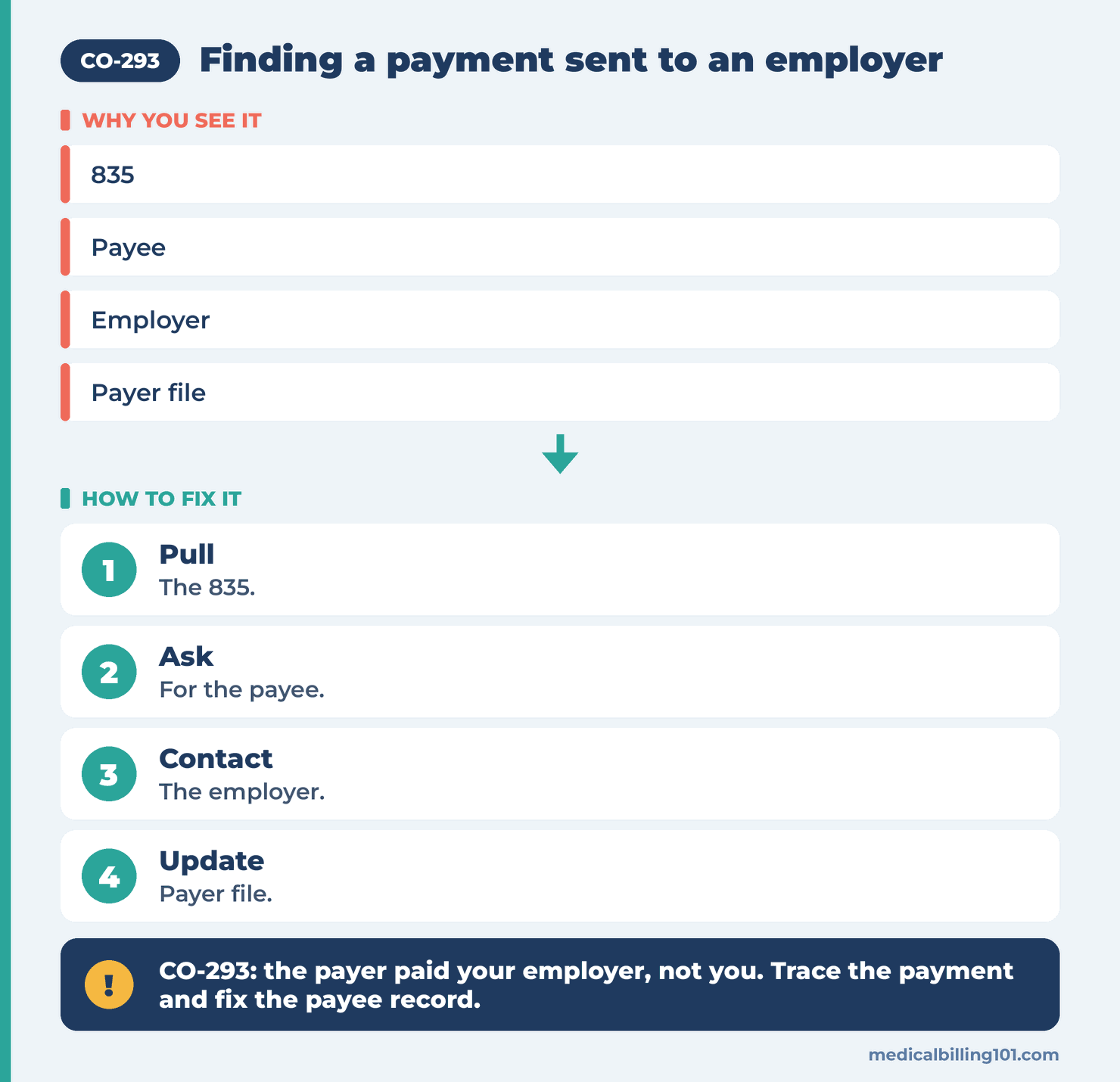
- Pull the 835. Note the payer claim number and the paid amount on the line.
- Ask for the payee. Request the payee name, tax ID and payment trace number.
- Contact the employer. Ask its payment posting team to send the funds to your account.
- Update the payer file. Send the payee change form with a current W-9.
- Confirm the next claim. Check that the next remittance goes to the right payee.
Example scenario (fictional names), part 2
How the CO-293 Denial Was Resolved
Marisol called the payer. The provider file still linked Dr. Prasad to his old hospital group, and the payment had gone there.
Fix: she sent the payer a payee change form with a current W-9 and the practice’s bank details. She also asked the former employer’s payment team to return the funds with the trace number.
Outcome: the hospital group sent the payment back within a few weeks. The payer updated the payee link, and later claims paid to Ridgeview. Marisol now checks the payer file whenever a provider joins or leaves.
Names and details are illustrative; no real patient data.
Names and details are illustrative; no real patient data.
Is CO-293 the same as CO-294?
No, CO-293 is not the same as CO-294. CARC 293 says the payment went to an employer. CARC 294 says it went to an attorney. Both explain a zero on your line when the service itself was processed. The recovery path differs, so check the code before you call anyone.
Can I bill the patient for CO-293?
No, you cannot bill the patient for CO-293 lines. The payer already reimbursed the service, so the patient has no remaining balance for that amount. For example, if you charged a patient and the employer later returns the money, you would owe a refund. The NUCC instructions describe the billing provider fields the payer reads.
Related codes
| Code | Meaning |
|---|---|
| CO-45 | Charge exceeds the fee schedule or maximum allowable amount |
| CO-24 | Charges covered under a capitation agreement |
| CO-18 | Exact duplicate claim or service |
| CO-22 | Care may be covered by another payer per coordination of benefits |
FAQ
What does CO-293 mean?
The payer sent the payment to the employer instead of to the billing provider.
Do I need to rebill a CO-293 claim?
No. The service was paid. Trace the payment and fix the payee record.
Is CO-293 the same as CO-294?
No. CO-294 means the payment went to an attorney.
Which group code comes with CARC 293?
X12 sets no restriction. CO is the common choice on payee notices.
Does the patient owe a CO-293 amount?
No. The payer already paid it, to a different payee.
Sources
How we checked: the CARC 293 quote was matched word for word with the X12 CARC list on 14 November 2026.
- X12, Claim Adjustment Reason Codes (CARC 293, 294, 24). Accessed 14 Nov 2026.
- X12, Remittance Advice Remark Codes. Accessed 14 Nov 2026.
- NUCC, 1500 claim form instructions. Accessed 14 Nov 2026.
- IRS, Form W-9. Accessed 14 Nov 2026.
- CMS, Medicare enrollment for providers and suppliers. Accessed 14 Nov 2026.
Last updated: 14 November 2026 · Educational content; not legal advice.