
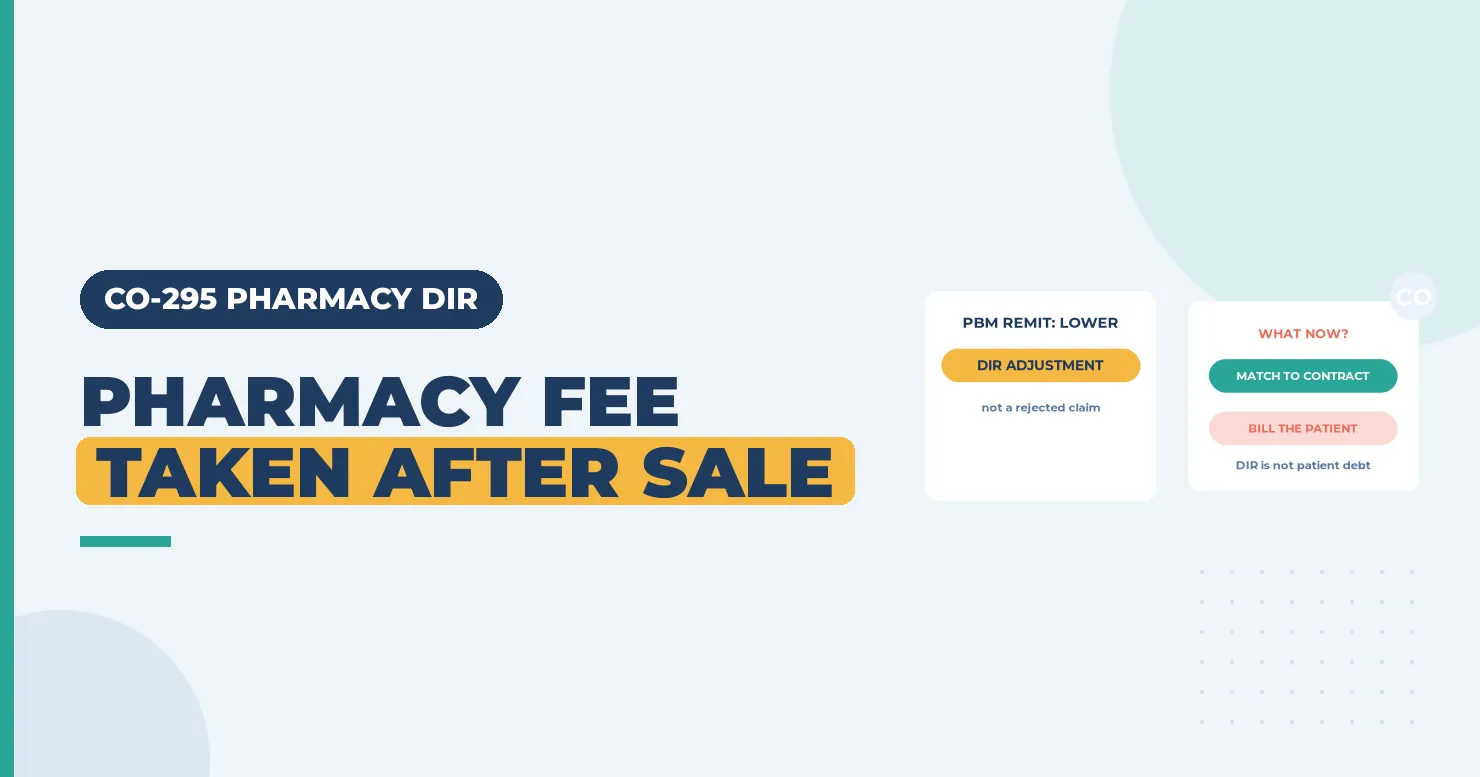
The CO-295 denial code is a pharmacy direct and indirect remuneration (DIR) adjustment. It lowers what the plan or its manager pays the pharmacy after the claim was filled. The fix is to match the adjustment to the PBM’s fee report, then dispute any amount your contract does not allow. (Primary source: X12 Claim Adjustment Reason Codes)
In brief: CARC 295 is not a rejected claim. It is a price concession taken from pharmacy payments. With CO-295, reconcile it to your contract and the PBM’s report; do not bill the patient for it.
Part of our denial codes library. Written by Manikandan J, CPC, CRCR, who has reconciled pharmacy remittances for independent and clinic-based pharmacies. Published 14 November 2026. Last updated: 14 November 2026. Code wording quoted word for word from X12. Read about the author and our editorial policy, or contact us to report an error.
What does denial code CO-295 mean?
Denial code CO-295 means a DIR amount was taken from the pharmacy’s payment. Reason code 295 appears on pharmacy-side remittances, not on routine physician claims. The adjustment reflects fees or price concessions the pharmacy agreed to in its network contract.
| Field | Value |
|---|---|
| Code | 295 |
| Description | “Pharmacy Direct/Indirect Remuneration (DIR)” |
| Group codes | No X12 group restriction; CO is the most common |
| Start | 03/01/2018 |
Source: X12 Claim Adjustment Reason Codes, checked 14 November 2026.
Methodology: the code wording is copied from the X12 list, and the Part D background comes from the CMS rule summary cited below.
Key terms: DIR is money a pharmacy gives back or loses after a claim is paid, through fees or performance terms. A PBM is a pharmacy benefit manager. CO is the contractual obligation group code.
CO-295 vs OA-295: what is the difference?
CO-295 books the DIR adjustment as a contract matter, which fits a fee the pharmacy agreed to in its network agreement. OA-295 reports the same reduction without a liability assignment. For reconciliation, both versions need the same proof: the contract term and the PBM’s fee report.
| Version | What it tells you | First step |
|---|---|---|
| CO-295 | Contract-based DIR adjustment | Match it to the network agreement |
| OA-295 | Same adjustment, no liability stated | Match it to the PBM fee report |
Neither version makes the patient owe the amount.
Why did the pharmacy receive a DIR adjustment?
The pharmacy receives a DIR adjustment when its contract allows fees or price concessions after the sale. Performance scores, network fees and similar terms are common examples. The plan or PBM then reduces a payment or sends a fee notice.
Medicare Part D changed the rules. Since January 1, 2024, Part D plans must apply all pharmacy price concessions to the negotiated price at the point of sale, as the CMS final rule summary explains. Commercial plans follow their own contracts.
Example scenario (fictional names), part 1
CO-295 Denial Example: What Happened
Alisha Grant keeps the books for Birchwood Community Pharmacy. The pharmacy’s weekly remittance from a fictional pharmacy benefit manager showed an adjustment line with CAS*CO*295 and a negative amount.
No single prescription was rejected. The pharmacy’s cash receipts for the month were lower than the sum of its paid claims.
The owner asked if the fee was a mistake. Was the amount allowed by the contract? Keep reading, or jump to how it was resolved. Keep reading, or jump to how the CO-295 denial was resolved.
How do I fix a CO-295 denial?
To fix a CO-295 adjustment, match it to your contract and to the PBM’s DIR report. Find the fee term, the period and the formula. If the amount fits, post it as a contractual adjustment. If it does not, file a written dispute with the PBM and keep the proof.
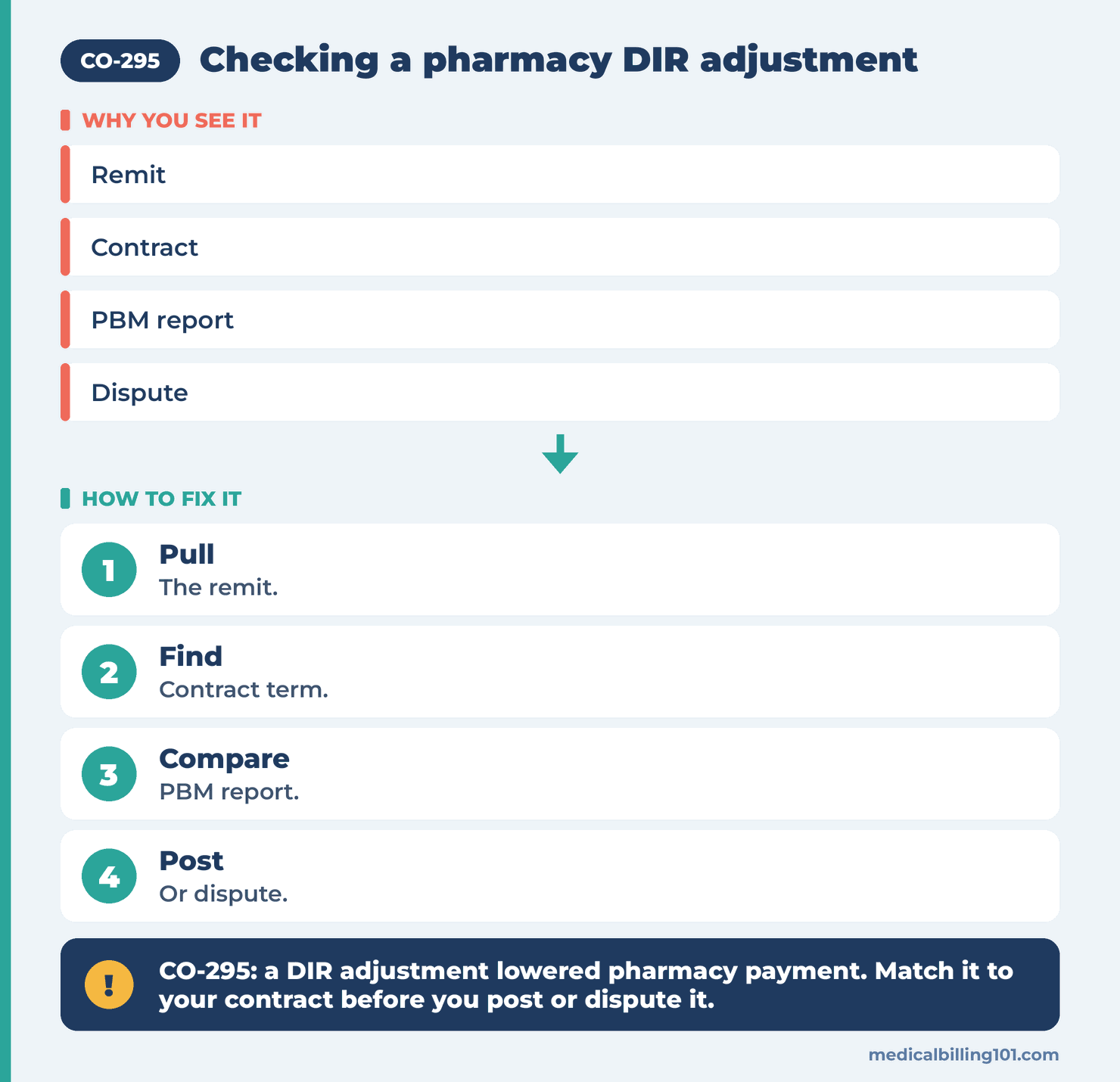
- Pull the remittance. Note the date, the amount and the claim count the line covers.
- Find the contract term. Locate the fee or performance clause in the network agreement.
- Get the PBM report. Ask for the DIR detail by period and by claim group.
- Compare the numbers. Recalculate the fee from the contract formula.
- Post or dispute. Post a matching amount as a contract adjustment, or dispute a mismatch in writing.
Example scenario (fictional names), part 2
How the CO-295 Denial Was Resolved
Alisha requested the PBM’s DIR detail report. It listed a monthly network fee and a performance adjustment for the period.
Fix: she recalculated both from the contract formula. The network fee matched. The performance adjustment used a score lower than the PBM’s own scorecard showed, so she filed a written dispute with the scorecard attached.
Outcome: the PBM corrected the score and refunded part of the adjustment on the next remittance. Alisha now tracks the PBM scorecard each month before the DIR notice arrives.
Names and details are illustrative; no real patient data.
Names and details are illustrative; no real patient data.
Is CO-295 the same as a claim denial?
No, CO-295 is not a claim denial. CARC 295 describes a price concession, so the prescriptions themselves were paid. A true claim denial has a code such as CO-197 for a missing authorization. Treat CARC 295 as a payment reconciliation task for the pharmacy’s accounts team.
Can I bill the patient for CO-295?
No, you cannot bill the patient for CO-295. A DIR adjustment is a pharmacy contract matter, not patient responsibility. For example, the patient’s copay was set when the claim was filled and does not change later. Raise any fee dispute with the PBM, not with the patient.
Related codes
| Code | Meaning |
|---|---|
| CO-280 | Medical plan: submit to the pharmacy plan |
| CO-197 | Precertification or authorization absent |
| CO-45 | Charge exceeds the fee schedule or maximum allowable amount |
| CO-24 | Charges covered under a capitation agreement |
FAQ
What does CO-295 mean?
It is a pharmacy direct and indirect remuneration (DIR) adjustment on a pharmacy remittance.
Is CO-295 a rejected claim?
No. The prescriptions were paid. The adjustment lowers the payment afterward.
Which group code comes with CARC 295?
X12 sets no restriction. CO is the common choice for contract-based fees.
Can a pharmacy dispute a CO-295 amount?
Yes. Compare it with the contract and the PBM report, then dispute in writing.
Does the patient owe a CO-295 amount?
No. It is a pharmacy contract matter.
Sources
How we checked: the CARC 295 quote was matched word for word with the X12 CARC list on 14 November 2026, and the Part D point-of-sale rule date was checked against the CMS fact sheet.
- X12, Claim Adjustment Reason Codes (CARC 295, 280, 197). Accessed 14 Nov 2026.
- X12, Remittance Advice Remark Codes. Accessed 14 Nov 2026.
- CMS, CY 2023 Medicare Advantage and Part D Final Rule (CMS-4192-F). Accessed 14 Nov 2026.
- CMS, pharmacy price concessions memo. Accessed 14 Nov 2026.
- NCPDP, standards overview. Accessed 14 Nov 2026.
Last updated: 14 November 2026 · Educational content; not legal advice.