
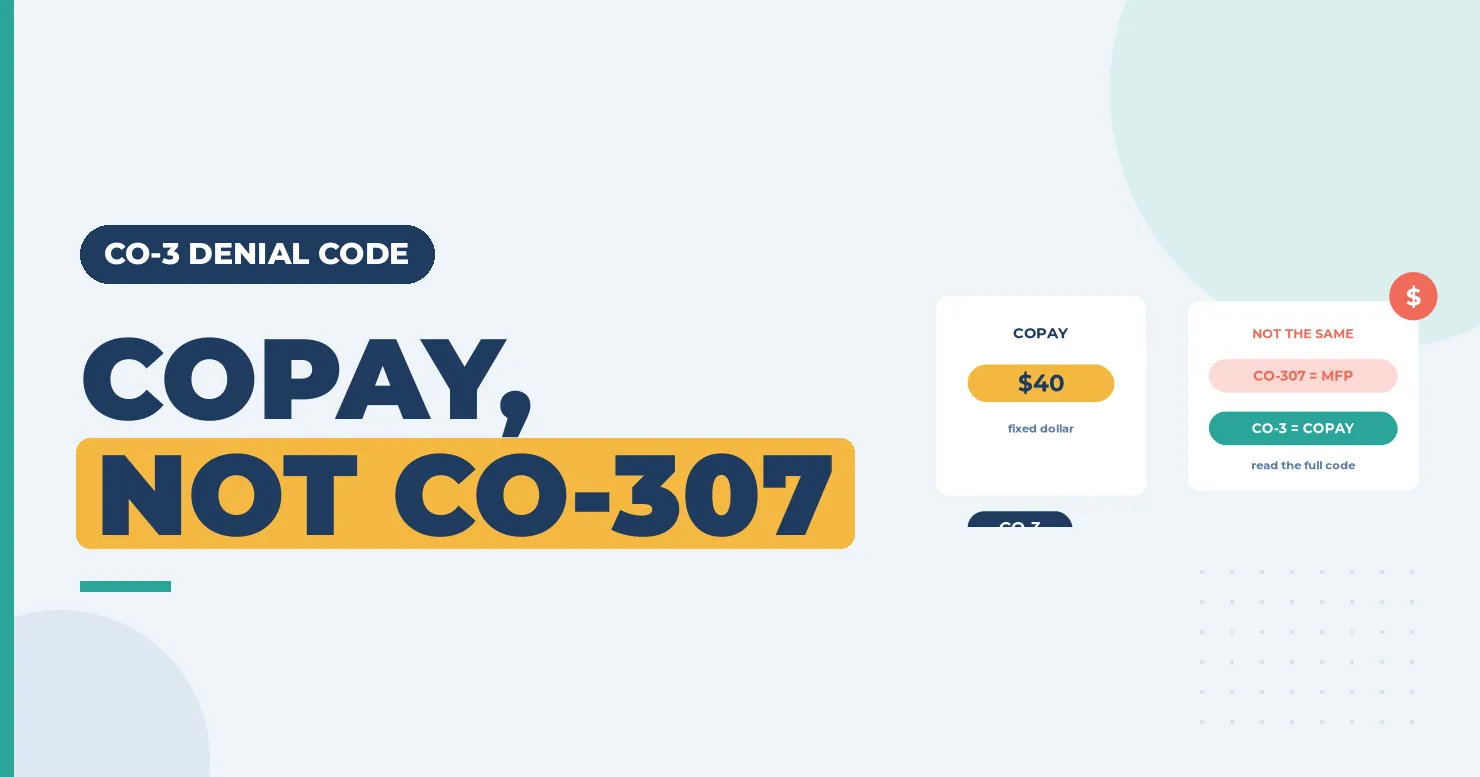
CO-3 is Claim Adjustment Reason Code 3 with group code CO. CARC 3 means “Co-payment Amount.” A copay is a fixed dollar member share (for example $40 for a specialist visit). Remits usually report that as PR-3. CO-3 is the same reason under Contractual Obligation, so those dollars are generally a provider write-off, not a patient balance. Before this page existed, WordPress’s 404 guess sent /denial-codes/co-3/ to CO-307 (Medicare Maximum Fair Price adjustment). That is a different code. Many people search for “co 3 denial code”, and that is the phrase this page answers. (Primary sources: X12 Claim Adjustment Reason Codes · CMS Claims Processing Manual, Ch. 22, §60.1 · PR-1 / PR-2 / PR-3 · CO-307)
Quick answer: PR-3 = fixed copay the patient (or secondary) may owe. CO-3 = fixed copay reason coded as contractual — do not bill the patient for that line until you confirm a waiver or get the group corrected. Do not treat CO-3 as CO-307 (Maximum Fair Price).
Part of our denial codes library. Written by Manikandan, a revenue cycle management specialist with more than 10 years of US medical billing experience. Last reviewed: 13 October 2026. Official code wording is quoted word for word from X12; Medicare rules link to their CMS source.
CO-3 denial code description (official X12 wording)
X12 Claim Adjustment Reason Code 3, verbatim:
“Co-payment Amount”
Source: X12 Claim Adjustment Reason Codes, checked 13 October 2026. Start: 01/01/1995. No later “Last Modified” date is listed for code 3.
The CARC is 3. Copayment is a flat dollar amount set by the plan, not a percentage (that is coinsurance, CARC 2).
What CO-3 means in plain English
- The payer applied a copay amount to the claim or line.
- Group CO means treat it as a contractual write-off unless you get the remit corrected.
- Group PR (PR-3) means the amount may be billed to the patient or insured after secondary.
- CO-3 is not CO-307. CO-307 is the Medicare Maximum Fair Price standard default refund amount adjustment and requires a remark code.
- CO-3 is not a non-covered denial. The visit usually processed; the adjustment is about the copay dollars.
CO-3 vs PR-3, CO-307, CO-241 and lookalikes
| Code | Official X12 idea | What it tells you |
|---|---|---|
| PR-3 | Co-payment Amount (group PR) | Patient fixed copay — PR-1 / PR-2 / PR-3 |
| CO-3 | Co-payment Amount (group CO) | Same CARC, contractual write-off |
| 307 | Medicare Maximum Fair Price Standard Default Refund Amount Adjustment (remark required) | Drug-price negotiation adjustment — CO-307 |
| 241 | Low Income Subsidy (LIS) Co-payment Amount | Separate LIS copay CARC |
| 45 | Charge exceeds fee schedule / contracted amount | Pricing cut often on the same remit |
| 1 / 2 | Deductible / Coinsurance | Other cost-sharing CARCs — CO-1, CO-2 |
Slug confusion: co-3 is a prefix of co-307, which is why the old guess redirect opened the Maximum Fair Price page. Always read the full code on the remit.
Group code matrix for CARC 3
| Group + 3 | Who carries the amount | Typical next step |
|---|---|---|
| PR-3 | Patient / insured | Collect copay or bill secondary |
| CO-3 | Provider (write-off) | Post contractual adjustment |
| OA-3 | Other adjustment | Read remarks |
CMS Ch. 22 §60.1 notes that PR “would typically be used for deductible and copay adjustments.” That is the expected home for a true member copay. CO on a copay needs a contract reason or a correction.
When group code CO appears on a copay
- Plan or clinic contract waives the copay at the point of service (employer clinic, promotional $0 copay events, certain value-based arrangements).
- Payer grouping error — ID card still shows a $25 / $40 / $50 copay.
- Secondary reporting of primary copay under CO.
- LIS or other special copay programs may use CARC 241 instead of 3; read the code you actually received.
Where CO-3 shows up in the 835
CLP*PCN99001*1*180.00*110.00*40.00*12*CLAIM667788~
SVC*HC:99213*180.00*110.00**1~
CAS*CO*45*30.00~
CAS*CO*3*40.00~
AMT*B6*150.00~
- Allowed $150 (charge $180 − CO-45 $30).
- Plan paid $110.
- CASCO3*$40 is a $40 copay coded under CO.
- Patient-billable twin: CASPR3*40.00.
Illustrative only. Real remits vary by payer and may add a remark code.
How to fix CO-3: decision path
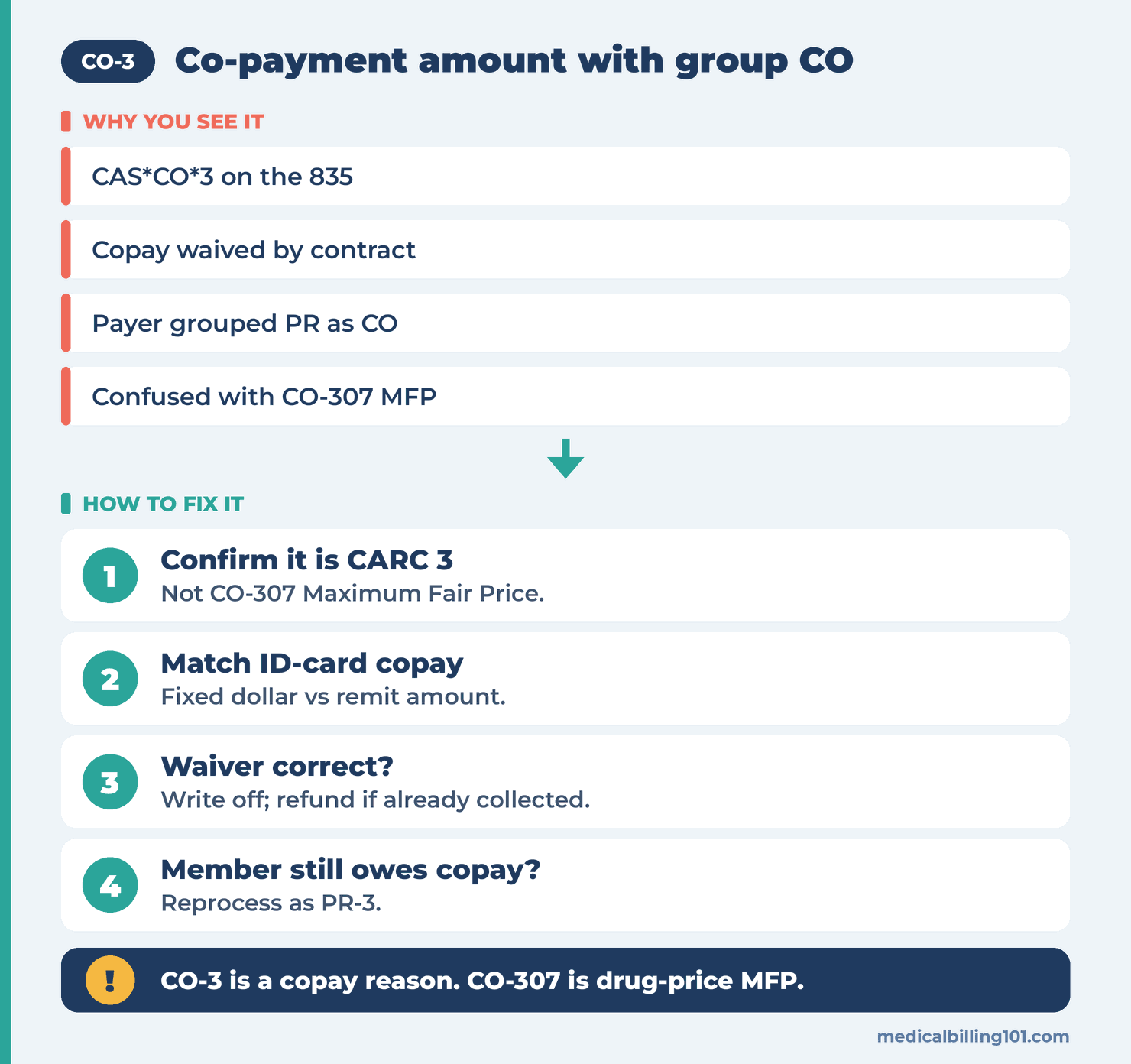
- Confirm CASCO3 and the dollar amount. Do not confuse the queue label with CO-307.
- Check the member ID card and eligibility for the scheduled copay amount.
- If the contract waives the copay, post CO-3 as a write-off.
- If the member owes the copay, request reprocessing as PR-3.
- If the remit is actually about Maximum Fair Price / drug negotiation, you need the CO-307 path and its remark code — not CO-3.
- Collect front-desk copays carefully. If you already collected $40 and the remit later shows CO-3 (write-off), you may owe the patient a refund under your policy.
- Bill secondary when the corrected group is PR and a supplemental plan exists.
- Update posting rules so CO-3 never auto-lands in patient AR.
Medicare, commercial and Medicaid notes
Medicare (Original). Many Part B services use deductible + coinsurance (PR-1 / PR-2) rather than a flat PR-3 copay. Medicare Advantage and commercial plans use fixed copays much more often. A CO-3 on Original Medicare FFS is unusual; verify before posting.
Commercial / MA. Fixed copays are common. Match the remit to the tier (PCP vs specialist vs urgent care). CO-3 with an active member copay on the card is a group-code dispute.
Medicaid. Copays, when they exist, are often small and sometimes non-collectible under state rules. CO-3 may simply mean “do not bill the member.”
Worked example (illustrative)
Specialist copay on the card is $40. Remit pays the line and shows CASCO3*40.00. Front desk already collected $40.
Letter / portal note when the group should be PR-3
[Date]
[Payer] Provider Services
Re: Please reprocess CAS*CO*3 as PR-3 (co-payment)
Patient: [Name]  Member ID: [ID]  Claim: [Claim #]  DOS: [date]

The remittance reports CAS*CO*3 for $[amount]. The member's benefit shows a
$[amount] copay for this service type, and our contract does not waive that
copay. Please reprocess with group code PR and CARC 3 so we may bill secondary
or the member correctly.

Enclosed: remit, ID card copay schedule, eligibility screenshot.
[Name]  [NPI]  [Phone]
Prevention checklist
- [ ] Teach CO-3 ≠ CO-307.
- [ ] Reconcile front-desk copay collections to the remit group code.
- [ ] Expect PR-3 for normal member copays.
- [ ] Investigate CO-3 before patient statements or refunds.
- [ ] Keep links to PR-1 / PR-2 / PR-3 and CO-307.
- [ ] Use the CARC and RARC guide for new billers.
Related denial codes
- PR-1 / PR-2 / PR-3: patient deductible, coinsurance and copay.
- CO-1: deductible amount with group CO.
- CO-2: coinsurance amount with group CO.
- CO-307: Medicare Maximum Fair Price adjustment.
- CO-45: charge above allowed / contracted amount.
- CARC and RARC guide.
Key takeaways
CARC 3 means co-payment amount. PR-3 is the usual patient-billable form. CO-3 is the contractual form — generally a write-off. Do not confuse it with CO-307 Maximum Fair Price.
FAQ
What is the CO-3 denial code description?
X12 describes CARC 3 as “Co-payment Amount.” CO-3 is that reason with group code CO. The patient-billable twin is PR-3.
Is CO-3 the same as CO-307?
No. CO-3 is a copayment cost-sharing reason. CO-307 is the Medicare Maximum Fair Price standard default refund amount adjustment and needs a remark code.
Can I bill the patient for CO-3?
Generally no while the group is CO. If the member owes the copay, ask the payer to reprocess as PR-3.
Why did the old co-3 URL open CO-307?
WordPress guessed a nearby slug when the co-3 page did not exist. This page is the real CO-3 guide.
What if we already collected the copay and the remit shows CO-3?
Confirm whether the write-off is correct. If CO-3 is right, refund under your policy. If PR-3 is right, get the remit corrected and keep the collection.
How is a copay different from coinsurance?
Copay (CARC 3) is a fixed dollar amount. Coinsurance (CARC 2) is a percentage of the allowed amount.
Quick facts
| Item | Value |
|---|---|
| X12 code | 3 |
| X12 start | 01/01/1995 |
| Official wording | Co-payment Amount |
| Usual group for patient copay | PR |
| This page’s group focus | CO |
| Patient-billable twin | PR-3 |
| Common lookalike | CO-307 (Maximum Fair Price) |
| Last reviewed | 13 October 2026 |
Sources
- X12, Claim Adjustment Reason Codes (CARC 3, 241, 307, 45). CARC 3 Start 01/01/1995. Accessed 13 Oct 2026.
- CMS, Medicare Claims Processing Manual (IOM 100-04), Ch. 22, §60.1 Group Codes. Accessed 13 Oct 2026.
- Medical Billing 101, PR-1 / PR-2 / PR-3 guide.
- Medical Billing 101, CO-307 guide.
Code wording and Medicare rules on this page were checked on 13 October 2026 against X12 and CMS sources.
Last reviewed: 13 October 2026 · This page is educational and doesn’t replace payer-specific contracts or benefit booklets.