

CO-2 is Claim Adjustment Reason Code 2 with group code CO. CARC 2 means “Coinsurance Amount.” Day-to-day remits almost always show patient coinsurance as PR-2. A CO-2 line uses the same reason under Contractual Obligation. CMS’s group-code rule treats those dollars as a provider write-off, not a patient balance. Before this page existed, a WordPress 404 guess sent /denial-codes/co-2/ to CO-22. That page covers coordination of benefits. That is a different code. Many people search for “co 2 denial code”, and that is the phrase this page answers. (Primary sources: X12 Claim Adjustment Reason Codes · CMS Claims Processing Manual, Ch. 22, §60.1 · PR-1 / PR-2 / PR-3 · CO-22)
Quick answer: If the remit says PR-2, the patient’s percentage share of the allowed amount may be billed (after secondary). If it says CO-2, do not bill the patient for that coinsurance line. Confirm a contractual write-off, a payer grouping error, or a mix-up with CO-22 (another payer may be primary).
Part of our denial codes library. Written by Manikandan, a revenue cycle management specialist with more than 10 years of US medical billing experience. Last reviewed: 13 October 2026. Official code wording is quoted word for word from X12; Medicare rules link to their CMS source.
CO-2 denial code description (official X12 wording)
X12 Claim Adjustment Reason Code 2, verbatim:
“Coinsurance Amount”
Source: X12 Claim Adjustment Reason Codes, checked 13 October 2026. Start: 01/01/1995. No later “Last Modified” date is listed for code 2.
The CARC is 2. Coinsurance is the patient’s percentage share of the allowed amount after the deductible. The group code (PR vs CO) decides whether those dollars are patient-billable.
What CO-2 means in plain English
- The payer identified a coinsurance amount on the claim or service line.
- With group CO, that amount is generally a contractual write-off for the provider.
- With group PR, the same CARC becomes PR-2, which you may bill to the patient or secondary after the plan’s rules.
- CO-2 is not CO-22. CO-22 means care may be covered by another payer per coordination of benefits. CO-2 is cost-sharing math.
- CO-2 is not a denial that the service was non-covered. It is an adjustment reason about coinsurance dollars.
CO-2 vs PR-2, CO-22, CO-45 and lookalikes
| Code | Official X12 idea | What it tells you |
|---|---|---|
| PR-2 | Coinsurance Amount (group PR) | Patient percentage share — PR-1 / PR-2 / PR-3 |
| CO-2 | Coinsurance Amount (group CO) | Same CARC, contractual write-off — do not bill the patient |
| 22 | Care may be covered by another payer per COB | Another health plan may be primary — CO-22 |
| 45 | Charge exceeds fee schedule / contracted amount | Pricing cut often paired with PR-2 |
| 248 | Coinsurance for professional service on institutional claim (PPACA bundled payment note) | Specialty coinsurance CARC for a narrow Medicare use |
| 109 | Not covered by this payer; send to correct payer | Wrong payer — CO-109 |
Slug confusion matters here: co-2 looks like the start of co-22, which is why the old guess redirect landed on coordination of benefits. Always match the full reason code on the remit.
Group code matrix for CARC 2
| Group + 2 | Who carries the amount | Typical next step |
|---|---|---|
| PR-2 | Patient / insured | Bill secondary, then patient per policy |
| CO-2 | Provider (write-off) | Post contractual adjustment; do not statement |
| OA-2 | Other adjustment | Read remarks; confirm grouping |
CMS Ch. 22 §60.1 says CO is generally a provider write-off. It is not billed to the patient. PR may be billed to the patient or insured. Payers typically use PR for deductible and copay. Everyday remits use the same PR pattern for coinsurance.
When group code CO appears on coinsurance
- Contract says the provider absorbs member coinsurance (some rental networks, worksite clinics, promotional waivers).
- Payer sends CO instead of PR by mistake — benefits still show a member coinsurance percentage.
- Secondary plan reporting of primary coinsurance math under CO while adjudicating its own payment.
- Not the same as unpaid PR-2. If the member still owes coinsurance under the benefit booklet, expect PR-2.
Where CO-2 shows up in the 835
CLP*PCN88990*1*300.00*160.00*40.00*12*CLAIM556677~
SVC*HC:99214*300.00*160.00**1~
CAS*CO*45*100.00~
CAS*CO*2*40.00~
AMT*B6*200.00~
- Allowed $200 (charge $300 − CO-45 $100).
- Plan paid $160.
- CASCO2*$40 is coinsurance coded under CO (write-off on this remit).
- The patient-billable twin would be CASPR2*40.00.
Illustrative only. Real remits vary by payer and may add a remark code.
How to fix CO-2: decision path
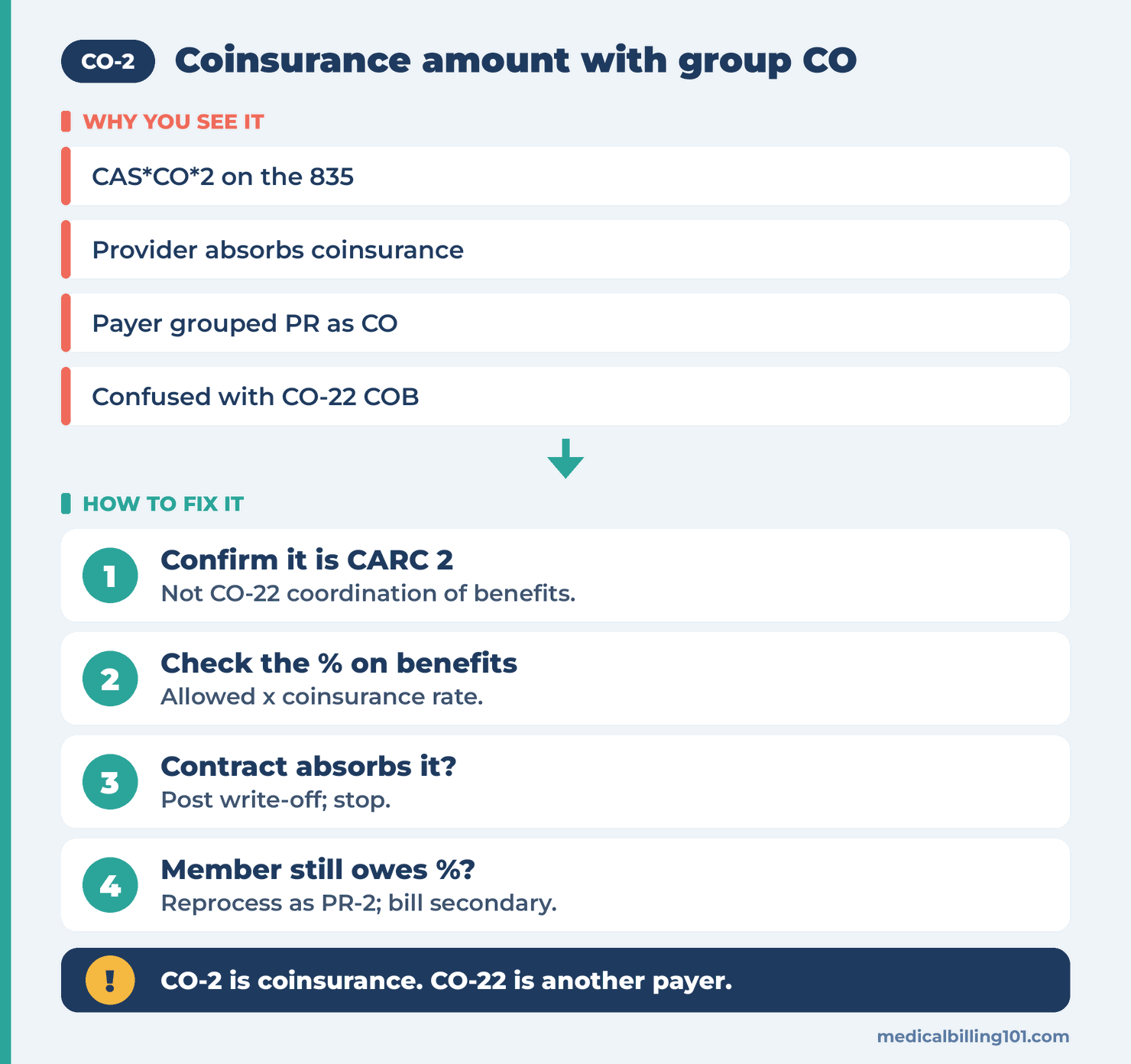
- Read CAS carefully. Confirm group CO, reason 2, and the dollar amount. Do not skim “CO-2” as “CO-22”.
- Check the benefit percentage. Eligibility and the EOB should show the member coinsurance rate (for example Medicare Part B 20% for 2026 per MLN MM14279).
- If the contract absorbs coinsurance, post CO-2 as a write-off and stop.
- If the member still owes coinsurance, ask the payer to reprocess with PR-2.
- If the story is really another payer, you want CO-22, not CO-2. Bill the primary plan first.
- Bill secondary before the patient when the corrected remit shows PR-2.
- Keep PMS rules from auto-moving CO-2 into patient AR.
- Document the call reference or portal ticket when you dispute the group code.
Medicare, commercial and Medicaid notes
Medicare (Original). Part B coinsurance is normally PR-2 at 20% of the allowed amount after the deductible (CMS 2026 fact sheet; MLN MM14279). A CO-2 on FFS is uncommon and worth a second look before you write it off or bill anyone.
Commercial. Percentages vary by plan (often one-tenth, one-fifth or three-tenths of the allowed amount, sometimes tiered). Match the remit dollars to allowed × coinsurance rate. If CO-2 appears but the ID card shows member coinsurance, dispute the group code.
Medicaid. Many state plans have limited or $0 coinsurance. A CO-2 line may simply reflect that the member share is not collectible.
Worked example (illustrative)
In day-to-day posting queues, CO-2 is the line that most often gets mixed up with CO-22 because of the shared “CO-2” prefix on truncated labels.
Allowed amount is $200 after CO-45. Plan coinsurance is one-fifth of allowed. Remit pays $160 and shows CASCO2*40.00.
Prevention checklist
- [ ] Train staff: CO-2 ≠ CO-22.
- [ ] Post from the 835 CAS segments, not from truncated queue labels.
- [ ] Expect PR-2 for normal member coinsurance.
- [ ] Investigate every CO-2 before patient statements.
- [ ] Link posters to PR-1 / PR-2 / PR-3 and CO-22.
- [ ] Use the CARC and RARC guide in onboarding.
Related denial codes
- PR-1 / PR-2 / PR-3: patient deductible, coinsurance and copay.
- CO-1: deductible amount with group CO.
- CO-3: co-payment amount with group CO.
- CO-22: coordination of benefits — another payer may be primary.
- CO-45: charge above allowed / contracted amount.
- OA-23: impact of prior payer adjudication.
- CARC and RARC guide.
Key takeaways
CARC 2 means coinsurance amount. PR-2 is the usual patient-billable form. CO-2 is the contractual-obligation form — generally a write-off. Do not confuse it with CO-22 coordination of benefits.
FAQ
What is the CO-2 denial code description?
X12 describes CARC 2 as “Coinsurance Amount.” CO-2 is that reason with group code CO. The patient-billable twin is PR-2.
Is CO-2 the same as CO-22?
No. CO-2 is coinsurance cost-sharing. CO-22 means another payer may be primary under coordination of benefits. Different fixes.
Can I bill the patient for CO-2?
Generally no while the group code is CO. If the member truly owes coinsurance, ask the payer to reprocess as PR-2.
Why did the old co-2 URL open the CO-22 page?
WordPress guessed a nearby slug when co-2 did not exist. Visitors landed on coordination of benefits by mistake. This page is the real CO-2 guide.
How is CO-2 different from PR-2?
Same CARC text, different group. PR-2 may be billed to the patient or secondary. CO-2 is generally a provider write-off under CMS group-code rules.
Does Medicare Part B coinsurance come back as CO-2?
Usually you see PR-2 for Part B coinsurance after the deductible (CMS 2026 fact sheet). Verify any CO-2 on a Medicare remit before posting.
Quick facts
| Item | Value |
|---|---|
| X12 code | 2 |
| X12 start | 01/01/1995 |
| Official wording | Coinsurance Amount |
| Usual group for patient coinsurance | PR |
| This page’s group focus | CO |
| Patient-billable twin | PR-2 |
| Common lookalike | CO-22 (COB) |
| Last reviewed | 13 October 2026 |
Sources
- X12, Claim Adjustment Reason Codes (CARC 2, 22, 45, 109, 248). CARC 2 Start 01/01/1995. Accessed 13 Oct 2026.
- CMS, Medicare Claims Processing Manual (IOM 100-04), Ch. 22, §60.1 Group Codes. Accessed 13 Oct 2026.
- CMS, 2026 Medicare Parts A & B Premiums and Deductibles. Part B coinsurance 20%. Accessed 13 Oct 2026.
- Medical Billing 101, PR-1 / PR-2 / PR-3 guide.
- Medical Billing 101, CO-22 guide.
Code wording and Medicare rules on this page were checked on 13 October 2026 against X12 and CMS sources.
Last reviewed: 13 October 2026 · This page is educational and doesn’t replace payer-specific contracts or benefit booklets.