
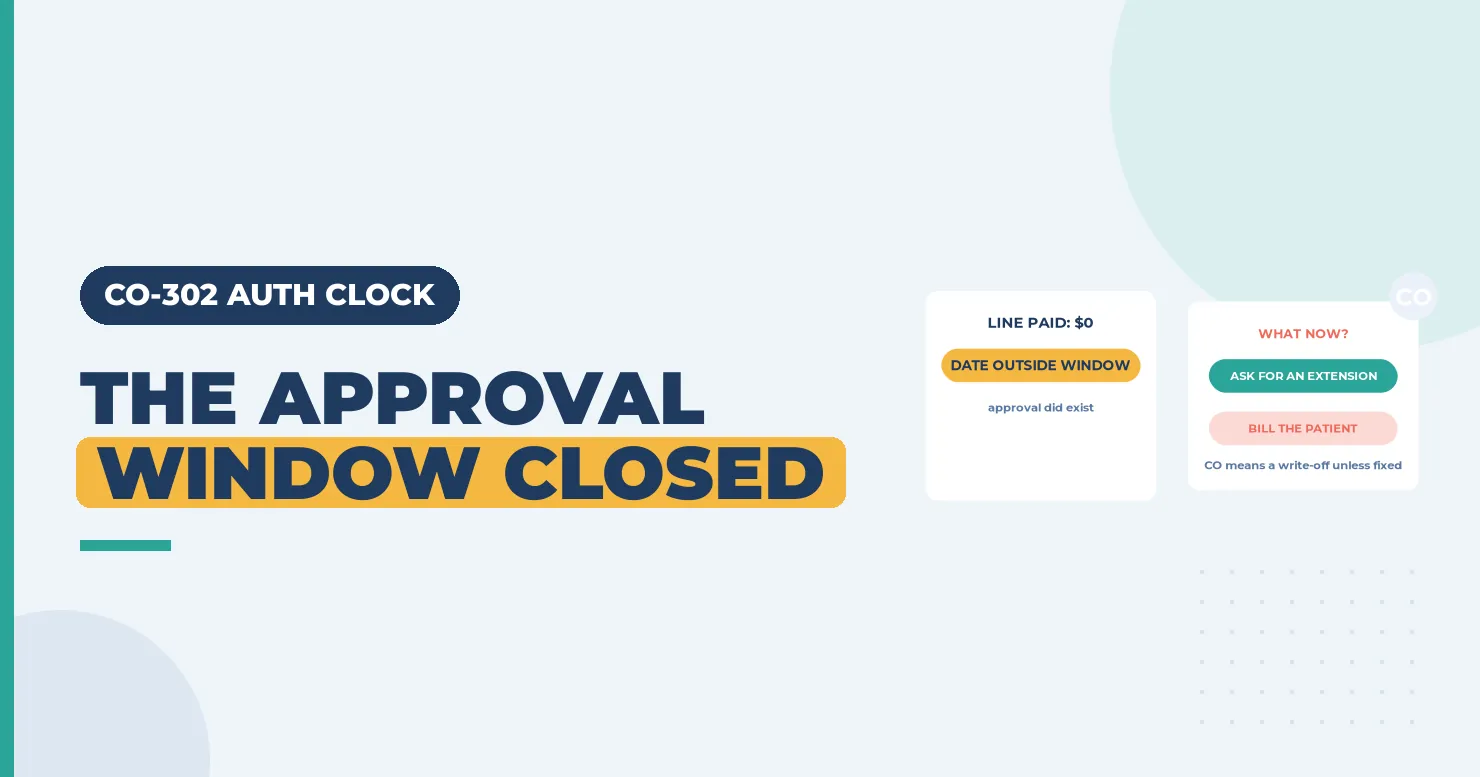
The CO-302 denial code means the prior authorization or notification time limit had expired. Either the service date fell outside the approval window, or the plan was told too late. Fix it by asking the plan to extend or reissue the approval, then send a corrected claim. (Primary source: X12 Claim Adjustment Reason Codes)
In brief: CARC 302 is about dates, not medical need. The approval existed, but the clock ran out. Prove why the date moved, ask for an updated approval, and do not bill the patient.
Part of our denial codes library. Written by Manikandan J, CPC, CRCR, who has worked expired approvals for surgery centers and hospital outpatient departments. Published 16 November 2026. Last updated: 16 November 2026. Code wording quoted word for word from X12. Read about the author and our editorial policy, or contact us to report an error.
What does denial code CO-302 mean?
Denial code CO-302 means a time limit tied to the approval had passed. Reason code 302 covers two cases. The approval may have expired before the service date, or the required notice reached the plan after its deadline.
| Field | Value |
|---|---|
| Code | 302 |
| Description | “Precertification/notification/authorization/pre-treatment time limit has expired.” |
| Group codes | No X12 group restriction; CO is the usual choice |
| Start | 11/01/2020 |
| Common remark | N54 for dates outside the approval; N385 for late admission notice |
Source: X12 Claim Adjustment Reason Codes, checked 16 November 2026.
Methodology: the code wording is copied from the X12 list, and the claim form steps follow the NUCC instructions cited below.
Key terms: An approval window is the date range in which the plan’s approval is valid. A notification deadline is the time you have to tell the plan about an admission. CO is the contractual obligation group code.
CO-302 vs OA-302: what is the difference?
CO-302 says your contract made you responsible for keeping the approval current. The amount is a provider write-off unless the plan reverses it. OA-302 reports the same expired window without assigning the loss to anyone. In practice, treat both the same way. Neither one lets you move the balance to the patient.
What makes an authorization time limit expire?
An authorization time limit expires when care happens outside the approved dates or the plan hears about it too late. For example, a surgery may move past a 60-day window after the patient falls ill. An inpatient stay may begin on a weekend, and nobody calls the plan within its notice period.
Remark code N385 reads “Notification of admission was not timely according to published plan procedures.” When it appears, the problem is the notice, not the approval dates. The CMS prior authorization final rule also sets decision time frames for many plans, so record when you asked.
Example scenario (fictional names), part 1
CO-302 Denial Example: What Happened
Tessa Lindqvist bills for Cedar Ridge Surgery Center, which shares staff with a local hospital. Dr. Paul Iverson planned a right knee arthroscopy with a partial medial meniscectomy. The fictional commercial plan approved 29881 for a 60-day window.
The patient caught pneumonia, and surgery moved out by three weeks. Nobody updated the approval. Tessa billed 29881-RT with diagnosis M23221 and the original approval number in Box 23.
The 835 showed CAS*CO*302 and remark code N54, which reads “Claim information is inconsistent with pre-certified/authorized services.”
Was the knee surgery money lost, or could Tessa still save it? Keep reading, or jump to how it was resolved. Keep reading, or jump to how the CO-302 denial was resolved.
How do I fix a CO-302 denial?
To fix a CO-302 denial, find out which clock expired and ask the plan to correct it. For an expired window, request an extension or a new approval with the reason for the delay. For a late notice, send proof of when you called. Then send a corrected claim or a written appeal.
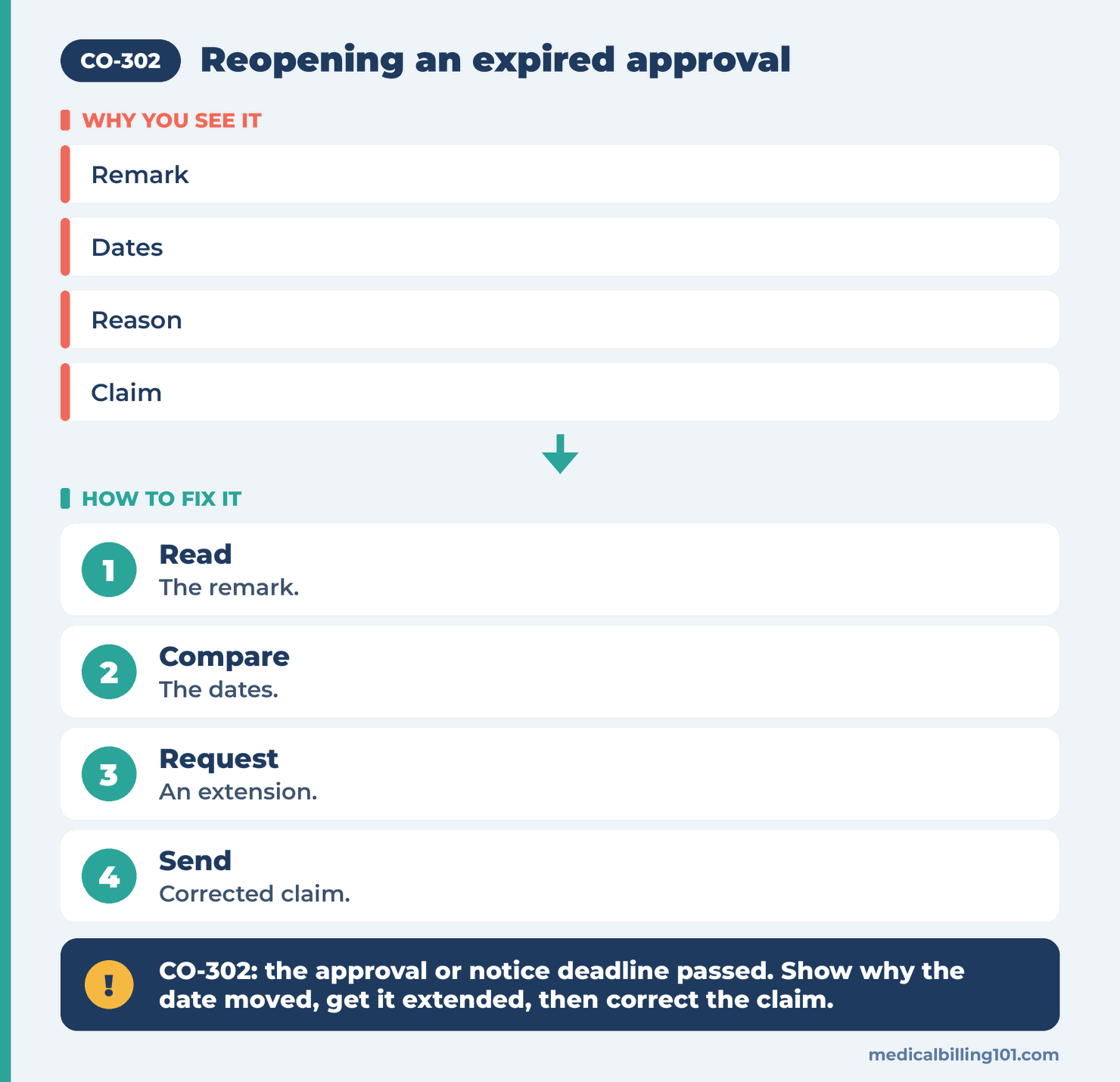
- Read the remark. N54 points to the approval dates. N385 points to a late admission notice.
- Compare the dates. Put the approval start and end dates next to the date of service.
- Gather the reason. Pull the note that explains the delay, such as an illness or a canceled operating room.
- Ask the plan. Request a date extension or a new approval, and log the call reference.
- Resubmit. Send a corrected claim with frequency code 7 and the updated approval number.
- Appeal if refused. Attach the delay note, the original approval and proof of medical need.
Example scenario (fictional names), part 2
How the CO-302 Denial Was Resolved
Tessa compared the dates and found the surgery was 21 days past the window. The chart had the pneumonia diagnosis and the canceled first booking. The plan’s provider manual allowed a date extension request with records.
Fix: Tessa sent the extension request with the cancellation note. The plan issued an updated approval covering the new date. She sent a corrected claim with frequency code 7 and the new number in Box 23.
Outcome: the plan paid 29881 on the next remit. The center now checks every approval’s end date two days before surgery.
Names and details are illustrative; no real patient data.
Names and details are illustrative; no real patient data.
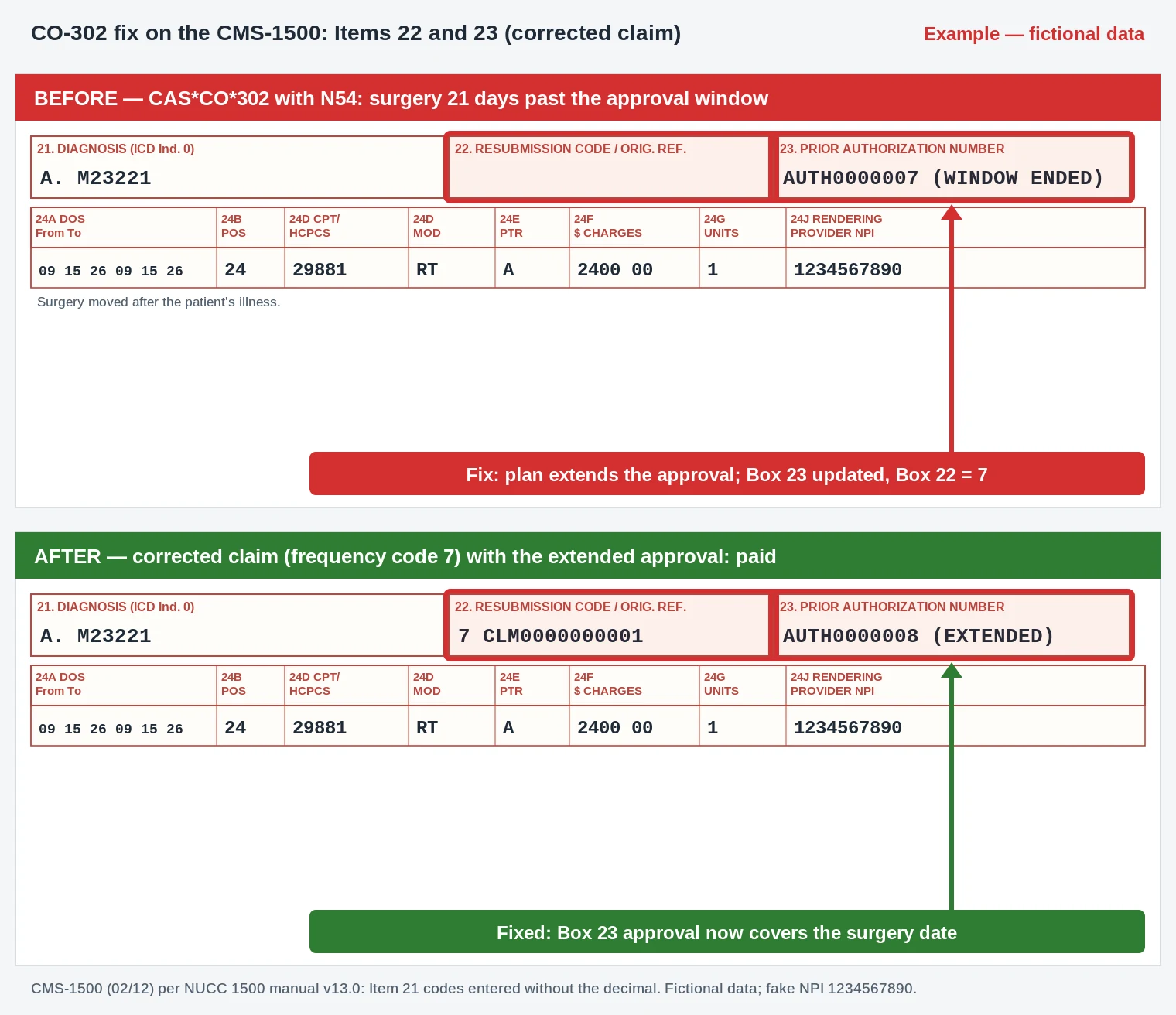
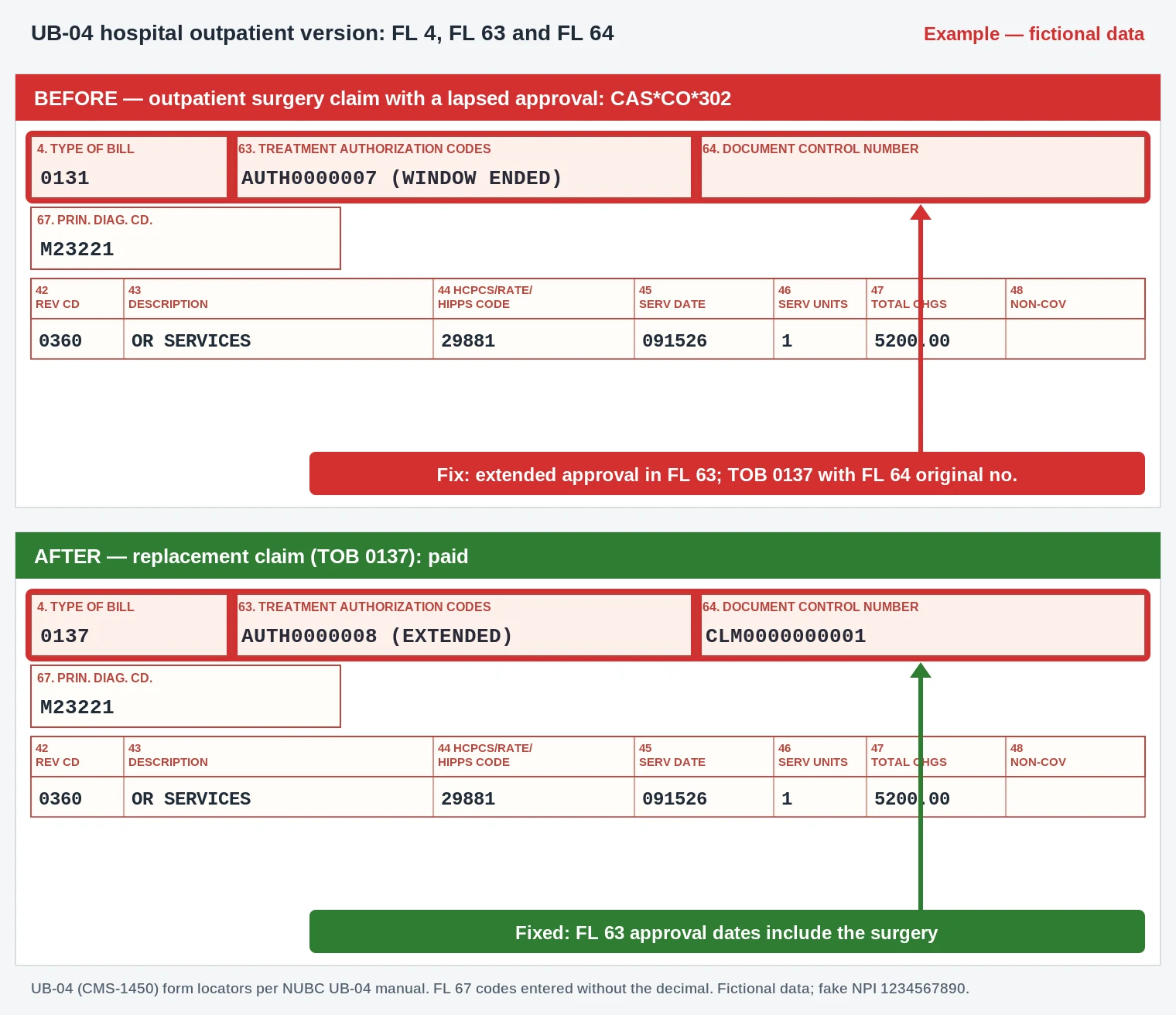
- Box 23 / FL 63: the lapsed approval was replaced with the extended approval that covers the actual surgery date.
- Box 22 / FL 4 + FL 64: frequency code 7 with the original claim number (bill type 0137 on the UB-04).
- Box 24D / FL 44: 29881-RT (revenue code 0360 on the UB-04) is unchanged, because the procedure itself did not change.
- Box 21 / FL 67: M23.221 (entered as M23221) is unchanged.
Can I bill the patient for CO-302?
No. CO-302 is a contractual adjustment, so the patient does not owe it. Keeping an approval current is the provider’s job under most network contracts. If the plan refuses every request, the amount becomes a write-off. The NUCC 1500 instructions show where the approval number goes in Box 23.
Is CO-302 the same as a timely filing denial?
No. Timely filing is about when the claim reached the plan, and that denial is CO-29. CO-302 is about the approval or notice deadline. A claim can be filed on time and still get CO-302. Medicare’s prior authorization programs also tie each approval to set dates.
Related codes
| Code | Meaning |
|---|---|
| CO-197 | Precertification or authorization absent |
| CO-198 | Precertification or authorization exceeded |
| CO-296 | Authorization valid but does not apply to the provider |
| CO-284 | Authorization does not apply to the billed services |
FAQ
What does CO-302 mean?
The approval or notification time limit had expired when the service or notice happened.
Is CO-302 the same as no authorization?
No. With CO-302 an approval existed, but its window or notice deadline passed. CO-197 means none existed.
Can a plan extend an expired authorization?
Many plans allow a date extension or a new approval when you show why the date moved.
Which group code comes with CARC 302?
X12 sets no restriction. CO is the usual choice, because the contract requires a current approval.
Does the patient owe a CO-302 amount?
No. It is a contractual adjustment, so fix the approval or appeal instead.
Sources
How we checked: the CARC 302 quote was matched word for word with the X12 CARC list on 16 November 2026, and N54 and N385 with the X12 RARC list.
- X12, Claim Adjustment Reason Codes (CARC 302, 197, 29). Accessed 16 Nov 2026.
- X12, Remittance Advice Remark Codes (N54, N385). Accessed 16 Nov 2026.
- CMS, Interoperability and Prior Authorization Final Rule (CMS-0057-F). Accessed 16 Nov 2026.
- CMS, Prior authorization and pre-claim review initiatives. Accessed 16 Nov 2026.
- NUCC, 1500 claim form instructions. Accessed 16 Nov 2026.
Last updated: 16 November 2026 · Educational content; not legal advice.