
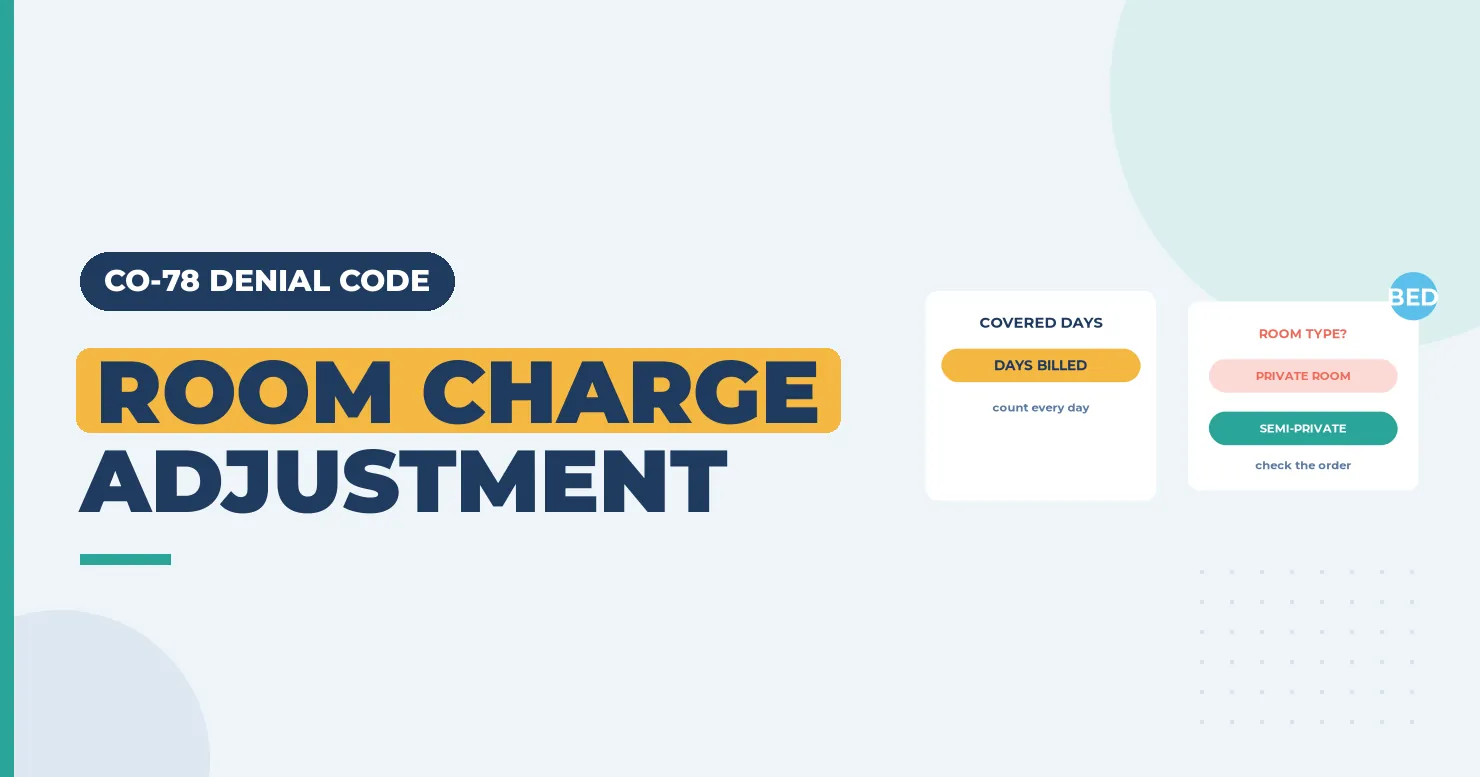
CO-78 means the payer cut part of an inpatient bill because some days weren’t covered or the room charge was higher than the plan allows. The two most common situations are straightforward: either a patient occupied a private room that wasn’t medically necessary, so the plan reimbursed the semi-private rate, or some days of the stay fell outside coverage, such as days spent waiting for a nursing facility bed. The correct fix depends on which situation you’re looking at. (Primary source: X12 Claim Adjustment Reason Codes).
In brief: CO-78 means “Non-Covered days/Room charge adjustment.” Check whether the cut is on room and board lines (often a private room) or on whole days. For rooms, show the private room was medically needed or the only room free. For days, check the level of care, the occurrence span codes and the covered and non-covered day counts. Rebill with correct codes, appeal with records, or post under CO when the cut is right.
Part of our denial codes library. Written by Manikandan J, CPC, CRCR, who has billed and audited hospital inpatient claims for payers and billing companies. Published 20 October 2026. Last updated: 20 October 2026. Code wording is quoted word for word from X12.
Official CARC 78 wording
| Field | Official X12 text |
|---|---|
| Description | “Non-Covered days/Room charge adjustment.” |
| Start | 01/01/1995 |
Source: X12 Claim Adjustment Reason Codes, checked 20 October 2026.
Denial code 78, CARC 78 and reason code 78
Denial code 78, CARC 78 and reason code 78 are one code. With the CO group, the cut stays with the hospital. A plan may send PR-78 for a private room the patient asked for and agreed to pay for.
Room charge or non-covered days?
A room and board charge is the daily charge for the bed, nursing and meals, billed with revenue codes such as 011X for a private room and 012X for a semi-private room. A non-covered day is a day in the stay that the plan won’t pay for, even though the patient was still in the hospital. A level of care is the type of care a patient needs that day, such as acute, skilled or custodial.
| What the remit shows | Likely meaning | First check |
|---|---|---|
| CARC 78 on a 011X line, partial cut | Private room paid at the semi-private rate | Was the private room medically needed? |
| CARC 78 on whole days | Days outside coverage | Level of care for those days |
| CARC 78 on leave of absence days (018X) | Days the patient was away from the hospital | Were they billed as non-covered? |
| CARC 78 plus a day count change | Benefit days ran out | Covered and lifetime reserve days left |
Private rooms under Medicare
Medicare pays for a semi-private room. It pays for a private room when it’s medically needed, for example to isolate a patient with an infection, or when no semi-private room is free. If a patient asks for a private room for comfort, the hospital can charge the patient the difference, but only if the patient was told and agreed first. The CMS Benefit Policy Manual, Chapter 1 covers inpatient room rules.
Common causes of non-covered days
- Waiting for placement. The patient no longer needs acute care but waits for a nursing home bed.
- Level of care dropped. Notes show custodial care only for some days.
- Leave of absence. The patient went home for a day during a planned stay.
- Benefit days used up. The Medicare benefit period ran out and lifetime reserve days weren’t used.
- Late admission order. Days before a valid inpatient order may be cut by some plans.
Codes to check on the UB-04
| Field | Code | What it says |
|---|---|---|
| Value code | 80 | Covered days |
| Value code | 81 | Non-covered days |
| Value code | 82 | Coinsurance days |
| Value code | 83 | Lifetime reserve days |
| Occurrence span | 74 | Non-covered level of care or leave of absence |
| Revenue code | 018X | Leave of absence days |
If these codes don’t match the patient’s medical record, the payer’s day calculation won’t match either. The NUBC owns the official UB-04 code lists; CMS explains how Medicare uses them in the Claims Processing Manual, Chapter 3.
How to work a CO-78
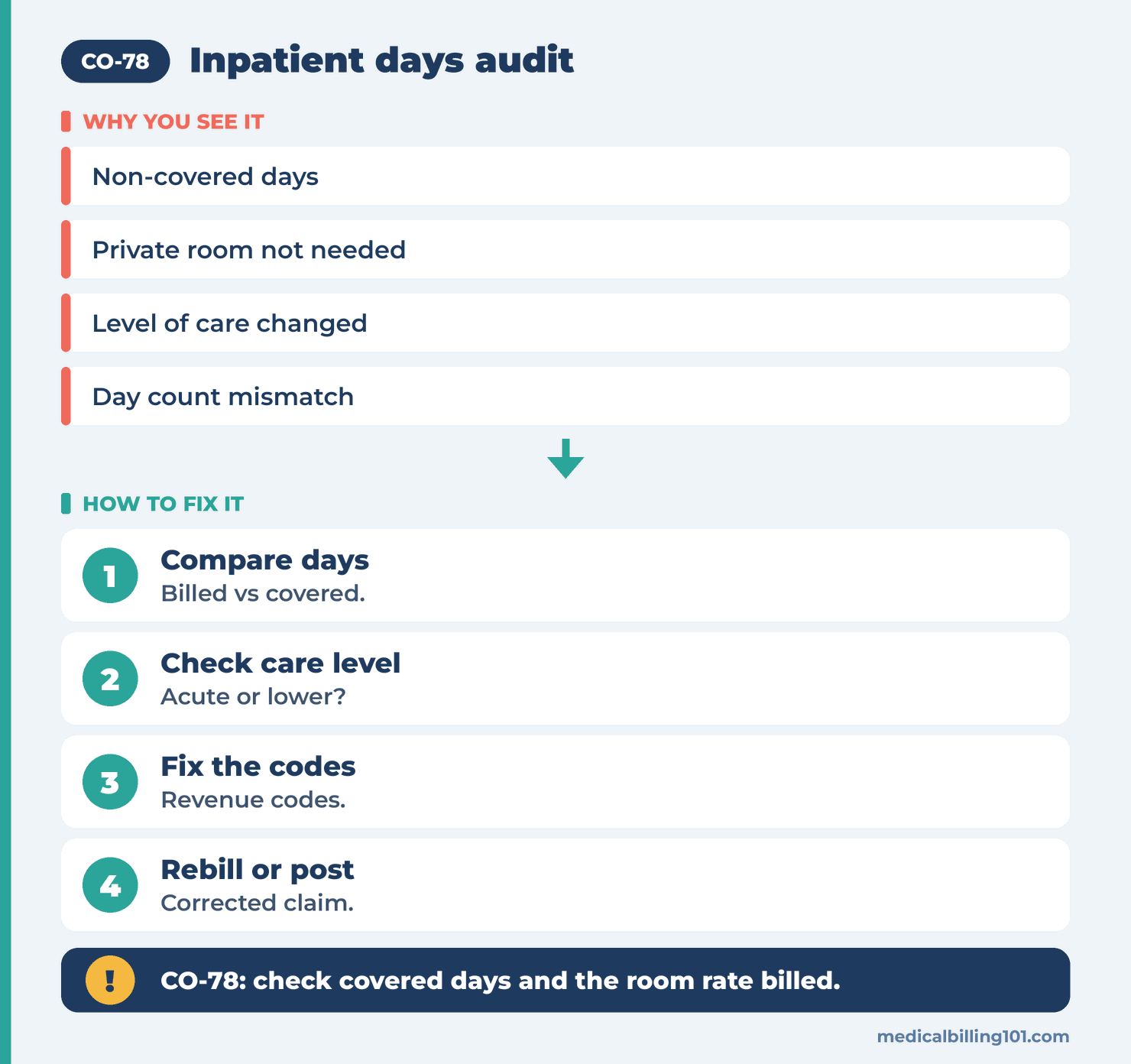
- Compare the days billed with the days the payer counted.
- Check the level of care for each cut day in the notes and the utilization review file.
- Look at the room lines. If a private room was cut, find the reason it was used.
- Fix the codes such as value codes 80 and 81 or occurrence span 74 if they were wrong.
- Rebill or appeal. Send a corrected claim for code errors. Appeal with notes when acute care was needed.
- Post the cut under CO when it’s right, or bill the patient only for a private room they agreed to.
Worked example (illustrative)
A patient with a C. difficile infection is admitted and placed in a private room for contact isolation, and the hospital bills revenue code 0110 for six days. The plan pays the semi-private rate and reports CAS*CO*78*540.00. The biller retrieves the isolation order and the infection prevention documentation, then appeals on the basis that the private room was medically necessary. The plan pays the difference.
Consider a second case. A stroke patient stays three extra days waiting for a rehab bed. The notes show no acute care on those days. The hospital didn’t mark them as non-covered. The biller sends a corrected claim with value code 81 and occurrence span 74, so the claim is right. Whether the hospital can bill those days depends on the plan’s notice rules.
Prevention checklist
- [ ] Document the reason for every private room, such as isolation.
- [ ] Get written consent before charging a patient for a private room they asked for.
- [ ] Review level of care daily for long stays.
- [ ] Code leave of absence days with 018X and occurrence span 74.
- [ ] Check benefit days before discharge for long Medicare stays.
Related denial codes
- CO-50: not deemed a medical necessity.
- CO-96: non-covered charges.
- CO-45: charge exceeds fee schedule or contracted amount.
- PR-119: benefit maximum for this time period reached.
- CO-16: claim lacks information needed for adjudication.
- Denial codes hub for every code we cover.
Key takeaways
CO-78 cuts non-covered inpatient days or a room charge. Decide first whether it’s a room issue or a days issue. Prove a private room was medically needed, check the level of care for cut days, and make sure the value and occurrence codes match the chart. Rebill code errors, appeal with notes, and post correct cuts under CO.
FAQ
What does CO-78 mean?
It means the payer adjusted the inpatient claim for non-covered days or for an accommodation charge, such as a private room without documented medical necessity.
Does Medicare pay for a private room?
Only when it’s medically needed or no semi-private room is free. Otherwise it pays the semi-private rate.
Can I bill the patient for a private room?
Only if the patient asked for it and agreed in writing to pay the difference. Then the plan may send PR-78.
Which value code shows non-covered days?
Value code 81. Value code 80 shows covered days.
What is occurrence span code 74?
It marks a period of non-covered level of care or a leave of absence.
How do I appeal CO-78 for non-covered days?
Send notes that show the patient needed acute care on the cut days.
Sources
How we checked: every code quote on this page was compared word for word with the X12 CARC list on 20 October 2026.
- X12, Claim Adjustment Reason Codes (CARC 78). Accessed 20 Oct 2026.
- CMS, Medicare Benefit Policy Manual, Ch. 1, Inpatient Hospital Services. Accessed 20 Oct 2026.
- CMS, Medicare Claims Processing Manual, Ch. 3, Inpatient Hospital Billing. Accessed 20 Oct 2026.
Last updated: 20 October 2026 · This page is educational and doesn’t replace payer contracts or coding rules.