
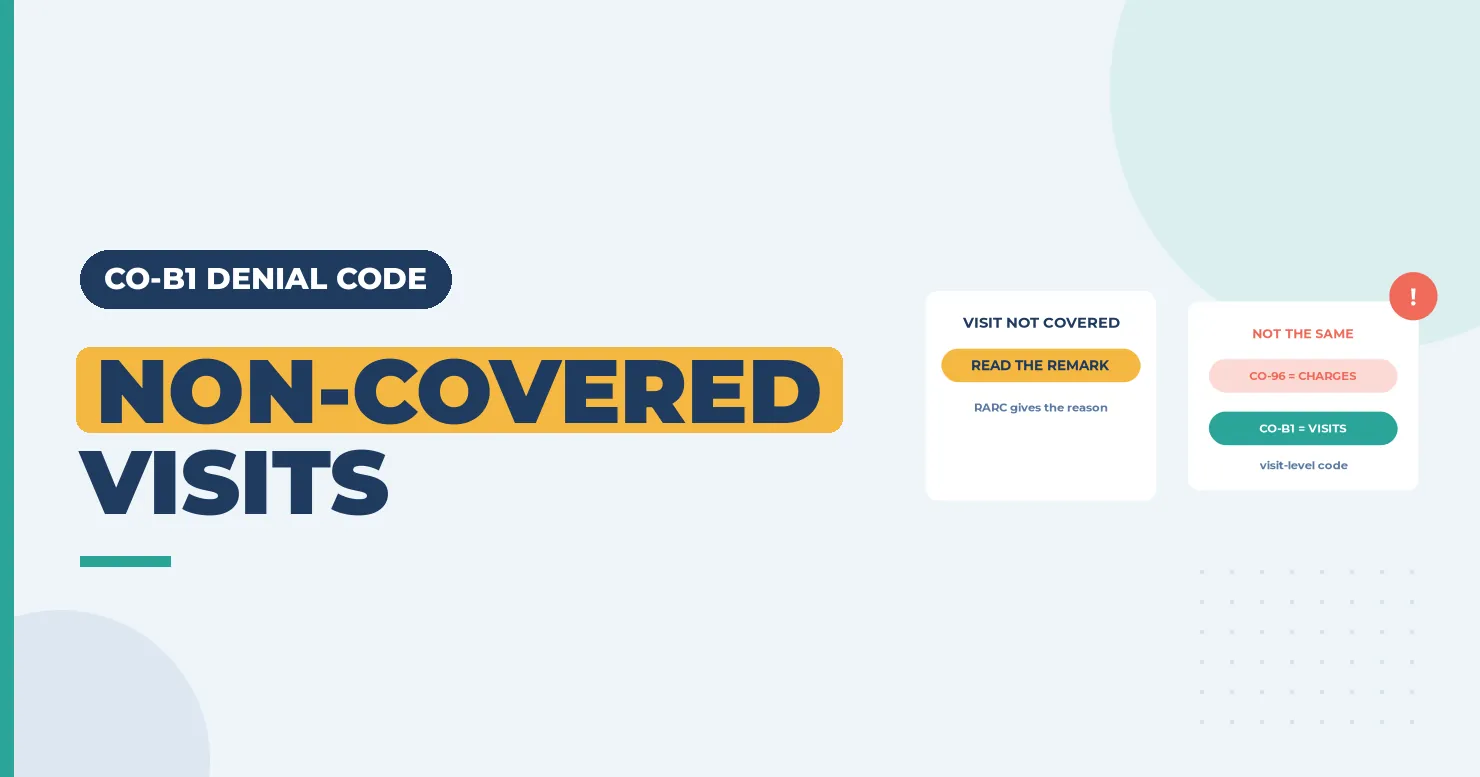
CO-B1 is Claim Adjustment Reason Code B1 with group code CO. CARC B1 means non-covered visits. A visit-level adjustment is an adjustment that applies to an encounter as a whole, such as an office visit or a clinic stay, instead of one drug or supply. The payer decided that the visit is not covered, and the code alone does not say why. Many people search for “co b1 denial code”, and that is the phrase this page answers. (Primary sources: X12 Claim Adjustment Reason Codes · X12 Remittance Advice Remark Codes · CMS Claims Processing Manual, Ch. 22, §60.1)
Quick answer: CO-B1 is a short code with no usage note, so the remark code carries the real reason. Read the RARC on the same line first. Then check eligibility, benefits and coding for that visit. Fix what you can, appeal if the visit should be covered, and write off the rest. A CO group means the patient is not billed.
Part of our denial codes library. Written by Manikandan, a revenue cycle management specialist with more than 10 years of US medical billing experience. Last reviewed: 16 October 2026. Official code wording is quoted word for word from X12; Medicare rules link to their CMS source.
CO-B1 denial code description (official X12 wording)
X12 Claim Adjustment Reason Code B1, verbatim:
“Non-covered visits.”
Source: X12 Claim Adjustment Reason Codes, checked 16 October 2026. Start: 01/01/1995. X12 lists no usage note and no later modification.
The CARC is B1. The group code is usually CO. CMS Transmittal 470 (2005) lists B1 with group code CO for Medicare fiscal intermediaries. CMS Ch. 22, §60.1 says CO adjustments are “generally… considered a write off for the provider and are not billed to the patient.”
What CO-B1 means in plain English
- The payer says the visit is not covered. The decision is about the encounter, not a single supply or drug.
- The code gives no reason. X12 gives only the two words “Non-covered visits.”
- The remark code explains it. Look for a RARC on the same line before you decide what to do.
- It may be a coverage rule or a billing problem. For example, the plan excludes the visit type, or the visit fell inside a global period.
- The patient does not owe it while the group is CO.
CO-B1 vs CO-96, CO-B9, CO-50 and lookalikes
| Code | Official X12 idea | What it tells you |
|---|---|---|
| CO-B1 | Non-covered visits | Visit-level, reason in the RARC. This page |
| 96 | Non-covered charge(s) | Charge-level exclusion. See CO-96 |
| 50 | Not deemed a medical necessity by the payer | Medical necessity. See CO-50 |
| B9 | Patient is enrolled in a hospice | Hospice election. See CO-B9 |
| B15 | Qualifying service not received or adjudicated | Missing prerequisite. See CO-B15 |
| B7 | Provider not certified/eligible for this service on this date | Enrollment. See CO-B7 |
Remark codes that explain a non-covered visit
X12 does not publish a fixed list of remarks for B1. The RARCs below are real X12 codes whose official wording describes a visit-level reason, so they are the ones to watch for. Your payer may use others.
| RARC | Official X12 wording | What to check |
|---|---|---|
| N20 | Service not payable with other service rendered on the same date. | Another service on the same day |
| N30 | Patient ineligible for this service. | Eligibility for that service |
| N113 | Only one initial visit is covered per physician, group practice or provider. | Initial vs follow-up visit coding |
| N525 | These services are not covered when performed within the global period of another service. | Global period and modifiers |
| N628 | Out-patient follow up visits on the same date of service as a scheduled test or treatment is disallowed. | Same-day follow-up visit |
| N734 | The patient is eligible for these medical services only when unable to work or perform normal activities due to an illness or injury. | Plan wording and diagnosis |
| N912 | Our records indicate that this beneficiary did not elect hospice. | Hospice status and billing path |
N174 is also worth knowing. X12 words it as “This is not a covered service/procedure/ equipment/bed, however patient liability is limited to amounts shown in the adjustments under group ‘PR’.” If a PR adjustment sits on the same line, that part may be billable to the patient. Read the group code on each CAS segment.
Common triggers for CO-B1
- Visit type excluded by the plan. The benefit does not include that kind of encounter.
- Visit inside a global period. A follow-up was billed as a separate visit.
- Duplicate or same-day visit rule. A second visit or an add-on was billed on the same date.
- Eligibility problem. The patient was not eligible for that service on that date.
- Billing path problem. Consider a hospice patient whose visit should have gone to a different payer or with a different code.
Where CO-B1 shows up in the 835
CLP*PCN55902*4*95.00*0.00*0.00*12*CLAIM664120~
SVC*HC:99213*95.00*0.00**1~
CAS*CO*B1*95.00~
LQ*HE*N525~
- Status code 4 means the claim was denied.
- The line paid $0.
- CAS*CO*B1*95.00 took the full charge as a non-covered-visit adjustment.
- The LQ line carries the remark code that gives the reason.
- This sample is illustrative only. Real remits vary.
How to fix CO-B1: decision path
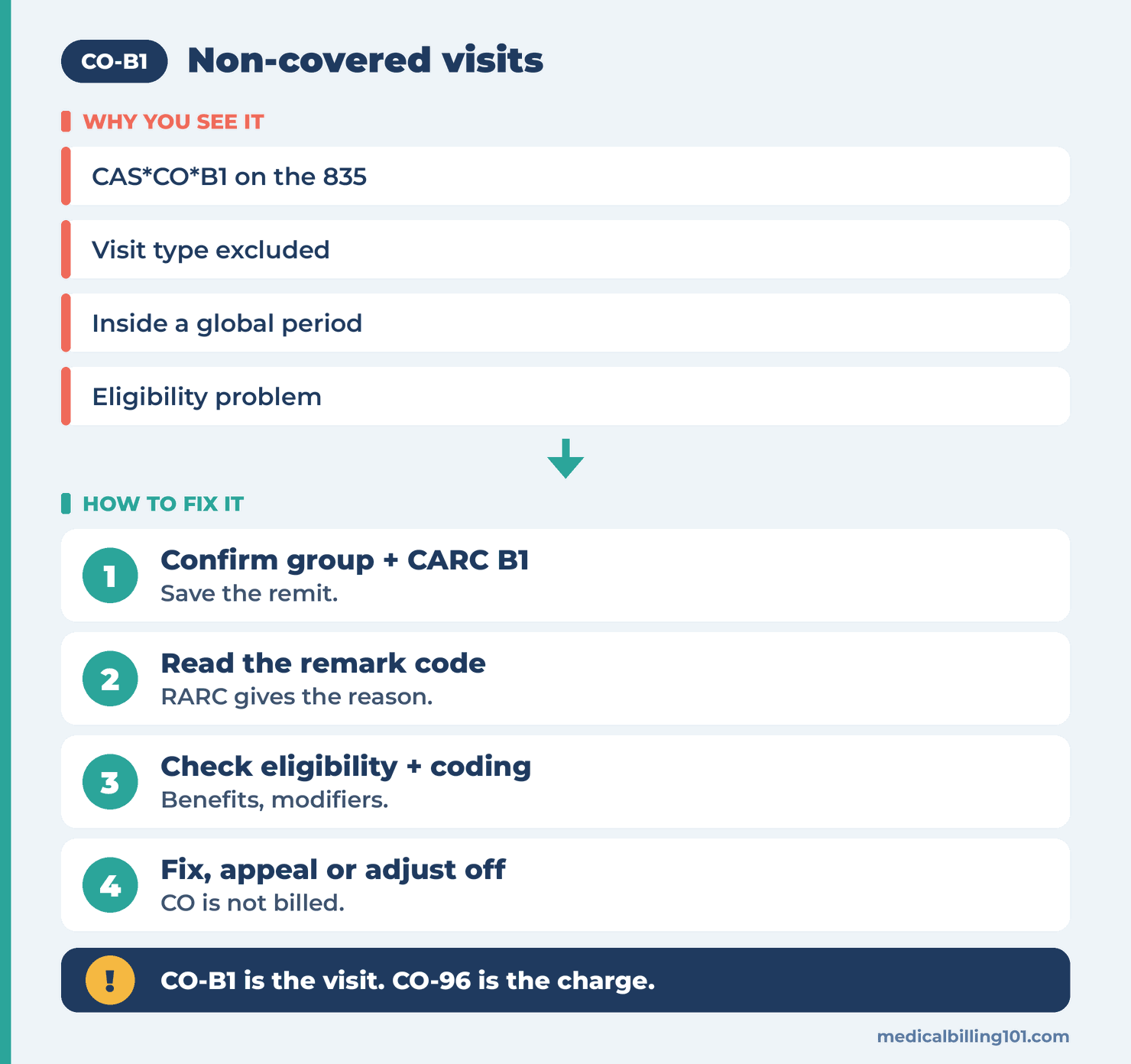
- Confirm the CAS segment. Check the group (CO), the reason (B1), and the amount. Save the remit.
- Read the remark code on the same line, in the LQ segment or the RMK segment of the 835.
- Check eligibility and benefits for the date of service and the visit type.
- Check the coding. Look at the visit code, the modifiers, and any other services billed the same day.
- If the claim was coded wrong, correct it and resubmit as a corrected claim.
- If the visit should be covered, appeal with the chart and the plan language. Ask the payer which rule it applied.
- If the visit is a true exclusion, adjust it off. The CO group means it is not billed to the patient.
- Do not move the amount to the patient unless the same line also carries a PR adjustment.
Medicare, commercial and Medicaid notes
Medicare. CMS Transmittal 470 lists B1 with CO. For a visit inside a global surgical period, CMS Claims Processing Manual Ch. 12, §30.6.6 A says A/B MACs pay an unrelated E/M service when it is billed with modifier 24 and documentation shows it is not related to the postoperative care.
Commercial. Plans define covered visit types in their benefit documents. Ask for the clause behind the remark code.
Medicaid. State programs list covered visit types and limits in their provider manuals. Check the manual for the visit type.
Worked example (illustrative)
A surgeon bills 99213 for a visit three weeks after a surgery that has a global period. The remit shows CAS*CO*B1*95.00 with remark N525.
Reading it: The payer treats the visit as part of the global surgical package, so it called the visit non-covered.
Check: The note shows the patient came in for a new, unrelated problem and not for postoperative care.
Fix: The biller adds modifier 24, attaches the note that shows the visit was unrelated, and sends a corrected claim. Under CMS §30.6.6 A, Medicare pays this kind of service when it is billed with modifier 24 and documented as unrelated.
Second scenario: The visit was routine postoperative care. The biller adjusts it off as a true global-period service and does not bill the patient.
Prevention checklist
- [ ] Verify the visit type against the plan’s benefits before scheduling.
- [ ] Track global periods and flag unrelated visits for the right modifier.
- [ ] Add a same-day service check at charge entry.
- [ ] Work every B1 line from its remark code, not from the CARC alone.
- [ ] Track B1 by payer and by remark code to spot rules you can fix.
- [ ] Keep the CARC and RARC guide handy for staff training.
Related denial codes
- CO-96: non-covered charge(s).
- CO-50: not deemed a medical necessity by the payer.
- CO-B9: patient is enrolled in a hospice.
- CO-B15: qualifying service not received or adjudicated.
- CARC and RARC guide.
Key takeaways
CO-B1 says the visit is not covered, and the remark code says why. Read the RARC first. Check eligibility, benefits and coding, then correct, appeal or adjust off. Under group CO, the patient is not billed.
FAQ
What is the CO-B1 denial code description?
X12 describes CARC B1 as “Non-covered visits.” CO-B1 is that reason with group code CO.
Can I bill the patient for CO-B1?
Not under the CO group. CMS says CO adjustments are generally a provider write-off. Bill the patient only for amounts on a PR adjustment.
Why does CO-B1 not tell me the reason?
The CARC has no usage note. The remark code on the same line carries the detail, so read it first.
Is CO-B1 the same as CO-96?
No. CO-B1 is a visit-level code, and CO-96 is for non-covered charges. The fix depends on which one you have.
Can I appeal a CO-B1 denial?
Yes, if the visit should be covered. Send the chart and the plan language, and ask which rule the payer applied.
Does a global period cause CO-B1?
It can, when the payer treats a follow-up as part of the global package. For Medicare, CMS pays an unrelated E/M service in the postoperative period when it is billed with modifier 24 and documented.
Quick facts
| Item | Value |
|---|---|
| X12 code | B1 |
| X12 start | 01/01/1995 |
| Official wording | Non-covered visits |
| Usual group | CO |
| CMS 2005 group for CARC B1 | CO |
| Common confusions | CO-96 (charges), CO-B9 (hospice), CO-50 (medical necessity) |
| Last reviewed | 16 October 2026 |
Sources
- X12, Claim Adjustment Reason Codes (CARC B1, 50, 96, B7, B9, B15). CARC B1 Start 01/01/1995. Accessed 16 Oct 2026.
- X12, Remittance Advice Remark Codes (N20, N30, N113, N174, N525, N628, N734, N912). Accessed 16 Oct 2026.
- CMS, Medicare Claims Processing Manual (IOM 100-04), Ch. 22, §60.1 Group Codes. Accessed 16 Oct 2026.
- CMS, Medicare Claims Processing Manual (IOM 100-04), Ch. 12, §30.6.6 A. Accessed 16 Oct 2026.
- CMS, Transmittal 470 (4 Feb 2005). Accessed 16 Oct 2026.
Code wording and Medicare rules on this page were checked on 16 October 2026 against X12 and CMS sources.
Last reviewed: 16 October 2026 · This page is educational and doesn’t replace payer-specific contracts or coding rules.