
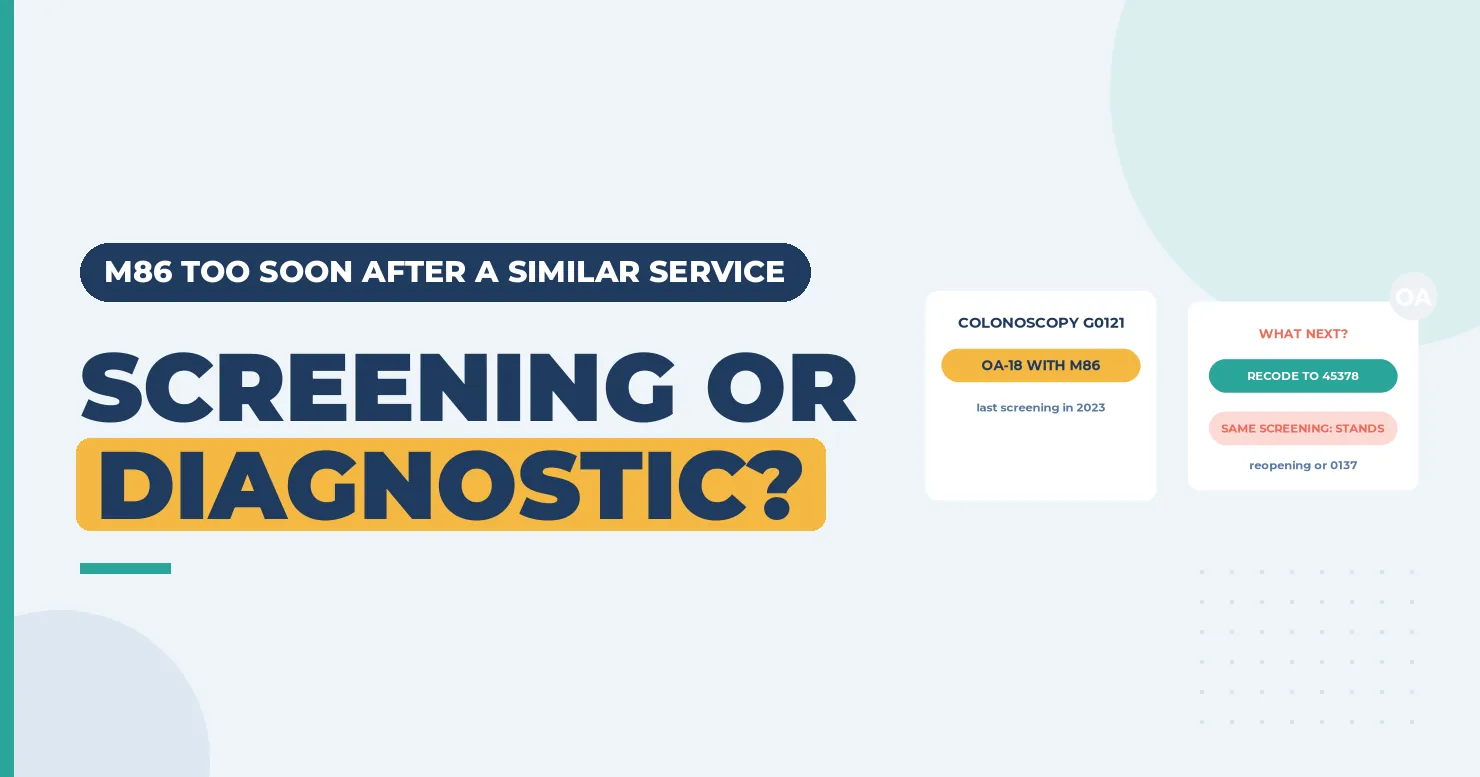
The M86 denial code means the payer already paid for the same or a similar procedure within a set time frame. It is a frequency denial, not a true duplicate in most cases. The payer saw an earlier paid service and decided this one came too soon. The fix depends on whether the new service really matches the earlier one. (Primary source: X12 Remittance Advice Remark Codes)
In brief: remark code M86 means the payer’s history shows a similar paid service inside the waiting period. Find that earlier service and the rule. If the new service was a different, covered service, such as a diagnostic test billed as a screening, correct the code. If it was the same service, the denial stands.
Part of our denial codes library. Written by Manikandan J, CPC, CRCR, who has worked Medicare screening denials for gastroenterology and hospital outpatient clients and audits screening versus diagnostic coding. Published 28 November 2026. Last updated: 28 November 2026. Code wording quoted word for word from X12. Read about the author and our editorial policy, or contact us to report an error.
What does remark code M86 mean?
Remark code M86 says the payer denied the service because it already paid for the same or a similar procedure within a set time frame. The time frame comes from the payer’s rule, such as a Medicare screening interval. M86 explains a CARC, often CARC 18 or 151. It does not mean you sent the claim twice.
| Field | Value |
|---|---|
| Code | RARC M86 |
| M86 wording | “Service denied because payment already made for same/similar procedure within set time frame.” |
| Type | Remittance Advice Remark Code |
| Start | 01/01/1997 |
| Last modified | 06/30/2003 |
| Paired with | A CARC, such as 18 or 151, and a group code |
Source: X12 Remittance Advice Remark Codes, checked 28 November 2026.
Methodology: the code wording is copied from the X12 list. The Medicare pairings and screening intervals come from the CMS claims manual, chapter 18, and the coverage rule in the federal regulations.
Key terms: A screening colonoscopy (G0121 for average risk) is done with no signs or symptoms. A diagnostic colonoscopy (45378) is done because of signs, symptoms or a known condition. A reopening is how a Medicare contractor fixes a clerical error without an appeal.
Which CARC and group code come with M86?
M86 takes its group from the CARC on the same line. CMS pairs it with CARC 18 for colorectal screening done too soon, and with CARC 151 for some counseling visits. X12 says CARC 18 goes with group OA, except where state comp rules call for CO.
| Pair | When you may see it | First move |
|---|---|---|
| OA-18 with M86 | Screening repeated inside the Medicare interval | Find the date of the earlier screening |
| CO-151 with M86 | Frequency limit, no signed ABN (GZ) | Check whether the visit was needed |
| PR-151 with M86 | Frequency limit, signed ABN on file (GA) | Bill the patient under the ABN |
Example scenario (fictional names), part 1
M86 Denial Example: What Happened
Marcus Bell bills for Riverside Digestive Health, whose doctors work at Lakeview Community Hospital. A Medicare patient had an average risk screening colonoscopy, G0121, in May 2023. In September 2026 she came in with rectal bleeding and iron deficiency anemia.
Dr. Alicia Moreno did a colonoscopy with no biopsy. The office billed G0121 with Z12.11 (entered as Z1211), out of habit. The line came back with CAS*OA*18 and remark M86. Medicare denied the hospital claim the same way.
Why would a colonoscopy for bleeding be denied as too soon? Keep reading, or jump to how the M86 denial was resolved.
What causes an M86 denial?
An M86 denial usually comes from a frequency edit that found an earlier paid service. For example, Medicare pays an average risk screening colonoscopy only after at least 119 months have passed since the last one. Here are the usual causes.
| Cause | What it looks like |
|---|---|
| Diagnostic service billed as screening | Screening code with symptoms in the note |
| Screening truly repeated too soon | Interval not met |
| Similar service paid by another provider | Earlier claim from a different office |
| Wrong risk level on the claim | Average risk code for a high risk patient |
| Visit limit per period reached | Counseling or therapy over the limit |
CMS chapter 18 lists CARC 18 with M86 when a similar procedure was already paid within the set time frame. It also sets the G0121 interval at 119 months, or 47 months after a screening flexible sigmoidoscopy. The federal coverage rule is 42 CFR 410.37.
How do I fix an M86 denial?
To fix an M86 denial, find the earlier paid service and compare it with the new one. If the new service was diagnostic, change the code and diagnosis to match the record. If it was the same screening, the denial is correct, unless an ABN moved liability.
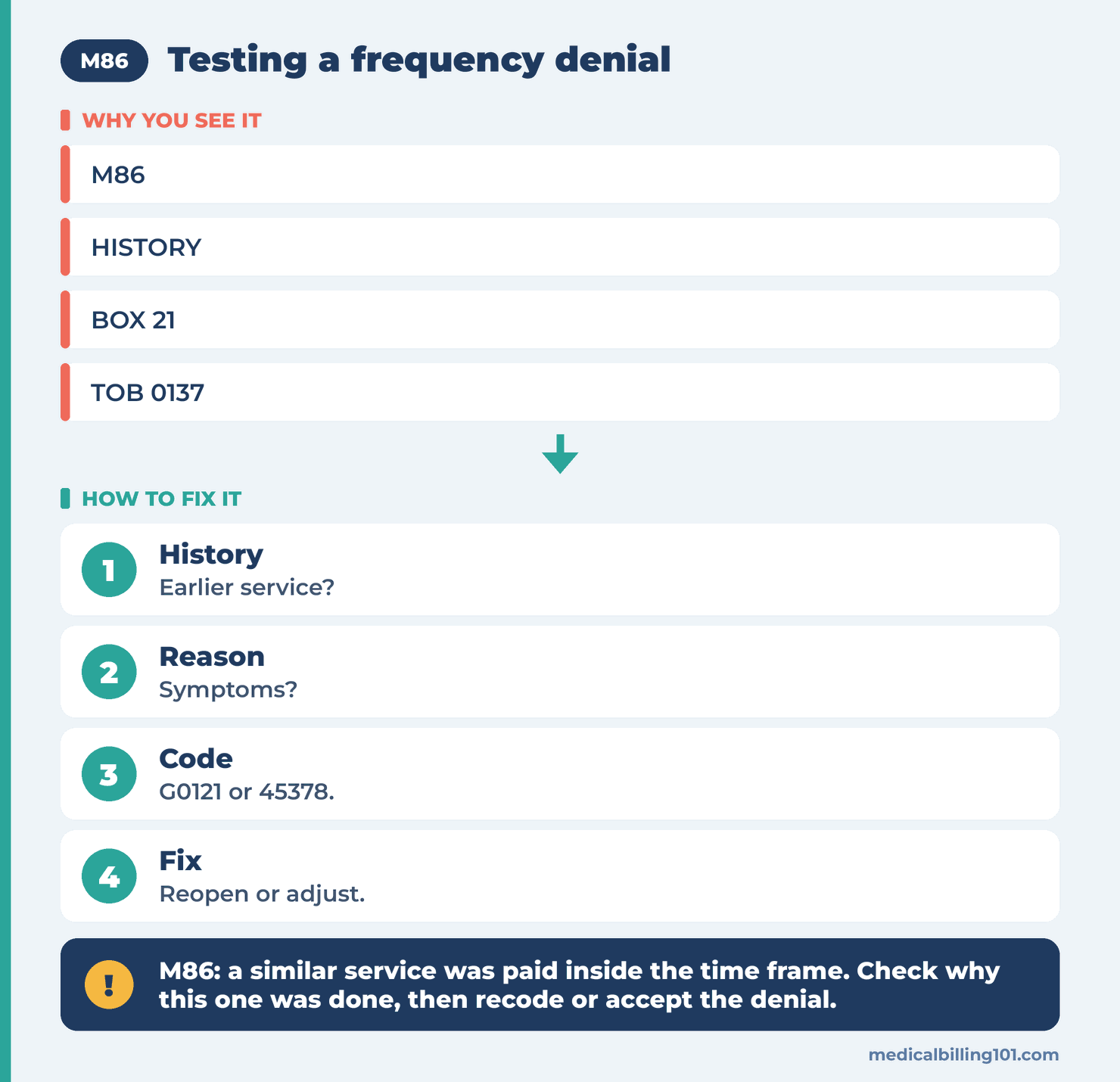
| Step | Action | Where to check |
|---|---|---|
| 1 | Find the earlier paid service and its date | Eligibility or payer history |
| 2 | Read why the new service was done | Procedure note and referral |
| 3 | Pick screening or diagnostic code | G0121 vs 45378 |
| 4 | Put the symptom diagnosis first | Box 21 or FL 67 |
| 5 | Professional claim: ask for a reopening | MAC phone, portal or letter |
| 6 | Hospital claim: send an adjustment | Bill type 0137 with FL 64 |
The CMS reopening chapter treats data entry mistakes as clerical errors handled by reopening. It also lets Part A providers send adjusted claims. Medicare leaves Box 22 blank on the CMS-1500. The CMS chapter 18 manual lists the screening codes and intervals.
Example scenario (fictional names), part 2
How the M86 Denial Was Resolved
Marcus read the note. Dr. Moreno ordered the colonoscopy for bleeding and anemia, so it was diagnostic from the start. The screening code was wrong, and the 2023 screening had nothing to do with this visit.
Fix: Marcus asked the MAC for a clerical reopening. He changed G0121 to 45378 and put K62.5 and D50.9 (entered as K625 and D509) in Box 21. The hospital sent an adjustment claim, bill type 0137, with 45378 in FL 44 and K625 in FL 67.
Outcome: Medicare paid both claims as a diagnostic colonoscopy, with the usual cost share. Marcus added a rule that flags any screening code when the referral lists a symptom.
Names and details are illustrative; no real patient data.
Names and details are illustrative; no real patient data.
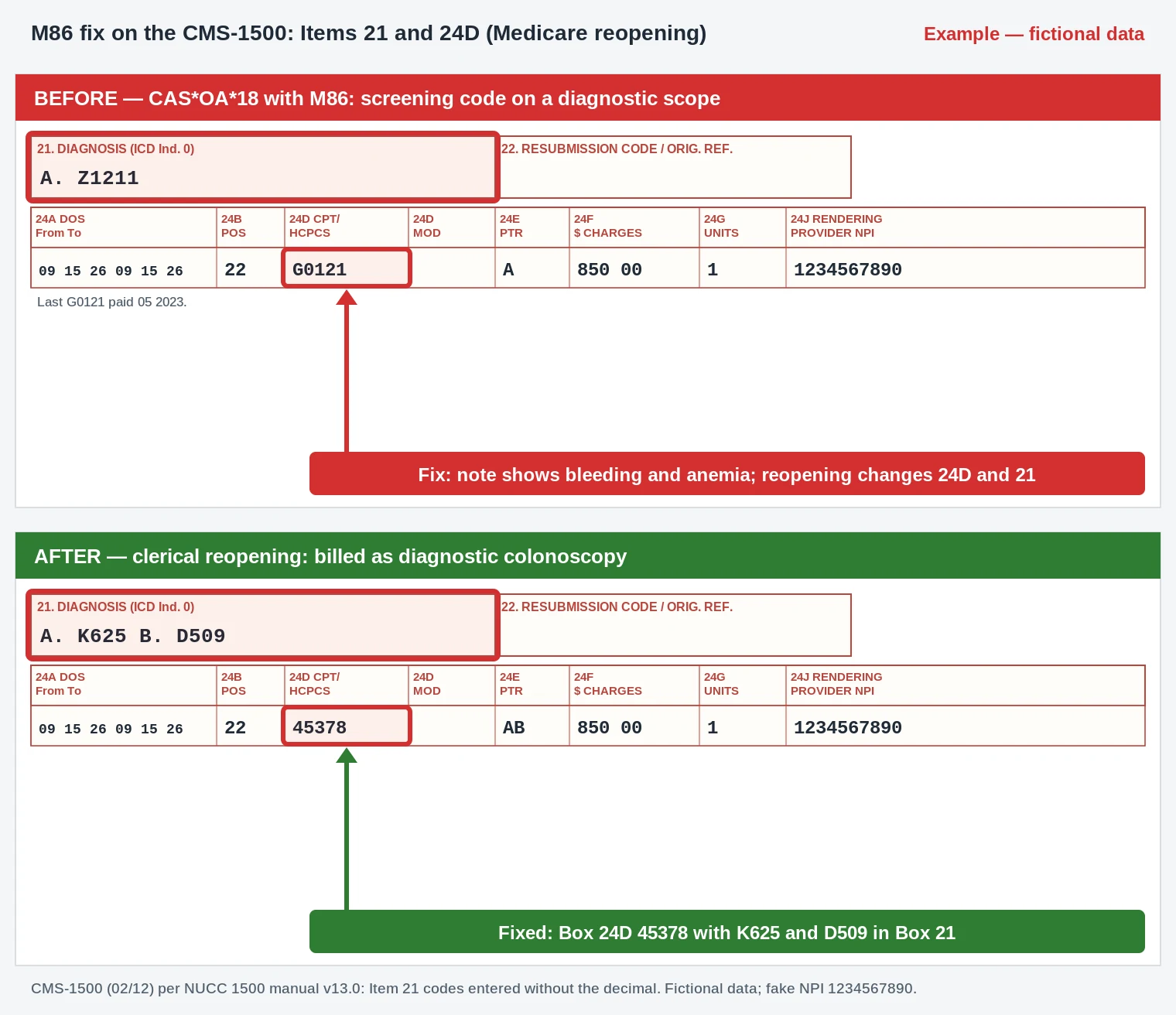
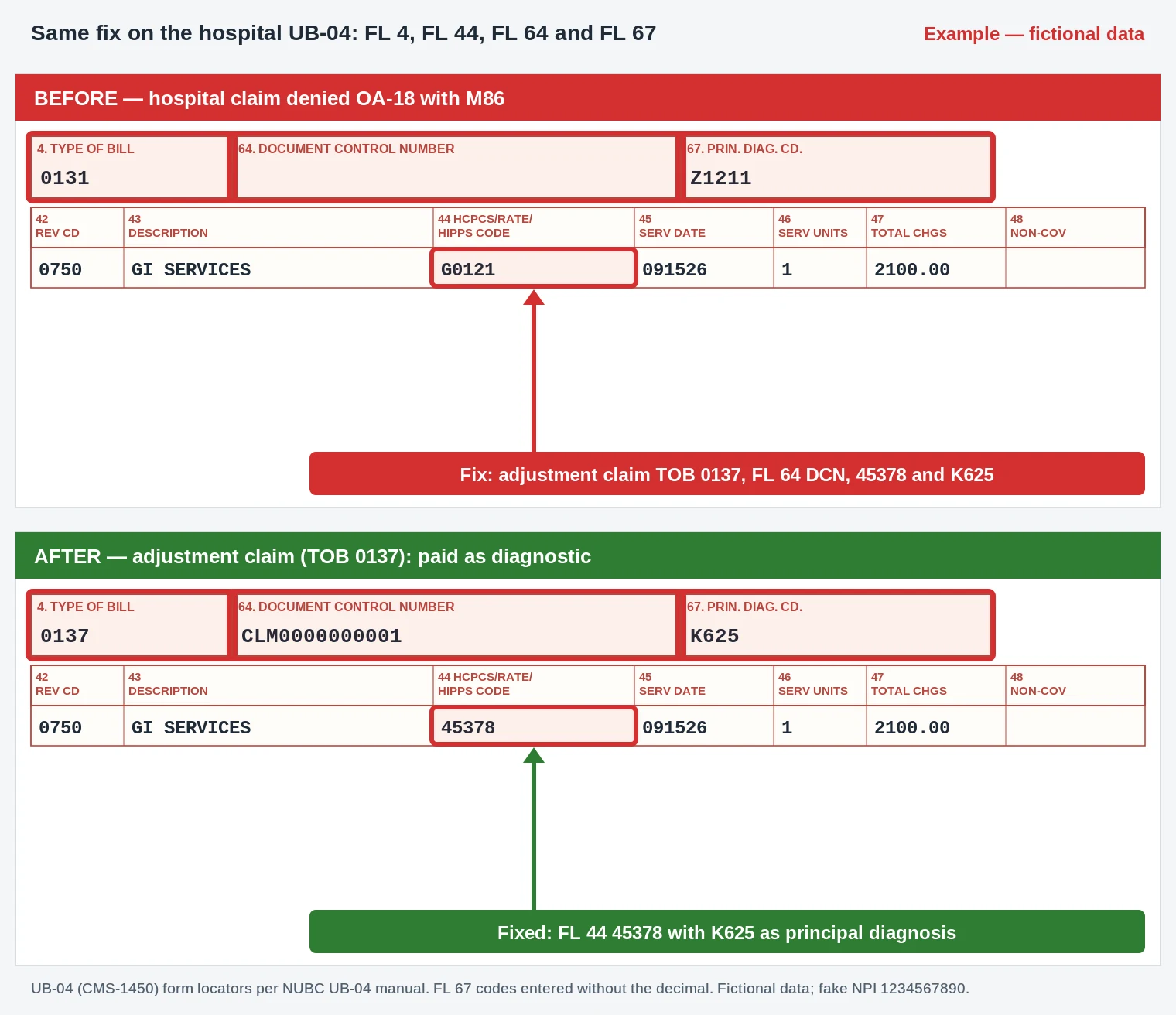
- Box 24D / FL 44: G0121 (average risk screening) changed to 45378 (diagnostic colonoscopy), because the scope was ordered for rectal bleeding and anemia.
- Box 21 / FL 67: Z12.11 replaced by K62.5, with D50.9 as a second code (entered as K625 and D509).
- Box 22: left blank for Medicare; the professional change goes through a clerical error reopening.
- FL 4 + FL 64: the hospital sends an adjustment claim, bill type 0137, with the original document control number.
Can I bill the patient for an M86 denial?
Only in some cases. With OA-18 or CO-151, you do not bill the patient. With PR-151 and a signed ABN, the patient may owe it. If you correct a screening to a diagnostic code, the patient owes the normal cost share on the paid claim.
Related codes
| Code | Meaning |
|---|---|
| OA-18 | Exact duplicate claim or service |
| CO-18 | Duplicate claim with a CO group |
| PR-119 | Benefit maximum reached for the period |
| CO-151 | Frequency not supported by the information sent |
| CO-B13 | Previously paid under an earlier claim |
FAQ
What does M86 mean on a remit?
It means the payer already paid the same or a similar service within its time frame, so it denied this one.
Is M86 the same as a duplicate claim?
No. A duplicate means someone sent the same claim twice. M86 is a new service that came too soon after a similar one.
How often does Medicare pay a screening colonoscopy?
For average risk, after at least 119 months since the last one. High risk patients can have G0105 once every 24 months.
Can a screening code be changed to diagnostic?
Yes, if the record shows the doctor performed the test because of symptoms. Change the code and put the symptom diagnosis first.
What if a lesion is removed during a screening?
CMS says to bill the diagnostic procedure with modifier PT, not G0121.
Sources
How we checked: the M86 quote was matched word for word with the X12 RARC list on 28 November 2026. The Medicare rules come from CMS manual chapters 18 and 34 and 42 CFR 410.37.
- X12, Remittance Advice Remark Codes (RARC M86). Accessed 28 Nov 2026.
- X12, Claim Adjustment Reason Codes (CARC 18, 151, 119, B13). Accessed 28 Nov 2026.
- CMS, Medicare Claims Processing Manual, chapter 18, preventive and screening services. Accessed 28 Nov 2026.
- CMS, Medicare Claims Processing Manual, chapter 34, reopening and revision. Accessed 28 Nov 2026.
- Cornell LII, 42 CFR 410.37, colorectal cancer screening tests. Accessed 28 Nov 2026.
Last updated: 28 November 2026 · Educational content; not legal advice.