
PR-179 is a timing denial on the patient’s side. The person is enrolled, but the plan says coverage, or a specific benefit, doesn’t start until a waiting period ends. New employees often face a waiting period before employer coverage begins. Some plans also make members wait for certain benefits, such as major dental work. The PR group points to the patient, but before you send a bill, check whether an older plan still covered the date. (Primary source: X12 Claim Adjustment Reason Codes)
In brief: CARC 179 reads “Patient has not met the required waiting requirements.” Confirm when the waiting period ends, then look for coverage that bridges the gap, such as COBRA from a previous job, a spouse’s plan or a marketplace plan. Bill that plan. Bill the patient only when nothing covered the date.
Part of our denial codes library. Written by Manikandan J, CPC, CRCR, who has untangled job-change coverage gaps for outpatient clinics. Published 22 October 2026. Last updated: 22 October 2026. Code wording quoted word for word from X12.
Official CARC 179 description
| Field | X12 text |
|---|---|
| Code | 179 |
| Description | “Patient has not met the required waiting requirements.” |
| X12 usage note | Refer to the 835 Healthcare Policy Identification Segment (loop 2110 Service Payment Information REF), if present. |
| Start | 06/30/2005 |
| Last modified | 03/01/2017 |
Source: X12 Claim Adjustment Reason Codes, checked 22 October 2026.
Key terms behind CARC 179
A waiting period is the time a person must wait after becoming eligible before coverage, or a benefit, starts. For most employer group health plans, federal rules generally limit the coverage waiting period to 90 days. COBRA continuation lets people keep a former employer’s plan for a time after leaving a job. HealthCare.gov’s COBRA coverage page explains how it works and how elections can be made after the job ends.
A benefit waiting period is a delay on one type of service, such as crowns or orthodontics on a dental plan, while other benefits are active.
Common causes of PR-179
- New job, new plan. For example, coverage starts on the first of the month after 60 days of employment.
- Benefit waiting period. The plan covers checkups at once but makes members wait for major services.
- Wrong start date on file. The employer reported the hire date late or wrong.
- Old coverage ignored. The patient still had COBRA or another plan, but registration billed the new one.
Example scenario (fictional names), part 1
PR-179 Denial Example: What Happened
Ethan Park works registration follow-up at Oakview Primary Care. A patient who changed jobs in August came in on 15 September for a sinus infection (J01.90). The front desk scanned the new employer’s card, from Crestmoor Health, a fictional plan, and billed 99213 to it.
The 835 showed CAS*PR*179 with remark LQ*HE*N130, “Consult plan benefit documents/guidelines for information about restrictions for this service.” Crestmoor’s portal showed coverage starting 1 November after a waiting period. The patient said they had signed up for COBRA from the old job.
Should Ethan bill the patient, or was there still a plan for 15 September? Keep reading, or jump to how the PR-179 denial was resolved.
Remark codes often paired with CARC 179
| RARC | X12 wording | What it tells you |
|---|---|---|
| N130 | “Consult plan benefit documents/guidelines for information about restrictions for this service.” | The plan’s waiting rules apply |
| N30 | “Patient ineligible for this service.” | Not eligible yet |
| N155 | “Alert: Our records do not indicate that other insurance is on file. Please submit other insurance information for our records.” | The plan doesn’t know about other coverage |
See the X12 RARC list for the full set.
How to fix a PR-179 denial
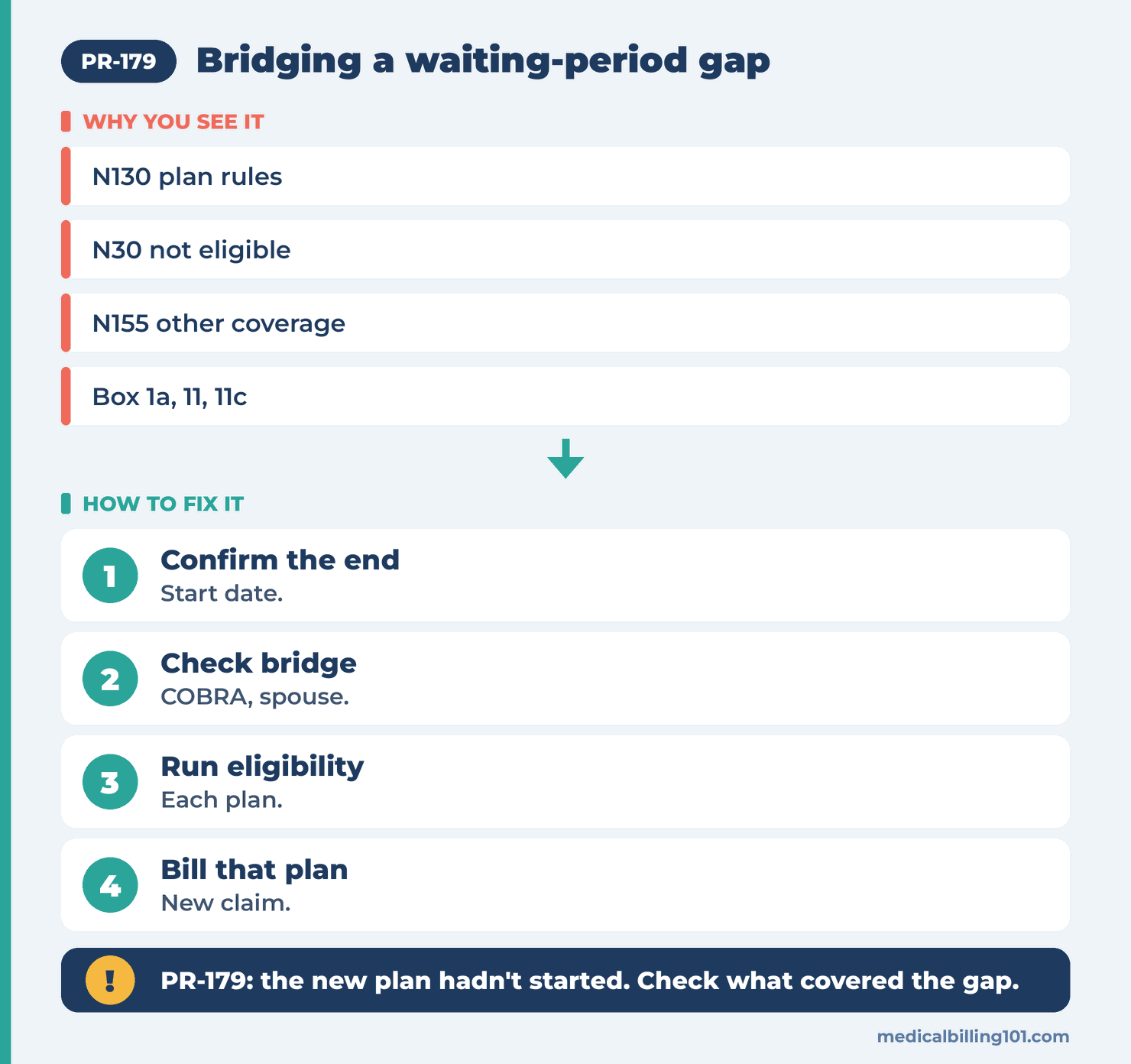
- Confirm the waiting period. Find the start date of coverage or of the benefit in question.
- Check bridge coverage. Ask about COBRA, a spouse’s plan, a marketplace plan or Medicaid for the date of service.
- Run eligibility on each possible plan for that date.
- If another plan covers the date, update registration and send a new claim to it with the right member ID and group number.
- If the employer reported the wrong date, ask the employer and plan to correct it, then request reprocessing.
- If nothing covered the date, bill the patient and explain the waiting period.
Example scenario (fictional names), part 2
How the PR-179 Denial Was Resolved
Ethan called the old employer’s COBRA administrator. The patient had elected COBRA within the election window and paid the first premium, so coverage under Fairhaven Health, a fictional plan, was active on 15 September.
Fix: Ethan sent a new claim to Fairhaven with the COBRA member ID in Box 1a, the old employer’s group number in Box 11 and Fairhaven in Box 11c. Crestmoor stayed on file with its 1 November start date.
Outcome: Fairhaven paid the visit. Oakview now asks new-job patients whether they elected COBRA and checks the new plan’s start date before billing it.
Names and details are illustrative; no real patient data.
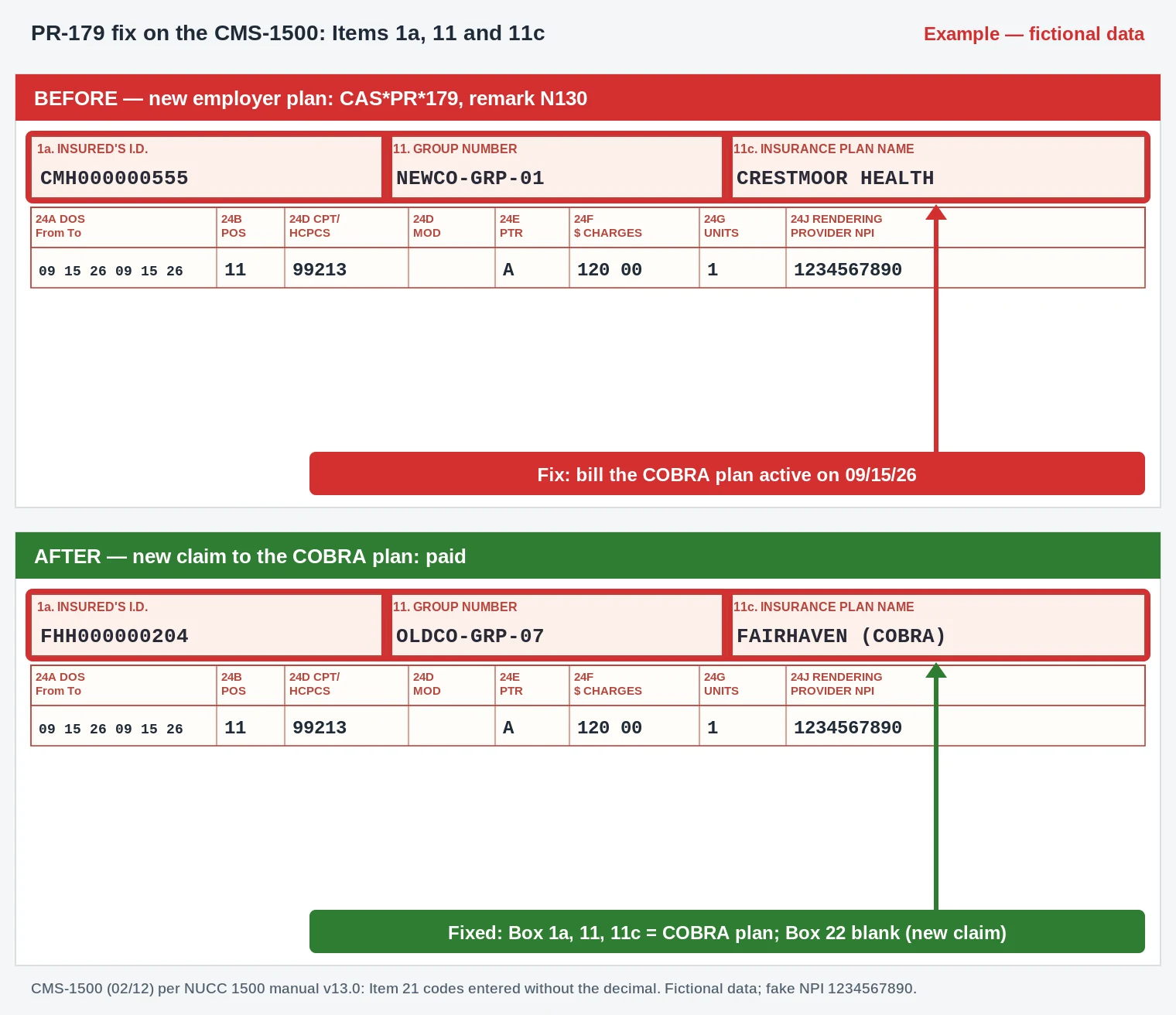
- Box 1a: new employer plan ID replaced with the COBRA member ID.
- Box 11 / 11c: the former employer’s group number and the COBRA plan name.
- Box 22: left blank. This is a new claim to a different payer, not a corrected claim.
- Box 24D / 21A: 99213 with J01.90 (entered as J0190) is unchanged.
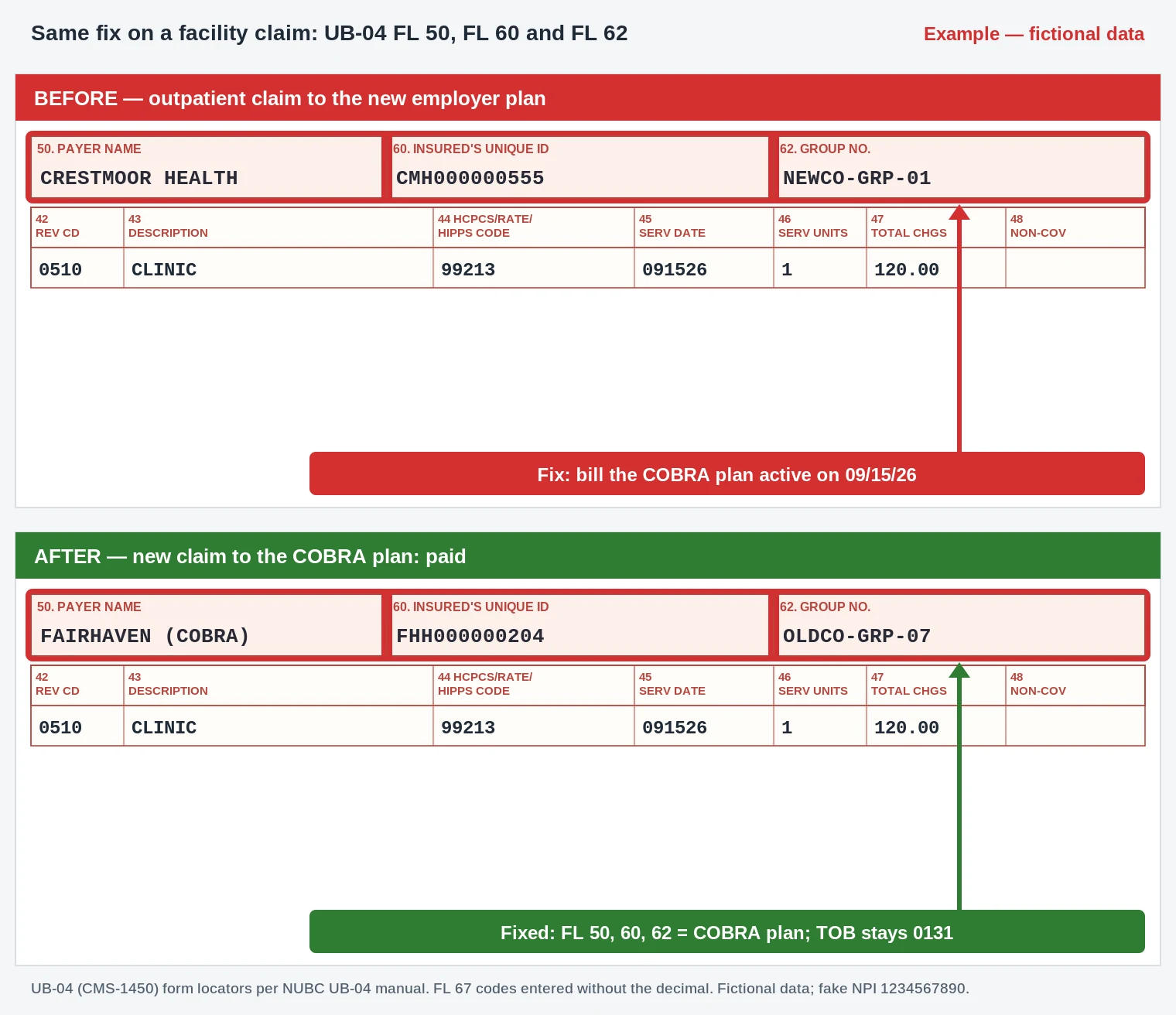
- UB-04 (facility): FL 50 payer, FL 60 member ID and FL 62 group number changed to the COBRA plan; new claim, so type of bill stays 0131.
Worked example (illustrative)
A dental patient enrolls in a plan that covers cleanings right away but has a 12-month benefit waiting period for crowns. In month five the dentist places a crown and the claim draws PR-179. The patient had no other dental coverage. The office bills the patient, who had signed a financial agreement after a pre-treatment estimate showed the waiting period. The estimate kept the bill from being a surprise.
PR-179 vs similar codes
| Code | What it means | Main difference |
|---|---|---|
| PR-179 | Waiting requirements not met | Waiting period not over |
| PR-177 | Eligibility requirements not met | Fails a coverage rule |
| CO-26 | Expenses incurred prior to coverage | Coverage hadn’t started |
| PR-106 | Payment option or election not in effect | Option not active |
Registration checklist
- Ask new-job patients for the new plan’s start date.
- Ask about COBRA and other coverage during the gap.
- Run eligibility on every possible plan before billing.
- Use pre-treatment estimates when benefit waiting periods apply.
Recap
PR-179 means the patient was still in a waiting period. Confirm when it ends, look for coverage that bridged the gap, and bill that plan with a new claim. Bill the patient only when nothing covered the date.
FAQ
What does PR-179 mean?
The patient hadn’t met the plan’s waiting requirements on the date of service.
Can I bill the patient for PR-179?
Yes, if no other coverage applied. Check COBRA and other plans first.
How long can an employer waiting period be?
For most employer group health plans, federal rules generally cap it at 90 days. Benefit waiting periods on dental plans can be longer.
Does COBRA cover the gap?
It can, if the patient elected it and paid the premium. Check with the COBRA administrator.
Do I send a corrected claim or a new claim?
A new claim to the plan that covered the date. Corrected claims go only to the plan that processed the original.
How is PR-179 different from CO-26?
CO-26 means coverage hadn’t started. PR-179 points to a waiting requirement and assigns the amount to the patient.
Sources
How we checked: each code quote on this page was matched word for word with the X12 CARC and RARC lists on 22 October 2026.
- X12, Claim Adjustment Reason Codes (CARC 179, 177, 26, 106). Accessed 22 Oct 2026.
- X12, Remittance Advice Remark Codes (N130, N30, N155). Accessed 22 Oct 2026.
- HealthCare.gov, COBRA coverage. Accessed 22 Oct 2026.
Last updated: 22 October 2026 · Educational content; not legal advice.
Related denial codes
- PR-180: Patient Has Not Met the Required Residency Requirements
- PR-178: Patient Has Not Met the Required Spend-Down Requirements
- PR-177: Patient Has Not Met the Required Eligibility Requirements
- CO-166: Submitted After the Payer's Responsibility for the Plan Ended
- PR-200: Expenses During Lapse in Coverage
- PR-204: Not Covered Under the Patient's Current Benefit Plan
- CO-140: Patient Name and Member ID Don't Match
- CO-224: Patient Identity Compromised