
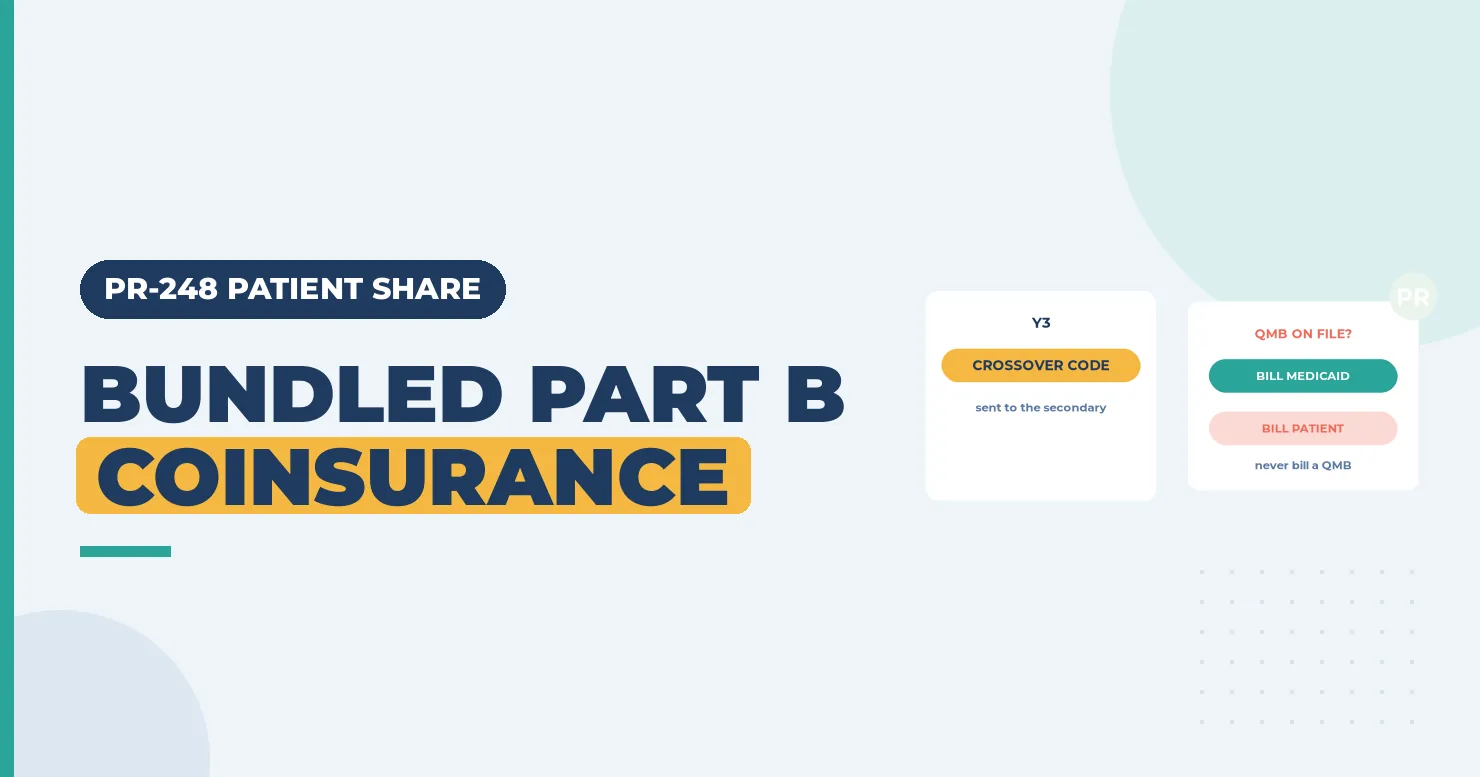
The PR-248 denial code is a coinsurance amount, not a refusal to pay. Medicare used CARC 248 to show the Part B coinsurance for physician services that were paid inside a hospital’s bundled payment, so the cost share appears on the hospital’s institutional claim. The patient, or the patient’s secondary coverage, owes it. (Primary source: X12 Claim Adjustment Reason Codes)
In brief: reason code 248 reads “Coinsurance for Professional service rendered in an Institutional setting and billed on an Institutional claim.” With group PR it is a patient share. Bill the secondary first, and never bill a QMB patient for it.
Part of our denial codes library. Written by Manikandan J, CPC, CRCR, who has set up crossover billing and QMB checks for hospital business offices. Published 27 October 2026. Last updated: 27 October 2026. Code wording quoted word for word from X12. Read about the author and our editorial policy, or contact us to report an error.
Official CARC 248 description
| Field | Value |
|---|---|
| Code | 248 |
| Description | “Coinsurance for Professional service rendered in an Institutional setting and billed on an Institutional claim.” |
| Start | 09/30/2012 |
| Notes | For Medicare Bundled Payment use only, under the Patient Protection and Affordable Care Act (PPACA). |
Source: X12 Claim Adjustment Reason Codes, checked 27 October 2026. CMS added CARC 247 and 248 together in CR 8154. Its partner code for the deductible is PR-247.
Key terms: A CARC is a Claim Adjustment Reason Code from the X12 list, and it says why a line was paid differently than billed. A RARC is a Remittance Advice Remark Code that adds detail to the CARC. The group code is the two-letter prefix on the adjustment; PR means patient responsibility: the balance may be billed to the patient under the plan terms.
Methodology: the code wording above is copied from the X12 list, and each fix step below links to the payer or CMS page it comes from.
Example scenario (fictional names), part 1
PR-248 Denial Example: What Happened
Marisol Grant works the self-pay queue at Cedar Point Regional, a fictional hospital. While cleaning up old balances, she finds a 2018 inpatient stay with a Medicare remit showing CAS*PR*248*84 and the remark LQ*HE*M137. The patient was dual eligible: Medicare plus Medicaid, with QMB status on file.
The billing system had turned the $84 into a patient statement and sent it twice. Nobody had sent the amount to Medicaid. The CARC 248 line looked like any other coinsurance.
Can the hospital bill this patient for the PR-248 amount? Keep reading, or jump to how it was resolved. Keep reading, or jump to how the PR-248 denial was resolved.
PR-248, PR-247 and PR-2 side by side
| Code | What it holds | Claim it appears on | Crossover value code |
|---|---|---|---|
| PR-2 | Any coinsurance | Any claim type | None needed |
| PR-247 | Part B deductible for doctor services in the bundle | Hospital (institutional) claim | Y5 |
| PR-248 | Part B coinsurance for doctor services in the bundle | Hospital (institutional) claim | Y3 |
The difference matters in posting. For example, PR-2 on a physician claim belongs to the physician’s account. PR-248 belongs to the hospital’s account, even though the service was a doctor’s, because the hospital received one payment for the whole stay.
Why the coinsurance moved to the hospital claim
Under BPCI Model 4, Medicare paid the hospital one prospective amount that covered the hospital and the physicians for the stay (CMS BPCI overview). The doctors still billed, but their claims processed as no-pay with N67, “Professional provider services not paid separately.” The Part B cost share therefore had to sit somewhere else. CMS placed the fixed Part B coinsurance on the hospital’s Part A claim and told the crossover process to report it with value code Y3 (CMS CR 8070, Transmittal 1251).
How to work a PR-248 balance
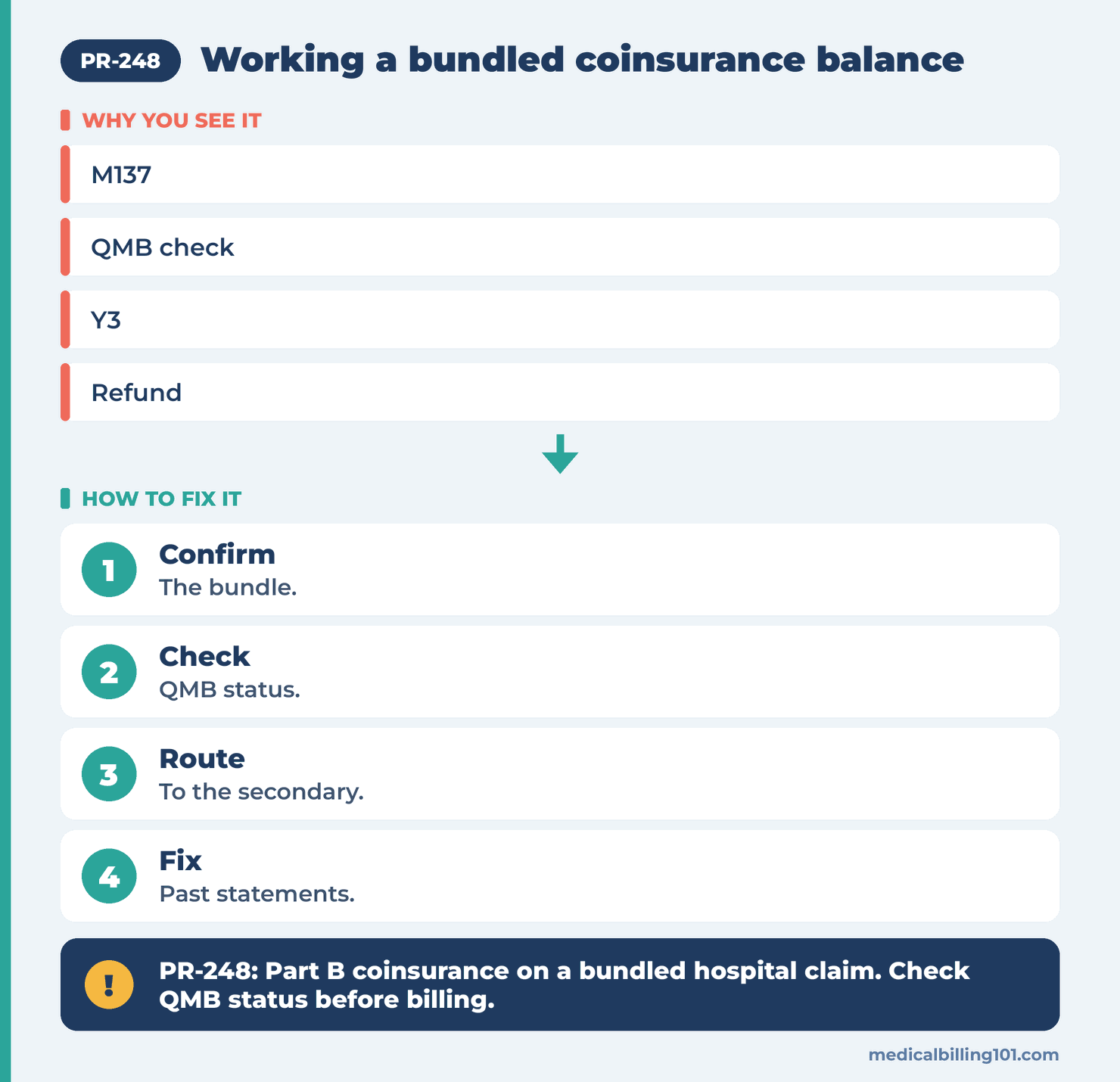
- Confirm it is a bundle claim. Look for M137, “Part B coinsurance under a demonstration project or pilot program,” or N568 on the same remit. If neither is there, call the payer before you post.
- Check dual eligibility and QMB status. Federal law bars providers from billing Qualified Medicare Beneficiaries for Medicare deductibles, coinsurance or copays (CMS QMB program page).
- Route it to the secondary. A secondary plan, such as Medigap, a retiree plan or Medicaid, gets the amount first. On a Medicaid Part A crossover, enter Y3 for PR-248 (MO HealthNet tip).
- Bill the patient only what remains. That applies only to patients without QMB status and only after the secondary has paid or denied.
- Fix past statements. If a QMB patient was billed or paid, stop the statements and refund the money.
Claim form note
No claim form visual is shown here. PR-248 is a coinsurance on a hospital claim that was billed correctly, so no CMS-1500 box or UB-04 form locator changes. The work happens in posting, crossover billing and patient statements.
Is reason code 248 still in use?
Hardly. The X12 note limits it to Medicare bundled payment. Model 4 ended with the BPCI extension on September 30, 2018, and CMS reported only 2 Model 4 participants as of July 1, 2018 (CMS BPCI page). Today you meet it in places such as old A/R, audits, refund reviews and system conversions. If a commercial payer sends CARC 248 in 2026, ask them in writing what it means.
Example scenario (fictional names), part 2
How the PR-248 Denial Was Resolved
Marisol checked the eligibility history. The patient had QMB status for the whole stay, and the remit’s M137 confirmed a bundled Part B coinsurance. Under the QMB rule, the hospital could not bill the patient for the $84.
Fix: she stopped the patient statements, reversed the self-pay transfer and sent the amount to Medicaid as a Part A crossover with value code Y3. The patient had paid $20 after the first statement, so she refunded it.
Outcome: Medicaid processed the crossover under its state rules, and the patient’s account closed at $0. Marisol added a rule that blocks patient statements on any PR line when QMB status is on file.
Names and details are illustrative; no real patient data.
Names and details are illustrative; no real patient data.
Related codes
| Code | Meaning | Where to start |
|---|---|---|
| PR-247 | Part B deductible on a bundled hospital claim | Post as deductible, Y5 |
| PR-2 | Coinsurance | Patient or secondary |
| PR-3 | Copayment | Patient or secondary |
| CO-249 | Readmission | Same hospital bundle era |
| PR-275 | Prior payer patient share | Secondary rules |
FAQ
What does PR-248 mean?
It is the Part B coinsurance for doctor services paid in a Medicare bundled hospital claim.
Who owes the PR-248 amount?
The secondary payer first, then the patient, unless the patient has QMB status.
Can I bill a QMB patient for PR-248?
No. Providers may not bill QMB patients for Medicare coinsurance. Send it to Medicaid.
What value code goes with CARC 248?
Y3, the Part B coinsurance on a Part A claim, per CMS CR 8070.
Is PR-248 the same as PR-2?
Both are coinsurance. PR-248 is only the bundled Part B share on a hospital claim.
Sources
How we checked: the CARC 248 quote was matched word for word with the X12 CARC list on 27 October 2026, and the M137 and N67 remarks with the X12 RARC list.
- X12, Claim Adjustment Reason Codes (CARC 248). Accessed 27 Oct 2026.
- X12, Remittance Advice Remark Codes (M137, N67, N568). Accessed 27 Oct 2026.
- CMS, CR 8070 (Transmittal 1251), BPCI Model 4 implementation. Accessed 27 Oct 2026.
- CMS, CR 8154 code update with CARC 247 and 248. Accessed 27 Oct 2026.
- CMS, Qualified Medicare Beneficiary program. Accessed 27 Oct 2026.
- MO HealthNet, Bundled value code for Medicare UB-04 Part A claims. Accessed 27 Oct 2026.
Last updated: 27 October 2026 · Educational content; not legal advice.
Related denial codes
- PR-247: Part B Deductible on an Institutional Claim
- CO-249: Claim Identified as a Readmission
- PR-241: Low Income Subsidy Copay Explained
- CO-239: Rebill Separate Claims by Coverage Period
- CO-233: Hospital-Acquired Conditions
- CO-232: Institutional Transfer Amount
- CO-267: Claim Spans Multiple Months
- CO-274: Paid Through a Care Coordination Arrangement