
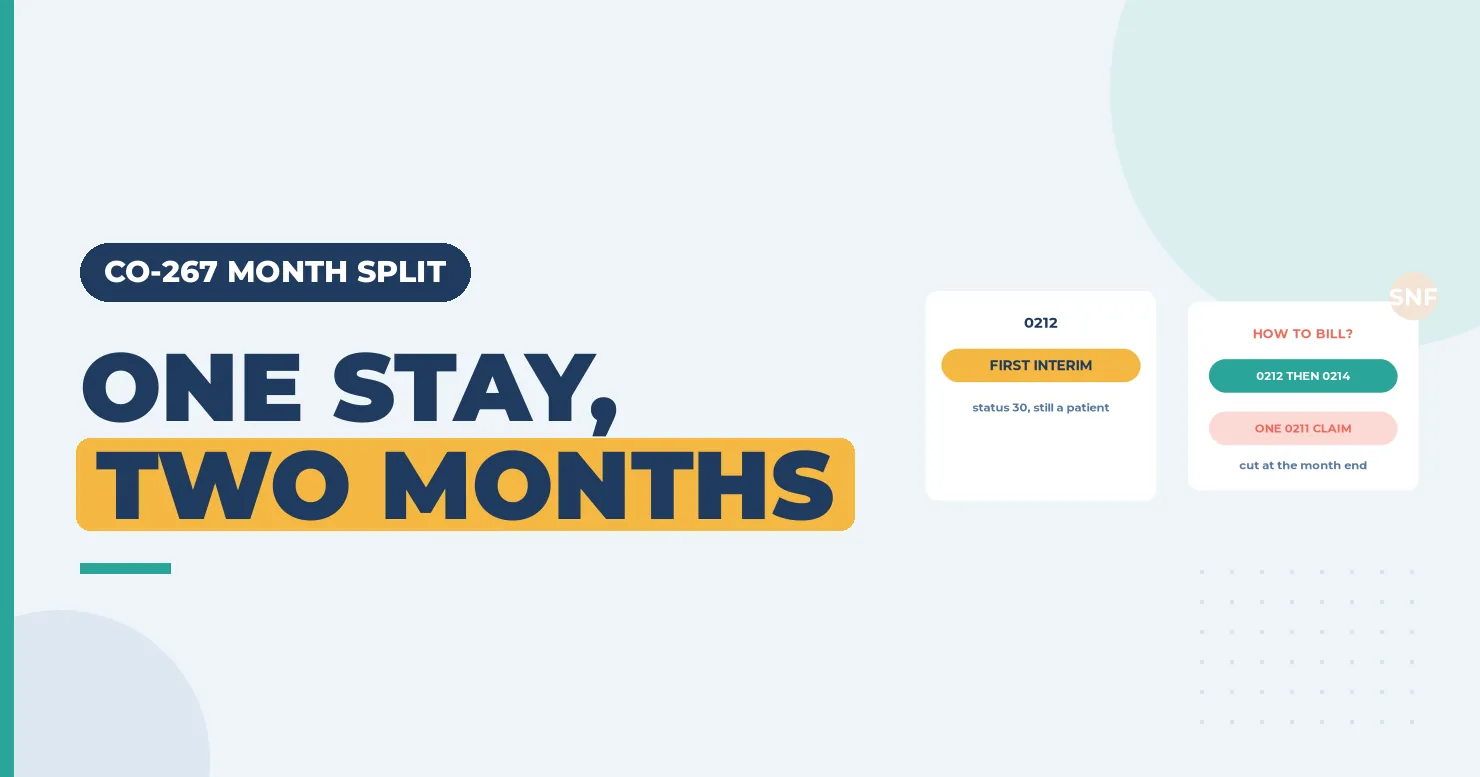
CO-267 is a date-range denial. The claim’s statement period runs from one month into the next, and the payer wants one bill per month. It is common on skilled nursing and other long facility stays, where the care itself is usually documented correctly. The bill simply needs to be divided at the month boundary, with bill types that identify which portion of the stay each claim covers. (Primary source: X12 Claim Adjustment Reason Codes)
In brief: CARC 267 reads “Claim/service spans multiple months.” Split the stay at the end of each month. Use an interim bill type for the first part, with patient status 30, and a final bill type for the last part. Each new from date is the day after the prior through date.
Part of our denial codes library. Written by Manikandan J, CPC, CRCR, who has billed skilled nursing stays and split long facility claims. Published 24 October 2026. Last updated: 24 October 2026. Code wording quoted word for word from X12. Read about the author and our editorial policy, or contact us to report an error.
Definition from X12
| Field | Value |
|---|---|
| Code | 267 |
| Description | “Claim/service spans multiple months. At least one Remark Code must be provided (may be comprised of either the NCPDP Reject Reason Code, or Remittance Advice Remark Code that is not an ALERT.)” |
| Start | 11/01/2014 |
Source: X12 Claim Adjustment Reason Codes, checked 24 October 2026.
Key terms: A CARC is a Claim Adjustment Reason Code from the X12 list, and it says why a line was paid differently than billed. A RARC is a Remittance Advice Remark Code that adds detail to the CARC. The group code is the two-letter prefix on the adjustment; CO means contractual obligation: the provider owns the balance and it cannot be billed to the patient. An electronic remittance advice (ERA) is the ANSI X12 835 transaction that carries these codes from the payer to the provider; its paper equivalent is the remittance notice or explanation of benefits.
Methodology: the code wording above is copied from the X12 list, and each fix step below links to the payer or CMS page it comes from.
Monthly billing rules for SNF stays
The Medicare Claims Processing Manual, chapter 6, section 40 says SNFs bill on discharge, benefit exhaustion, a drop to less than skilled care, or monthly. It also says the from date must be the day after the through date on the prior bill.
The last digit of the type of bill in FL 4 tells the payer where the claim sits in the stay:
| Type of bill | Meaning | Patient status |
|---|---|---|
| 0211 | Admit through discharge, one claim | Discharge status |
| 0212 | Interim, first claim | 30, still a patient |
| 0213 | Interim, continuing claim | 30 |
| 0214 | Interim, last claim | Discharge status |
Example scenario (fictional names), part 1
CO-267 Denial Example: What Happened
Ruth Alvarez bills for Maple Grove Care Center, a fictional skilled nursing facility. A resident was admitted on 15 October and went home on 20 November.
Ruth submitted a single admission-through-discharge claim, type of bill 0211, covering 15 October to 20 November, and the remittance returned CAS*CO*267.
How should Ruth split this stay? Keep reading, or jump to how the CO-267 denial was resolved.
Why claims get a CO-267
- One bill for a long stay. The entire admission was billed as a single claim after discharge.
- Wrong bill type. For example, type of bill 0211 (admission through discharge) used on a claim that should have been an interim bill, 0212 or 0214.
- Dates overlap. A continuing claim starts on the same day the prior one ended.
- Payer policy. Some plans also require monthly billing for home health, hospice or recurring therapy services.
Splitting the stay into monthly claims
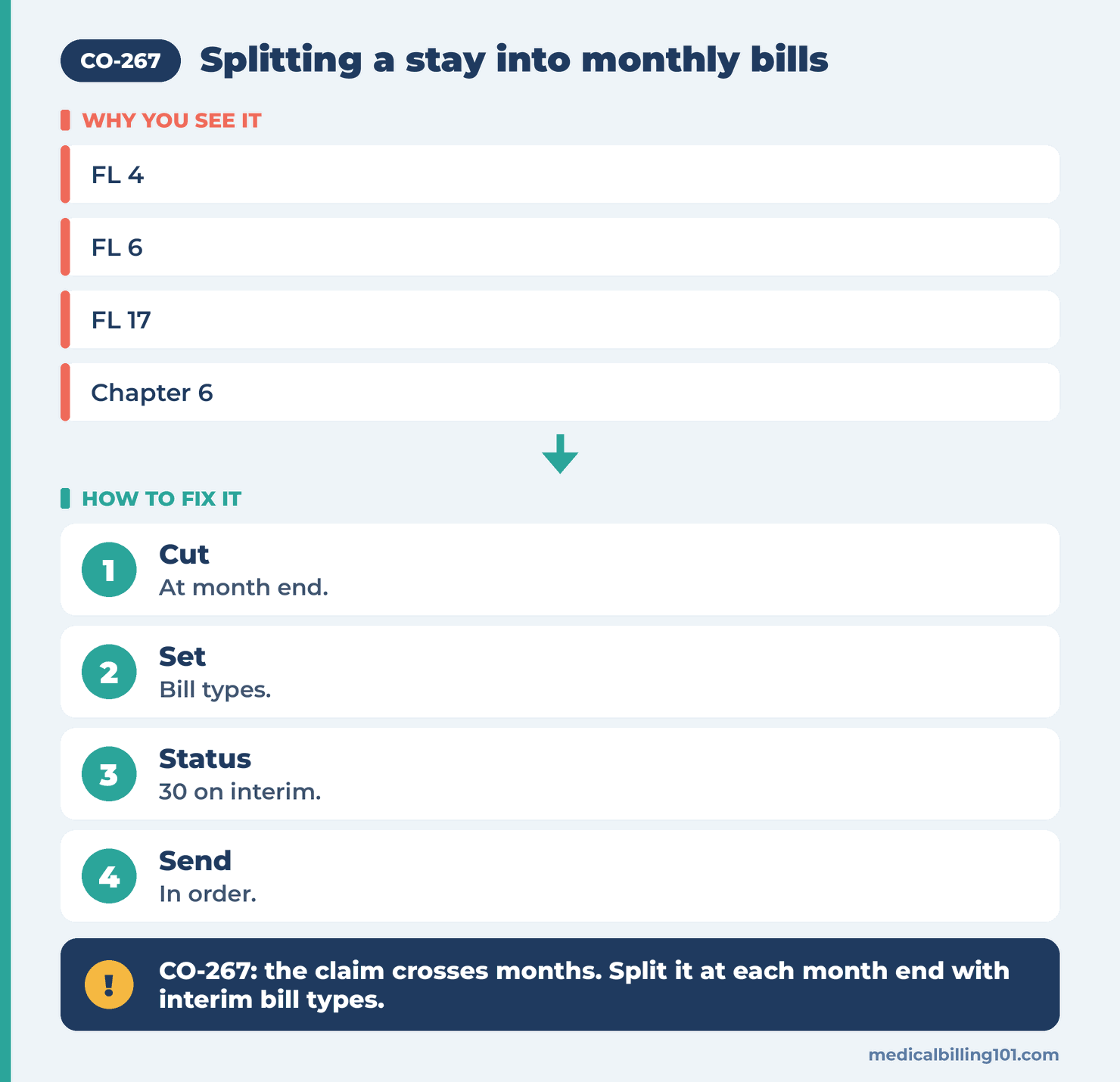
- Divide at each month end. Each claim’s through date is the last calendar day of its month, except the final claim, which ends on the discharge date.
- Set bill types. First claim 0212 (interim, first claim), any middle months 0213 (interim, continuing claim), last month 0214 (interim, last claim).
- Set patient status. Use 30 on interim claims and the discharge status on the last one.
- Line up the dates. Each new from date is the day after the prior through date. Bill each month’s days and charges only once.
- Send in order. Medicare section 40.1 asks SNFs to submit bills in sequence.
Example scenario (fictional names), part 2
How the CO-267 Denial Was Resolved
Ruth reviewed the facility’s billing calendar, cancelled the denied 0211 claim and rebuilt the stay as two separate claims.
Fix: Claim 1 was 0212, 15 to 31 October, status 30, with 17 days. Claim 2 was 0214, 1 to 20 November, status 01, with 19 days. The discharge day was not counted.
Outcome: Both claims were processed and paid. The facility now generates interim claims automatically at each month end instead of waiting for discharge.
Names and details are illustrative; no real patient data.
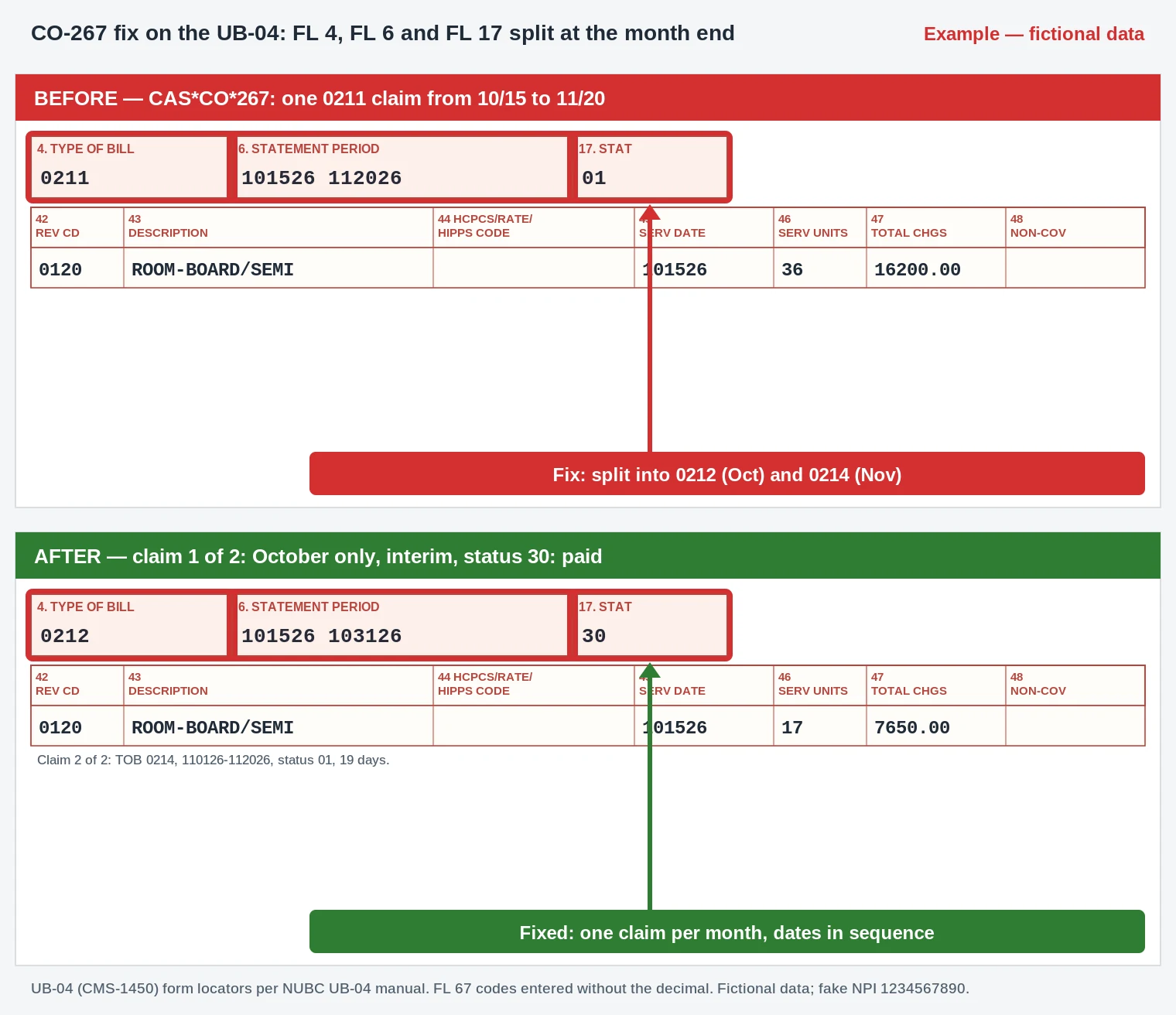
CMS-1500 not shown: each professional line has its own date, so the month split is a UB-04 facility issue.
- FL 4: 0211 replaced by 0212 for October and 0214 for November.
- FL 6: 10/15-10/31 on claim 1 and 11/01-11/20 on claim 2; no overlap.
- FL 17: status 30 (still a patient) on claim 1; 01 (home) on claim 2.
- FL 46: 17 days on claim 1 and 19 on claim 2; the discharge day is not counted.
- CMS-1500: not used; this is a facility statement period rule.
CO-267 compared with other date codes
| Code | Problem | Fix |
|---|---|---|
| CO-267 | Claim crosses months | Split by month |
| CO-268 | Claim crosses calendar years | One claim per year |
| CO-29 | Filed too late | Proof of timely filing |
| CO-18 | Exact duplicate | Check prior claims |
FAQ
What does CO-267 mean?
The claim’s statement period extends across more than one month, and the payer requires a separate claim for each month.
Which bill type is the first monthly claim?
For an SNF, 0212 for the first interim claim, 0213 for continuing months, and 0214 for the last.
What patient status goes on interim claims?
Status 30, still a patient. The final claim carries the discharge status.
Do professional claims get CO-267?
Rarely. CMS-1500 lines carry their own dates, so the edit is mostly a facility issue.
Can the patient be billed?
No. It is a billing format issue that the provider must correct.
Sources
How we checked: the code quote and the SNF billing rules on this page were matched with the source text on 24 October 2026.
- X12, Claim Adjustment Reason Codes (CARC 267). Accessed 24 Oct 2026.
- CMS, Medicare Claims Processing Manual, chapter 6. Accessed 24 Oct 2026.
- NUBC, National Uniform Billing Committee. Accessed 24 Oct 2026.
Last updated: 24 October 2026 · Educational content; not legal advice.
Related denial codes
- CO-274: Paid Through a Care Coordination Arrangement
- CO-249: Claim Identified as a Readmission
- CO-239: Rebill Separate Claims by Coverage Period
- CO-233: Hospital-Acquired Conditions
- CO-232: Institutional Transfer Amount
- CO-190: Payment Included in the SNF Qualified Stay
- CO-186: Level of Care Change Adjustment
- CO-135: Interim Bills Cannot Be Processed