
A hospital expects the full DRG payment for an inpatient stay. When the claim says the patient left for another hospital or certain post-acute care, many payers pay a smaller transfer amount instead, and the difference shows as CO-232. Sometimes that cut is right. Often it traces back to one field: the discharge status code. (Primary source: X12 Claim Adjustment Reason Codes)
In brief: CARC 232 reads “Institutional Transfer Amount.” It explains the DRG amount difference when care crosses institutions. Check the discharge status in UB-04 FL 17 against the discharge summary. If the patient did not really transfer, send a replacement claim (type of bill 0117) with the right status. If they did, the reduced payment is usually correct.
Part of our denial codes library. Written by Manikandan J, CPC, CRCR, who has audited DRG transfer underpayments for community hospital billing offices. Published 23 October 2026. Last updated: 23 October 2026. Code wording quoted word for word from X12.
What does CO-232 mean?
| Field | Value |
|---|---|
| Code | 232 |
| Description | “Institutional Transfer Amount.” |
| Usage | “Applies to institutional claims only and explains the DRG amount difference when the patient care crosses multiple institutions.” |
| Start | 11/01/2009 |
| Last modified | 07/01/2017 |
Source: X12 Claim Adjustment Reason Codes, checked 23 October 2026.
CO-232 is a payment adjustment, not a full denial. A DRG (diagnosis related group) is the fixed inpatient payment category for a stay. A transfer payment is a reduced, per-day amount paid to the sending hospital when a patient moves to another hospital, or, for some DRGs, to post-acute care, before the typical length of stay. CMS describes how Medicare inpatient payment works on its acute inpatient PPS page.
The patient discharge status code in FL 17 tells the payer where the patient went. For example, 01 means discharged to home or self care, and 02 means discharged or transferred to a short-term general hospital for inpatient care.
Why CO-232 shows up
- A real transfer. The patient moved to another acute hospital. The cut is expected.
- A post-acute transfer. Such as discharge to a skilled nursing facility or home health for DRGs covered by a post-acute transfer policy.
- A wrong status code. A planned transfer that never happened, but the abstract still says 02.
- A short stay with the wrong status. For instance, a patient who left against advice coded as a transfer.
Example scenario (fictional names), part 1
CO-232 Denial Example: What Happened
Thomas Reed is a billing analyst at Valley Springs Community Hospital. A four-day stay for cellulitis of the right lower leg (L03.115, entered as L03115) was paid well below the expected DRG. The remit showed CAS*CO*232 for the difference.
The UB-04 had discharge status 02 in FL 17. The case manager’s notes showed the team had arranged a transfer to a university hospital on day three, but the patient improved and the transfer was cancelled.
Where did the patient actually go? Keep reading, or jump to how the CO-232 denial was resolved.
How to fix a CO-232 underpayment
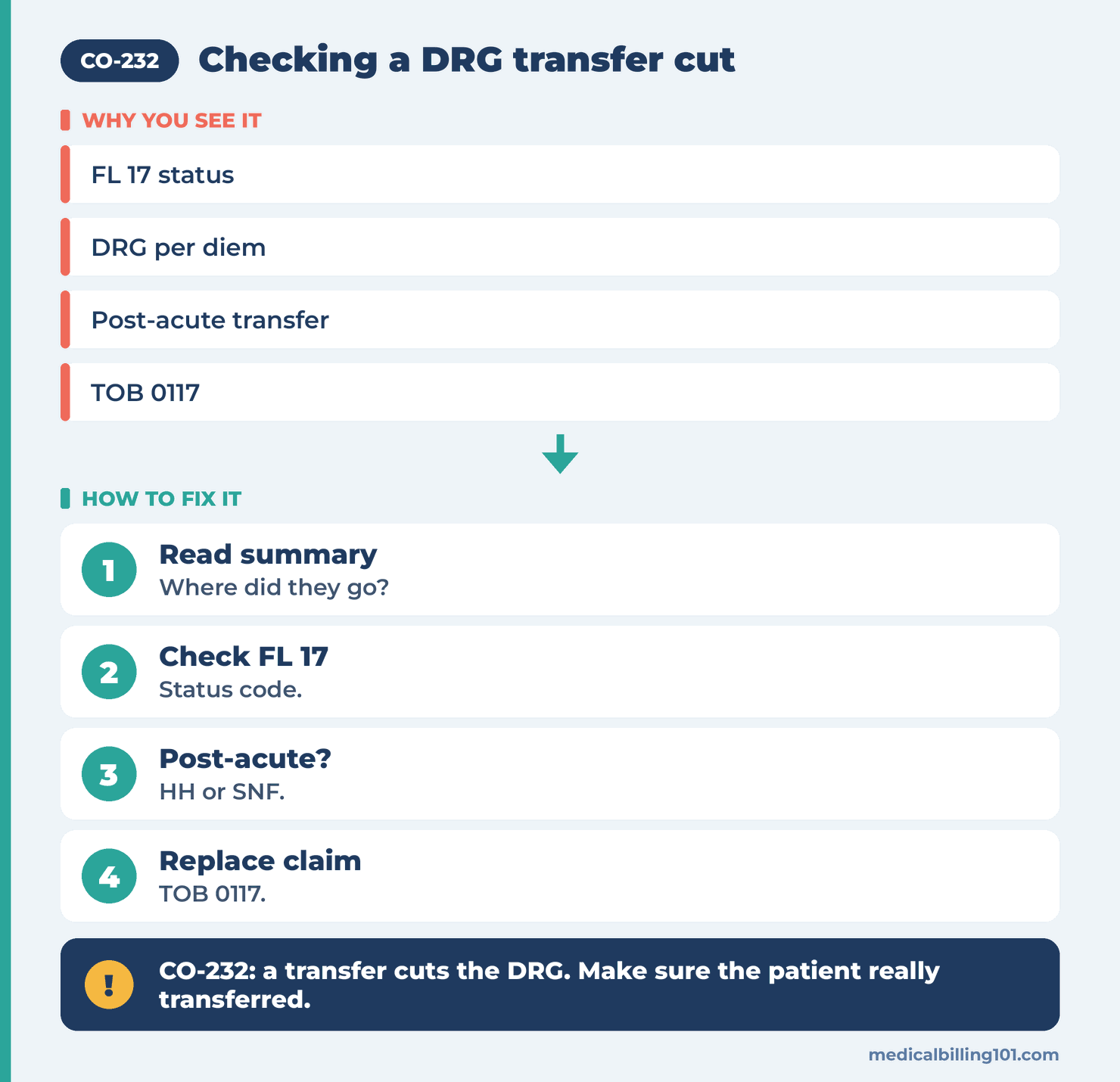
- Read the discharge summary. Confirm where the patient went and on what date.
- Compare with FL 17. Check that the two-digit status code matches.
- Check post-acute services. If home health or a nursing facility started soon after discharge, the status may need to show that, not 01.
- Send a replacement claim (type of bill 0117) with the correct status and the original claim number in FL 64.
- Fix the source. Make sure case management updates the status when plans change.
The claim form section below shows the UB-04 change.
Example scenario (fictional names), part 2
How the CO-232 Denial Was Resolved
Thomas checked the discharge summary. It said the patient was discharged home on day four with oral antibiotics, and no home health was ordered.
Fix: He sent a replacement claim, type of bill 0117, changing FL 17 from 02 to 01, with the original claim number in FL 64.
Outcome: The payer reprocessed the stay at the full DRG amount. Valley Springs added a check that blocks claims with status 02 unless the receiving hospital is named in the record.
Names and details are illustrative; no real patient data.
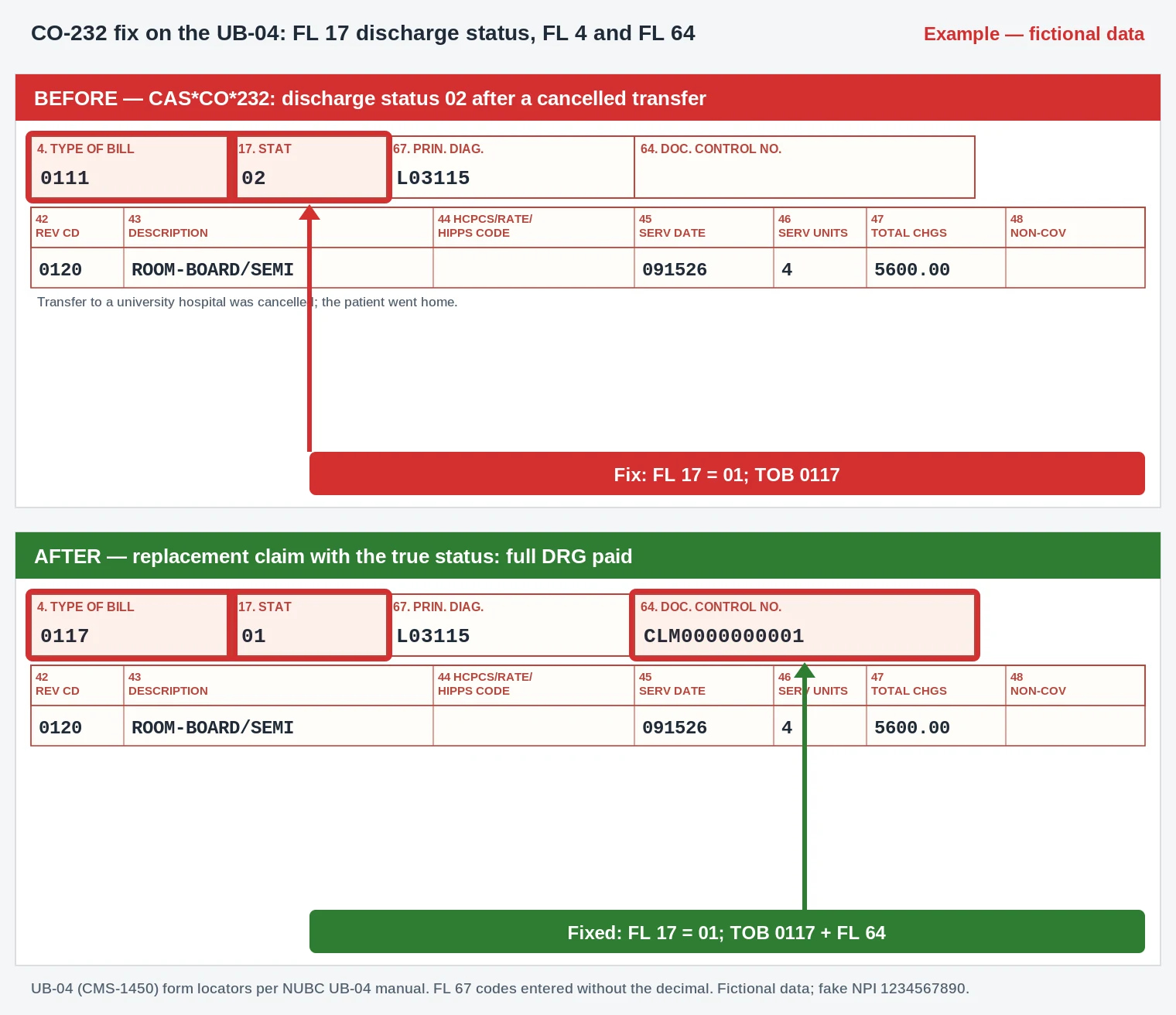
CMS-1500 not shown: CARC 232 applies to institutional claims only, and discharge status (FL 17) exists only on the UB-04.
- FL 17: patient discharge status 02 (transfer to a short-term hospital) changed to 01 (home or self care), matching the discharge summary.
- FL 4 + FL 64: type of bill 0117 (inpatient replacement) with the original claim number.
- FL 67: L03.115 (entered as L03115) and the room lines are unchanged.
- CMS-1500: no equivalent box; transfer amounts apply to institutional claims only.
CO-232 vs related codes
| Code | Meaning | Fix |
|---|---|---|
| CO-232 | Transfer amount, DRG cut | Verify discharge status |
| CO-45 | Above fee schedule | Usually none |
| CO-16 | Missing information | Supply the data |
| OA-23 | Prior payer impact | Read the primary EOB |
FAQ
What does CO-232 mean?
It is the institutional transfer amount: the DRG payment difference when a patient’s care crosses more than one institution.
Is CO-232 a denial?
No. It reduces the DRG payment rather than denying the claim.
Does CO-232 apply to physician claims?
No. X12 says it applies to institutional claims only.
How do I fix a wrong transfer?
Send a replacement claim, type of bill 0117, with the correct discharge status in FL 17.
Can the patient be billed the difference?
No. Group code CO keeps it with the hospital.
Sources
How we checked: each code quote on this page was matched word for word with the X12 CARC list on 23 October 2026.
- X12, Claim Adjustment Reason Codes (CARC 232). Accessed 23 Oct 2026.
- CMS, Acute Inpatient PPS. Accessed 23 Oct 2026.
- CMS, MS-DRG Classifications and Software. Accessed 23 Oct 2026.
- NUBC, National Uniform Billing Committee. Accessed 23 Oct 2026.
Last updated: 23 October 2026 · Educational content; not legal advice.
Related denial codes
- CO-233: Hospital-Acquired Conditions
- CO-239: Rebill Separate Claims by Coverage Period
- CO-249: Claim Identified as a Readmission
- CO-267: Claim Spans Multiple Months
- CO-274: Paid Through a Care Coordination Arrangement
- CO-190: Payment Included in the SNF Qualified Stay
- CO-186: Level of Care Change Adjustment
- CO-135: Interim Bills Cannot Be Processed