
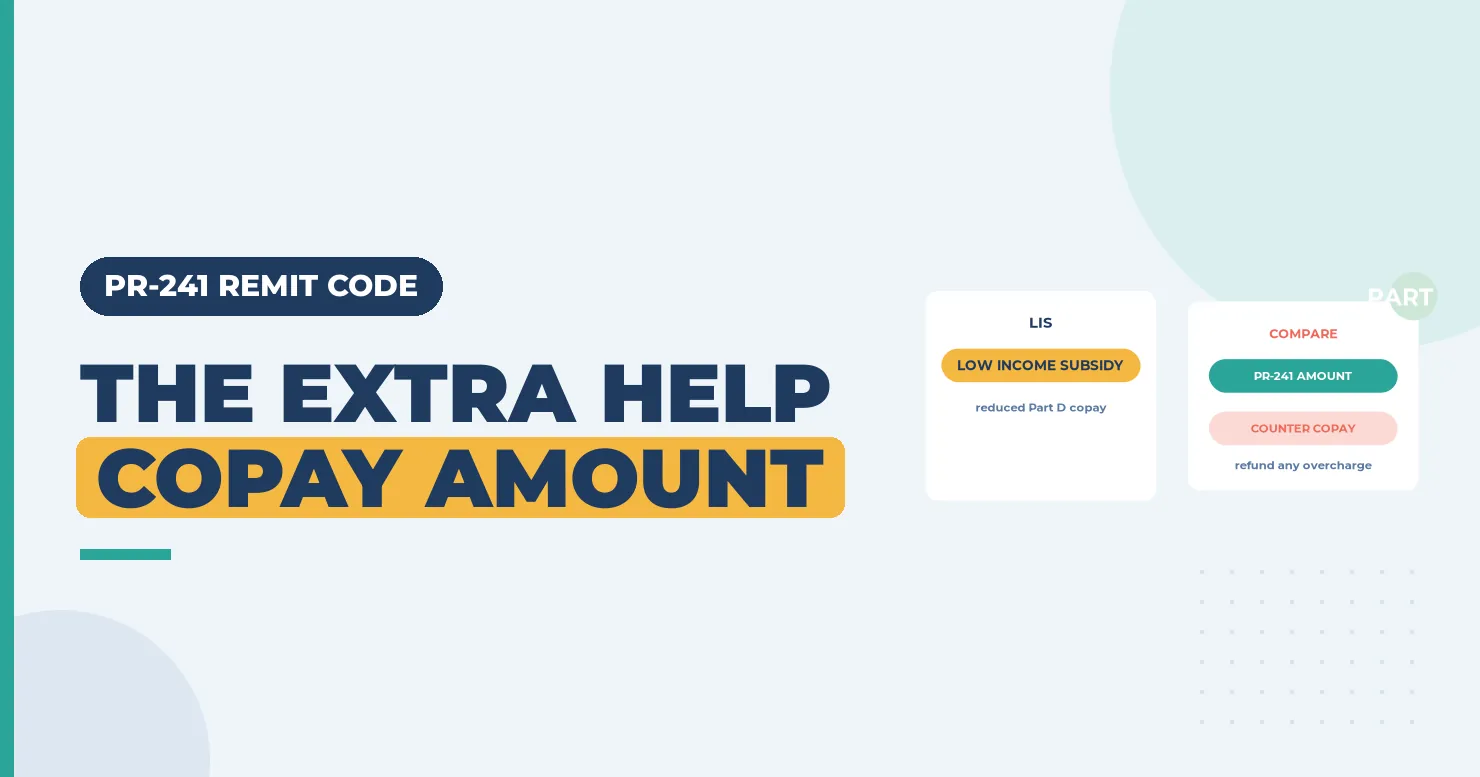
PR-241 is not a rejection of the drug. It tells the pharmacy how much of the claim is the member’s reduced copay under the Medicare Part D Low Income Subsidy, also called Extra Help. The plan pays the rest. Problems start when the copay collected at the counter does not match the LIS amount on the remit. (Primary source: X12 Claim Adjustment Reason Codes)
In brief: CARC 241 reads “Low Income Subsidy (LIS) Co-payment Amount”. With group code PR it is the member’s share at the LIS copay level. Compare it with what the patient paid, refund any overcharge, and fix the member’s subsidy status in your pharmacy system.
Part of our denial codes library. Written by Manikandan J, CPC, CRCR, who has reconciled pharmacy and Medicare remits for health plans and billing companies. Published 24 October 2026. Last updated: 24 October 2026. Code wording quoted word for word from X12.
What does PR-241 mean on a remit?
| Field | Value |
|---|---|
| Code | 241 |
| Description | “Low Income Subsidy (LIS) Co-payment Amount” |
| Group code | PR (patient responsibility) |
| Start | 06/03/2012 |
Source: X12 Claim Adjustment Reason Codes, checked 24 October 2026.
LIS is the federal subsidy that lowers Part D premiums, deductibles and copays for people with limited income and resources. Medicare explains the program on its Extra Help page. PR means the amount belongs to the member, not the pharmacy. So a PR-241 line is a statement of what you may collect, not money taken away.
You will mostly see this code on pharmacy remittances from Part D plans. Medical offices see it rarely, because Part B and medical claims do not use LIS copay tiers.
Why PR-241 causes trouble at the pharmacy
The real-time pharmacy claim tells the counter what to collect. The 835 arrives later. When the two disagree, the patient has paid the wrong amount. Common reasons include:
- Late subsidy status. The member qualified for Extra Help, but the plan had not loaded the LIS level when the drug was filled.
- Wrong LIS level. The member moved to a lower copay level, for example after becoming full-benefit dual eligible.
- Stale profile data. The pharmacy system kept an old copay override.
- Counter rounding or manual pricing. Staff typed a copay by hand instead of using the adjudicated amount.
Example scenario (fictional names), part 1
PR-241 Denial Example: What Happened
Dana Whitfield runs billing for Cedar Lane Pharmacy, a fictional independent store. An older member filled three maintenance drugs in early October and paid the plan’s standard copays at the counter.
Two weeks later the plan’s 835 showed CAS*PR*241 on each line, and the PR amounts were far lower than what the member had paid.
Did the pharmacy overcharge, or was the remit wrong? Keep reading, or jump to how the PR-241 denial was resolved.
How to work a PR-241 line
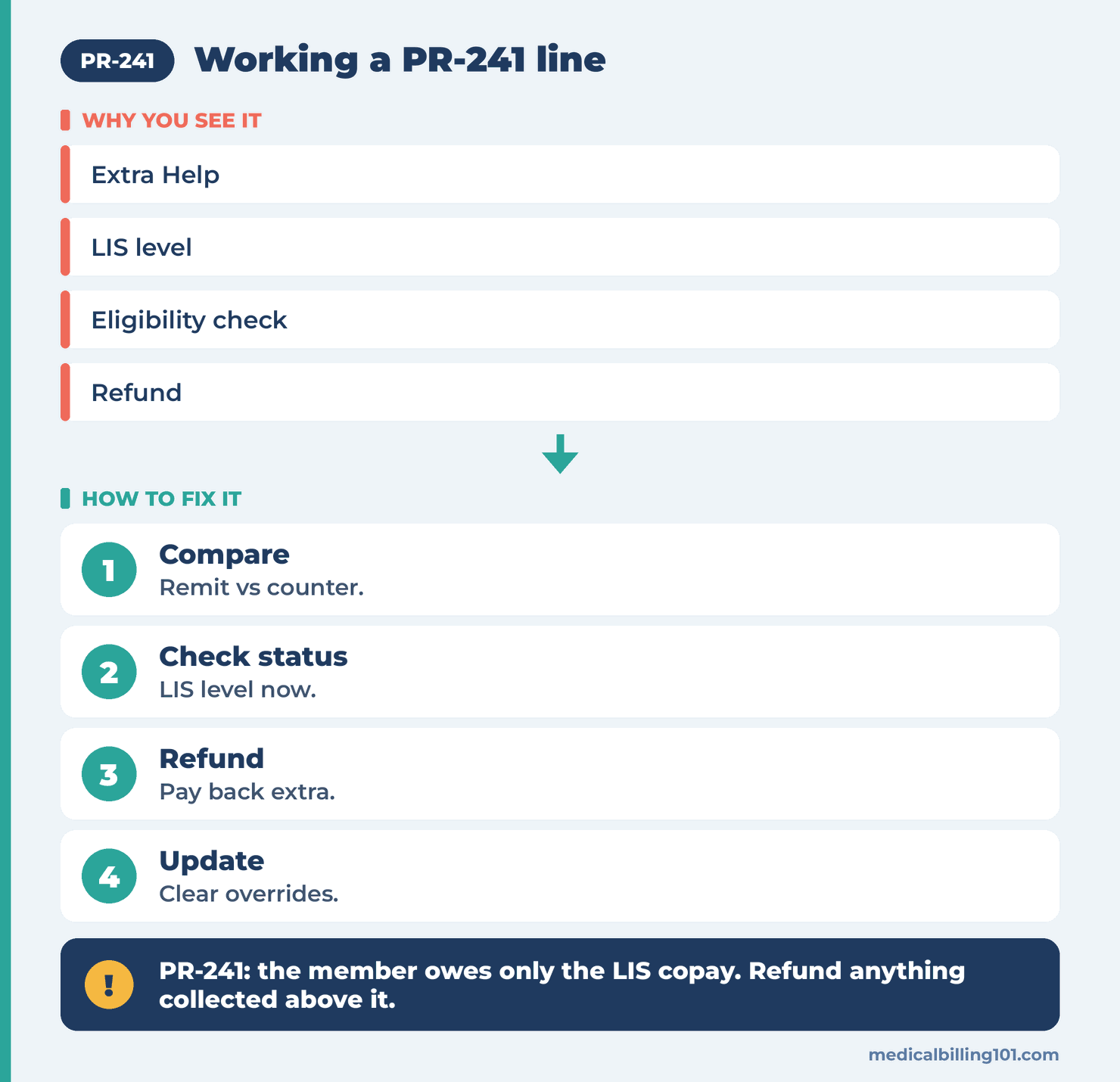
- Compare the amounts. Put the PR-241 amount next to the copay collected for the same fill. A higher counter copay means a likely refund.
- Check subsidy status. Run a fresh eligibility check and look at the LIS level the plan now reports for the member.
- Ask for proof if needed. If a member says they have Extra Help but the plan disagrees, ask for their award letter or Medicaid card. CMS calls this the best available evidence process.
- Refund the difference. Return any amount above the PR-241 figure to the member, and record the refund on the account.
- Update the profile. Clear old copay overrides so the next fill uses the plan’s adjudicated amount.
For a broader view of how patient responsibility codes differ, see our guides to PR-1 for deductibles and PR-2 for coinsurance.
Example scenario (fictional names), part 2
How the PR-241 Denial Was Resolved
Dana ran a new eligibility check. The plan now showed the member at an LIS copay level, effective from the first of the month, so the counter copays had been too high.
Fix: She refunded the difference on all three fills, cleared a manual copay override in the profile, and noted the award date on the account.
Outcome: The next refill priced at the LIS copay at the counter. Cedar Lane added a monthly report that flags any fill where the collected copay is above the PR-241 amount.
Names and details are illustrative; no real patient data.
PR-241 compared with other patient responsibility codes
| Code | What it reports | Usual action |
|---|---|---|
| PR-241 | LIS reduced copay | Collect only this amount |
| PR-3 | Regular copay | Collect per plan |
| PR-2 | Coinsurance | Bill the member or secondary |
| OA-209 | Amount not billable to a dual eligible | Do not bill; refund if collected |
FAQ
Is PR-241 a denial?
No. It reports the member’s reduced copay under the Low Income Subsidy. The plan has paid the rest of the allowed amount.
Can the pharmacy collect more than the PR-241 amount?
No. If the counter copay was higher, refund the difference to the member.
Why did the copay change after the fill?
The plan often updates the subsidy level after the date it took effect. The 835 then reflects the corrected copay.
Do doctors’ offices see PR-241?
Rarely. The code belongs to Part D drug claims, which pharmacies bill.
Where can members learn about Extra Help?
They can read the Medicare Extra Help page or contact Social Security to apply.
Sources
How we checked: the code quote on this page was matched word for word with the X12 CARC list on 24 October 2026.
- X12, Claim Adjustment Reason Codes (CARC 241). Accessed 24 Oct 2026.
- Medicare.gov, Help with drug costs (Extra Help). Accessed 24 Oct 2026.
- CMS, Coordination of Benefits overview. Accessed 24 Oct 2026.
Last updated: 24 October 2026 · Educational content; not legal advice.
Related denial codes
- PR-247: Part B Deductible on an Institutional Claim
- PR-248: Part B Coinsurance on a Hospital Claim
- PR-275: Secondary Plan Won’t Cover Prior Cost Share
- PR-201: Patient Responsible Through a Set-Aside Arrangement
- PR-187: Consumer Spending Account Payments Explained
- PR-142: Monthly Medicaid Patient Liability Amount
- PR-102: Major Medical Adjustment
- OA-100: Payment Made to the Patient