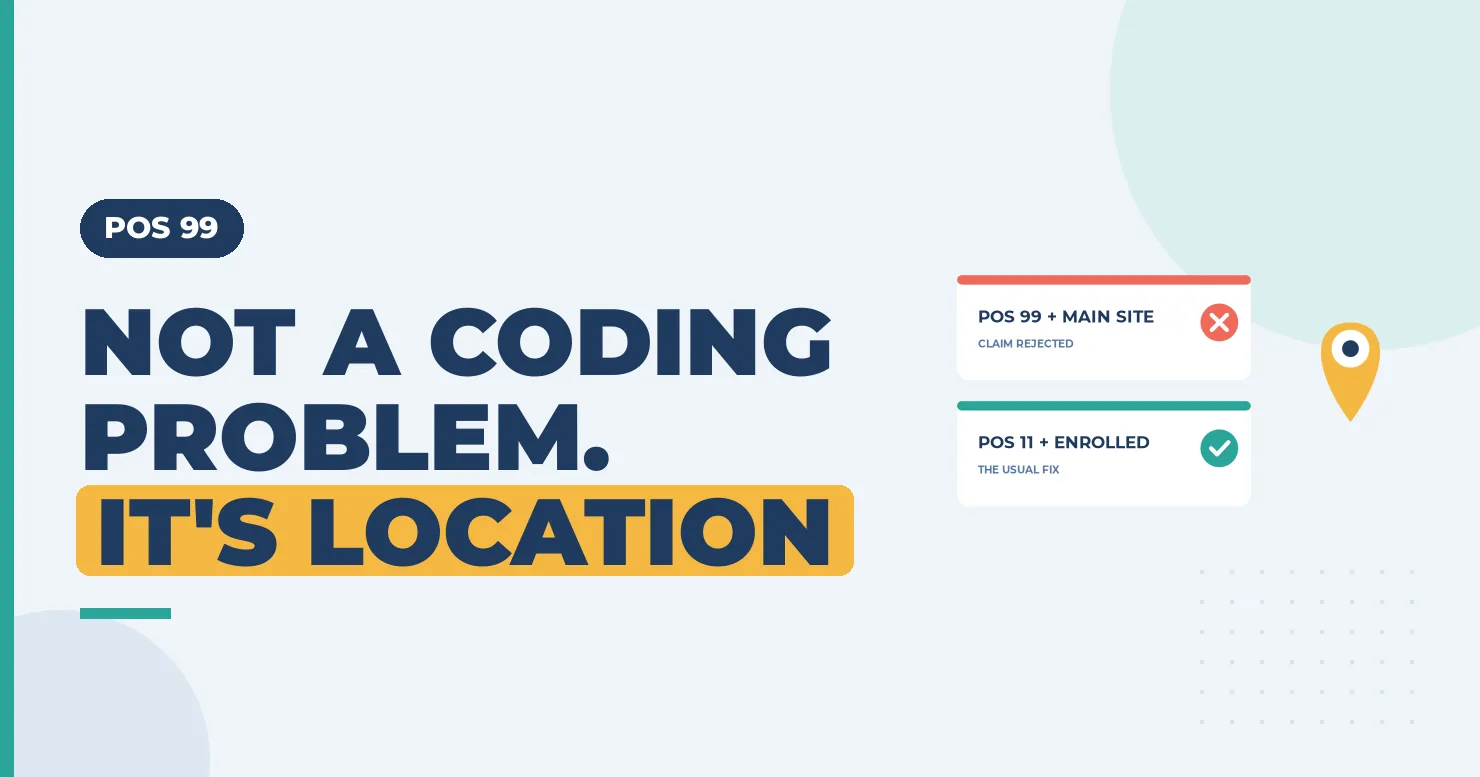
Place of service 99 means “Other Place of Service,” a setting not described by any other POS code. Use it only when no other code fits. For a provider who sees patients at a community center on a set schedule, the better fix is often POS 11 with that address enrolled as a practice location.
Most POS 99 denials are a location problem, not a coding problem. The payer cannot match the service address to the provider’s enrollment, so it rejects or holds the claim.
TL;DR: POS 99 is a valid code, and Medicare prices it at the non-facility rate. But it is a last resort. First test the setting against POS 11, 15, 27, 04, 71 and 50. Enroll the real service address. Report it in Item 32 or loop 2310C. Ask your MAC when the right code is unclear.
Written by Manikandan J, CPC, CRCR, a certified coder and revenue cycle specialist. Published 16 November 2026. Last updated: 16 November 2026.
Table of Contents
What is place of service 99?
Place of service 99 is the national POS code for “Other Place of Service.” CMS defines it as another place of service not identified above in the code set. It is a catch-all code. It tells the payer the visit happened somewhere that no other two-digit POS code describes.
The official list is the CMS Place of Service code set. It lists codes 01 through 99, with many numbers unassigned. Code 99 sits at the end, after 81 Independent Laboratory and the unassigned block 82-98.
The same list appears in the Medicare Claims Processing Manual. Chapter 26, section 10.5 marks POS 99 as non-facility (NF) for physician fee schedule payment.
When should you bill place of service 99?
Bill place of service 99 only after you rule out every specific code. If a specific code describes the setting, the specific code is correct. POS 99 fits rare, one-off settings, such as a single health screening at an event venue that is not a mobile unit or a regular clinic site.
Walk through the closest codes first. This table uses the CMS definitions.
| Setting | POS code | CMS definition in short | Medicare rate |
|---|---|---|---|
| Site where the provider routinely sees patients | 11 Office | Location where the professional routinely provides exams, diagnosis and treatment on an ambulatory basis | Non-facility |
| Van or bus clinic | 15 Mobile Unit | Unit that moves place to place, equipped to provide services | Non-facility |
| Street medicine for unsheltered people | 27 Outreach Site/Street | Non-permanent street or found location for unsheltered homeless patients | Non-facility |
| Homeless shelter | 04 Homeless Shelter | Facility whose main purpose is temporary housing for homeless people | Non-facility |
| Health department clinic | 71 State or Local Public Health Clinic | Facility run by a state or local health department | Non-facility |
| Federally qualified health center | 50 FQHC | Facility that provides Medicare-covered FQHC services | Non-facility |
| No code above fits | 99 Other | Other place of service not identified above | Non-facility |
CMS also adds a practical line under the code set. The Medicare contractor can give guidance when the right POS code is unclear. Ask your MAC in writing and keep the reply on file.
What POS code do you use for a community center visit?
For example, take a community center where the provider holds regular clinic hours. There, POS 11 Office is usually the better fit. The Office definition turns on routine ambulatory care at that location. It says nothing about owning the space or paying rent. Free use of a room does not by itself make the site POS 99.
Check the exceptions first. The Office definition excludes hospitals, SNFs, community health centers and public health clinics. If the community center is actually an FQHC or a health department clinic, use that code, and the right entity bills.
Some payers still treat a part-time site differently. That is why the MAC’s written answer matters more than any forum opinion.
On my AR calls, a payer rep’s first question on a place-of-service denial was almost always which address the patient was seen at.
Why do place of service 99 claims get denied?
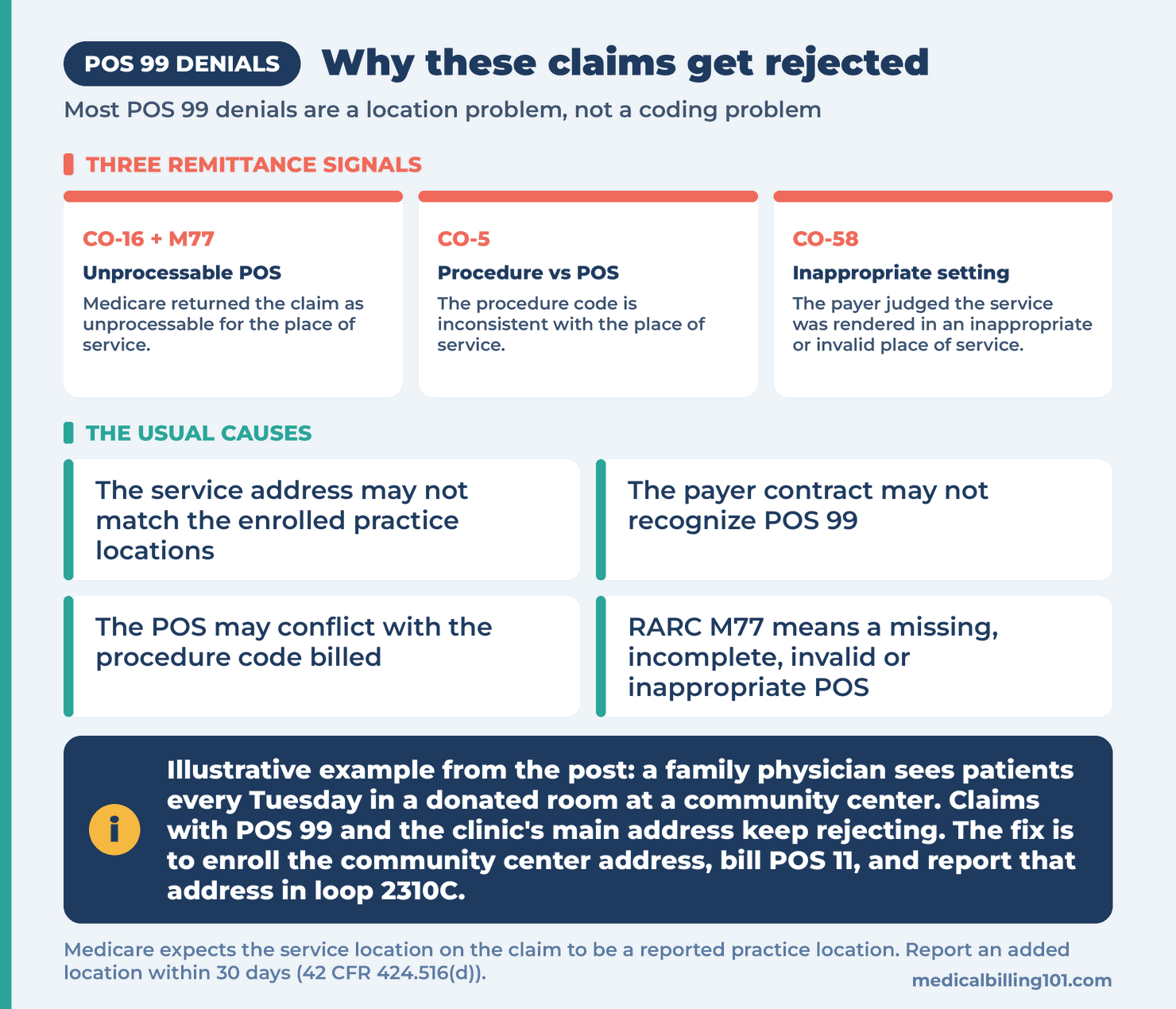
Place of service 99 claims are usually denied because the payer cannot validate the setting. The service address may not match the enrolled practice locations. The payer contract may not recognize POS 99. Or the POS may conflict with the procedure code billed.
RARC M77 is the remark code for a missing, incomplete, invalid or inappropriate place of service. Read the remittance codes to see which problem you have. Each code points to a different fix.
- CO-16 with M77 means Medicare returned the claim as unprocessable for the POS.
- CO-5 means the procedure code is inconsistent with the place of service.
- CO-58 means the payer judged the service was rendered in an inappropriate or invalid place of service.
The code wording comes from the X12 CARC list and the X12 RARC list. Medicare’s edit rules are in Claims Processing Manual chapter 26, sections 10.5 and 10.6.
Does the service address need to be enrolled with Medicare?
Yes. Medicare expects the service location on the claim to be a reported practice location. Physicians and practitioner groups must report a change, addition or deletion of a practice location within 30 days. That rule is 42 CFR 424.516(d).
A practice location is an address where the provider sees patients, listed on the enrollment record. Add the community center through PECOS or the CMS-855 form. Do the same with each commercial and Medicaid plan, since each keeps its own provider file. Use our NPI lookup to confirm the NPI and address data you send.
The address also drives payment. Medicare prices physician fee schedule services by the locality of the service ZIP code. A wrong or missing address can send the claim to the wrong pricing locality.
Where does the service address go on the claim?
Item 32 is the CMS-1500 box for the service facility location. Put the service address in Item 32 on the CMS-1500, or in loop 2310C on the 837P. CMS requires the service location for all POS codes on claims processed on or after January 1, 2011. Only one service address fits on each claim, so split claims by location.
Item 24B carries the two-digit POS for each line. Item 32a holds the service facility NPI when the payer’s policy requires it. If you also use Item 19 for notes, see our answer on what to put in Box 19 on the CMS-1500.
Fix the claim, then send a corrected claim or a new claim as the payer requires. Our corrected claim resubmission guide covers frequency codes by payer type.
Does place of service 99 pay less than POS 11?
No, not under the Medicare physician fee schedule. CMS designates POS 99 as non-facility, the same as POS 11 Office. So a payable service at POS 99 prices at the non-facility rate. Commercial payers may price it differently or not accept it.
You can compare facility and non-facility amounts for a code with our RVU calculator. Telehealth is separate. Medicare uses only POS 02 or POS 10 for telehealth, as our orthopedic telehealth follow-up answer explains.
Here is an illustrative example. A family physician sees patients every Tuesday in a donated room at a community center. Claims with POS 99 and the clinic’s main address keep rejecting. The fix is to enroll the community center address, bill POS 11, and report that address in loop 2310C.
3-step checklist
- Test the setting against POS 11, 15, 27, 04, 71 and 50 before you choose POS 99, and ask your MAC when unsure.
- Enroll the real service address with Medicare within 30 days and with every other payer.
- Report that address in Item 32 or loop 2310C, match the remittance code to the fix, and resubmit.
FAQ
What does POS 99 mean on a claim?
POS 99 is the CMS code for Other Place of Service. It means a setting not identified by any other POS code. Medicare marks it non-facility for physician fee schedule payment.
Is POS 99 valid for Medicare claims?
Yes. POS 99 is part of the national POS code set. But Medicare checks that the POS fits the procedure and the service address. Use it only when no specific code describes the setting.
What POS code is used for a community center clinic?
If the provider routinely sees patients there, POS 11 Office usually fits. The Office definition does not require owning or renting the space. Use POS 50 or 71 if the site is an FQHC or a health department clinic.
What denial code means invalid place of service?
Medicare uses CO-16 with RARC M77 for a missing or invalid POS. CO-5 means the procedure is inconsistent with the POS. CO-58 means the payer judged the place of service inappropriate.
Does a new service location need Medicare enrollment?
Yes. Under 42 CFR 424.516(d), physicians and practitioner groups must report an added practice location to their Medicare contractor within 30 days.
Sources
My methodology was simple. I checked the CMS POS code set, Claims Processing Manual chapter 26, the Medicare enrollment reporting rule and the X12 code lists. Commercial and Medicaid rules differ, so confirm each payer’s policy.
- CMS, Place of Service Code Set (linked above). Accessed 16 Nov 2026.
- CMS, Medicare Claims Processing Manual, Chapter 26, sections 10.4, 10.5 and 10.6, Rev. 14466 (linked above). Accessed 16 Nov 2026.
- eCFR, 42 CFR 424.516 Additional provider and supplier requirements for enrolling and maintaining active enrollment status (linked above). Accessed 16 Nov 2026.
- X12, Claim Adjustment Reason Codes 5, 16 and 58 (linked above). Accessed 16 Nov 2026.
- X12, Remittance Advice Remark Code M77 (linked above). Accessed 16 Nov 2026.
Read about the author, or contact us with a question. See our editorial policy.
Last updated: 16 November 2026 · Educational content for U.S. billers. Check each payer’s current rules.