
CO-90 means the payer cut the drug cost on your claim to its own price for that drug. X12 says reason code 90 is for pharmaceuticals only. You’ll see it on pharmacy remits and on medical claims for drugs given in a clinic. The reduction is usually a pricing calculation, not a coverage denial, because the payer reimbursed the medication at a lower ingredient price than you billed. (Primary source: X12 Claim Adjustment Reason Codes).
In brief: CO-90 means “Ingredient cost adjustment.” Payers pay drugs at the lower of your charge or a benchmark such as actual acquisition cost, NADAC, a MAC list or ASP. Check the NDC, units and package size first, since those errors cause most wrong cuts. If the price is right by the payer’s rules, the cut is a contract write-off. If you paid more than the payer allows, take it up with the payer or your buyer.
Part of our denial codes library. Written by Manikandan J, CPC, CRCR, who has worked pharmacy and drug claims for payers and billing companies. Published 20 October 2026. Last updated: 20 October 2026. Code wording is quoted word for word from X12.
What X12 says about CARC 90
| Field | Official X12 text |
|---|---|
| Description | “Ingredient cost adjustment.” |
| Usage | “To be used for pharmaceuticals only.” |
| Start | 01/01/1995 |
Source: X12 Claim Adjustment Reason Codes, checked 20 October 2026.
Denial code 90, CARC 90 and reason code 90
Billers call it denial code 90, CARC 90 or reason code 90. It’s the same code. With CO, the reduced amount is a contractual adjustment that can’t be billed to the patient.
How payers price a drug
Ingredient cost is the price of the drug itself, apart from any fee for filling it. Actual acquisition cost is the state Medicaid agency’s estimate of what pharmacies really pay for a drug. NADAC is a national survey-based average of what retail pharmacies pay, which many Medicaid programs use as their AAC. MAC is a maximum allowable cost list a PBM or plan sets for generics.
| Benchmark | Who uses it | Where it applies |
|---|---|---|
| AAC or NADAC | State Medicaid | Retail pharmacy claims |
| Federal upper limit | Medicaid | Some multi-source generics |
| MAC list | PBMs and health plans | Mostly generics |
| ASP plus add-on | Medicare Part B | Drugs given in a clinic or hospital outpatient |
| WAC-based price | Some commercial plans | Brand drugs |
Under federal rules, Medicaid pays most drugs at the lower of AAC plus a dispensing fee or the pharmacy’s usual and customary charge. See 42 CFR 447.512. Medicare Part B prices clinic drugs from the ASP pricing files.
Common causes of a wrong CO-90 cut
- Wrong NDC. The claim lists a different package or labeler than the one used, so the payer prices a cheaper product.
- Unit mix-ups. Billing in mL when the payer prices per vial, or the HCPCS units don’t match the NDC quantity.
- Outdated price file. The payer’s MAC or ASP file hasn’t caught up with a recent manufacturer price increase.
- Usual and customary set too low. Your own charge was below the benchmark, so the payer reimbursed your charge instead.
Steps to work a CO-90
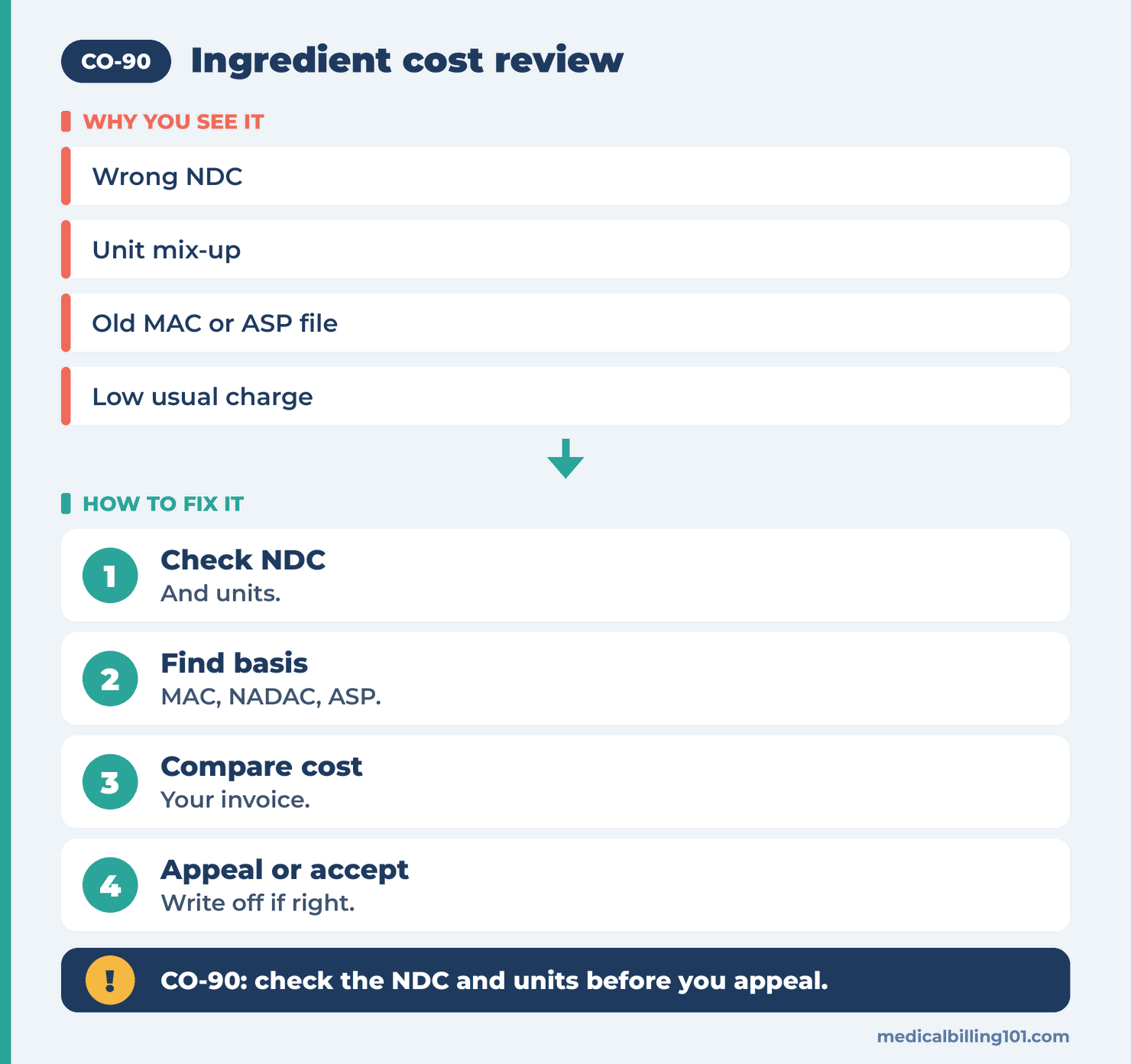
- Check the NDC and units. Match the 11-digit NDC, unit of measure and quantity to the vial or package used.
- Find the pricing basis. Ask the payer or check the remit for the benchmark used, such as MAC, NADAC or ASP.
- Compare to what you paid. Pull the wholesaler invoice for that specific lot.
- Fix and rebill if the NDC or units were wrong.
- Appeal the price if your cost is above the benchmark. Most PBMs have a MAC appeal process with short deadlines.
- Accept and write off if the reduction matches your contract terms.
Worked example (illustrative)
An oncology clinic bills a commercial plan for an injectable drug with HCPCS units of 10 and an NDC for a 100 mg vial. The plan pays less than expected and shows CAS*CO*90*312.40. The coder sees the NDC on the claim was for a smaller vial from another labeler, which the plan prices lower. She corrects the NDC and units, sends a corrected claim, and the line reprices to the contract rate.
Consider a retail pharmacy case. A pharmacy fills a generic and gets CO-90 from a PBM because its MAC price is below the pharmacy’s invoice cost. The pharmacy files a MAC appeal with the invoice within the PBM’s deadline. The PBM raises the MAC price and pays the difference.
Prevention checklist
- [ ] Use an NDC crosswalk that matches HCPCS units to package sizes.
- [ ] Scan the NDC from the vial used, not the one in the charge list.
- [ ] Load new ASP files each quarter and watch price changes.
- [ ] Track MAC appeal deadlines for each PBM.
- [ ] Review usual and customary charges at least once a year.
Related denial codes
- CO-16: claim lacks information, such as a missing NDC.
- CO-45: charge exceeds fee schedule or contracted amount.
- CO-15: authorization number missing or invalid.
- CO-54: multiple physicians or assistants not covered.
- Full CARC and RARC list for code lookups.
- Denial codes hub for every code we cover.
Key takeaways
CO-90 cuts a drug’s price to the payer’s ingredient cost benchmark. Most incorrect reductions come from NDC or unit errors, so verify those first. If the price is correct by contract, write it off. If your real cost is higher than the benchmark, appeal with the invoice.
FAQ
What does CO-90 mean?
It means the payer reduced the drug’s ingredient cost to its own price for that drug.
Is CO-90 only for drugs?
Yes. X12 says CARC 90 is to be used for pharmaceuticals only.
What is NADAC?
It’s a national average of what retail pharmacies pay for drugs, built from a monthly survey and used by many Medicaid programs.
Can I bill the patient after a CO-90 cut?
No. The CO group means it’s a contract adjustment you must write off.
How do I appeal a MAC price?
Send the PBM your invoice showing your cost, using its MAC appeal process before the deadline.
How does CO-90 differ from CO-91?
CO-90 adjusts the drug’s ingredient cost. CO-91 adjusts the dispensing fee for filling it.
Sources
How we checked: every code quote on this page was compared word for word with the X12 CARC list on 20 October 2026.
- X12, Claim Adjustment Reason Codes (CARC 90). Accessed 20 Oct 2026.
- eCFR, 42 CFR 447.512, Drugs: Aggregate upper limits of payment. Accessed 20 Oct 2026.
- CMS, ASP Pricing Files. Accessed 20 Oct 2026.
Last updated: 20 October 2026 · This page is educational and doesn’t replace payer contracts or coding rules.