
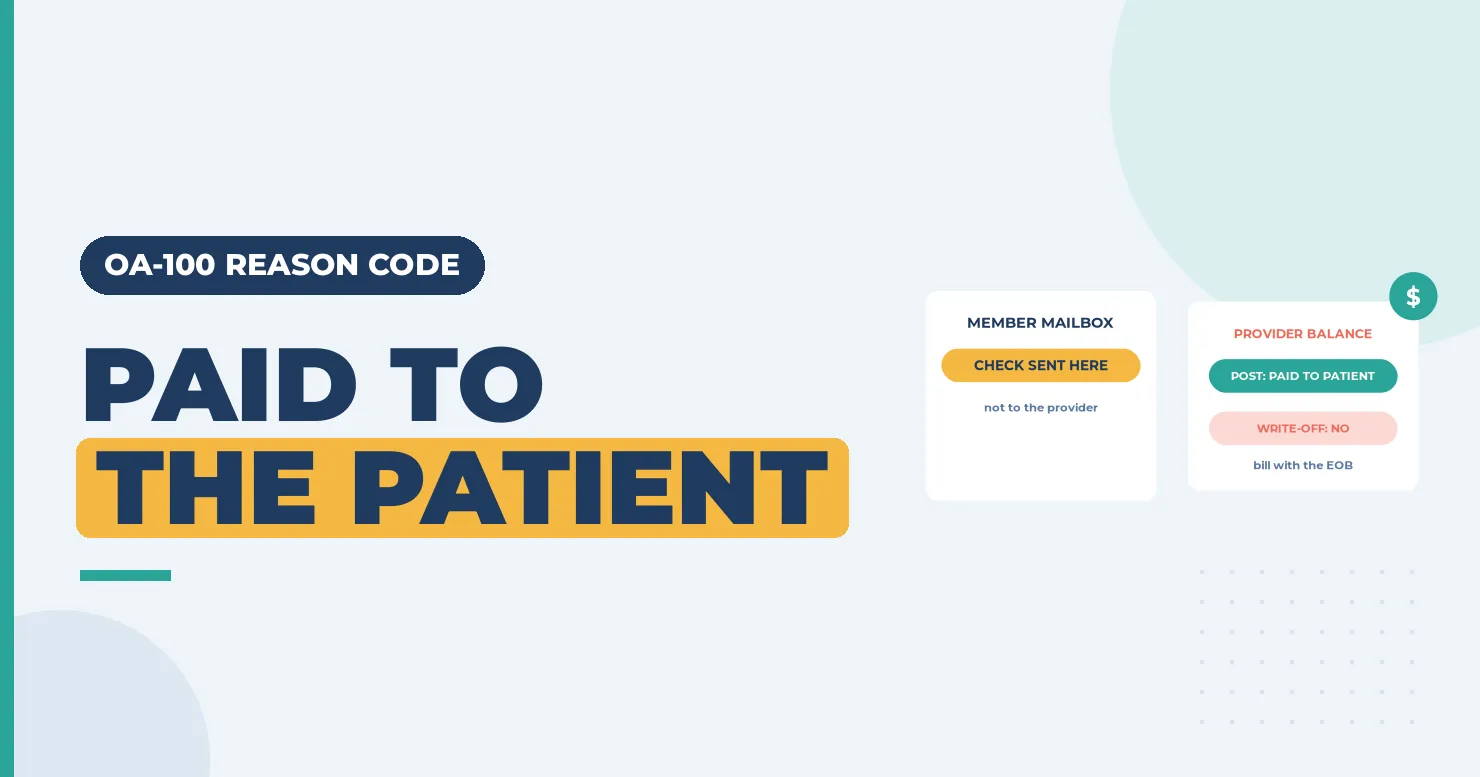
CARC 100 means the payer did pay the claim, just not to you. The money went to the patient, the insured or another responsible party. Your remit shows the claim as processed, but your bank account shows nothing. That’s why reason code 100 often gets mistaken for a denial. It isn’t one. It’s a routing problem: the benefit was paid to the wrong person from your point of view. You now collect from whoever got the check, and you fix whatever sent it there. (Primary source: X12 Claim Adjustment Reason Codes)
In brief: The X12 wording is “Payment made to patient/insured/responsible party.” The payer considers its part done. Check the remit for the amount paid to the member. Post it as paid to patient, then bill the patient for that amount plus any patient share. Then find out why assignment didn’t hold.
Part of our denial codes library. Written by Manikandan J, CPC, CRCR, who has posted remits for out-of-network and non-assigned claims. Published 21 October 2026. Last updated: 21 October 2026. Code wording is quoted word for word from X12.
What X12 says about CARC 100
| Field | X12 text |
|---|---|
| Code | 100 |
| Description | “Payment made to patient/insured/responsible party.” |
| Start | 01/01/1995 |
| Last modified | 05/01/2018 |
Source: X12 Claim Adjustment Reason Codes, checked 21 October 2026. Payers report it under different group codes, most often OA or PR. The group matters less than one fact: someone other than you holds the payment.
Example scenario (fictional names), part 1
OA-100 Denial Example: What Happened
Priya Natarajan bills for Lakeshore Sleep Center, which is out of network with Harborview Health Plan, a fictional commercial plan. Dr. Owen Castellano read a home sleep test for a patient with obstructive sleep apnea (G47.33), billed as 95806.
The 835 showed the claim as paid, with CAS*OA*100 for the full allowed amount and remark LQ*HE*N381. Lakeshore’s deposit for that claim was zero. The patient had signed the clinic’s assignment form at intake. So why did the OA-100 reason code send the money to the patient’s home?
Was the plan wrong, or did the clinic’s paperwork never reach it? Keep reading, or jump to how the OA-100 denial was resolved.
Why payers pay the patient instead of you
Assignment of benefits is the patient’s written OK for the plan to pay the provider directly. When a plan won’t honor it, or never sees it, the check goes to the member. The usual reasons:
- You’re out of network. Many commercial plans pay members directly for out-of-network care, even when the patient signed an assignment.
- The claim didn’t ask for direct payment. On the CMS-1500, Box 13 (insured’s signature for payment) and Box 27 (accept assignment) tell the payer where to send money. A blank or “No” can route payment to the member.
- You don’t accept Medicare assignment. A non-participating provider is one that hasn’t signed a Medicare participation agreement. On unassigned claims, Medicare pays the beneficiary, and the provider’s remit is for information. CMS explains assignment in the Medicare Claims Processing Manual, Chapter 1.
- The patient already paid you in full, and the plan reimbursed the patient.
Remark codes that tell you more
| RARC | X12 wording | When you’ll see it |
|---|---|---|
| MA28 | “Alert: Receipt of this notice by a physician or supplier who did not accept assignment is for information only and does not make the physician or supplier a party to the determination.” | Unassigned Medicare claims |
| N381 | “Alert: Consult our contractual agreement for restrictions/billing/payment information related to these charges.” | Contract or network terms decided where money went |
| MA59 | “Alert: The patient overpaid you for these services.” | The patient paid more than their share and you owe a refund |
Read the full lines on the X12 RARC list; some are longer than shown here.
How to post and collect an OA-100 line
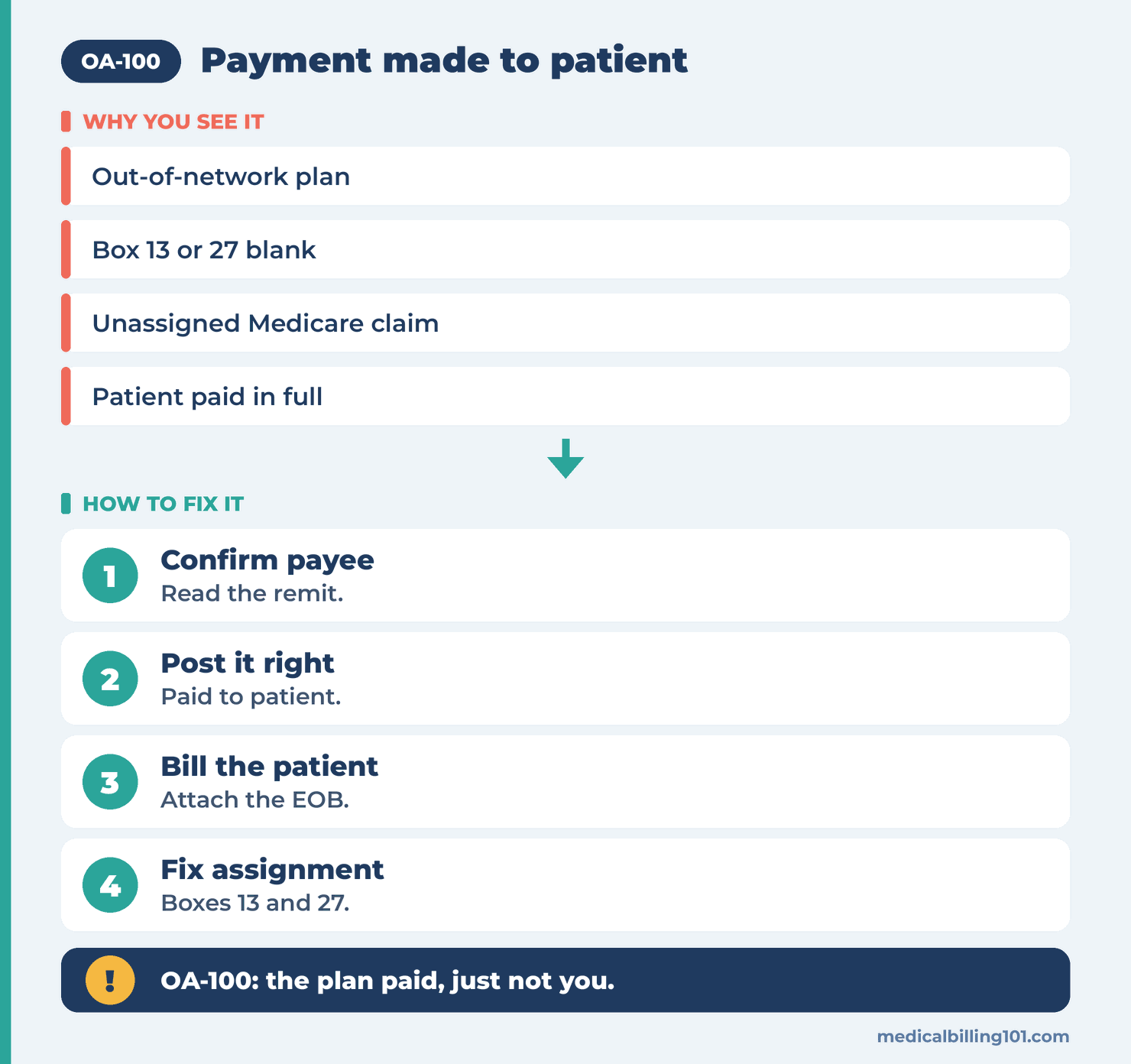
- Confirm who was paid. The remit shows the amount paid to the member. Call the payer if it isn’t clear.
- Post it correctly. Record the CARC 100 amount as paid to patient, not as a write-off. It’s money the patient now owes you.
- Bill the patient. Send a statement for the amount the plan paid them plus any deductible, copay or coinsurance on the remit. Include a copy of the explanation of benefits.
- Check your assignment setup. Look at Box 13, Box 27 and the signed form on file.
- Ask about reissue only when the payer erred. If the claim showed assignment and the plan honors it, ask the plan to stop payment and reissue to you. Not every plan will.
- Track the balance. Patient checks from a plan are easy to spend. Follow up early and offer a payment plan if needed.
Example scenario (fictional names), part 2
How the OA-100 Denial Was Resolved
Priya checked the claim first. Box 13 showed signature on file and Box 27 was marked yes, so the claim asked for direct payment. N381 told her the plan’s terms decided the route. Harborview’s provider guide said it pays members directly for all out-of-network care.
Fix: no corrected claim could change that. Priya sent the patient a statement for the paid amount with a copy of the plan’s explanation, and explained the check was meant for the clinic.
Outcome: the patient paid the balance within the month. Lakeshore now collects a deposit at the visit from patients whose plans pay members on out-of-network claims.
Names and details are illustrative; no real patient data.
Worked example (illustrative)
A non-participating dermatologist bills Medicare unassigned for an office visit. The remit shows the line under CARC 100 with MA28. The practice already collected its charge from the patient at the visit, so nothing more is due from anyone. The biller posts the remit as information only and checks that the charge stayed within Medicare’s limiting charge for unassigned claims.
Posting mistakes to avoid
- Writing it off. A CARC 100 amount is still owed to you. A write-off throws away real money.
- Rebilling the payer. A second claim will likely come back as a duplicate, such as CO-18.
- Billing the patient without the EOB. Patients often don’t connect the plan’s check with your bill. Send proof.
- Ignoring refunds. If the patient paid you and the plan also paid them, check MA59-type alerts before you keep anything.
Related codes
- PR-1, PR-2 and PR-3: deductible, coinsurance and copay.
- CO-45: charge exceeds the fee schedule.
- CO-23: impact of prior payer adjudication.
Key takeaways
OA-100 isn’t a denial. The plan paid, but it paid the patient. Post the amount as paid to patient, bill the patient with the EOB attached, and then fix the cause. That might be out-of-network rules, Box 13 and Box 27, or Medicare assignment. Payment that goes to the wrong person is still payment, so don’t write it off.
FAQ
What does reason code 100 mean?
It means “Payment made to patient/insured/responsible party.” The payer sent its payment to the patient, not the provider.
Is OA-100 a denial?
No. The claim was paid. The money just went to the member.
Can I bill the patient after CARC 100?
Yes. The patient received the payment meant for your services, so they owe it to you, plus any patient share shown on the remit.
Why did the plan pay the patient when we have an assignment form?
Some plans don’t honor assignment for out-of-network care. Also check Box 13 and Box 27 on the claim.
Can the payer reissue the check to me?
Sometimes, if the payer made the error and the check hasn’t been cashed. Ask the payer about its stop-payment rules.
Does CARC 100 apply to Medicare?
Yes. On unassigned claims from non-participating providers, Medicare pays the beneficiary and the provider’s remit is for information.
Sources
How we checked: each code quote on this page was compared word for word with the X12 CARC and RARC lists on 21 October 2026.
- X12, Claim Adjustment Reason Codes (CARC 100, 18, 23, 45). Accessed 21 Oct 2026.
- X12, Remittance Advice Remark Codes (MA28, N381, MA59). Accessed 21 Oct 2026.
- CMS, Medicare Claims Processing Manual, Chapter 1. Accessed 21 Oct 2026.
Last updated: 21 October 2026 · This page is educational and doesn’t replace payer contracts or Medicare rules.
Related denial codes
- PR-201: Patient Responsible Through a Set-Aside Arrangement
- PR-275: Secondary Plan Won’t Cover Prior Cost Share
- PR-102: Major Medical Adjustment
- PR-85: Patient Interest Adjustment
- OA-121: Indemnification Adjustment for Outstanding Member Responsibility
- CO-129: Prior Processing Information Incorrect
- PR-66: Blood Deductible the Patient Owes
- OA-136: Failure to Follow Prior Payer’s Coverage Rules