
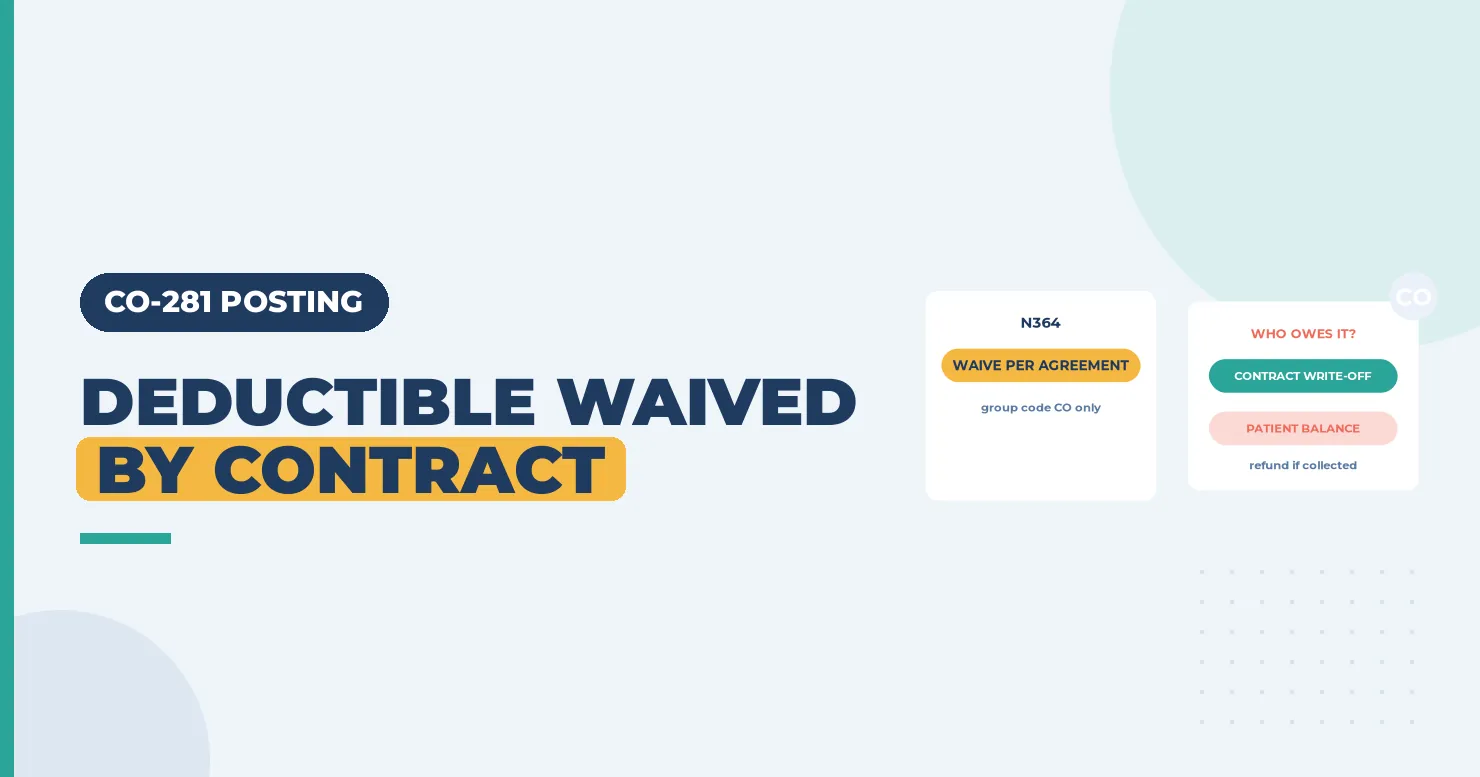
The CO-281 denial code means the payer waived the patient’s deductible because your contract says so. That amount is not paid by the plan, and it is not billed to the patient. The fix is mostly about posting: write it off as a contractual adjustment and check that the waiver really applies. (Primary source: X12 Claim Adjustment Reason Codes)
In brief: CARC 281 is a write-off code, not a true denial. X12 allows it only with group code CO. If your system moves the amount to the patient, the patient gets a bill they do not owe.
Part of our denial codes library. Written by Manikandan J, CPC, CRCR, who has posted and audited contract adjustments for primary care groups and employer clinic programs. Published 11 November 2026. Last updated: 11 November 2026. Code wording quoted word for word from X12. Read about the author and our editorial policy, or contact us to report an error.
What does denial code CO-281 mean?
Denial code CO-281 means a deductible that would normally fall on the patient was waived under your payer agreement. The plan applies the waiver and reports the amount as a contractual adjustment. You absorb it, and the patient owes nothing for it.
| Field | Value |
|---|---|
| Code | 281 |
| Description | “Deductible waived per contractual agreement. Use only with Group Code CO.” |
| Group code | CO only, per X12 |
| Start | 07/01/2017 |
Source: X12 Claim Adjustment Reason Codes, checked 11 November 2026.
Key terms: A deductible is the amount a member pays before the plan starts paying (HealthCare.gov glossary). A contractual waiver is a payer agreement term that removes it for certain services. CO means contractual obligation, so the provider owns the balance.
Methodology: the code wording is copied from the X12 list, and the posting steps follow how the 835 reports CAS adjustments.
CO-281 vs OA-281: what is the difference?
CO-281 is the only valid version. X12 says to use CARC 281 only with group code CO, because the waiver comes from your contract. If you see OA-281, the payer used the wrong group code. Post it as a contractual write-off, then ask the payer to correct its remit mapping.
| Version | Is it valid? | What to do |
|---|---|---|
| CO-281 | Yes, the X12 group for this code | Write off the amount; do not bill the patient |
| OA-281 | No, X12 limits 281 to CO | Treat as contractual; report the remit error |
| PR-281 | No, a waived deductible is never patient owed | Do not bill; call provider services |
A waived deductible cannot be patient responsibility at the same time. So any PR pairing is a payer error.
Why do payers waive the deductible by contract?
Payers waive the deductible by contract to steer members to certain providers or services. For example, an employer plan may waive it at an on-site clinic. A value-based or tiered network deal may waive it for preferred providers. The waiver lives in your contract, not in the patient’s choice.
Do not confuse this with waiving a deductible on your own. A routine waiver outside the contract can break payer terms. The payer must apply the waiver; you only post it. Many payers also send N364, “Alert: According to our agreement, you must waive the deductible and/or coinsurance amounts.”
Example scenario (fictional names), part 1
CO-281 Denial Example: What Happened
Tomás Reyes posts payments for Cedar Hill Family Medicine. The practice runs a clinic for a local employer under a fictional commercial plan contract. That contract waives the deductible for office visits at the clinic.
- Billed: 99214 for a follow-up visit, with E11.9 entered as E119.
- 835 result:
CAS*CO*281on the deductible portion, plus N364. - What the system did: the posting rule mapped every deductible amount to the patient.
A week later the patient called about a statement for the visit.
Was the statement right, and who owed the amount? Keep reading, or jump to how it was resolved. Keep reading, or jump to how the CO-281 denial was resolved.
How do I post and fix a CO-281 adjustment?
To post a CO-281 adjustment, write the amount off to a contractual adjustment code, not to patient balance. Then confirm the waiver in your contract covers details such as the service and location. If the payer waived it wrongly, or skipped a waiver it owed, dispute the payment with the contract terms.
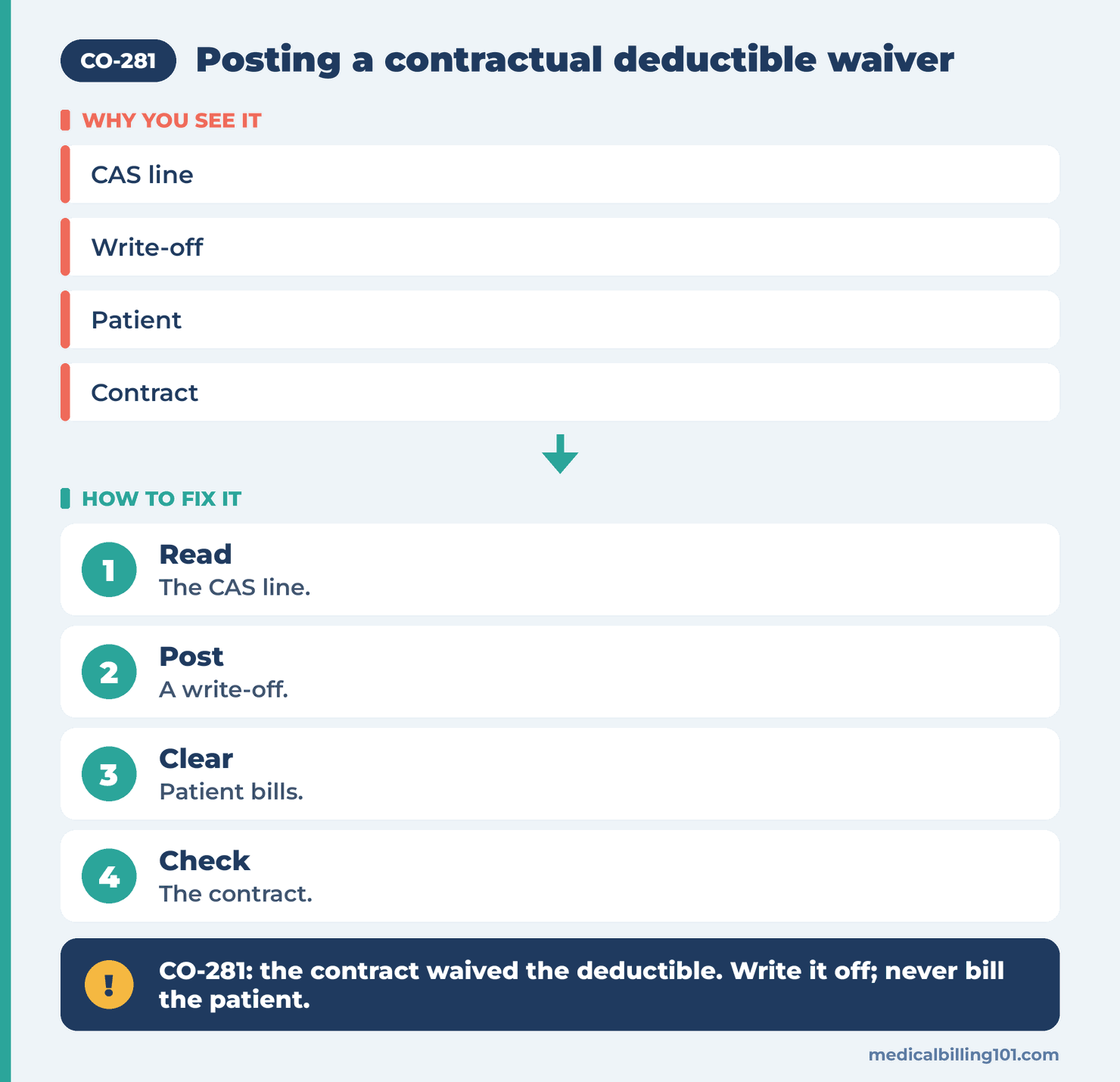
- Read the CAS segment. Confirm the group is CO and the reason is 281.
- Map it to a write-off. Use a contract adjustment code in your system.
- Clear patient balances. Cancel statements and refund any amount you collected.
- Check the contract. Make sure the service and site qualify for the waiver.
- Fix the posting rule. Stop mapping every deductible amount to the patient.
Example scenario (fictional names), part 2
How the CO-281 Denial Was Resolved
Tomás opened the 835 and saw the group code. It was CO, not PR. The reason was CARC 281, and N364 confirmed the contract waiver.
Fix: he reversed the patient charge and posted the amount to the contract write-off code. The patient had already paid, so the practice refunded the payment and voided the statement.
Outcome: the patient account showed a zero balance. Tomás changed the posting rule so CO-281 lines can never move to patient responsibility.
Names and details are illustrative; no real patient data.
Names and details are illustrative; no real patient data.
Can a CO-281 adjustment be wrong?
Yes, a CO-281 adjustment can be wrong when the payer applies a waiver your contract does not include. Then the plan has cut its payment and left you with a write-off you never agreed to. Compare the service, place of service and date with the contract’s waiver terms.
If the waiver does not apply, send a payment dispute with the contract section attached. Ask the payer to reprocess with the deductible assigned correctly. The appeal letter generator can help you draft the dispute.
Can I bill the patient for CO-281?
No, you cannot bill the patient for a CO-281 amount. The deductible was waived under your contract, and CO puts the amount on you. If you already collected it, refund the patient. Billing a waived deductible can also breach your payer agreement.
Related codes
| Code | Meaning |
|---|---|
| CO-1 | Deductible amount |
| CO-45 | Charge exceeds the fee schedule or contracted amount |
| PR-2 | Coinsurance amount owed by the patient |
| CO-3 | Co-payment amount |
FAQ
What does CO-281 mean?
The patient’s deductible was waived under your payer contract, so you write it off.
Is CO-281 a denial?
Not really. It is a contractual adjustment that lowers what anyone pays for that amount.
Can CARC 281 be used with PR or OA?
No. X12 says to use CARC 281 only with group code CO.
What should I do with N364?
Treat it as confirmation that your agreement requires waiving the deductible or coinsurance.
Does the patient owe a CO-281 amount?
No. Refund it if the patient already paid.
Sources
How we checked: the CARC 281 quote and its group rule were matched word for word with the X12 CARC list on 11 November 2026, and N364 with the X12 RARC list.
- X12, Claim Adjustment Reason Codes (CARC 281, 1, 45). Accessed 11 Nov 2026.
- X12, Remittance Advice Remark Codes (N364). Accessed 11 Nov 2026.
- X12, Claim Adjustment Group Codes. Accessed 11 Nov 2026.
- HealthCare.gov, deductible definition. Accessed 11 Nov 2026.
- CMS, Remittance Advice overview. Accessed 11 Nov 2026.
Last updated: 11 November 2026 · Educational content; not legal advice.
Related denial codes
- CO-1: Deductible Amount (When the Group Code Is CO)
- CO-45: Charge Exceeds Fee Schedule or Contracted Amount
- CO-2: Coinsurance Amount (When the Group Code Is CO)
- CO-3: Co-payment Amount (When the Group Code Is CO)
- PR-2: Coinsurance Amount (Patient Responsibility)
- CO-256: Service Not Payable Per Contract
- CO-253: Sequestration Reduction in Federal Payment
- CO-278: Performance Program Proficiency Not Met