
The CO-285 denial code means the payer did not review your appeal because you skipped a required step. The original denial still stands, and nobody looked at the merits. The fix is to read the payer’s appeal rules, rebuild the request with every required piece, and refile it at the right level before the deadline. (Primary source: X12 Claim Adjustment Reason Codes)
In brief: CARC 285 is a process rejection, not a clinical decision. Common triggers are a wrong address, a missing payer form, a skipped appeal level, or no claim reference. With CO, you cannot bill the patient while you fix the appeal.
Part of our denial codes library. Written by Manikandan J, CPC, CRCR, who has rebuilt rejected appeals for cardiology and multi-specialty practices. Published 11 November 2026. Last updated: 11 November 2026. Code wording quoted word for word from X12. Read about the author and our editorial policy, or contact us to report an error.
What does denial code CO-285 mean?
Denial code CO-285 means your appeal reached the payer, but it did not meet the payer’s appeal procedure. So the payer closed it without a decision on the service. The first denial, such as a medical necessity denial, is still in place.
| Field | Value |
|---|---|
| Code | 285 |
| Description | “Appeal procedures not followed” |
| Group codes | No X12 group restriction; CO is the most common |
| Start | 11/01/2017 |
Source: X12 Claim Adjustment Reason Codes, checked 11 November 2026.
Key terms: An appeal is a written request asking the payer to review its claim decision again. An appeal level is one step in the payer’s review chain, such as a first-level review before a second level. CO means contractual obligation, so the provider owns the balance.
Methodology: the code wording is copied from the X12 list, and the appeal filing rules come from the eCFR pages cited below.
CO-285 vs OA-285: what is the difference?
CO-285 means a contracted payer rejected the appeal under the dispute rules in your agreement. OA-285 reports the same process failure without a contract basis, for example on an out-of-network appeal. In both cases the claim is still denied, and the next move is a clean refiling.
| Version | Whose rules you missed | Where to look |
|---|---|---|
| CO-285 | The appeal or dispute process in your payer contract | Provider manual and contract dispute section |
| OA-285 | The payer’s general appeal process, no contract named | Plan appeal page and the notice on the denial |
CO-285 is also different from CO-286. CARC 286 means you missed the appeal deadline, while CARC 285 means you missed a step.
Why do payers reject an appeal for procedure?
Payers reject an appeal for procedure when the request is missing something their process requires. For example, Medicare says a redetermination request goes to the contractor named on the notice. It must also be in writing and name the patient, the Medicare number, the service and the date (42 CFR 405.944).
Commercial plans set similar rules in the provider manual. Typical misses are sending a corrected claim when the plan wanted an appeal, or the reverse. Employer plans must keep reasonable claims procedures under 29 CFR 2560.503-1. Many payers add N1, “You may appeal this decision in writing within the required time limits.”
Example scenario (fictional names), part 1
CO-285 Denial Example: What Happened
Marcus Hale works denials for Harborview Cardiology. A fictional commercial plan denied an echocardiogram, 93306, for medical necessity. The patient had shortness of breath, R06.02, entered as R0602.
Marcus wrote a strong letter with the cardiologist’s notes. He mailed it to the claims address on the remittance, without the plan’s provider appeal form.
Six weeks later the plan’s response came back with CAS*CO*285 and N1. Nobody had reviewed the notes.
Was the letter the problem, or the way it was sent? Keep reading, or jump to how it was resolved. Keep reading, or jump to how the CO-285 denial was resolved.
How do I fix a CO-285 denial?
To fix a CO-285 denial, find out which step you missed. Read the payer’s rejection letter and the appeal section of the provider manual. Then refile with the right form, the right address or portal, and the claim reference, at the correct appeal level. Track the deadline from the original denial.
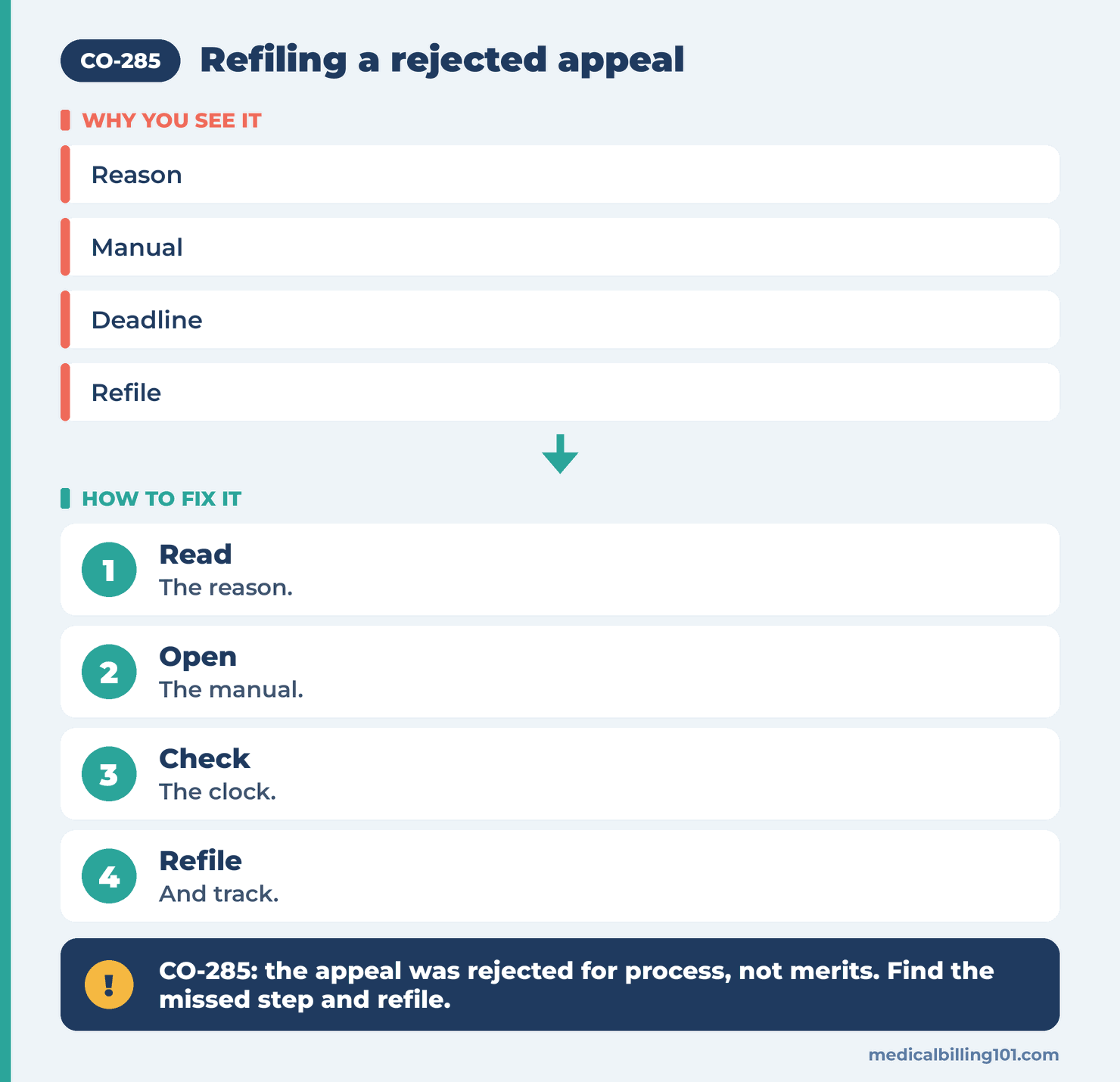
- Read the rejection reason. The letter often names the missing step.
- Open the provider manual. Note the form, address or portal and level.
- Check the clock. Count the days left from the original denial date.
- Rebuild the packet. Include the form, claim number, records and a short letter.
- Refile and track. Keep proof of delivery and follow up on time.
Example scenario (fictional names), part 2
How the CO-285 Denial Was Resolved
Marcus called provider services and read the manual. The plan required its provider appeal form and accepted appeals only through the portal or an appeals P.O. box. The claims address did not route to appeals.
Fix: he filled out the appeal form with the claim number and attached the same notes and letter. He uploaded the packet through the portal well inside the appeal window and saved the confirmation number.
Outcome: the plan reviewed the merits this time and overturned the 93306 denial. Marcus added the appeal form and portal link to the practice’s payer grid.
Names and details are illustrative; no real patient data.
Names and details are illustrative; no real patient data.
Does a CO-285 rejection stop the appeal clock?
No, a CO-285 rejection usually does not stop the appeal clock. Most payers count the deadline from the original denial, not from the rejection. So a rejected appeal can eat most of your window. Refile as soon as you know the missing step.
If time has already run out, the next response may be CARC 286, appeal time limits not met. Ask the payer whether it accepts good cause for a late refiling. The appeal letter generator can help you rebuild the letter fast.
Can I bill the patient for CO-285?
No, you cannot bill the patient for a CO-285 amount. CO means your contract keeps the denied amount on you. The appeal failed on process, so the service has not been judged. Refile the appeal instead of moving the balance to the patient.
Related codes
| Code | Meaning |
|---|---|
| CO-50 | Not deemed a medical necessity by the payer |
| CO-29 | The time limit for filing has expired |
| CO-16 | Claim lacks information needed for adjudication |
| CO-252 | An attachment or other documentation is required |
FAQ
What does CO-285 mean?
The payer rejected your appeal because its appeal procedure was not followed.
Did the payer review my records?
Usually not. A CARC 285 rejection closes the appeal before the merits are reviewed.
What is the difference between CO-285 and CO-286?
CO-285 means a missed step. CO-286 means the appeal arrived after the time limit.
Can I resend the same appeal letter?
Yes, if the content was sound. Add the missing form, claim reference or routing first.
Does the patient owe a CO-285 amount?
No. CO keeps the amount on the provider under the contract.
Sources
How we checked: the CARC 285 and 286 wording was matched word for word with the X12 CARC list on 11 November 2026, and N1 with the X12 RARC list.
- X12, Claim Adjustment Reason Codes (CARC 285, 286). Accessed 11 Nov 2026.
- X12, Remittance Advice Remark Codes (N1). Accessed 11 Nov 2026.
- eCFR, 42 CFR 405.944 (filing a Medicare redetermination). Accessed 11 Nov 2026.
- eCFR, 29 CFR 2560.503-1 (ERISA claims procedure). Accessed 11 Nov 2026.
- CMS, Medicare appeals: first level redetermination. Accessed 11 Nov 2026.
Last updated: 11 November 2026 · Educational content; not legal advice.
Related denial codes
- CO-29: The Time Limit for Filing Has Expired
- CO-50: Not Deemed a Medical Necessity by the Payer
- CO-193: Original Payment Decision Maintained
- CO-216: Denied on Review Findings
- MA130: Unprocessable Claim, No Appeal Rights
- CO-252: An Attachment or Other Documentation Is Required
- CO-16: Claim Lacks Information or Has a Billing Error
- CO-164: Attachment or Documentation Not Received in a Timely Fashion