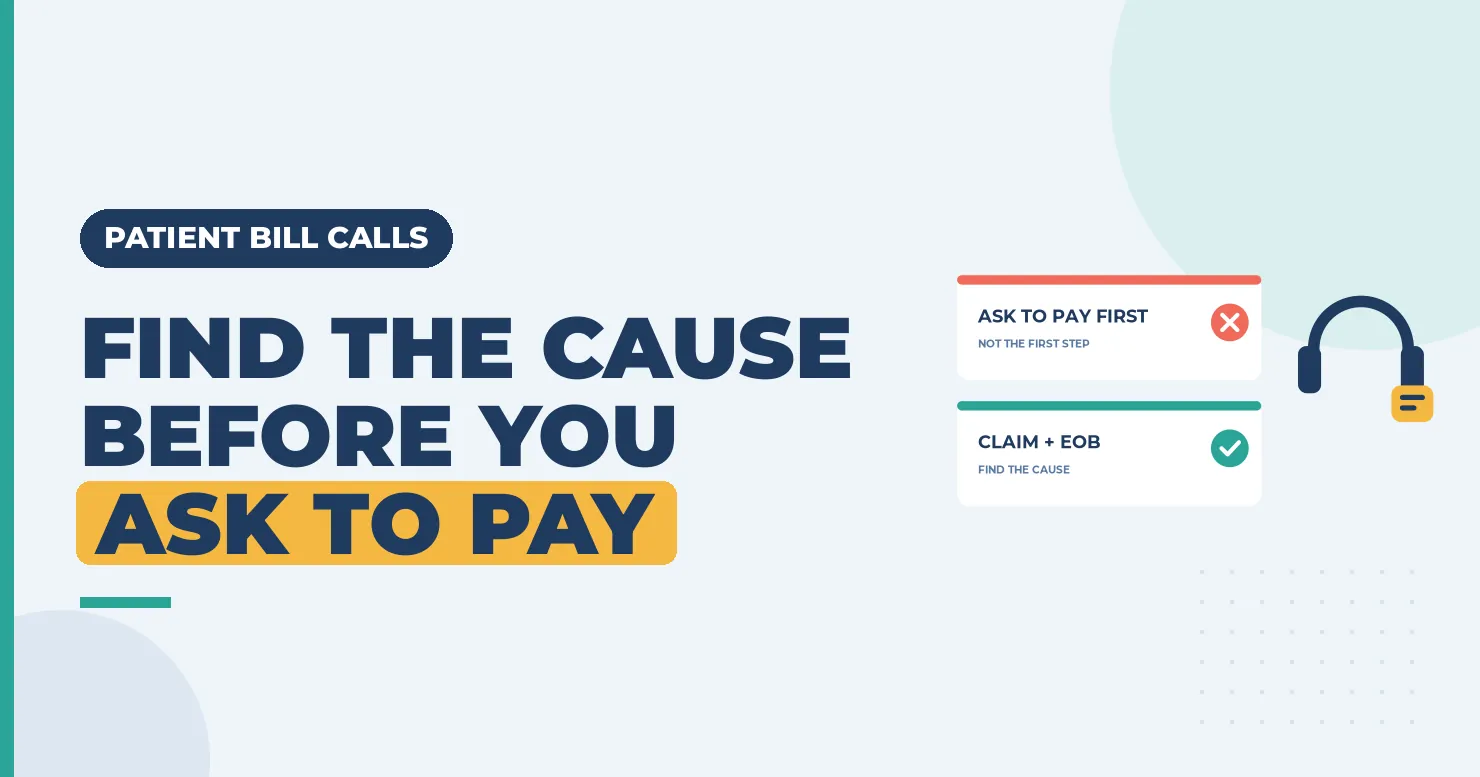
When a patient is upset about a medical bill, find the cause of the balance before you ask for payment. Listen first and verify identity. Then check the claim, the payer’s remittance and the patient’s coverage line by line.
The fix is usually a short call plan. Explain the balance in plain words, correct any billing error, and offer a payment plan or financial assistance when the balance is valid.
TL;DR: Most angry bill calls come from three causes: a surprise patient balance, a denial the patient never heard about, or an error. Pull the claim and the remittance before you defend the bill. Hold collections while you investigate. Know the No Surprises Act dispute rule for self-pay patients and the hospital financial assistance rules.
Written by Manikandan J, CPC, CRCR, a certified coder and revenue cycle specialist. Published 16 November 2026. Last updated: 16 November 2026.
Table of Contents
What should billing staff do first when a patient is upset about a bill?
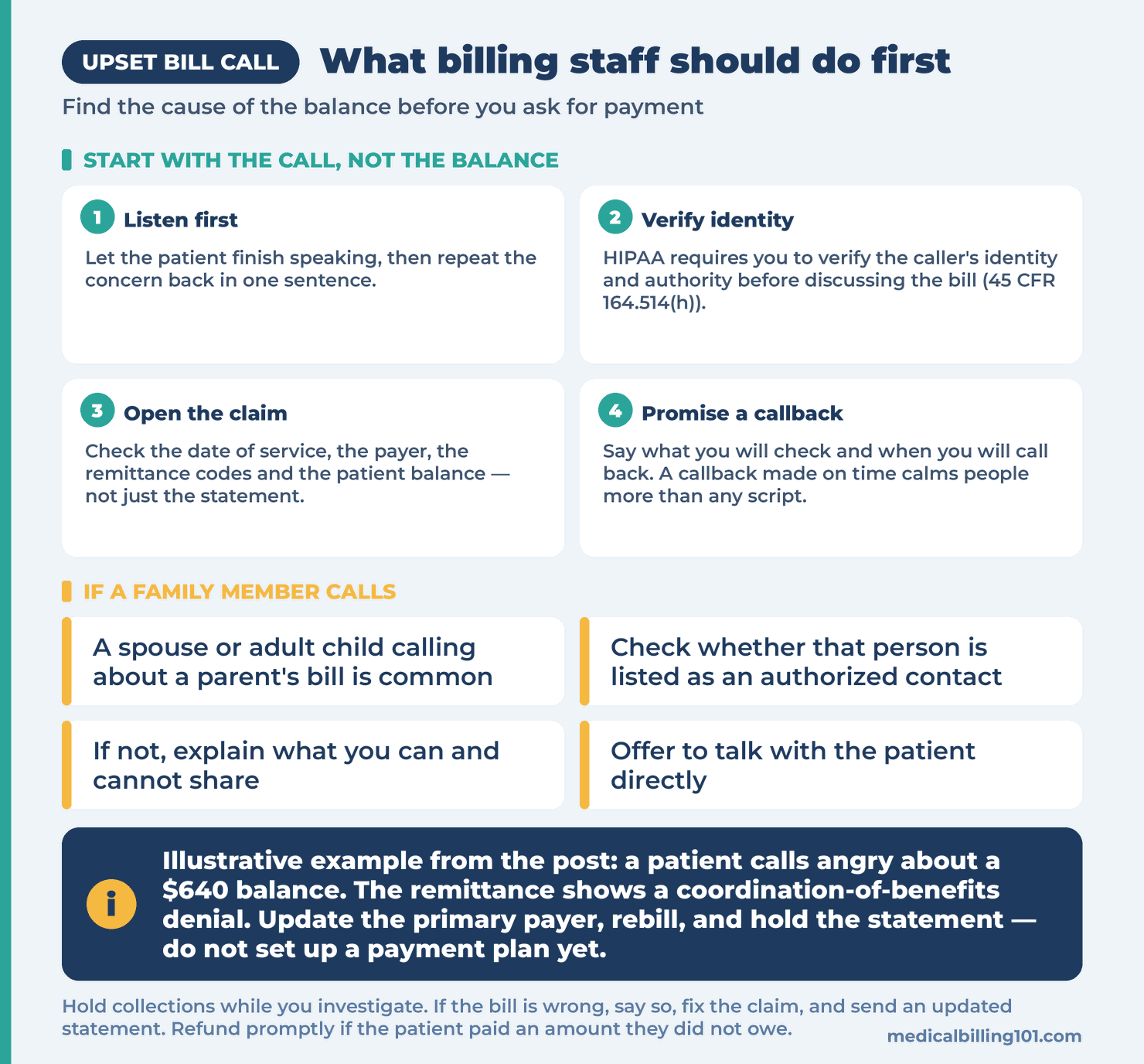
Let the patient finish speaking, then repeat the concern back in one sentence. Next, verify identity before you discuss any details. Then open the claim, not just the statement. You need the date of service, the payer, the remittance codes and the patient balance before you explain anything.
Identity checks are a legal step, not a nice extra. The HIPAA Privacy Rule requires a covered entity to verify a caller’s identity and authority before disclosing protected health information. The rule is in 45 CFR 164.514(h).
A spouse or adult child calling about a parent’s bill is common. Check whether that person is listed as an authorized contact. If not, explain what you can and cannot share, and offer to talk with the patient directly.
Keep your tone calm and clear. Say what you will check and when you will call back. A callback made on time calms people more than any script.
Why do patients get bills they did not expect?
Most unexpected balances come from deductibles, coinsurance, a denied claim, or a coverage problem. The patient often sees only a total, not the reason. Your task is to read the remittance and name the exact cause, such as a deductible or a non-covered service.
Start with the group code on the remittance. A PR adjustment means the payer assigned the amount to the patient. A CO adjustment means a contractual obligation, which the patient usually should not see on a statement. Our guide to PR-1, PR-2 and PR-3 explains deductible, coinsurance and copay balances.
| What the patient says | Likely cause | Where to check | Typical fix |
|---|---|---|---|
| “My insurance should have paid this.” | Deductible, coinsurance or copay | PR adjustments on the remittance | Explain the plan share using the EOB |
| “I was never told this wasn’t covered.” | Non-covered or medical necessity denial | Denial codes and ABN on file | Appeal, or review liability before billing |
| “I have two insurances.” | Coordination of benefits problem | Payer order and secondary claim | Update payer order and rebill |
| “This is way more than my estimate.” | Bill exceeds good faith estimate | Self-pay estimate on file | Review the charges; note dispute rights |
| “Why am I getting this now?” | Late reprocessing or recoupment | Claim history and payer notes | Explain the dates and send a new statement |
Then check the common billing causes:
- The contractual write-off was billed to the patient instead of adjusted (CO-45).
- The claim went to the wrong primary payer. See our answer on a claim denied for coordination of benefits.
- The plan does not cover the service, shown as PR-204.
- The bill arrived late because the claim was reworked. Our guide on a medical bill months later covers that case.
In my years on AR calls, many patient balances I reviewed traced back to a missing secondary payer, not the patient’s plan.
How do you explain a medical bill to an upset patient?
Explain the bill in three parts: what was billed, what the insurance paid or adjusted, and what remains with the reason. Use the patient’s own explanation of benefits as the shared document. Avoid codes and jargon unless the patient asks for them. For example, say the plan applied the amount to the deductible.
Ask the patient to hold their EOB during the call. Walk through each line together. Our guide on how to read an explanation of benefits uses the same order a biller should follow.
Offer an itemized statement when the patient questions charges. For Medicare items and services, federal law lets a beneficiary request an itemized statement in writing. The provider must furnish it within 30 days, under 42 U.S.C. 1395b-7.
Use plain words. Say “your plan’s deductible” instead of “PR-1”. Say “the insurance company needs a corrected claim” instead of “CO-16 with a RARC”. Plain words show the patient that you are on their side.
What if the bill is wrong?
If the bill is wrong, say so, put the account on hold, and fix the claim. Common fixes are a corrected claim, a resubmission to the right payer, or a write-off of an amount the contract does not allow. Then send the patient an updated statement.
Note the call, the cause and the fix on the account. Tell the patient the expected timeline for the payer to reprocess. A corrected claim usually takes a new payer review, so set a follow-up date.
Check the ABN for Original Medicare medical necessity denials. CMS says the Advance Beneficiary Notice is issued to transfer potential financial liability to the patient. If no valid ABN is on file, review the claim before you bill the patient.
If the patient already paid an amount they did not owe, refund it promptly. A fast refund ends many complaints.
What if the bill is higher than the good faith estimate?
For uninsured or self-pay patients, the No Surprises Act gives a dispute right. A good faith estimate is the written cost estimate a provider gives these patients before care. If a provider’s billed charges are at least $400 more than that provider’s good faith estimate, the patient can start patient-provider dispute resolution. The patient must start it within 120 calendar days of the first bill.
Patient-provider dispute resolution is the federal process where a third party reviews the bill. The rule is 45 CFR 149.620. While a dispute is pending, the provider must not send the disputed bill to collections or threaten to. The provider must also suspend late fees until the process ends.
The CMS dispute-a-bill page lists a $25 non-refundable administrative fee for the patient. If the patient wins, CMS says the fee is deducted from the amount owed.
Good faith estimates have deadlines too. Under 45 CFR 149.610, a service scheduled at least 3 business days ahead needs an estimate within 1 business day of scheduling. A service scheduled at least 10 business days ahead needs one within 3 business days. A requested estimate is due within 3 business days. Our patient cost estimator helps staff prepare these numbers.
What can you offer a patient who cannot pay the bill?
Financial assistance is a free or discounted care program, often called charity care. Offer a payment plan, a prompt-pay or self-pay discount if your policy allows one, and a financial assistance screening. Nonprofit hospitals must follow federal financial assistance rules before they use extraordinary collection actions. Write the agreed plan down and send a copy to the patient.
For tax-exempt hospitals, 26 CFR 1.501(r)-6 sets the notice periods. The hospital must generally wait at least 120 days from the first post-discharge statement before most extraordinary collection actions. It must also give written notice at least 30 days before the first one.
The same rule sets the application deadline. It can be no earlier than the later of 30 days after that written notice or 240 days after the first post-discharge statement.
Patients also worry about credit reports. Equifax, Experian and TransUnion stopped reporting paid medical collections and now wait one year before reporting unpaid ones. They also removed medical collections under $500, per the credit bureaus’ April 2023 announcement. Some states add stricter limits.
When should a billing complaint be escalated?
Escalate when the patient disputes a valid balance after your explanation, asks for a supervisor, mentions a lawyer or regulator, or raises a privacy concern. Also escalate any bill that is already with a collection agency. A supervisor can approve adjustments and recall accounts.
Recall the account from collections while the dispute is open, if your policy allows it. Patients can read our patient guide on how to dispute a medical bill in collections.
Out-of-network surprise bills need a separate review. Many emergency bills, and some bills from out-of-network doctors at in-network hospitals, are protected from balance billing.
Here is an illustrative example. A patient calls angry about a $640 balance. The remittance shows the payer denied for coordination of benefits. The fix is to update the primary payer, rebill, and hold the statement, not to set up a payment plan.
3-step checklist
- Listen, verify identity, and pull the claim, remittance and EOB before explaining the balance.
- Name the cause in plain words, then fix errors, hold collections, and send an updated statement.
- For valid balances, offer a payment plan or financial assistance, and note any dispute rights and deadlines.
FAQ
Should billing staff send an upset patient’s bill to collections?
Not while you are still checking a dispute. Hold the account, find the cause, and fix any error first. For self-pay patients in a No Surprises Act dispute, 45 CFR 149.620 bars collections on the disputed bill.
Can a patient dispute a bill that is higher than the good faith estimate?
Yes, if they were uninsured or self-pay and the bill is at least $400 more than that provider’s estimate. They must start the dispute within 120 calendar days of the first bill and pay a $25 fee.
Can a Medicare patient ask for an itemized bill?
Yes. Under 42 U.S.C. 1395b-7, a Medicare beneficiary can request an itemized statement in writing. The provider must furnish it within 30 days of the request.
Can I discuss a patient’s bill with a family member?
Only after you verify the caller’s identity and authority. The HIPAA Privacy Rule at 45 CFR 164.514(h) requires that check before disclosing protected health information.
Will an unpaid medical bill hurt the patient’s credit?
Equifax, Experian and TransUnion wait one year before reporting unpaid medical collections. They do not report paid medical collections or medical collections under $500. Some states add stricter limits.
Sources
My methodology was simple. I checked the federal No Surprises Act rules, the CMS dispute page, the HIPAA verification rule, the Medicare itemized statement law, the IRS 501(r) rules and the credit bureaus’ announcement. Payer and state rules differ, so confirm details locally.
- eCFR, 45 CFR 149.620 Patient-provider dispute resolution (linked above). Accessed 16 Nov 2026.
- eCFR, 45 CFR 149.610 Good faith estimates for uninsured or self-pay individuals (linked above). Accessed 16 Nov 2026.
- CMS, Dispute a medical bill (linked above). Accessed 16 Nov 2026.
- eCFR, 45 CFR 164.514(h) HIPAA verification requirements (linked above). Accessed 16 Nov 2026.
- 42 U.S.C. 1395b-7, Itemized statement for Medicare items and services (linked above). Accessed 16 Nov 2026.
- eCFR, 26 CFR 1.501(r)-6 Billing and collection (linked above). Accessed 16 Nov 2026.
- CMS, Advance Beneficiary Notice of Non-coverage (linked above). Accessed 16 Nov 2026.
- Equifax, Experian and TransUnion, joint announcement on medical collections under $500, 11 April 2023 (linked above). Accessed 16 Nov 2026.
- CFPB, Have medical debt? Anything already paid or under $500 should no longer be on your credit report. Accessed 16 Nov 2026.
Read about the author, or contact us with a question. See our editorial policy.
Last updated: 16 November 2026 · Educational content for U.S. billers. Check each payer’s and state’s current rules.