
The modifier 62 co-surgeon rule is simple. Both surgeons bill the same codes and add 62 to every line they shared. That includes add-on codes such as 22860 when both surgeons worked on that second level.
So if the vascular co-surgeon’s biller puts 62 on 22857 only, the claims no longer match. The fix is to compare both operative notes, agree on one code set, and send corrected claims.
TL;DR: Modifier 62 means two surgeons of different specialties each did a distinct part of one procedure. Each surgeon reports the same CPT code with 62, plus 62 on any add-on code they performed together. Medicare pays each co-surgeon 62.5 percent of the fee schedule amount. If only one surgeon did the add-on work, that surgeon bills the add-on without 62.
Written by Manikandan J, CPC, CRCR, a certified coder and revenue cycle specialist. Published 17 November 2026. Last updated: 17 November 2026.
Table of Contents
Does modifier 62 go on the add-on code too?
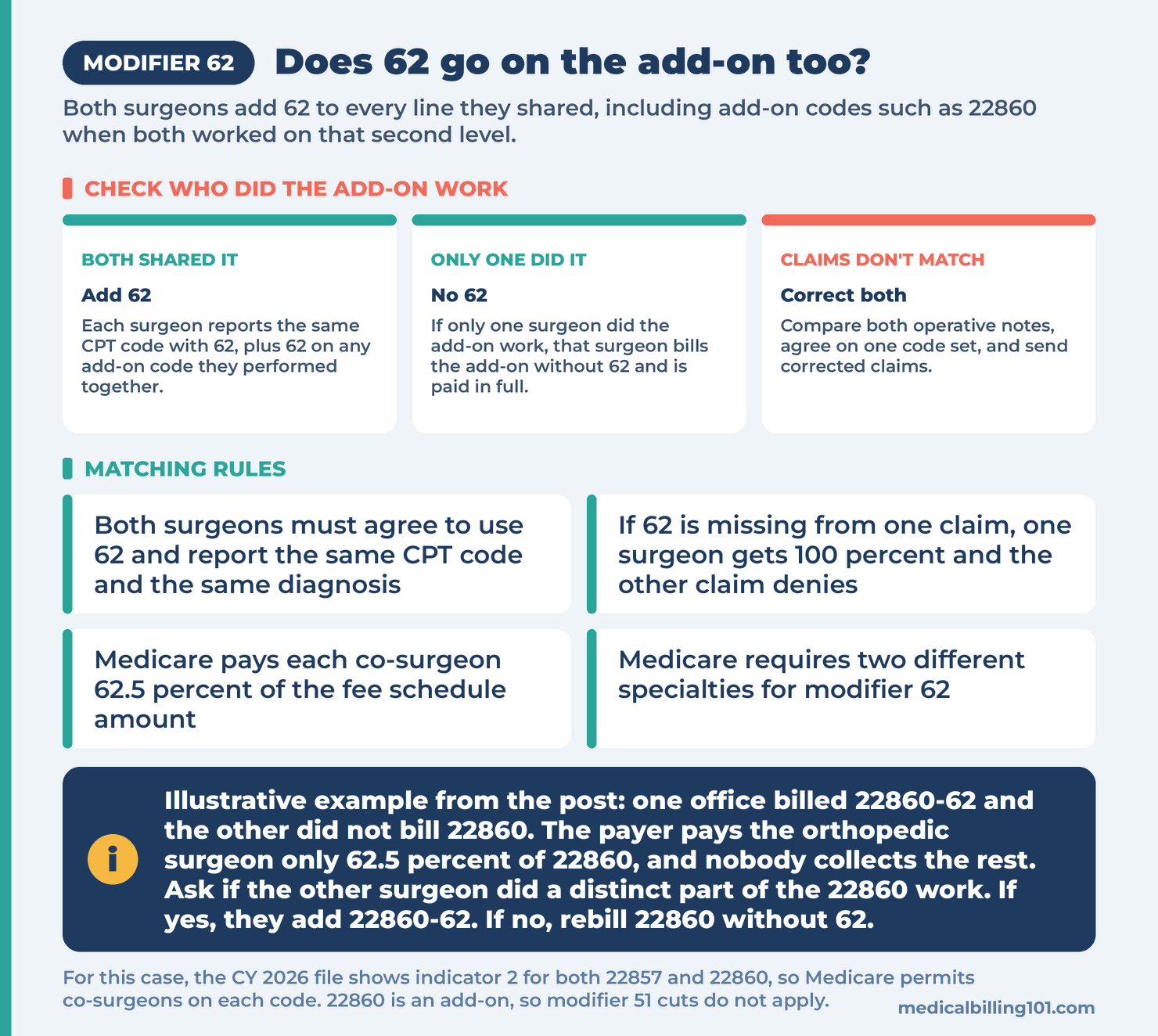
Yes, when both surgeons stay primary surgeons for the add-on work. The CPT definition of modifier 62 tells each surgeon to add 62 to the procedure code and any associated add-on codes. That holds as long as both continue working together as primary surgeons.
Novitas, a Medicare contractor, repeats this wording on its surgical modifiers page. So the coder who wrote 22857-62 and 22860-62 read the rule correctly. That is true only if the vascular surgeon also worked on the second interspace.
The add-on rule cuts both ways. If the vascular surgeon exposed only the first level, the orthopedic surgeon did the second level alone. Then 22860 is not co-surgery. The orthopedic surgeon bills 22860 with no 62 and is paid in full.
What is modifier 62 and when does it apply?
Modifier 62 is the two surgeons modifier. It applies when one procedure needs the skills of two surgeons, each in a different specialty. Each surgeon does a distinct part of the same CPT code in the same session. Neither surgeon is acting as an assistant.
Chapter 12, section 40.8 of the Medicare Claims Processing Manual sets the Medicare rules. Each surgeon bills the procedure with 62. Each is paid the lower of the charge or 62.5 percent of the global fee schedule amount. Global surgery rules apply to both surgeons.
Section 40.8 also draws a clear line. If surgeons of different specialties each perform a different procedure with its own CPT code, neither co-surgery nor multiple surgery rules apply. That is true even through the same incision. In that case, each surgeon bills only his or her own code with no 62.
How do you check if a code allows co-surgeons?
Check the co-surgeon indicator in the Medicare Physician Fee Schedule file. CMS lists it in the “CO-SURG” column of the RVU file. The indicator tells you whether Medicare will pay two surgeons for that code.
| Indicator | Meaning | What happens with 62 |
|---|---|---|
| 0 | Co-surgeons not permitted. | First claim pays up to 100 percent; the second claim denies. |
| 1 | Co-surgeons may be paid with documentation. | Claim suspends for review of the operative notes. |
| 2 | Co-surgeons permitted. | No documentation needed if the two specialties differ. |
| 9 | Concept does not apply. | Do not use 62. |
For this case, the CY 2026 file shows indicator 2 for both 22857 and 22860. So Medicare permits co-surgeons on each code without extra documentation. You can look up any code in our RVU calculator.
How should co-surgeons bill 22857 and 22860?
CPT 22857 is total disc arthroplasty with an anterior approach, single interspace, lumbar. CPT 22860 is the add-on code for the second lumbar interspace. Both co-surgeons should report the identical combination of codes and modifiers when they shared both levels.
| Who did the work | Orthopedic surgeon bills | Vascular surgeon bills |
|---|---|---|
| Both surgeons worked on both levels. | 22857-62, 22860-62 | 22857-62, 22860-62 |
| Both shared level one; ortho did level two alone. | 22857-62, 22860 | 22857-62 only |
The thread’s problem is a third, mixed version. One office billed 22860-62 and the other did not bill 22860. The payer then pays the orthopedic surgeon only 62.5 percent of 22860. Nobody collects the rest. That is the underpayment.
Noridian’s modifier 62 page lists the matching rules. Both surgeons must agree to use 62. Both must use the same CPT code and the same diagnosis. If 62 is missing from one claim, one surgeon gets 100 percent and the other claim denies.
How much does Medicare pay for modifier 62?
Medicare pays each co-surgeon 62.5 percent of the fee schedule amount. Together the two surgeons receive 125 percent of the single-surgeon fee. 22860 is an add-on code with multiple procedure indicator 0, so modifier 51 cuts do not apply to it.
In 2026, 22857 carries 46.97 total RVUs. At the $33.4009 conversion factor, that is about $1,568.84 nationally. Each co-surgeon would get about $980.53 before locality adjustment.
22860 carries 10.31 total RVUs, about $344.36 nationally. With 62, each surgeon gets about $215.22. Without 62, a surgeon working alone gets the full $344.36. That gap is why the mismatch matters.
Lumbar disc replacement has its own Medicare limit. NCD 150.10 makes it non-covered for beneficiaries over 60. Most of these cases are commercial, so check the plan’s own policy.
Why do modifier 62 claims deny?
Modifier 62 claims deny mainly because the two surgeons’ claims do not match. Other causes are a code that does not allow co-surgeons, or two surgeons of the same specialty. Medicare uses CO-54 when it will not pay a co- or team surgeon.
- Mismatched codes or modifiers. One claim has 62 and the other does not. The second claim looks like a duplicate.
- Indicator 0 or 9. The code does not allow two surgeons, so only the first claim pays.
- Indicator 1 without notes. The claim suspends, then denies if the notes do not show why two surgeons were needed.
- Same specialty. Medicare requires two different specialties for 62.
Commercial plans can be stricter. For example, a Wellpoint commercial modifier 62 policy pays only indicator 2 codes, at 63 percent per surgeon. Pull each payer’s policy before you appeal.
In my AR work, I have seen co-surgery claims stall for weeks because one office added 62 and the other did not.
A missing modifier can also show as CO-4. Our guide to a 33361 modifier 62 denial for a missing or inconsistent modifier shows that remit in a TAVR case.
What if the other surgeon’s biller refuses to add 62?
Settle it with the operative notes, not with articles. Each surgeon should dictate a note that states his or her own role and names the other as co-surgeon. The two notes together should describe the full procedure for each code billed with 62.
Send the other billing company both notes for the second level. Ask one question: did their surgeon do a distinct part of the 22860 work? If yes, they add 22860-62. If no, your surgeon rebills 22860 without 62 and is paid at 100 percent. Either way, the underpayment ends.
Then send a corrected claim for your surgeon’s line. If the payer still underpays, appeal with both notes attached. Our appeal letter generator gives you a clean starting letter. Our answer on billing spine procedures at a third level shows how payers treat add-on levels.
3-step checklist
- Check the CO-SURG indicator for every code; use 62 only on codes with 1 or 2.
- Compare both operative notes and agree which codes each surgeon shared, including add-ons.
- Bill identical codes, modifiers and diagnoses with 62, or bill the add-on alone without 62, then correct any mismatch.
FAQ
Do co-surgeons put modifier 62 on add-on codes?
Yes, when both surgeons stay primary surgeons for the add-on work. CPT tells each surgeon to add 62 to the procedure code and any associated add-on codes. If only one surgeon did the add-on, that surgeon bills it without 62.
How much does Medicare pay each co-surgeon?
Medicare pays each co-surgeon the lower of the billed charge or 62.5 percent of the global fee schedule amount, per Medicare Claims Processing Manual Chapter 12, section 40.8.
Can two surgeons of the same specialty use modifier 62?
Not for Medicare. Medicare requires the two surgeons to be in different specialties. Some commercial payers have their own rules, so check the plan policy.
What happens if only one surgeon uses modifier 62?
The claims no longer match. Noridian says one surgeon may be paid at 100 percent and the other claim will deny. Both surgeons should send corrected claims with the same codes and modifiers.
What does co-surgeon indicator 2 mean?
Indicator 2 in the Medicare fee schedule file means co-surgeons are permitted. No documentation is required if the two-specialty requirement is met.
Sources
My methodology was simple. I checked the CMS claims manual, the 2026 Medicare fee schedule file, the lumbar disc NCD, two Medicare contractor modifier pages and one commercial payer policy. Commercial payers may differ, so confirm each payer’s current policy.
- CMS, Medicare Claims Processing Manual, Chapter 12, section 40.8 (linked above). Accessed 17 Nov 2026.
- CMS, PFS Relative Value Files, CY 2026 RVU26D, co-surgeon indicators and RVUs (CMS page). Accessed 17 Nov 2026.
- CMS, NCD 150.10 Lumbar Artificial Disc Replacement (linked above). Accessed 17 Nov 2026.
- Novitas Solutions JL, Surgical Modifiers, modifier 62 (linked above). Accessed 17 Nov 2026.
- Noridian JF Part B, Modifier 62 (linked above). Accessed 17 Nov 2026.
- Wellpoint Massachusetts, Commercial Reimbursement Policy C-21005, Modifier 62 (linked above). Accessed 17 Nov 2026.
Read about the author, or contact us with a question. See our editorial policy.
Last updated: 17 November 2026 · Educational content for U.S. billers. Check each payer’s current rules.