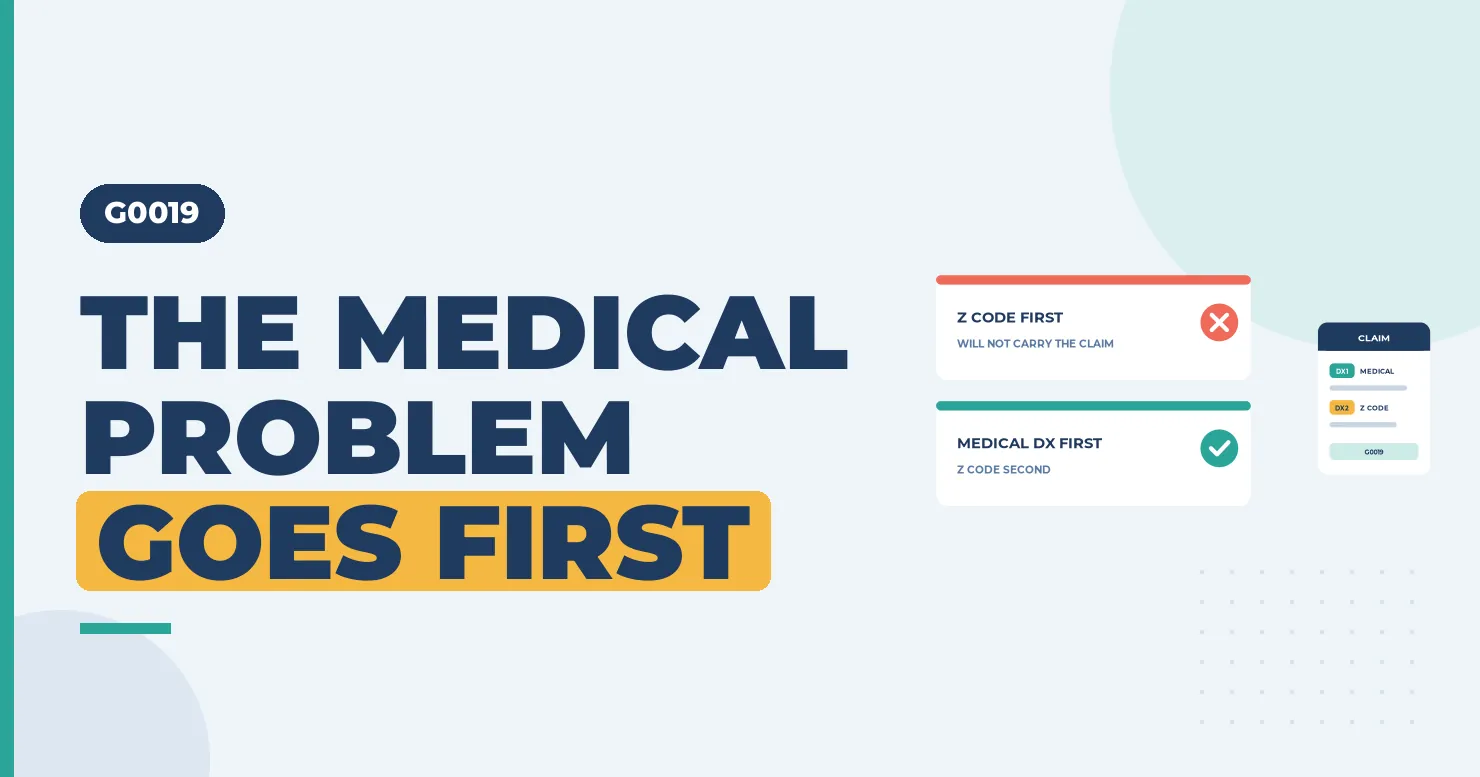
In G0019 diagnosis coding, the medical problem goes first. List the condition from the initiating visit, then add the SDOH Z code (Z55-Z65) as a secondary diagnosis. A Z code alone should not carry the claim.
The fix: point G0019 to the condition the social need is blocking, such as diabetes or heart failure. Then add the Z code for the need, such as Z59.41 for food insecurity.
TL;DR: CHI pays for help with social needs that block care of a medical problem. The medical problem goes first on the claim. ICD-10-CM rules say SDOH Z codes are reported only as secondary diagnoses. CMS encourages Z codes on the claim but does not require them.
Written by Manikandan J, CPC, CRCR, a certified coder and revenue cycle specialist. Published 20 November 2026. Last updated: 20 November 2026.
Table of Contents
What diagnosis code do you use with G0019?
Use the medical condition addressed in the CHI initiating visit as the first-listed diagnosis. Then add one or more SDOH Z codes for the social need. The medical code shows why the service is needed. The Z code shows what is getting in the way.
G0019 is community health integration (CHI) for the first 60 minutes per calendar month. CMS created it in the CY 2024 Physician Fee Schedule final rule (88 FR 78818). CHI covers SDOH needs that significantly limit the practitioner’s ability to diagnose or treat a problem. That problem is the one addressed in the initiating visit.
SDOH means social determinants of health. Examples are food, housing, transportation and utilities. Z55-Z65 is the ICD-10-CM code range for these social problems.
Example scenario (fictional names), part 1
G0019 diagnosis coding example: what happened
Tessa Langford codes for Mesa Verde Family Medicine, a fictional rural clinic. Dr. Rafael Ortiz saw a Medicare patient for type 2 diabetes with hyperglycemia. The patient said she skips meals at the end of each month. Dr. Ortiz charted food insecurity and started CHI services.
Next month, a community health worker spent 95 minutes linking her to food help and meal planning. The draft claim listed G0019 and G0022 with only Z59.41 in the first diagnosis slot. The scrubber stopped it. Was the Z code wrong, or just in the wrong place?
What would you check first? Keep reading, or jump to how it was resolved.
Can you bill G0019 with only an SDOH Z code?
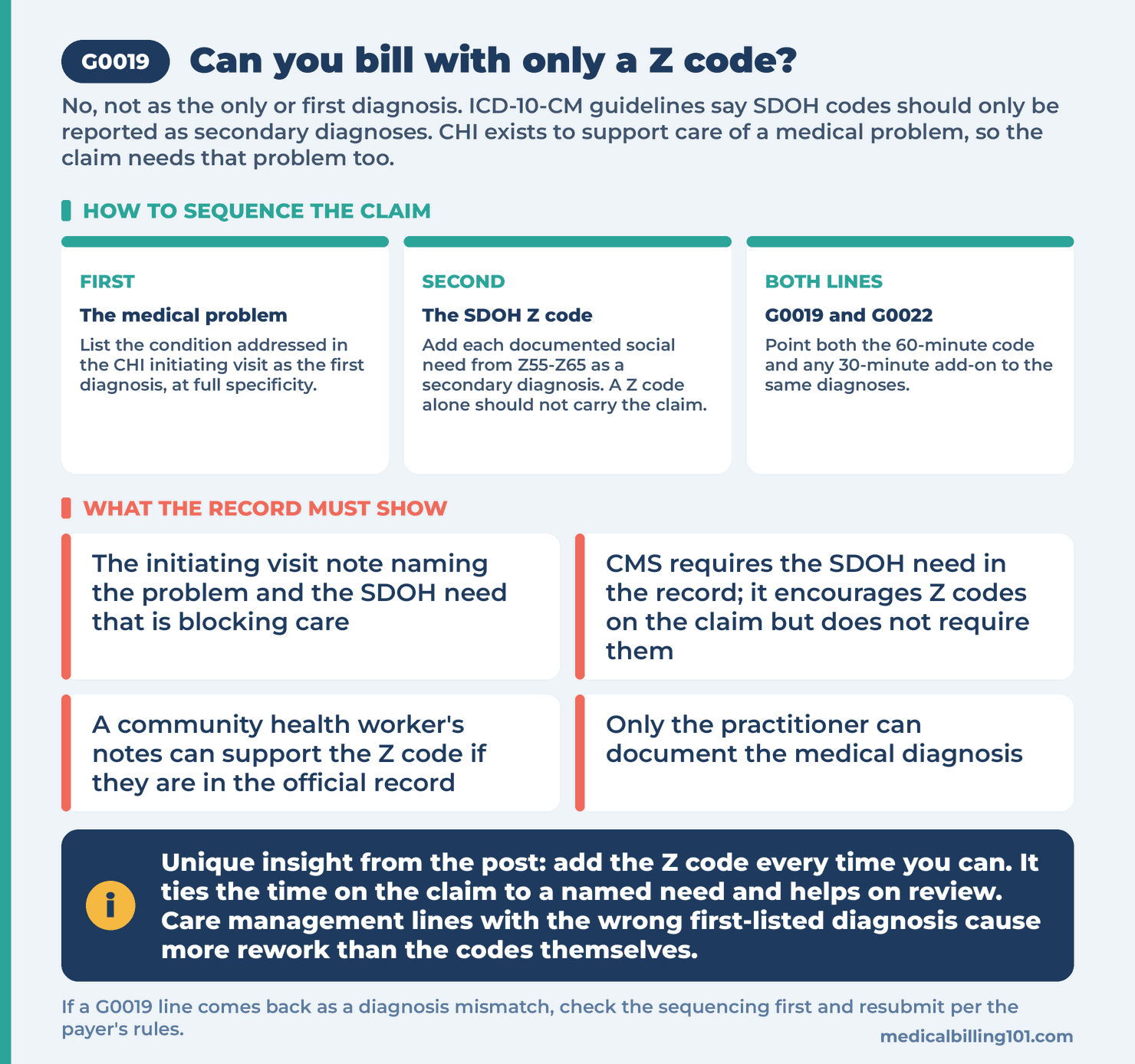
No, not as the only or first diagnosis. The ICD-10-CM guidelines say SDOH codes should only be reported as secondary diagnoses. CHI also exists to support care of a medical problem. So the claim needs that medical problem too.
This rule is in Section I.B.14 of the FY 2026 ICD-10-CM Official Guidelines for Coding and Reporting. Section I.C.21.c.17 adds that you should assign as many SDOH codes as needed. Each one must describe a social problem documented in the record.
If a payer returns the G0019 line as a diagnosis mismatch, check the sequencing first. Our CO-11 denial guide covers diagnosis and procedure mismatches.
Are SDOH Z codes required on a G0019 claim?
No. CMS requires the SDOH need to be documented in the medical record. It encourages, but does not require, the Z code in the record and on the claim. Medicare pays nothing extra for adding Z codes.
The CMS FAQ on CHI, PIN and related services confirms both points. Unmet upstream drivers must be documented and may be coded with Z55-Z65. Still, I add the Z code every time. It ties the time on the claim to a named need, which helps on review.
| Social need documented | Example Z code (secondary) |
|---|---|
| Food insecurity | Z59.41 |
| Homelessness | Z59.0- (Z59.00, Z59.01, Z59.02) |
| Inadequate housing | Z59.1- (for example Z59.10) |
| Problems related to health literacy | Z55.6 |
The CMS Office of Minority Health Z code resource lists the SDOH categories, Z55 through Z65. It also says to assign a Z code only when the record shows a related problem or risk.
What counts as the initiating visit for G0019?
The initiating visit is an E/M visit by the billing practitioner, other than a low-level visit done by clinical staff. A TCM visit or an annual wellness visit can also qualify. In that visit, the practitioner finds the SDOH need that limits diagnosis or treatment.
The CMS FAQ adds limits. ED and inpatient visits do not work if that practitioner will not furnish the CHI services. An AWV counts only when the practitioner who will bill CHI performs it. See our Medicare annual wellness visit answer for AWV documentation. Our E/M level calculator helps check the visit level.
You need the initiating visit only before CHI starts, not every month. The diagnosis from that visit is the one G0019 supports.
How do G0019 and G0022 work together?
G0019 covers the first 60 minutes of CHI per calendar month. G0022 is an add-on for each additional 30 minutes. Link both lines to the same diagnoses. Document the total time and what the staff did each month.
- Same practitioner: the practitioner who did the initiating visit bills CHI.
- One practitioner per month: only one practitioner may bill CHI for a patient in a calendar month.
- Consent: get advance consent once. Explain cost sharing and the one-practitioner rule.
- Supervision: auxiliary staff work incident to the practitioner under general supervision.
- Home health: CHI cannot be billed while the patient is under a Medicare home health plan of care.
General supervision for designated care management services comes from 42 CFR 410.26(b)(5). The usual Part B deductible and coinsurance apply. Our patient cost estimator helps explain that share at consent.
Can a community health worker’s notes support the Z code?
Yes. For SDOH codes, coders may use notes from community health workers, social workers, case managers or nurses. Those notes must be in the official medical record. Patient self-reported answers also count once a clinician signs off.
That comes from Section I.B.14 and I.C.21.c.17 of the ICD-10-CM guidelines. The medical diagnosis is different. It must come from the patient’s provider. So the CHW can support Z59.41, but only the practitioner can document the diabetes.
How do you fix a G0019 claim with the wrong diagnosis?
Move the medical condition to the first diagnosis position and keep the Z code as secondary. Point G0019 and G0022 to both. Then resubmit it the way your payer requires for that claim status.
- Read the initiating visit note: find the problem the SDOH need is blocking.
- Code that problem first: use the provider’s documented diagnosis, at full specificity.
- Add every documented SDOH need: code each one from Z55-Z65 as secondary.
- Check time and consent: confirm 60 minutes for G0019 and each additional 30 minutes for G0022.
- Resubmit: a rejected claim goes out as new. A processed claim needs a reopening, corrected claim or appeal, per payer rules.
A rejection for missing data is often CO-16. Our CO-16 denial guide covers that fix. For a denial you disagree with, use the Medicare appeal guide.
Example scenario (fictional names), part 2
How the G0019 diagnosis case was resolved
Tessa pulled the initiating visit note. Dr. Ortiz had linked the missed meals to the patient’s high blood sugar. So the Z code was right, but it was in the wrong slot.
She listed E11.65 first and Z59.41 second, and pointed both lines to both codes. She confirmed 95 minutes, which supports G0019 plus one unit of G0022. Consent with the cost-sharing talk was already in the chart. The claim passed the scrubber and went out clean.
Names and details are illustrative; no real patient data.
What is the difference between G0019 and principal illness navigation?
CHI (G0019) is built around unmet social needs that block care. Principal illness navigation (G0023) is built around one serious, high-risk condition. PIN patients may have social needs too, but PIN does not require one.
The CMS FAQ lists PIN examples such as cancer, COPD, heart failure, dementia and substance use disorder. For PIN, the serious condition drives the diagnosis. For CHI, the medical problem plus the SDOH Z code tells the story.
What documentation supports a G0019 claim?
The record must show the SDOH need, the time spent and what staff did. It should also tie that work to the practitioner’s plan of care. The billing practitioner must review and verify the notes, even if staff enter them.
- The initiating visit note naming the problem and the SDOH need.
- Documented consent, including the cost-sharing talk.
- Monthly minutes and activities, such as referrals and care coordination.
- Any new SDOH need the practitioner agrees is limiting care.
In my AR work, care management lines with the wrong first-listed diagnosis caused more rework than the codes themselves.
For more on what reviewers look for, read our medical necessity documentation guide. If the AWV and a problem visit happen the same day, see our modifier 25 answer.
3-step checklist
- List the medical problem from the initiating visit as the first diagnosis on G0019.
- Add each documented SDOH need as a secondary Z55-Z65 code.
- Confirm consent, monthly time and the same billing practitioner before you submit.
FAQ
What diagnosis supports G0019?
The medical problem addressed in the CHI initiating visit, listed first. Add SDOH Z codes from Z55-Z65 as secondary diagnoses.
Can G0019 be billed with only a Z code?
No. ICD-10-CM guidelines say SDOH codes should only be reported as secondary diagnoses, so a medical diagnosis must come first.
Does CMS require Z codes for CHI services?
No. CMS requires the SDOH need in the medical record and encourages Z codes on the claim, but does not require them.
Can an annual wellness visit start CHI services?
Yes, if the practitioner who will bill CHI performs the AWV and finds an unmet SDOH need that blocks the prevention plan.
How much time is needed for G0019 and G0022?
G0019 covers the first 60 minutes per calendar month. G0022 covers each additional 30 minutes in the same month.
Sources
My methodology was simple. I checked the CMS final rule, the CMS FAQ, the federal regulation and the official ICD-10-CM guidelines.
- Federal Register, CY 2024 Physician Fee Schedule final rule, 88 FR 78818, CHI section (linked above). Accessed 20 Nov 2026.
- CMS, FAQ on Caregiver Training, Community Health Integration and Principal Illness Navigation (linked above). Accessed 20 Nov 2026.
- CMS, ICD-10-CM Official Guidelines for Coding and Reporting FY 2026, Sections I.B.14 and I.C.21.c.17 (linked above). Accessed 20 Nov 2026.
- CMS Office of Minority Health, Improving the Collection of SDOH Data with ICD-10-CM Z Codes (linked above). Accessed 20 Nov 2026.
- eCFR, 42 CFR 410.26(b)(5) (linked above). Accessed 20 Nov 2026.
Read about the author, or contact us with a question. See our editorial policy.
Last updated: 20 November 2026 · Educational content for U.S. billers. Check each payer’s current rules.