
The CO-P15 denial code means a workers’ comp carrier reduced or denied a service because its bill review compared the care with the state’s medical treatment guideline and found it outside the limits. For example, a visit count over the limit is the classic trigger. Show that a different guideline applies, or that the extra care was approved, and the line can be paid. (Primary source: X12 Claim Adjustment Reason Codes)
In brief: reason code P15 ties a cut to a treatment guideline, not to a coding error. Find the guideline the carrier used, then check the claim data that led it there. Missing surgery details or a missing approval number are the usual culprits.
Part of our denial codes library. Written by Manikandan J, CPC, CRCR, who has worked visit-limit denials for therapy and spine practices treating injured workers. Published 23 November 2026. Last updated: 23 November 2026. Code wording quoted word for word from X12. Read about the author and our editorial policy, or contact us to report an error.
What does denial code CO-P15 mean?
Denial code CO-P15 says the line was cut under a workers’ comp treatment guideline. Many states use such guidelines to set how much care fits an injury, for example how many therapy visits or which scans. California calls its version the Medical Treatment Utilization Schedule (MTUS).
| Field | Value |
|---|---|
| Code | P15 |
| Description | “Workers’ Compensation Medical Treatment Guideline Adjustment. To be used for Workers’ Compensation only.” |
| Use | Workers’ compensation only |
| Group codes | No X12 group restriction; CO is the usual pairing |
| Start | 11/01/2013; replaces code W4 |
| Common remarks | N435 or N640 |
Source: X12 Claim Adjustment Reason Codes, checked 23 November 2026.
Methodology: the code wording is copied from the X12 list. The California visit rules come from Labor Code section 4604.5 and the DWC regulations cited below; other states use different guidelines.
Key terms: A treatment guideline is a state rule for how much care fits an injury. Utilization review (UR) is the carrier’s check of a treatment request before or during care. A request for authorization (RFA) is California’s form for asking the carrier to approve treatment.
CO-P15 vs OA-P15: how the group changes your options
A CO-P15 cut sits with your practice, and California comp law bars billing the injured worker for it. OA-P15 is uncommon; it may appear when the guideline cut is reported without assigning it to you, such as on a crossover to another payer. In both cases, the way out is the same: prove the care fits the right guideline or was approved.
| Group | Who holds the cut | Way out |
|---|---|---|
| CO-P15 | Your practice | Corrected bill or second review with the approval and records |
| OA-P15 | Not assigned | Fix it with the comp carrier first |
Example scenario (fictional names), part 1
CO-P15 Denial Example: What Happened
Arjun Patel bills for Coastline Spine and Physical Therapy in San Diego. A delivery driver hurt his back at work in 2025. He had lumbar radiculopathy, M54.16. He had 24 therapy visits before his surgeon performed a lumbar fusion.
Seven weeks after surgery, the surgeon ordered therapy. The carrier’s review approved 12 visits. The first post-op visit came back with CAS*CO*P15 and remark N435, “Exceeds number/frequency approved /allowed within time period without support documentation.” The claim listed only M54.16 and left Box 23 blank.
Did the carrier count the post-op visit against the 24-visit cap? Keep reading, or jump to how the CO-P15 denial was resolved.
Why do treatment guideline limits cut visits?
In California, Labor Code section 4604.5 caps physical therapy, occupational therapy and chiropractic care at 24 visits each per injury. The cap has two big exceptions: extra visits the employer authorizes in writing, and post-surgical therapy given under the post-surgical rules. If the bill does not show either one, bill review software sees visit 25 and cuts it. The DWC MTUS page lists the guidelines in force.
| What the bill shows | What bill review assumes | Likely result |
|---|---|---|
| Only the original injury diagnosis | Ongoing non-surgical care | Visit counted toward the 24-visit cap |
| Surgery status and aftercare codes | Post-surgical period | Post-surgical rules apply |
| No approval number | No written authorization | Visits over the cap cut |
| UR approval number in Box 23 | Approved care | Paid within the approval |
How do I fix a CO-P15 denial?
To fix a CO-P15 denial, give the carrier the facts its guideline check needs. Under 8 CCR 9792.24.3, the post-op rules apply only during the post-op period. After it ends, care falls back under the 24-visit limit.
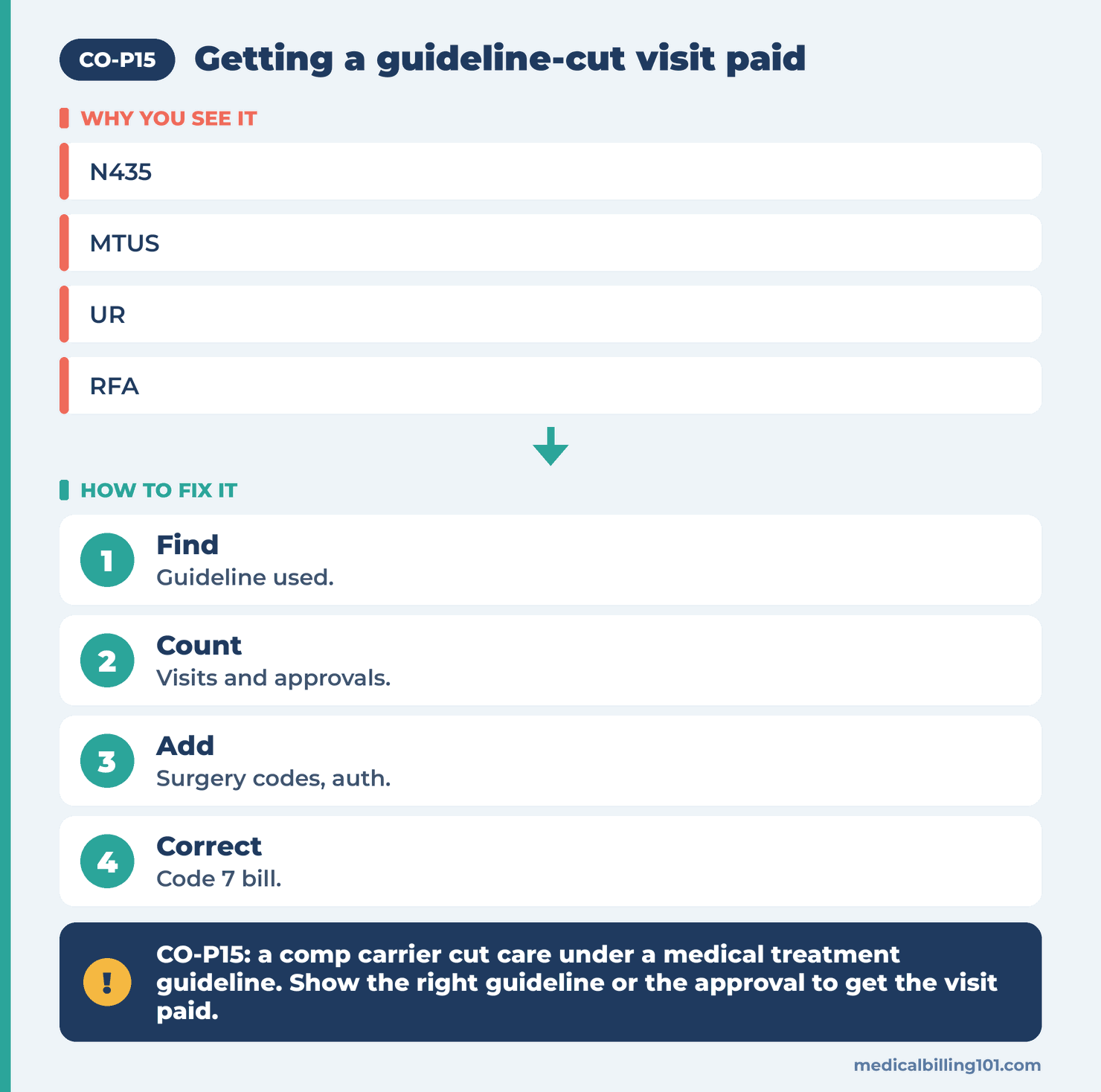
| Step | Action | Where to check |
|---|---|---|
| 1 | Find the guideline and limit the carrier used | EOR text and remark code |
| 2 | Count visits and check for surgery or approvals | Visit log, UR approval letter |
| 3 | Add missing facts to the bill | Box 21 surgery status, Box 23 approval number |
| 4 | Send a corrected bill | Box 22 code 7 with the original reference number |
| 5 | If care was never approved, send an RFA for future visits | DWC Form RFA |
| 6 | If UR denies the request, use independent medical review | California DWC IMR |
Example scenario (fictional names), part 2
How the CO-P15 Denial Was Resolved
Arjun pulled the approval letter and the surgery report. The visit fell in the post-op period, and the approval covered it.
Fix: he sent a corrected bill with Box 22 code 7 and the original reference number. Box 21 added Z98.1 (arthrodesis status) and Z47.89 (orthopedic aftercare), entered as Z981 and Z4789. Box 23 now carried the UR approval number, and he attached the approval letter.
Outcome: the carrier paid the visit at the fee schedule rate. Arjun added a check to his intake: every post-op comp visit needs the surgery codes and the approval number before it is billed.
Names and details are illustrative; no real patient data.
Names and details are illustrative; no real patient data.
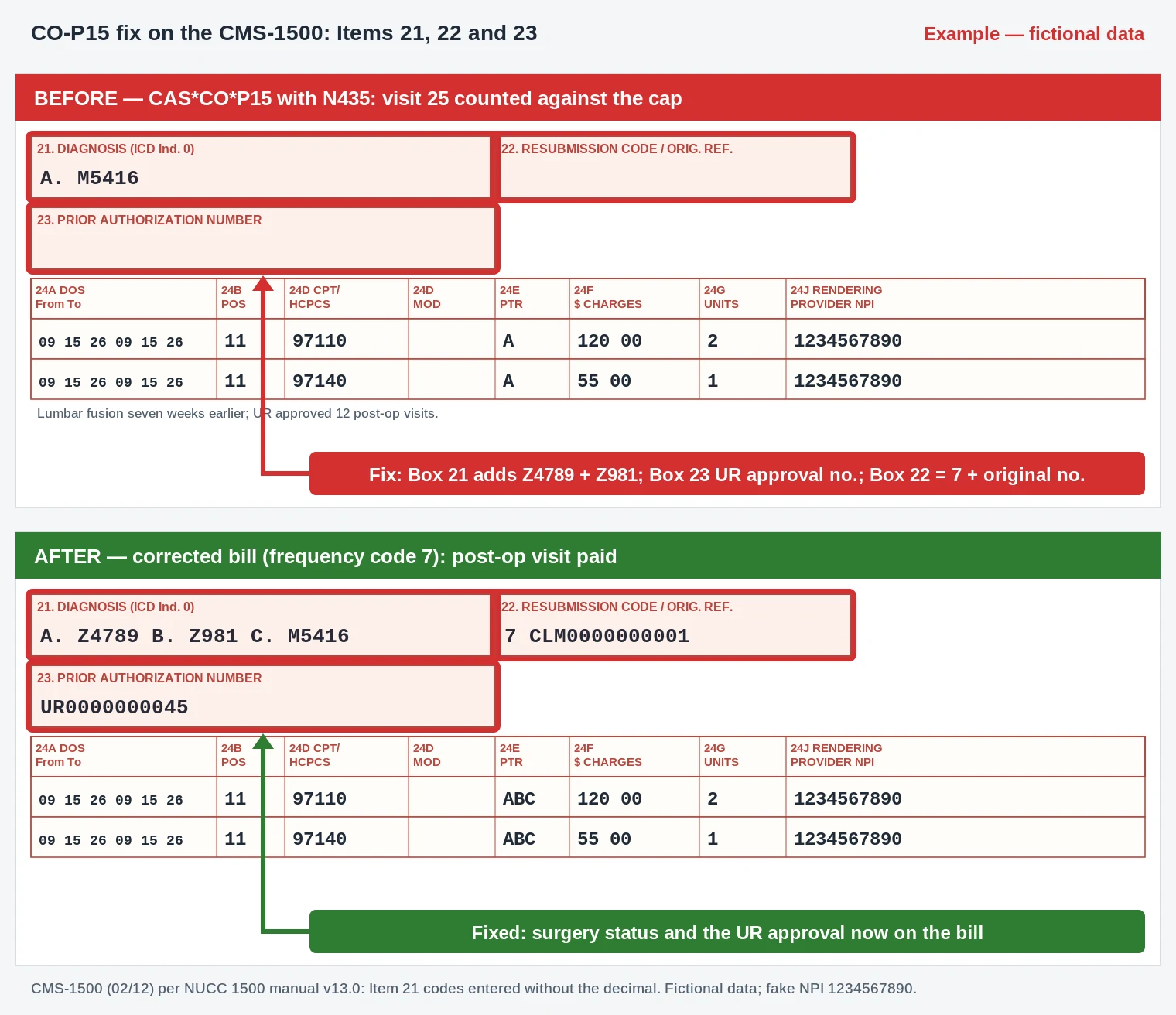
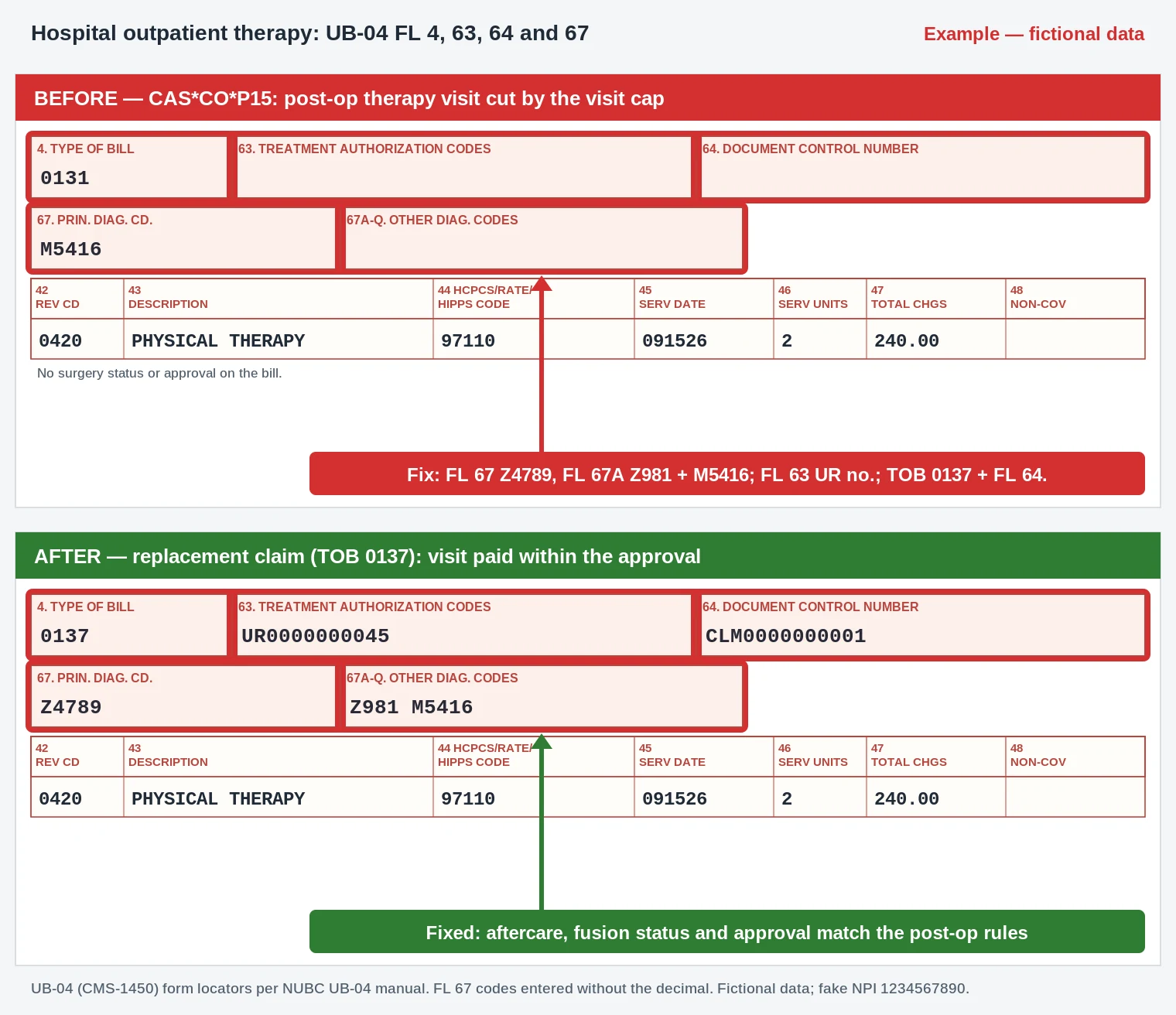
- Box 21 / FL 67: aftercare code Z47.89 and fusion status Z98.1 (entered as Z4789 and Z981) added ahead of M54.16, so bill review sees a post-surgical visit.
- Box 23 / FL 63: the utilization review approval number for the post-op visits.
- Box 22 / FL 4 + FL 64: frequency code 7 with the original reference number (bill type 0137 on the UB-04).
- Box 24 / FL 42-47: therapy codes and units are unchanged; the approval letter is attached.
Can I bill the injured worker for a CO-P15 cut?
No. CO-P15 puts the amount on your practice, and California comp law protects injured workers from bills for their claim. If care went past the guideline without approval, the lesson is to get approval first. Write off what you cannot support and request authorization for future visits.
Related codes
| Code | Meaning |
|---|---|
| PR-119 | Benefit maximum for this time period or occurrence has been reached |
| CO-151 | Payer deems the information does not support this many services |
| CO-197 | Precertification or authorization was absent |
| CO-P4 | Workers’ comp claim found non-compensable |
| CO-50 | Payer deems the service not medically necessary |
FAQ
What does CO-P15 mean?
A comp carrier cut the line under a state treatment guideline. Often the visit count went past the limit.
Does P15 mean the care was not medically necessary?
Not exactly. It means the care fell outside the guideline the carrier applied. Records or an approval can show it was still appropriate.
Which remark codes come with P15?
N435 or N640 are common when visit limits drive the cut. Read the EOR for the guideline section.
Does the 24-visit cap apply after surgery?
No. During the post-op period, the state’s post-op rules apply instead.
What code did CARC P15 replace?
X12 lists P15 as the replacement for deactivated code W4 from 11/01/2013.
Sources
How we checked: the CARC P15 quote was matched word for word with the X12 CARC list on 23 November 2026. N435 and N640 were checked on the X12 RARC list.
- X12, Claim Adjustment Reason Codes (CARC P15, P4, 119, 151, 197, 50). Accessed 23 Nov 2026.
- X12, Remittance Advice Remark Codes (N435, N640). Accessed 23 Nov 2026.
- California DWC, Medical Treatment Utilization Schedule. Accessed 23 Nov 2026.
- California Code of Regulations, title 8, section 9792.24.3. Accessed 23 Nov 2026.
- California DWC, Independent Medical Review. Accessed 23 Nov 2026.
Last updated: 23 November 2026 · Educational content; not legal advice.