

CO-131 is Claim Adjustment Reason Code 131 with group code CO. CARC 131 means the payer reduced the claim by a discount negotiated for this specific claim, not by the standard fee schedule. Searchers usually type “co 131 denial code”, and this page explains it in that order: the official words, what it means, and how to check it. (Primary sources: X12 Claim Adjustment Reason Codes · X12 Remittance Advice Remark Codes · CMS Claims Processing Manual, Ch. 22, §60.1)
Quick answer: CO-131 is a pricing adjustment, not a denial. Find the agreement behind it: a single-case agreement, a prompt-pay or repricing offer you accepted, or a rental network discount. If the rate matches what you agreed, post it as a contractual write-off. If you never agreed to a discount for this claim, ask the payer to name the agreement and send a written dispute.
Part of our denial codes library. Written by Manikandan, a revenue cycle management specialist with more than 10 years of US medical billing experience. Last reviewed: 12 October 2026. Official code wording is quoted word for word from X12.
CO-131 denial code description (official X12 wording)
X12 Claim Adjustment Reason Code 131, verbatim:
“Claim specific negotiated discount.”
Source: X12 Claim Adjustment Reason Codes, checked 12 October 2026. Start: 02/28/1997.
The X12 entry has no usage note and no “Last Modified” date. It is one of the shortest CARCs on the list. Payers almost always report it with group code CO, because a negotiated discount is a contractual obligation, not a patient balance.
What CO-131 means in plain English
- The payer paid less than your billed charge because of a discount tied to this claim.
- “Claim specific” is the key phrase. It points to an agreement made for this claim or this patient, not your normal fee schedule.
- Typical sources: a single-case agreement for an out-of-network patient, a negotiated settlement offered by a repricing vendor, or a rental or wrap network contract the payer applied.
- A single-case agreement is a written rate for one patient or episode between an out-of-network provider and a plan.
- A repricer is a vendor that negotiates a reduced payment on a claim for the plan.
- CO-131 is not a denial of the service. It explains a lower payment. The question is only whether the discount is one you actually agreed to.
CO-131 vs CO-45, CO-24, CO-253 and N381
| Code | Official X12 idea | Difference |
|---|---|---|
| 131 | Claim specific negotiated discount | A discount negotiated for this claim |
| 45 | Charge exceeds fee schedule/maximum allowable or contracted/legislated fee arrangement | Standard contract or fee schedule cut — CO-45 |
| 24 | Charges are covered under a capitation agreement/managed care plan | Paid through capitation — CO-24 |
| 253 | Sequestration – reduction in federal payment | Medicare sequestration — CO-253 |
| N381 (RARC) | Alert: consult our contractual agreement for restrictions/billing/payment information | Points you to the contract — N381 |
If you see 45, compare the payment to your fee schedule. If you see 131, look for a claim-level deal instead. The two can appear on the same remit when a payer applies a fee schedule and then a negotiated discount.
Group code matrix for CARC 131
| Group + 131 | Who carries the amount | Typical next step |
|---|---|---|
| CO-131 | Provider | Match to the agreement; write off or dispute |
| PR-131 | Patient (unusual) | Confirm the payer really meant patient responsibility |
| OA-131 | Other adjustment | Read remarks and the payer’s letter |
| PI-131 | Payer-initiated (non-Medicare) | Treat like CO; ask for the agreement |
CMS Ch. 22 §60.1 defines CO as an adjustment from “a contractual agreement between the payer and payee, or a regulatory requirement” and says such amounts are generally “a write off for the provider and are not billed to the patient.” That matches how CO-131 should be posted when the discount is valid.
CMS Ch. 22 §80.2 adds that the CAQH CORE operating rules require standardized CARC and RARC combinations on the X12 835, from a list CAQH CORE updates three times a year. That is why many payers pair CARC 131 with a contract alert remark such as N381.
Where CO-131 shows up in the 835
CLP*PCN55501*1*4200.00*2940.00**12*CLAIM441122~
SVC*HC:29827*4200.00*2940.00**1~
CAS*CO*131*1260.00~
LQ*HE*N381~
- Billed 4,200.00; paid 2,940.00; the 1,260.00 difference is the claim-specific discount.
- The N381 alert tells you to check the agreement for the terms.
Illustrative numbers only. Use your own remit and agreement.
How to fix CO-131: decision path
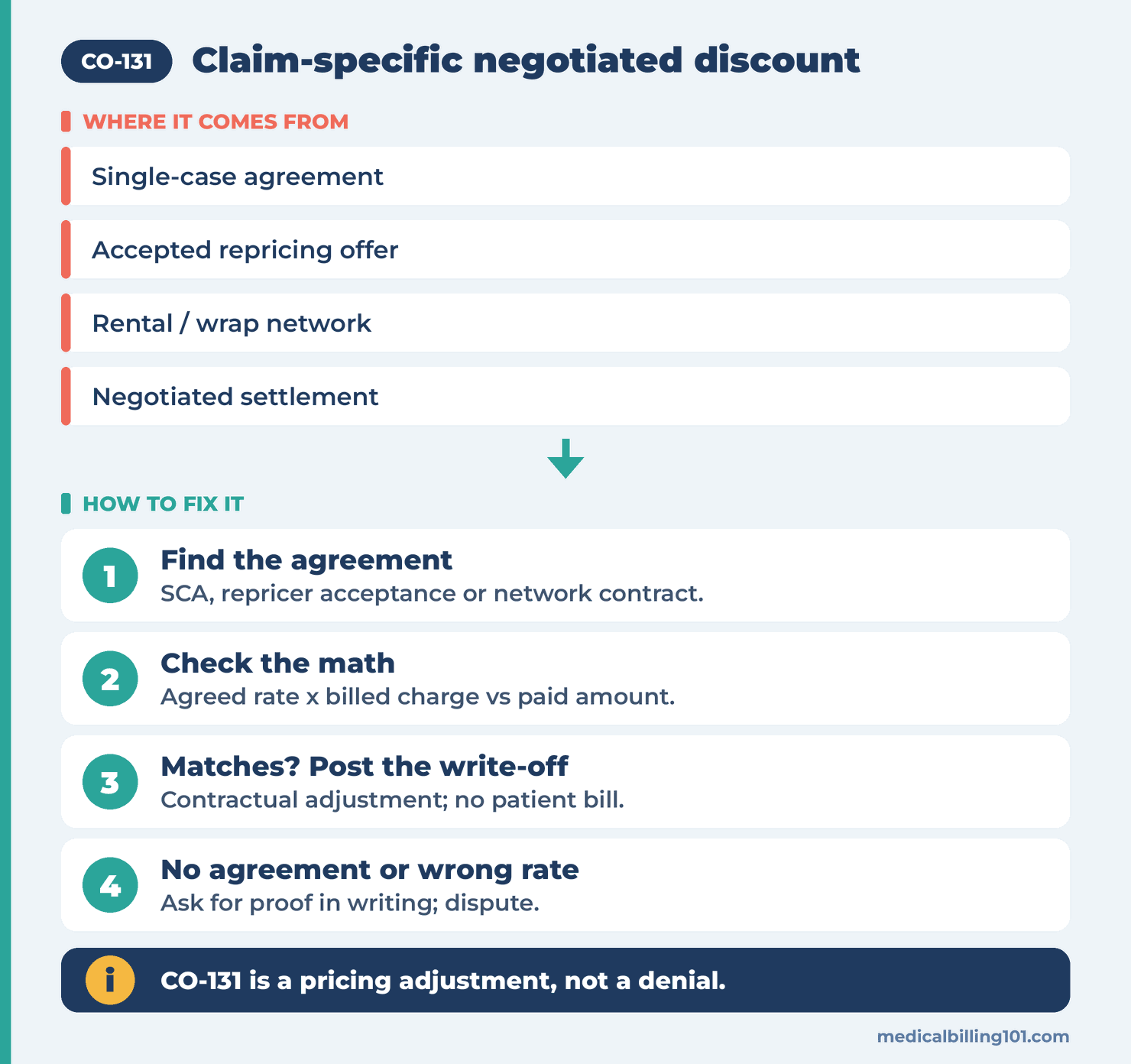
- Read the full remit. Note the CASCO131 amount, any remark codes, and any repricer or network name printed on the EOB.
- Find the agreement. Check for a single-case agreement, an accepted repricing offer (fax, email or portal click), or a rental network contract on file.
- Check the math. Apply the agreed percentage or flat rate to the billed amount. Small rounding differences are normal; large gaps are not.
- If it matches, post CO-131 as a contractual adjustment. Do not bill the patient for it.
- If the math is wrong, call the payer or repricer with the agreement and ask for an adjustment.
- If you never agreed, ask the payer in writing which agreement they applied and who signed it. Dispute the discount if they cannot show one.
- If a network you do not participate in was applied, send your participation list and ask for reprocessing at the correct rate.
- Log the outcome so the same repricer offer is handled the same way next time.
Single-case agreements, repricers and rental networks
Single-case agreements (SCAs). An out-of-network provider and a plan agree on a rate for one patient or one episode. The rate should be in writing. CO-131 is a common way for that rate to show on the remit. Keep the SCA with the account and check every claim under it.
Repricing vendors. Some plans send out-of-network claims to a vendor who offers a reduced payment. If your office accepts the offer, the payment usually arrives with a negotiated-discount code. If no one accepted, ask for the record of acceptance.
Rental and wrap networks. A payer may access a discount through a network contract you signed years ago. Check your contract list and the network’s access rules. Some state laws limit how rental network discounts can be applied; ask your contracting team about your state.
Medicare fee-for-service. Medicare pays from fee schedules, so CO-131 is not a code you should expect on traditional Medicare remits. Medicare Advantage plans can use it for out-of-network deals.
Worked example (illustrative)
An out-of-network orthopedic practice treats a patient whose plan has no in-network surgeon nearby. The plan and practice sign a single-case agreement at 70% of billed charges. The remit shows billed 4,200.00, paid 2,940.00 and CASCO131 for 1,260.00.
CO-131 dispute letter (no agreement or wrong rate)
[Date]
[Payer] Provider Disputes / Appeals
[Address, fax or portal]

Re: CARC 131 (claim specific negotiated discount) — dispute
Patient: [Name]   Member ID: [ID]   DOB: [MM/DD/YYYY]
Claim number: [Claim #]   Date(s) of service: [MM/DD/YYYY]
Billed: [$]   Paid: [$]   CO-131 amount: [$]

The remittance shows CAS*CO*131. We dispute this adjustment because:
[ ] We have no claim-specific agreement for this claim. Please provide
    the agreement, the date accepted and the name of the person who accepted.
[ ] Our single-case agreement dated [date] sets the rate at [terms];
    the payment does not match (calculation enclosed).
[ ] We do not participate in the [network name] network applied.

Please reprocess at the correct rate.

Enclosed: remit, claim, agreement or participation list, calculation.

[Name, credentials]  [Practice, NPI]  [Phone / email]
Prevention checklist
- [ ] Keep every single-case agreement in the patient account and the contract system.
- [ ] Route repricing offers to one owner; log accept, decline and the rate.
- [ ] Keep a current list of the networks you participate in, including rental networks.
- [ ] Compare each CO-131 to the agreement before posting.
- [ ] Separate CO-131 (claim deal) from CO-45 (fee schedule) in posting codes.
- [ ] Never send the patient a bill for a CO-131 amount.
- [ ] Train staff with the CARC and RARC guide.
Related denial codes
- CO-45: charge exceeds the fee schedule or contracted amount.
- N381: alert to consult the contractual agreement.
- CO-24: covered under a capitation agreement.
- CO-253: Medicare sequestration reduction.
- PR-1, PR-2, PR-3: deductible, coinsurance and copay.
- CARC and RARC guide.
Key takeaways
CARC 131 means a discount negotiated for this claim was applied. Find the agreement, check the math, post it when it is right, and dispute it in writing when no agreement exists.
FAQ
What is the CO-131 denial code description?
X12 describes CARC 131 as “Claim specific negotiated discount.” CO-131 is that reason code with group code CO, so the discount is a contractual adjustment and not a patient balance.
Is CO-131 a denial?
No. It explains a reduced payment. The service was paid, just at a negotiated rate below your billed charge.
What is the difference between CO-131 and CO-45?
CO-45 is a cut to your standard fee schedule or contracted rate. CO-131 is a discount negotiated for this specific claim, such as a single-case agreement or an accepted repricing offer.
Can I bill the patient for a CO-131 adjustment?
No, not when the group code is CO. CO amounts are generally written off by the provider. Bill the patient only for amounts the remit shows as PR.
How do I dispute a CO-131 discount?
Ask the payer in writing to name the agreement, the date it was accepted and who accepted it. If no agreement exists or the rate is wrong, request reprocessing with your calculation.
Does Medicare use CARC 131?
Traditional Medicare pays from fee schedules, so CO-131 is uncommon there. Medicare Advantage and commercial plans use it more often for out-of-network deals.
Quick facts
| Item | Value |
|---|---|
| X12 code | 131 |
| X12 start | 02/28/1997 |
| Usage note | None on the X12 list |
| Usual group code | CO |
| Type | Pricing adjustment, not a denial |
| Last reviewed | 12 October 2026 |
Sources
- X12, Claim Adjustment Reason Codes (CARC 131, 45, 24, 253). CARC 131 Start 02/28/1997. Accessed 12 Oct 2026.
- X12, Remittance Advice Remark Codes (N381). Accessed 12 Oct 2026.
- CAQH CORE, Operating Rules (Uniform Use of CARCs and RARCs). Accessed 12 Oct 2026.
- CMS, Medicare Claims Processing Manual (IOM 100-04), Ch. 22, §60.1 Group Codes and §80.2 Uniform Use of CARCs and RARCs. Accessed 12 Oct 2026.
Code wording and group code rules on this page were checked on 12 October 2026 against X12 and CMS sources.
Last reviewed: 12 October 2026 · This page is educational and doesn’t replace your payer contracts or legal advice.